
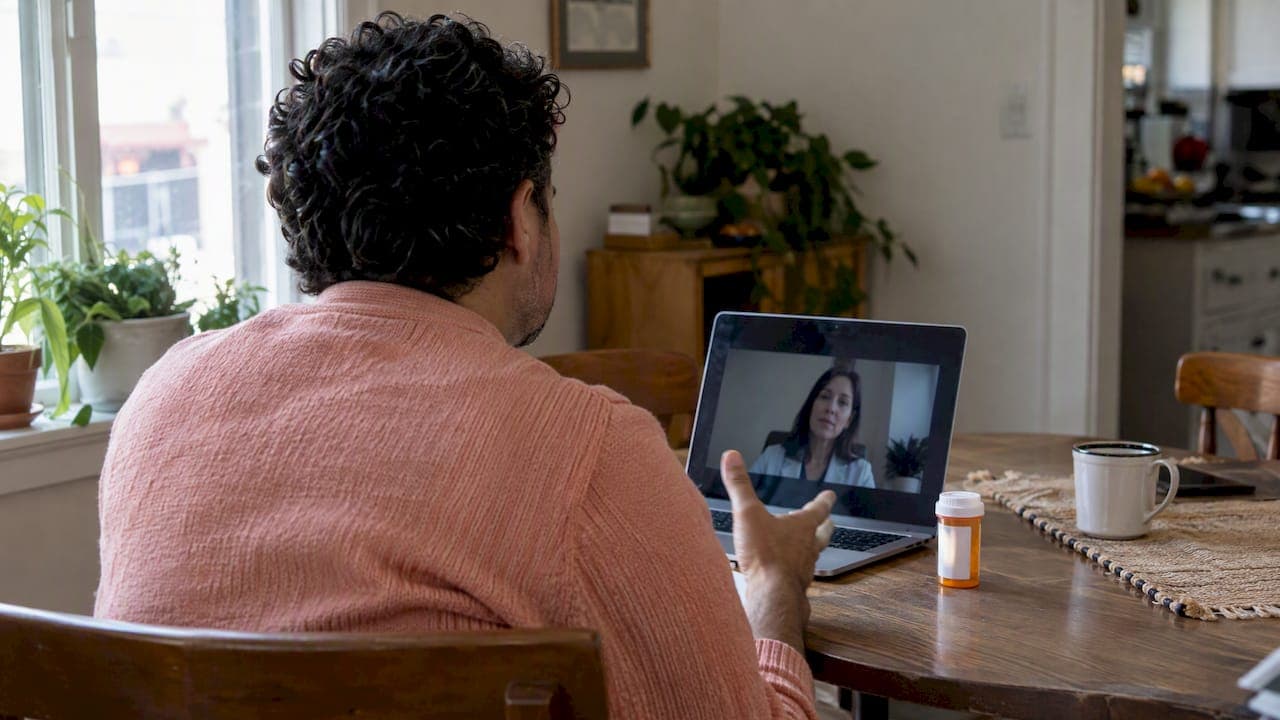
Telepsychiatry medication management means meeting a licensed prescriber by secure video to evaluate your symptoms, start or adjust psychiatric medication, and follow up on how it is working, without going to a clinic. In California, it is a well-established way to get psychiatric care, and for many working adults it is the only format that fits a schedule. This guide covers what happens in a visit, what the 2026 rules say about controlled substances, how to check your insurance, and how to prepare.
TL;DR
- Telepsychiatry medication management covers evaluation, prescribing, dose adjustments and follow-up by video. The American Psychiatric Association lists it among the services telepsychiatry can deliver.
- Federal flexibilities currently let DEA-registered prescribers prescribe Schedule II-V controlled substances by audio-video telehealth without an initial in-person evaluation, through December 31, 2026. Many medications are not controlled at all.
- California commercial health plans must cover medically necessary treatment of mental health conditions. Verify your specific plan before booking.
- Your prescriber must be licensed in the state where you are physically sitting during the visit, which matters if you travel for work.
- Bring a current medication list, relevant records and your questions. Prepared visits are shorter and more useful.
Table of Contents
- What telepsychiatry medication management actually involves
- Does it work as well as in-person care?
- Controlled substances and telehealth in 2026
- California-specific points to know
- Paying for it: insurance in California
- How to prepare for your first telepsychiatry visit
- Who telepsychiatry suits, and who needs more
- Our perspective: medication works best inside a plan
- Medication management at Kin Wellness
- Frequently asked questions
- Sources
What telepsychiatry medication management actually involves
Medication management is the part of psychiatric care focused on the prescription: choosing a medication, confirming it suits your history, watching for side effects, and deciding when to change a dose or stop. Therapy addresses patterns and skills. Medication management addresses the biology side, and the two often run together.
A typical course has three stages.
The first evaluation
The first visit is the longest. Expect questions about your symptoms, sleep, appetite, energy, mood history, substance use, family history, past medications and what worked or did not. The prescriber will ask about medical conditions and everything you take, including supplements and over-the-counter products, because these affect which medication is safe.
At the end you may leave with a diagnosis or working impression, a treatment plan, and sometimes a prescription. Some prescribers will order labs or ask for records from your primary care doctor first.
The adjustment phase
After a start or change, follow-ups are usually frequent and short. The point is to catch side effects early, see whether symptoms are moving, and adjust. Standard scales such as the PHQ-9 for depression are often used to track progress; our post on antidepressant follow-up timelines and the PHQ-9 explains how those checkpoints work, and psychiatry follow-up by phase and lab rules shows how visit frequency changes with risk.
The maintenance phase
Once you are stable, visits space out. The prescriber still reviews refills, side effects, life changes (a new job, pregnancy, a new diagnosis elsewhere) and whether the medication is still needed. Stopping or tapering should be planned with the prescriber, never done alone.
Does it work as well as in-person care?
The evidence is encouraging but not unlimited. A narrative review of telemental health for mood disorders in the Journal of Behavioral Health Services & Research reports that remote interventions can improve medication adherence in conditions such as depression, bipolar disorder and schizophrenia, because providers can address missed doses and concerns closer to when they happen rather than waiting for the next clinic slot.
There is also a practical access point. A 2024 NIMH-cited secret-shopper study found that among private treatment facilities offering telehealth, 77% provided medication management, and that new-patient telehealth wait times averaged 14 days, ranging from 4 to 75 days depending on location. Wait times vary a lot, so ask any practice for its actual first-appointment timeline.
Video does have limits. A prescriber cannot take your blood pressure or draw blood over a screen. For medications that need monitoring, such as certain mood stabilizers, the plan will include local lab work, and a good telepsychiatry practice will coordinate that with you. If symptoms involve thoughts of harming yourself, you need urgent help, not a scheduled visit: call or text 988, the Suicide & Crisis Lifeline, or go to the nearest emergency room.

Controlled substances and telehealth in 2026
This is the question behind many searches, including "Can I get a Xanax prescription through telehealth?" The honest answer: it depends on the prescriber's judgment, your clinical picture and federal rules that are still temporary.
What the rules say right now
Under the Ryan Haight Act, an in-person medical evaluation was historically required before prescribing controlled substances by telemedicine. During the pandemic that was relaxed, and the relaxation has been extended repeatedly. Telehealth.HHS.gov reports that DEA-registered practitioners may prescribe Schedule II-V controlled substances via audio-video telehealth without a prior in-person evaluation through December 31, 2026. The DEA's January 2026 diversion newsletter describes this as the fourth temporary extension, and the California Telehealth Resource Center summarizes what it means for clinicians.
Two things follow. First, the flexibility has an end date, and federal policy may change after 2026. Ask your prescriber how they plan for that. Second, "allowed" does not mean "automatic." Prescribers still weigh diversion risk, and the DEA newsletter signals continued attention to documentation and red flags.

Why a responsible prescriber may say no, or go slowly
Benzodiazepines such as Xanax, and stimulants used for ADHD, carry misuse risks. The FDA labeling for benzodiazepine products warns that combining benzodiazepines with opioids can cause profound sedation, respiratory depression and death, and calls for assessing abuse and misuse risk before and during treatment. That applies whether you are in an office or on a laptop.
So expect more questions, not fewer, when you ask about a controlled medication: your full medication and substance history, possibly a check of California's prescription monitoring database, and often a trial of non-controlled alternatives first. Many people are well treated for anxiety, depression, ADHD or sleep problems with non-controlled medications, and a prescriber who suggests those is not being difficult.
If you take opioids or drink regularly, tell the prescriber at the first visit. It changes what is safe.
California-specific points to know
Consent and documentation
California has its own telehealth consent requirement. According to the California Board of Psychology's telehealth standards page, providers must obtain informed consent about the particular risks of telehealth, such as data-security breaches and connection problems, and document it, referencing Business and Professions Code section 2290.5. In practice, you will be asked to acknowledge a consent form before your first session. Read it. It is where you learn how your information is stored and what happens if the video drops.
Where you are during the visit
Telehealth is regulated by where the patient is, not where the clinic is. If you live in Los Angeles but take a call from a hotel in Nevada or New York, your California-licensed prescriber may not be authorized to treat you at that moment. For executives and consultants who travel, this is the most common surprise. Before a trip, ask your prescriber whether they can see you in the destination state, and schedule around it, or make sure you have enough medication and a plan for refills.
Pharmacy and refills
Prescriptions are sent electronically to the pharmacy you choose. Pick one near home or work that stocks your medication, and confirm refill timing with the prescriber rather than waiting until you run out. Controlled substances generally cannot be refilled the way other prescriptions can, so plan those visits further ahead.
Paying for it: insurance in California
California's parity rules help. Under the Department of Managed Health Care's behavioral health guidance, commercial plans must cover medically necessary treatment of mental health conditions, with SB 855 (2020) expanding that requirement and tying medical necessity to criteria from nonprofit clinical specialty associations. That is the law on paper. What you pay depends on your plan type, network and deductible.
What to check before booking:
- Plan type. HMO plans usually require in-network care and sometimes a referral. PPO plans often include out-of-network benefits, which can reimburse part of a visit with a provider outside the network.
- Telehealth coverage. Confirm that psychiatric visits by video are covered at the same level as in-person ones.
- Visit codes. Medication management is typically billed as an evaluation and management visit, sometimes with a psychotherapy add-on. Ask your insurer how each is covered.
- Prior authorization. Some plans require it for certain services. Our guide on prior authorization in California walks through it.
- Out-of-network reimbursement. Ask for your out-of-network deductible, coinsurance and how to submit a claim.
We have written step-by-step checklists for verifying psychiatry coverage in California, verifying teletherapy coverage under parity law, and how telehealth claims are submitted. If a claim is denied for a mental health service, the mental health parity rules we explain here can help you push back.
How to prepare for your first telepsychiatry visit
The American Psychiatric Association advises preparing for a virtual appointment the way you would for an in-person one: a current list of medications, relevant medical records and specific questions. Here is how to make that concrete.
- Write your medication list. Name, dose, how often, and how long. Include supplements, cannabis and alcohol use. Honest answers prevent dangerous interactions.
- Note past psychiatric medications. What you tried, roughly when, what helped, and what caused side effects.
- Track symptoms for a week. Sleep hours, mood, energy, anxiety spikes, concentration. Short notes beat memory.
- Gather records. Recent labs, your primary care doctor's name, any prior psychiatric records.
- Choose a private space. Use headphones, a stable connection and a door that closes. Our piece on telehealth etiquette in therapy has simple habits that carry over to psychiatry visits.
- Know your pharmacy and your insurance card details.
- Write three questions. For example: How long until I should feel a difference? What side effects should make me call you? What is the plan if this does not work?
A useful way to run the first visit is to say your goal out loud: "I want to sleep through the night and stop dreading Monday," or "I need to focus through a full shift." Goals give the prescriber something to measure against.
Who telepsychiatry suits, and who needs more
Video medication management tends to suit adults with depression, anxiety, ADHD, sleep problems or stable chronic conditions who value flexibility: clinicians between shifts, parents without childcare, executives with packed calendars.
It may not be enough alone if you are in crisis, are at risk of harming yourself, have severe mania or psychosis, or need medically supervised withdrawal. Those situations call for urgent or higher-level in-person care. Between ordinary weekly therapy and hospitalization sits a middle level, an intensive outpatient program, which adds several hours of structured treatment per week while you stay at home and at work.
Our perspective: medication works best inside a plan
We see medication management as one part of treatment, not a standalone fix. A prescription without follow-up, therapy or a plan for what comes next tends to leave people guessing whether it is working. That is why we build care around licensed clinicians who coordinate: your prescriber, your therapist and, when you need more structure, an intensive outpatient program.
We also think the most useful thing a prescriber can do on a video call is slow down. Ask what a typical Tuesday looks like. Ask what you are afraid of with a medication. Ask what you would want to be different in three months. Telehealth removes the commute, and that time should go into a better conversation, not a faster one.
For working professionals and healthcare workers in particular, we know burnout and clinical depression or anxiety can look alike from the inside. A good evaluation separates them, and the treatment differs: sometimes the answer is medication, sometimes therapy, sometimes both, sometimes a change in workload that no pill replaces. Anyone who promises a quick answer on that is selling something.
— Dakota
Medication management at Kin Wellness
Kin Wellness provides virtual outpatient care for adults in California, including medication management delivered by licensed prescribers, alongside individual, group and family therapy, EMDR therapy, aftercare planning and a virtual intensive outpatient program. We accept most major insurance plans and offer insurance billing support. You can see the full list on our services page, and learn more about telepsychiatry for adults on our blog. We do not publish prices, so ask us about your plan's coverage when you reach out.
Frequently asked questions
Will a telehealth psychiatrist prescribe medication?
Yes, when it is clinically appropriate. After an evaluation, a licensed prescriber can prescribe many psychiatric medications by video, and the APA lists medication management among telepsychiatry services. Prescribing is a clinical decision, not a guarantee: the prescriber must be comfortable that the medication is safe for you.
Can I get a Xanax prescription through telehealth?
It is legally possible right now. Federal flexibilities allow controlled-substance prescribing by audio-video telehealth without an initial in-person exam through December 31, 2026. Many prescribers still prefer non-controlled options first, because benzodiazepines carry risks, especially alongside opioids or alcohol.
What does a medication management psychiatrist do?
They evaluate your symptoms and history, choose a medication, monitor how you respond, manage side effects, and adjust or stop treatment as needed. They also coordinate with your therapist and primary care doctor. Most visits are shorter than therapy sessions and focus on how the medication is working.
Is telepsychiatry covered by insurance in California?
Often, yes, but coverage depends on your plan. California requires commercial plans to cover medically necessary mental health treatment. Call your insurer, ask about video visits, copays, deductibles and out-of-network benefits, and get the answers before your first appointment.
Can I keep seeing my prescriber if I travel out of state?
Not always. The prescriber generally needs to be licensed where you are physically located during the visit. Ask before you travel, and plan refills so you do not run out while away.
Sources
- American Psychiatric Association: What is Telepsychiatry?
- Telehealth.HHS.gov: Prescribing controlled substances via telehealth
- DEA Diversion Control Division: January 2026 Diversion Newsletter
- California Telehealth Resource Center: DEA telehealth rule extension
- NIMH: Understanding the Availability of Mental Telehealth Services
- Springer: The Efficacy of Telemental Health Interventions for Mood Disorders
- FDA: benzodiazepine prescribing information
- California Board of Psychology: Telehealth Standards
- California DMHC: Behavioral Health Care