

California's Mental Health Parity Act, codified at HSC §1374.72, requires state-regulated commercial health plans to cover medically necessary mental health and substance use disorder treatment on the same terms as medical or surgical care. That duty is enforced by the Department of Managed Health Care and the California Department of Insurance under Commissioner Ricardo Lara. If your plan denies care, delays an appointment, or charges you more for behavioral health than for physical health, verify your benefits in writing, then file a complaint with the appropriate regulator.
TL;DR:
- Fully insured California plans must follow state parity laws and cannot impose stricter financial or treatment limits on mental health coverage than physical health.
- Self-funded plans are governed by federal law, and Medicare or Medi-Cal are generally exempt from these state parity requirements.
- Insurers are required to provide timely access to outpatient therapy within 10 business days, with out-of-network care arranged if no in-network provider is available promptly.
- Policyholders should verify benefits, documentation requirements, and prior authorization rules before scheduling to prevent coverage surprises or delays.
- Consumers can file complaints for violations, especially if insurers deny care improperly or do not adhere to current standards for clinically necessary mental health treatment.
Table of Contents
- What Mental Health Parity in California Actually Requires
- Does Your Plan Actually Have to Follow California Parity Rules?
- How Fast Should You Get a Therapy Appointment?
- How Do You Appeal a Denied Mental Health Claim?
- What Counts as "Medically Necessary" Mental Health Care?
- What Changed in California Mental Health Parity Enforcement for 2026?
- How Do You Avoid a Coverage Surprise Before You Book?
- Why Parity Law Alone Doesn't Guarantee You'll Get Care Fast
- Where to Verify These Rules Yourself
- Sources
What Mental Health Parity in California Actually Requires
SB 855 closed a loophole that used to let insurers cover only a short list of "severe" mental illnesses. Under current law, mental health parity in California means plans must cover every diagnosis recognized in the DSM-5 or ICD-11, not just conditions like schizophrenia or bipolar disorder. That includes anxiety disorders, eating disorders, substance use disorders, and adjustment disorders, treated with the same rigor as diabetes or a broken arm.
The statute does three specific things that matter to your wallet and your care plan:
- Bars insurers from applying stricter financial requirements (copays, deductibles, coinsurance) to behavioral health than they apply to medical care.
- Prohibits quantitative treatment limits, meaning a plan can't cap you at 20 therapy visits a year while allowing unlimited physical therapy visits for a knee injury.
- Requires insurers to arrange and pay for out-of-network care, at in-network cost sharing, when no in-network provider is available within timely-access standards.
That last point trips up a lot of people. If your insurer's directory lists providers who aren't accepting new patients or don't actually take your plan, you are entitled to out-of-network treatment without the usual higher out-of-network price tag. Insurers are supposed to arrange this proactively under HSC §1374.72, but in practice, you often have to ask for it by name.
Does Your Plan Actually Have to Follow California Parity Rules?
Not every health plan sold or used in California falls under state parity law, and knowing which category you're in changes your entire strategy.
- Fully insured commercial plans (individual, small group, large group, and most Covered California plans) must follow California's parity mandate under the DMHC's behavioral health guidance.
- Self-funded employer plans are typically governed by federal law under the Mental Health Parity and Addiction Equity Act (MHPAEA) rather than state statute, since federal ERISA law generally preempts state insurance regulation for these plans.
- Medicare is a federal program and is largely exempt from California's state parity law, though Medicare has its own separate behavioral health coverage rules.
- Medi-Cal works differently. Coverage runs through managed care plans and county behavioral health departments, and members with a dispute should start with their Medi-Cal managed care plan or the Mental Health Care Ombudsman rather than the DMHC complaint line.
Quickest way to check: look at your insurance card. If it says "DMHC" or lists a California-licensed HMO or PPO, state parity almost certainly applies. If your employer is headquartered outside California and self-insures, call your HR benefits contact to confirm which framework governs your plan.
How Fast Should You Get a Therapy Appointment?
Timely access isn't a courtesy, it's a regulatory standard. Under guidance tied to Covered California plans, insurers must offer you a return behavioral health appointment within 10 business days of a referral or an initial visit. Preventive mental health screenings must also be covered at no cost when you use an in-network provider.
Network adequacy rules back this up. If your plan can't produce an in-network therapist or psychiatrist who can see you inside that 10-day window, the insurer has to arrange out-of-network care at standard, in-network cost sharing.
When the system doesn't move fast enough, documentation is what turns a frustrating experience into a winnable complaint:
- Write down every call date, time, and representative name.
- Save reference or case numbers from each call.
- Screenshot online scheduling attempts that show no available appointments.
- Keep a copy of your referral or the date of your first visit.
Pro Tip: Call your insurer's member services line and specifically ask, "Can you confirm in writing that I'm entitled to out-of-network care because no in-network provider is available within 10 business days?" Getting that acknowledgment on record makes a future complaint far stronger.
How Do You Appeal a Denied Mental Health Claim?
A denial letter is not the end of the conversation. It's the start of a paper trail.
- Request the specific clinical criteria and utilization review rationale the insurer used to deny your claim. They're required to provide it.
- File an internal appeal within your plan's stated deadline, usually 180 days, and ask your clinician to submit a letter tying the requested service to a specific diagnosis and functional impairment.
- If the internal appeal fails, request an Independent Medical Review (IMR) through the DMHC. IMR decisions are binding on the insurer.
- File a formal complaint if you believe the denial itself violated parity requirements, separate from disputing the clinical decision.
What strengthens a complaint or appeal:
- Copies of denial letters and any cited clinical guidelines.
- A clinician letter referencing generally accepted standards of care.
- Your documented timeline of calls, dates, and reference numbers.
- Proof of financial harm, such as receipts for out-of-pocket sessions you paid for while waiting.
To file directly, use the DMHC complaint process for HMO plans or the Department of Insurance's complaint portal for PPO plans. Both have consumer hotlines staffed to walk you through the process.
What Counts as "Medically Necessary" Mental Health Care?
Insurers can't just invent their own restrictive definitions anymore. Under the 2025 regulations, utilization review has to align with generally accepted standards of care (GASC), meaning the clinical guidelines that professional bodies like the American Psychiatric Association actually use, referenced against DSM-5 or ICD-11 diagnostic criteria.
This matters most for the services insurers love to dispute: residential treatment, intensive outpatient programs, and ongoing medication management. These get flagged for review far more often than a single weekly therapy session, because they cost more and last longer.
- Ask your clinician's letter to name the specific diagnosis, the functional impairment it causes, and the clinical guideline supporting the level of care requested.
- Push back if a denial cites vague "lack of medical necessity" language without naming the actual clinical standard used.
- If you're considering a step up in care, a resource like Kin Wellness's guide to intensive outpatient programs explains what clinical indications typically justify that level of treatment.
What Changed in California Mental Health Parity Enforcement for 2026?
Commissioner Lara's department finalized new regulations that give the 2020 parity law real enforcement teeth. The 2025 final rulemaking requires insurers to align utilization review directly with generally accepted standards of care instead of internal, proprietary criteria, and it formally folds AB 988 crisis response services, including mobile crisis teams and stabilization units, into parity protections.
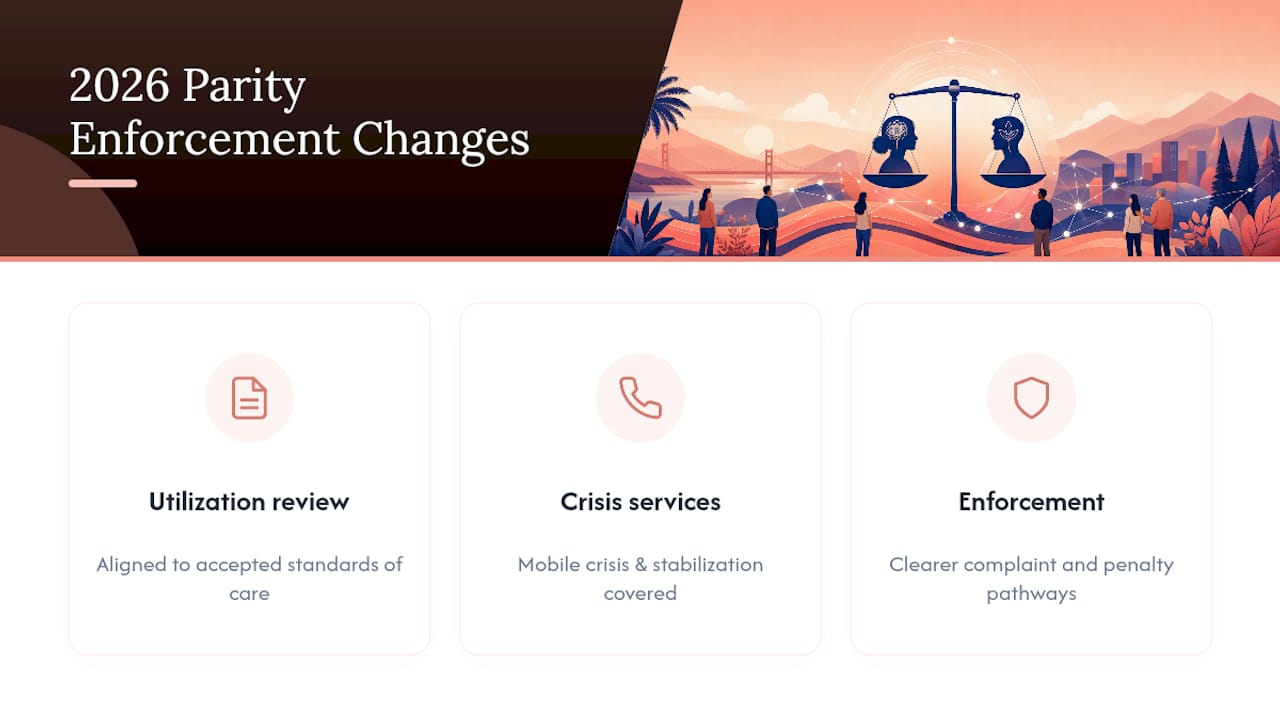
That crisis-services integration is a bigger deal than it sounds. It means a mobile crisis response can no longer be treated as outside the parity framework just because it doesn't look like a traditional therapy visit.
The regulations also formalize complaint and enforcement pathways, giving the Department of Insurance clearer authority to investigate and penalize insurers who fall short. For consumers, the practical effect is a stronger administrative record: when you file a complaint now, you're pointing to a specific, recently finalized rule rather than a vague statutory principle open to interpretation.
How Do You Avoid a Coverage Surprise Before You Book?
A few minutes of checking before your first appointment saves weeks of appeal headaches later.
- Confirm your plan ID and call member services to ask directly whether outpatient therapy, medication management, and telehealth visits require prior authorization.
- Ask what "medical necessity" documentation your plan requires for your specific diagnosis before your first session.
- For virtual care, confirm your plan actually reimburses telehealth mental health visits and ask which billing codes apply. Kin Wellness's breakdown of telehealth claim fields covers what clinicians need to get right to avoid a denial.
- If you're comparing HMO and PPO virtual therapy benefits, Kaiser vs Blue Shield coverage differences is a useful side-by-side before you pick a plan year.
- Verify your prescribing clinician's licensure covers care across any state lines involved in a telehealth visit.
For a fuller prebooking walkthrough, see 5 steps to verify psychiatry coverage in California before your appointment.
Why Parity Law Alone Doesn't Guarantee You'll Get Care Fast
Parity law fixes what insurers are allowed to charge and cover. It does almost nothing to fix how long you wait or how hard you have to fight to use that coverage. That gap between "covered on paper" and "accessible in practice" is where most Californians actually get stuck, and it's the part the law talks about least.

The 10-business-day appointment standard is a good example. It's a real rule with real teeth, but it only works if you know it exists and are willing to invoke it by name when a scheduler tells you the next opening is six weeks out. Most people don't push back, because they don't know they're allowed to.
Helping clients verify benefits and prepare appeal documentation before a denial happens, rather than after, consistently produces better outcomes than fighting a claim retroactively. Some providers work with insured adults across California on outpatient and intensive outpatient care, including help understanding what specific plans cover before committing to a treatment path.
— Dakota
Where to Verify These Rules Yourself
- DMHC behavioral health guidance for HMO complaint procedures.
- California Health & Safety Code §1374.72 for the statute itself.
- Department of Insurance's 2025 final regulations and complaint filing portal.
- Covered California mental health benefits page for timely-access standards.
If you're ready to talk to a licensed clinician about outpatient or intensive outpatient treatment covered under your plan, explore Kin Wellness's services to get started.
This article is general information, not a substitute for advice from a qualified doctor. Consult a qualified healthcare professional about your own circumstances before acting on anything here.
Sources
- Behavioral Health Care | DMHC
- California Health & Safety Code §1374.72
- Commissioner Lara expands mental health access with final landmark rulemaking to enforce California Mental Health Parity Act
- Mental Health | Covered California