
Most prescribers schedule an initial antidepressant follow-up within 1 to 4 weeks of starting or changing a medication, and sooner (about 1 week) for younger adults or anyone at higher risk. After that, monthly visits using a symptom scale like the PHQ-9 continue until symptoms lift. Each visit checks mood, side effects, adherence, and safety, and treatment typically continues at least six months past remission.
TL;DR:
- Most patients should have their first follow-up within one to four weeks of starting or changing antidepressants, with higher-risk groups checked at about one week.
- After initial visits, follow-ups are typically scheduled every two to four weeks during adjustment, then monthly until symptoms improve, and every two to three months once stable.
- Tracks such as PHQ-9 scores are used systematically to monitor symptoms, side effects, adherence, and safety at each visit, rather than relying on casual conversations.
- If there is no meaningful improvement by four to six weeks, clinicians generally consider dose increases, medication switches, or adding psychotherapy.
- Routine blood tests are not usually required unless there are concerns about adherence, toxicity, or complex medication interactions.
Table of Contents
- How Often Should You Follow Up on Antidepressants?
- What Happens During an Antidepressant Follow-Up Visit?
- When Does a Prescriber Change the Plan?
- What Safety Signs Should You Never Ignore?
- Does Antidepressant Monitoring Require Blood Tests?
- How Should You Prepare for an Urgent Concern or a Routine Visit?
- How Kin-wellness Structures Antidepressant Follow-Up Care
- Get Structured Medication Follow-Up With Kin-wellness
- Sources
- FAQ
How Often Should You Follow Up on Antidepressants?
The follow-up schedule shifts based on risk and how treatment is going. Adults aged 18 to 25 or anyone flagged for elevated suicide risk generally get a check-in within one week of a new prescription or dose change, according to NHS monitoring guidance. Most other adults are seen within two to four weeks.
From there, the rhythm depends on severity and progress:
- Severe depression: weekly or biweekly contact until symptoms start to stabilize.
- Standard starts or dose changes: every 2 to 4 weeks during the active adjustment period.
- After remission: monthly visits, then gradually spaced to every two or three months once stability holds.
Clinicians widen the gap between visits as scores on standardized scales improve and side effects settle. This isn't arbitrary. It reflects the fact that antidepressant risk clusters early, in the first few weeks of a new medication or dose, so that's when contact is tightest. One practical note: audits of primary care prescribing suggest many practices fall short of these recommended early follow-up windows. If your prescriber's office doesn't proactively schedule that first check, ask for it. Waiting for the system to remember you is a bad strategy when the first month carries the most risk.
What Happens During an Antidepressant Follow-Up Visit?
A well-run visit isn't a five-minute prescription refill. It's a structured check covering four areas: symptoms, side effects, adherence, and safety.
Most clinicians open with a validated scale, most commonly the PHQ-9, to score symptom severity in a way that's comparable visit to visit. This is what "measurement-based care" means in practice: numbers instead of vague impressions of "doing okay."
Side effects get a systematic run-through, not just a "how are you feeling" prompt. Expect questions across these categories:
- Gastrointestinal issues (nausea, appetite change)
- Sleep disruption or excessive sedation
- Activation or restlessness, especially early in SSRI treatment
- Sexual side effects, which patients underreport unless asked directly
- Weight changes
- Cardiovascular symptoms like palpitations
- Neurological effects such as tremor or headache
Many patients starting a new antidepressant report at least one side effect in the first weeks, which is why clinicians build this checklist into every visit rather than waiting for complaints.
Adherence gets reviewed by asking about missed doses directly, not just assuming refills equal compliance. A brief suicide risk screen closes most visits, framed as a routine safety question rather than a red flag conversation.
When Does a Prescriber Change the Plan?
Antidepressants don't work overnight, and the timeline for judging them matters as much as the medication itself.
- Weeks 2 to 4: Early, partial changes in sleep, appetite, or energy sometimes show up here, even before mood fully lifts.
- Weeks 4 to 6: This is the real decision point. If there's no meaningful improvement in symptom scores by 4 to 6 weeks, most clinicians consider a dose increase, a switch to a different medication class, or adding psychotherapy rather than waiting longer on an ineffective dose.
- Weeks 6 to 12: For partial responders, this window often brings augmentation, meaning a second agent added to boost the first, or a formal switch between SSRI and SNRI classes.
- 6 months post-remission: Clinical quality standards call for continuing treatment for at least six months after symptoms resolve, since stopping early raises relapse risk. This is tracked formally through continuation-of-care measures.
- 12+ months: Anyone with a history of recurrent depression, a severe first episode, or other high relapse risk factors is often kept on maintenance therapy well beyond a year.
Early follow-up isn't only about medication safety. It's also when clinicians finish diagnostic loose ends and set an actual care plan rather than just reacting to symptoms one visit at a time.
What Safety Signs Should You Never Ignore?
A few situations move a routine follow-up into an urgent one. New or worsening suicidal thoughts top that list, along with severe agitation that feels different from normal anxiety. Confusion, high fever, muscle rigidity, or sudden autonomic changes like rapid heart rate can signal serotonin syndrome, a rare but serious drug reaction that needs same-day evaluation.
Most side effects are far less dramatic and get managed with reassurance, a dose adjustment, or a short-term add-on medication while the body adjusts. Early activation or jitteriness, for instance, often fades within two weeks without any change to the prescription.
- Never stop an antidepressant abruptly, even if you feel fine.
- Ask your prescriber for a taper schedule before discontinuing.
- Report missed doses honestly rather than doubling up the next one.
Pro Tip: Keep a simple note on your phone logging mood, sleep, and any new physical symptom each week. Thirty seconds of tracking gives your prescriber real data instead of a foggy "I think it's been better" at your next visit.
Does Antidepressant Monitoring Require Blood Tests?
Regular symptom scoring, not lab work, drives most antidepressant decisions. Structured monitoring using PHQ-9 or similar tools gives clinicians comparable numbers across visits, which speeds up decisions about dose changes far more reliably than casual conversation.
Therapeutic drug monitoring (TDM), which measures actual medication levels in blood, is a different tool with narrower use. It is not routine for straightforward cases. A 2022 review of TDM evidence found it helpful for confirming adherence, adjusting doses in complex regimens, and avoiding toxicity, but the trial evidence tying blood levels directly to better outcomes remains limited and mixed.
TDM tends to get ordered when:
- A patient shows no response despite an adequate dose and duration.
- Multiple medications raise interaction or polypharmacy concerns.
- Adherence is genuinely unclear.
- Toxicity is suspected.
Labs like Quest Diagnostics offer serum tests confirming whether a medication is present at expected levels, useful evidence when adherence is in question rather than a routine add-on to every visit.
How Should You Prepare for an Urgent Concern or a Routine Visit?
For any thoughts of self-harm, severe agitation, or symptoms suggesting serotonin syndrome, call local emergency services or a crisis line immediately. Say plainly what's happening and when it started.
For routine visits, bring a short symptom timeline, a note of any missed doses, side effects you've noticed, and your PHQ-9 score if you've been tracking one at home. If your care happens over telehealth, confirm your emergency contact and location are on file before the appointment starts.
How Kin-wellness Structures Antidepressant Follow-Up Care
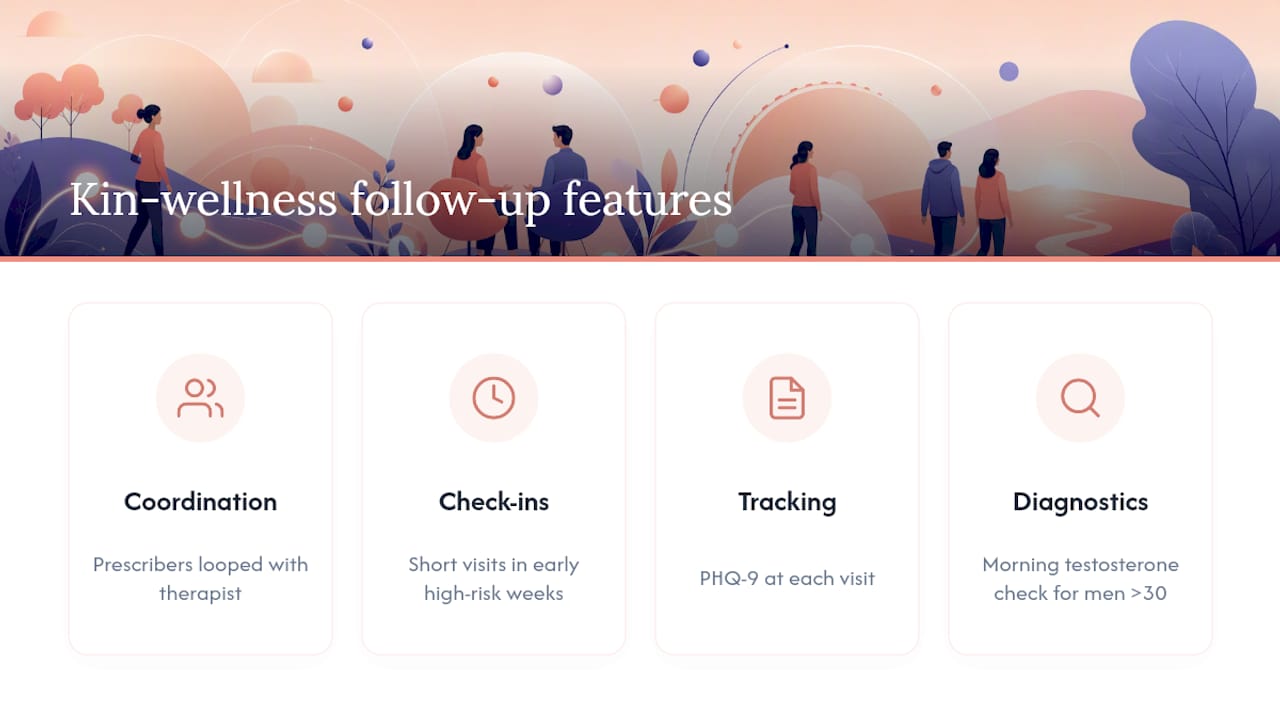
Measurement-based follow-up sounds straightforward on paper. In practice, most primary care settings are too rushed to run a PHQ-9 at every visit, track side effects systematically, and coordinate with a therapist, which is exactly the gap a structured virtual program is built to close.
Kin-wellness runs medication management as a coordinated piece of care, not a standalone prescription refill. Short check-ins get scheduled around the higher-risk early weeks, symptom tracking happens at each visit, and prescribers stay in the loop with the patient's therapist rather than working in isolation. For readers evaluating options, our guide on aftercare planning steps breaks down how that coordination actually works between sessions. Worth noting too: symptoms that look like depression sometimes have other roots. A morning testosterone check is a reasonable step for men over 30 whose symptoms don't fully fit the antidepressant response pattern.
— Dakota
Get Structured Medication Follow-Up With Kin-wellness
Most people leave a psychiatrist's office with a prescription and a vague "check back in a month." Kin-wellness builds the follow-up structure guidelines actually recommend, monthly reviews, PHQ-9 tracking, and real coordination between your prescriber and your therapist, into the program itself, so you're not the one responsible for remembering when your next check-in should happen.

The virtual medication management program pairs prescriber visits with symptom tracking and, when it fits your plan, therapy sessions running in parallel.
| Reader need | How the program addresses it |
|---|---|
| Fast early check-ins | Scheduled reviews during the highest-risk early weeks |
| Objective progress tracking | PHQ-9 and symptom scales used at each visit |
| Insurance questions | Billing support for most major insurance plans |
Start with a medication management consult through the services page to see how a coordinated follow-up plan would work for you.
This article is general information, not a substitute for advice from a qualified doctor. Consult a qualified healthcare professional about your own circumstances before acting on anything here.
Sources
- Major depressive disorder in adults: Approach to initial management - UpToDate
- Anti-depressant Medication Management | eCQI Resource Center
- Monitoring a person during and after antidepressant switching – NHS SPS
- Drug monitoring, antidepressants, with confirmation, serum — Quest Diagnostics
FAQ
How Soon Should I Have a Follow-Up After Starting an Antidepressant?
Most adults are seen within 1 to 4 weeks, and within about 1 week if they're under 25 or considered higher risk, according to guideline summaries. After that, monthly visits continue until symptoms improve substantially.
How Long Do I Need to Stay on an Antidepressant?
Continuation for at least six months after remission is the standard recommendation, tracked as a formal quality measure in many care settings. People with recurrent depression or high relapse risk are often advised to stay on maintenance therapy for 12 months or longer.
What If My Antidepressant Isn't Working After a Few Weeks?
Clinicians usually wait until the 4 to 6 week mark before judging a medication ineffective, since some improvement can take that long to show up clearly. If there's still no meaningful change by then, options include raising the dose, switching medications, adding a second agent, or bringing in psychotherapy.
Is Blood Testing Ever Needed for Antidepressants?
Not routinely. Therapeutic drug monitoring is reserved for specific situations like suspected nonadherence, unclear response despite adequate dosing, or drug interaction concerns, and test panels exist for exactly those cases rather than as a standard check for every patient.
Does Kin-wellness Offer Medication Follow-Up Visits?
Yes. Kin-wellness provides virtual medication management with structured, scheduled check-ins coordinated alongside therapy, detailed on the services page. Current pricing details are available directly on the site.