

Yes, most Californians with Marketplace, employer group, or Medi-Cal coverage have psychiatric benefits, since state and federal parity laws require mental health coverage comparable to medical coverage. Medicare works differently. Before booking anything, pull up your Summary of Benefits and Coverage and call the number on your insurance card to confirm psychiatric benefits and check whether the psychiatrist you want is in-network.
TL;DR:
- Commercial and Marketplace plans in California generally cover a full range of psychiatric and behavioral health services, including outpatient, inpatient, and residential care, with some services requiring prior authorization.
- Mental health and substance use disorder cost-sharing and limits must be comparable to medical coverage, but insurers may impose process barriers like prior authorization and step therapy, which regulators require them to justify upon request.
- Medi-Cal provides broad mental health services through managed care plans and county systems, while Medicare's mental health coverage operates under different federal rules with less emphasis on parity.
- Verifying in-network psychiatrists requires callers to confirm directly with providers and insurers, as directories may be outdated or incomplete, and telepsychiatry coverage varies by plan.
- Challenging coverage denials involves requesting detailed clinical criteria and analysis from insurers, documenting network gaps, and filing appeals or complaints through regulators if necessary.
Table of Contents
- Which Plans Must Cover Psychiatric Care Under California Law
- What Psychiatric Services Are Actually Covered in California
- How Parity Actually Plays Out in Copays and Coverage Limits
- Medi-Cal and Medicare Handle Psychiatric Coverage Differently
- How to Find a Psychiatrist Who Actually Takes Your Insurance
- Getting Past Prior Authorization Denials and Filing Appeals
- Your Step-By-Step Checklist Before Booking a Psychiatry Appointment
- How Kin-wellness Supports Insurance Verification for California Patients
- Why the Standard Advice on Psychiatry Coverage Falls Short
- Start With a Benefits Check, Not a Provider Search
- Where to Verify Your Rights and File a Complaint
- Sources
Which Plans Must Cover Psychiatric Care Under California Law
Almost every commercial plan sold in California must provide psychiatric and behavioral health treatment coverage. That includes individual and family plans, small and large group employer plans, and every plan sold on Covered California. The federal rule behind this is the Mental Health Parity and Addiction Equity Act, and California layered its own version on top with the Mental Health Parity Act, amended by SB 855, which requires full coverage for all diagnosable mental health and substance use disorders, not just a short list of "severe" conditions.
Marketplace plans specifically must treat mental health and substance use treatment as an essential health benefit, covering outpatient behavioral health, inpatient psychiatric stays, and substance use disorder treatment as core parts of the plan. Public programs split off from this framework in important ways:
- Medi-Cal covers a broad range of mental health and substance use services, but access often runs through your managed care plan or county behavioral health system rather than a direct provider search.
- Medicare follows separate federal rules, and MHPAEA generally does not apply to it the same way it applies to commercial insurance.
Your plan's SBC details copays, visit limits, and network rules. If not included, member services can provide it promptly.
What Psychiatric Services Are Actually Covered in California
Coverage typically spans a full continuum of care beyond just medication management. Commercial plans in California generally cover:
- Outpatient psychotherapy and psychiatric evaluation
- Medication management with a psychiatrist or psychiatric nurse practitioner
- Intensive outpatient programs (IOP) and partial hospitalization
- Inpatient psychiatric hospitalization
- Residential treatment when a plan determines it's medically necessary
SB 855 requires insurers to cover treatment across clinically appropriate settings rather than solely cost-based decisions. Crisis care coverage is integrated under AB 988, including the statewide 988 crisis line and crisis stabilization services.
Higher levels of care such as IOP, residential treatment, and inpatient stays often require prior authorization; routine outpatient therapy typically does not.
How Parity Actually Plays Out in Copays and Coverage Limits
Parity means mental health cost-sharing must be comparable to medical cost-sharing, not that psychiatric care is free. If your plan charges a $30 copay for a primary care visit, it can't quietly charge $75 for a psychiatry visit. California law is explicit that health plans cannot apply more restrictive cost-sharing to mental health and substance use services than to physical health services, whether that's deductibles, coinsurance, or annual visit caps.
The harder part to catch is what regulators call nonquantitative treatment limitations, or NQTLs. These aren't dollar amounts. They're process barriers like:
- Prior authorization requirements that apply to psychiatry but not to comparable medical specialties
- Step therapy rules forcing patients to try cheaper treatments first
- Narrower provider-type restrictions than exist on the medical side
Federal guidance requires insurers to document the rationale behind these limits and hand it over when a member asks. Comparing your actual mental health copay against your medical copay, side by side, is the fastest way to spot parity in practice, or the lack of it.
Pro Tip: Call member services and say, "I'd like the medical necessity criteria and comparative analysis your plan used to set limits on mental health services, as required under parity law." That specific phrasing gets you past the front-line script faster than "why isn't this covered?"
Medi-Cal and Medicare Handle Psychiatric Coverage Differently
Medi-Cal members have access to outpatient specialty mental health, inpatient psychiatric care, residential treatment, and substance use disorder services, though access pathways differ from commercial insurance. Instead of picking any in-network psychiatrist off a list, care usually routes through your Medi-Cal managed care plan or your county's behavioral health department, depending on how severe your symptoms are and which system covers that level of care.
If you're stuck figuring out where to start, a few contact points cut through the confusion:
- Medi-Cal Mental Health Care Ombudsman: (800) 896-4042, for help accessing services or resolving access problems
- Your managed care plan's member services line, listed on your Medi-Cal card
Medicare operates under different regulations and is generally not subject to MHPAEA parity protections applicable to commercial plans. Medicare Part B does cover outpatient psychiatric visits and medication management, but the cost-sharing structure and prior authorization rules follow Medicare's own framework, not the state parity statute.
How to Find a Psychiatrist Who Actually Takes Your Insurance
Provider directories can be outdated; a psychiatrist listed as in-network may not be accepting new patients or may no longer accept the plan. Work through this in order:
- Pull the provider directory from your insurer's website, then call the practice directly to confirm they're still in-network and accepting new patients, not just listed.
- Call member services and ask them to verify the provider's participation status using their internal system, since directories often lag by months.
- Confirm licensure and prescribing authority. Psychiatrists, psychiatric nurse practitioners, and some physician assistants can prescribe; not every "mental health provider" in a directory can manage medication.
- Ask about telepsychiatry specifically. Coverage for virtual psychiatric visits is now standard across most California plans, but confirm the provider is licensed to practice in California and that the billing code matches an in-network telehealth rate. A deeper look at telepsychiatry coverage walks through what to verify before your first virtual appointment.
- Document network gaps. If you call five in-network psychiatrists and none can see you within a reasonable window, write down names, dates, and call outcomes. That log is exactly what insurers require before they'll authorize and pay for out-of-network care under network adequacy rules.
Insurer choice also shapes how this process feels in practice. A comparison of how major California insurers handle virtual therapy networks shows how differently plans structure referrals and telehealth billing.
Getting Past Prior Authorization Denials and Filing Appeals
Insurers use prior authorization on psychiatric services, especially IOP, residential treatment, and inpatient care, because those levels of care cost more and involve more clinical judgment about necessity. That doesn't mean a denial is final.
You have a right to request the exact clinical guidelines and reasoning the plan used to deny your care, and under California's 2025 enforcement regulations, insurers face tighter obligations to produce that documentation on request.
If a denial comes through, the path forward runs in stages:
- File an internal appeal with your insurer first, in writing, referencing the specific denial letter.
- If that fails, request an independent medical review through the state, which is separate from the insurer's own appeals process.
- File a complaint with the DMHC if you have an HMO or managed care plan, or the California Department of Insurance if you have a PPO, both of which run consumer hotlines for exactly this situation.
Pro Tip: Keep every denial letter and every call log with the date, representative name, and what they said. Appeals move faster when you can show a clear paper trail instead of a vague timeline.
Your Step-By-Step Checklist Before Booking a Psychiatry Appointment
Work through this list before your first call to a provider's office, not after:
- Identify your plan type (HMO, PPO, EPO, Medi-Cal managed care) and pull your SBC.
- Call member services and ask specifically about psychiatric outpatient benefits, copay amount, and annual deductible status.
- Confirm the provider's in-network status directly with their office, then again with your insurer.
- Ask whether the visit type requires prior authorization, and if so, who submits it.
- Get a written or emailed cost estimate before your first visit if you're worried about surprise billing.
Two lines that work well on the phone: "Can you confirm this psychiatrist is currently in-network and accepting new patients under my plan?" and "What is my copay or coinsurance for an outpatient psychiatric visit?" If you hit a wall at any step, the DMHC and California DOI hotlines exist specifically for this.
Pro Tip: Ask your insurer for their claims-eligibility verification steps directly, similar to the process outlined in this insurance verification guide for medical practices. Understanding the questions they're trained to answer helps you ask sharper ones.
How Kin-wellness Supports Insurance Verification for California Patients
A provider of virtual outpatient and intensive outpatient psychiatric care for California adults may perform insurance verification, network participation checks, and prior authorization handling before your first session. That verification work happens on the front end, so you're not left guessing about copays or discovering a denial after you've already started treatment.
Why the Standard Advice on Psychiatry Coverage Falls Short
Most guidance on psychiatric insurance in California stops at "check if you're covered," as if coverage were binary. It isn't. Parity law doesn't guarantee a specific psychiatrist has an opening, and it doesn't stop an insurer from quietly applying stricter prior authorization to psychiatric care than to a comparable medical specialty, until someone asks for the paperwork proving otherwise.
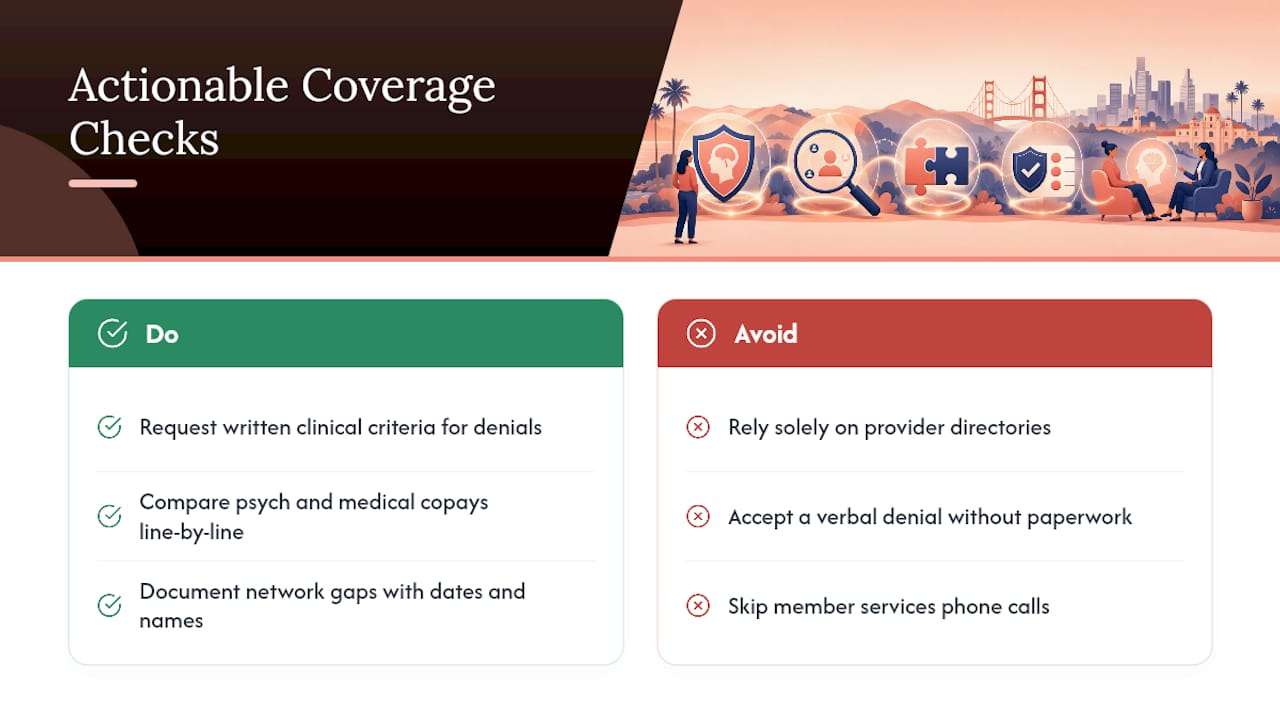
The advice that actually moves the needle is narrower and more procedural: request the clinical criteria behind a denial in writing, compare your psychiatric copay against your medical copay line by line, and document every network gap with dates and names. Regulators built these mechanisms into law specifically because insurers won't volunteer them.
What gets overrated is provider directories. What gets underrated is the phone call to member services asking a specific, informed question. California's 2025 enforcement rules make insurers more accountable than they've been in years, but only for patients who know which questions to ask and which office to call when the answer doesn't hold up.
— Dakota
Start With a Benefits Check, Not a Provider Search
Most people searching for a psychiatrist start with a name and work backward into insurance questions. This provider flips that order: benefits get verified first, so you know your copay and network status before you ever sit down for a session. That's the practical advantage over piecing coverage together after you've already picked a provider and hit a billing surprise.

This provider offers virtual outpatient psychiatry, medication management, and intensive outpatient programs for California adults, and may handle insurance verification and billing support as part of that process. Before your first appointment, have your insurance card, a current medication list, and any recent denial letter ready if one applies to your situation. Those three items let the intake team confirm benefits and prior authorization needs before you're on the calendar.
Visit Kin-wellness's services page to see current program options and start the verification process for your plan.
Where to Verify Your Rights and File a Complaint
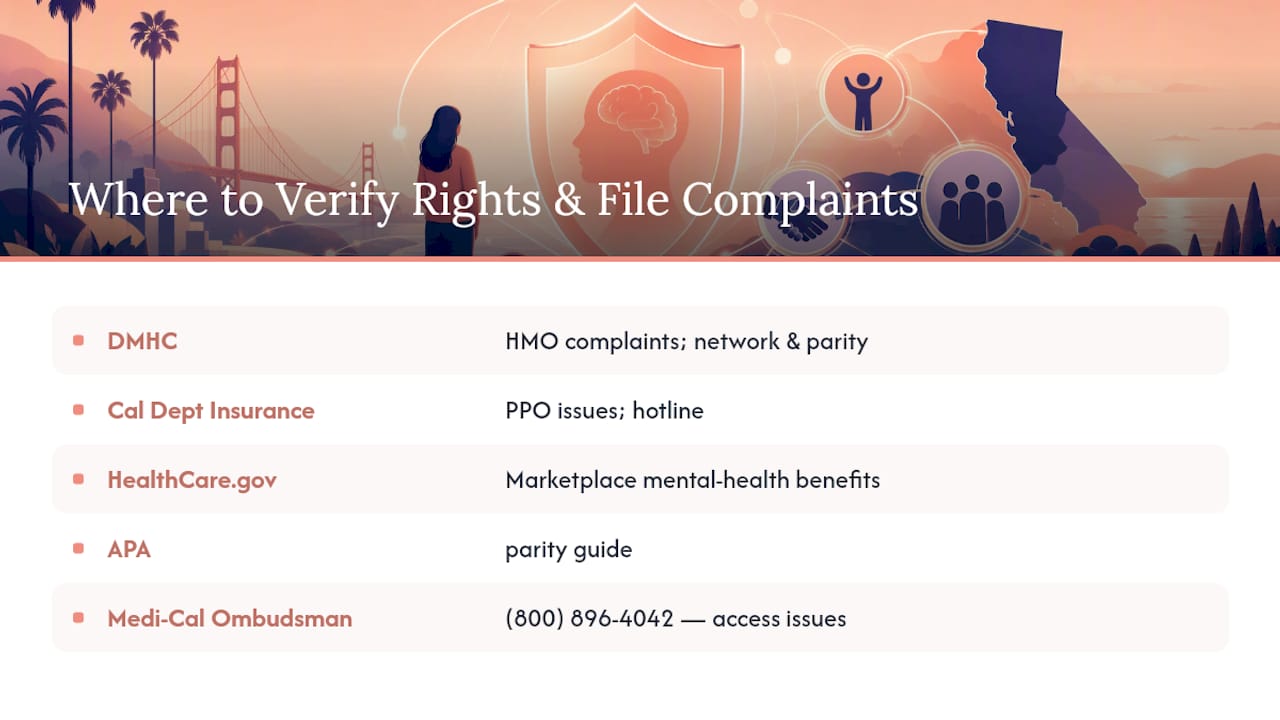
For questions about network adequacy, parity violations, or coverage denials, the DMHC's behavioral health care page covers HMO complaints, while the California Department of Insurance handles PPO-related issues through the hotline listed in Commissioner Lara's 2025 enforcement announcement. HealthCare.gov explains Marketplace mental health benefits in plain terms, and the APA's parity guide breaks down what parity does and doesn't require. Medi-Cal members can reach the Mental Health Care Ombudsman at (800) 896-4042 for access issues.
This article is general information, not a substitute for advice from a qualified doctor. Consult a qualified healthcare professional about your own circumstances before acting on anything here.
Sources
- Healthcare
- Behavioral Health Care — California Department of Managed Health Care (DMHC)
- Commissioner Lara expands mental health access with final landmark rulemaking to enforce California Mental Health Parity Act
- Mental health parity guide — American Psychological Association