

California law requires health plans and insurers to cover telehealth at parity with in-person care when the service is clinically appropriate, under Insurance Code 10123.855 and Health and Safety Code 1374.14. Medi-Cal reimburses synchronous video, audio-only, and asynchronous store-and-forward visits under matching rules. Getting paid, whether you're a patient checking a benefit or a clinician submitting a claim, comes down to using the right consent language, the correct Place of Service code, and the modifier that matches the visit type.
TL;DR:
- Telehealth reimbursement in California requires plans to cover services at the same rate and cost-sharing as in-person visits when clinically appropriate, but confusion arises from different network routes and plan structures.
- Medi-Cal covers synchronous video, audio-only, and asynchronous telehealth, paying the same rate as in-person services, but billing for originating site fees depends on the location and modality used.
- Licensed California providers can deliver telehealth without prior in-person visits, but must obtain verbal consent, document it properly, and follow specific billing code and modifier protocols to avoid claim denials.
- Private insurance plans may restrict telehealth to in-network vendors or different copay structures, making benefit verification before scheduling essential to avoid unexpected costs.
- Kin-wellness follows strict billing and consent procedures aligned with law, offering California residents compliant virtual mental health care that ensures affordability and continuous access.
Table of Contents
- What does California's telehealth coverage parity law actually require?
- How does Medi-Cal cover telehealth services in California?
- Who can legally provide telehealth in California, and what consent is required?
- What billing codes and modifiers do telehealth claims require in California?
- What should patients and providers verify with private insurance plans?
- How Kin-wellness applies these rules in daily practice
- How Kin-wellness supports compliant telehealth care for California adults
- Kin-wellness offers compliant virtual mental health care across California
- Where to verify California telehealth rules and billing guidance
- Sources
What does California's telehealth coverage parity law actually require?
Two statutes do the heavy lifting here, and they say almost the same thing from two different angles. Insurance Code 10123.855 governs commercial health insurers, while Health and Safety Code 1374.14 governs health care service plans, which is most of the HMO and PPO market Californians actually use. Both require reimbursement for telehealth "on the same basis and to the same extent" as an equivalent in-person visit, provided the service is clinically appropriate for delivery by video, phone, or asynchronous message.
That phrase, "same basis and same extent," is doing specific legal work. It means a plan cannot simply exclude telehealth from a benefit category, and it cannot make the telehealth version of a covered service harder to access or more expensive out of pocket than the in-person version.
Cost-sharing parity follows directly from that. Your copay, coinsurance, and deductible application for a telehealth therapy session or medication management visit cannot exceed what you'd pay walking into the office. If your plan quotes you a $60 in-person copay for a psychiatric follow-up but tries to charge $90 for the same visit over video, that's a discrepancy worth challenging.
In practice, a few things trip people up:
- Plans sometimes route telehealth through a separate vendor with its own network and cost structure, which can create confusion even though the underlying reimbursement rule still applies.
- "Clinically appropriate" is a real qualifier. A plan can decline parity if the service genuinely requires hands-on examination, but for outpatient mental health, the bar is rarely an issue.
- Out-of-network telehealth isn't automatically covered just because parity exists. Parity applies to services the plan already covers, not to expanding your network access.
Before scheduling, call member services and ask directly whether your plan's telehealth cost-sharing matches its in-person rate for your specific service category. If the answer sounds vague or contradicts the statute, ask for the language in writing. Plans handle this differently in practice, and how Kaiser and Blue Shield structure virtual therapy benefits illustrates just how much variation exists even among major California carriers.
How does Medi-Cal cover telehealth services in California?
Medi-Cal telehealth coverage in California is broader than most people expect, and the DHCS telehealth guidance spells out exactly what qualifies. Covered modalities include:
- Synchronous video visits for most outpatient services, including behavioral health, substance use disorder treatment, and general medical care.
- Audio-only (telephone) visits, covered for many services when video isn't accessible to the patient, though with narrower eligibility than video.
- Asynchronous store-and-forward, mainly used in specialties like dermatology and radiology where images or data are reviewed later rather than live.
- Remote patient monitoring, covered for specific chronic-condition management programs.
Payment parity is the backbone of the Medi-Cal telehealth model. When a service is medically necessary and appropriate for telehealth delivery, DHCS pays the same rate it would for the in-person equivalent. This isn't a lesser reimbursement tier bolted onto the fee schedule. It's the identical rate, tied to the identical CPT or HCPCS code, just delivered through a different channel.
Originating site fees are where things get technical. HCPCS code Q3014 covers the facility fee paid when a patient is physically located at a qualifying originating site (a clinic or facility, not their living room) during a telehealth visit with a distant provider. That fee only applies to live, synchronous encounters. Audio-only visits don't qualify for the Q3014 originating site payment, a distinction that trips up billing staff constantly. Code T1014 relates to the telehealth transmission itself and carries its own set of applicability rules depending on the delivery setup.
Pro Tip: If your clinic delivers care with patients at home rather than at a facility, skip the originating site fee altogether. Q3014 only applies when the patient is at a qualifying site, not when they log in from their couch.
To bill Medi-Cal for telehealth at all, providers need active California licensure in their discipline, Medi-Cal enrollment as a provider, and, in many cases, formal affiliation with an enrolled provider group. Skipping enrollment is the single fastest way to get every claim rejected before it's even reviewed for medical necessity.
Who can legally provide telehealth in California, and what consent is required?
Business and Professions Code 2290.5 defines telehealth broadly and sets the scope for who can deliver it: licensed physicians, psychologists, clinical social workers, marriage and family therapists, nurse practitioners, and other California-licensed health professionals acting within their scope of practice. The law does not require a prior in-person visit before a provider can treat a patient over telehealth. The clinician determines clinical appropriateness on a case-by-case basis, and for most outpatient mental health care, that threshold is easily met.
Verbal consent is required before the first telehealth encounter, and documenting it properly protects both the patient relationship and the claim. Here's the sequence that holds up under audit:
- State the modality clearly. Tell the patient they're receiving care via telehealth and briefly explain what that means for privacy and technology.
- Confirm understanding of the option. Note that the patient was informed of the right to request in-person care instead.
- Document the verbal agreement. Record the date, time, and a short note ("patient verbally consented to telehealth visit") directly in the chart, not just in a separate intake form.
- Re-verify at intervals. Ongoing care doesn't require consent at every session, but a refresh at treatment plan updates is good practice.
Providers licensed in California but treating patients who travel out of state, or vice versa, run into a separate set of licensure questions worth reviewing before scheduling; licensure and cross-state practice limits for telehealth clinicians covers the boundaries clinicians frequently misjudge.
What billing codes and modifiers do telehealth claims require in California?
Getting a telehealth claim paid on the first submission comes down to four fields matching the visit type exactly; this ensures compliance with medical necessity and clinical appropriateness standards required for approval. Per DHCS payment guidance:
- Place of Service 02 identifies the claim as telehealth delivered when the patient is not at a healthcare facility (home or other non-clinical setting).
- Modifier 95 applies to synchronous, real-time audio-video visits.
- Modifier GQ applies to asynchronous, store-and-forward encounters.
- Q3014 bills the originating site facility fee, only for synchronous visits where the patient sits at a qualifying facility.
- T1014 covers transmission-related billing for specific telehealth setups.
The most common denial triggers aren't exotic. They're a missing modifier, a POS code left at the in-person default, or documentation that doesn't clearly support medical necessity for the specific code billed. Fix the pattern, and most denials disappear.
| Denial Trigger | Why It Happens | Fix |
|---|---|---|
| Missing modifier 95 or GQ | Claim submitted without specifying visit type | Add modifier before submission; build it into the EHR template |
| Wrong Place of Service | POS defaults to 11 (office) instead of 02 | Set telehealth as a distinct visit type in scheduling software |
| Insufficient medical necessity documentation | Note doesn't justify the code billed | Document clinical rationale for telehealth delivery in each note |
| Q3014 billed for audio-only | Originating site fee doesn't apply to phone-only visits | Confirm modality before billing; skip Q3014 for audio-only |
For claim-specific questions, the DHCS Telephone Service Center handles Medi-Cal billing issues directly at (800) 541-5555 for in-state calls.
What should patients and providers verify with private insurance plans?
Commercial plans in California must meet the same coverage parity baseline as Medi-Cal, but how they implement it varies more than most patients expect. A plan can negotiate its own reimbursement rates with providers and can restrict telehealth to in-network providers or a specific vendor platform, even while honoring the parity requirement on paper.
Before booking a telehealth visit, check for:
- Whether the plan's telehealth benefit routes through a specific vendor, and whether your provider is actually in that vendor's network.
- Cost-sharing parity in writing, not just verbal assurance from a phone representative.
- Network adequacy for your specific service. A plan can cover telehealth broadly while having thin in-network options for a particular specialty like psychiatry.
- Whether your plan treats copay versus coinsurance differently for telehealth, since that split affects your out-of-pocket cost more than people assume, a distinction worth understanding in detail through how copay and coinsurance actually work for therapy.
Managed care plans that also administer Medi-Cal benefits layer their own network rules on top of the state's baseline requirements, so a Medi-Cal managed care enrollee should confirm both the state rule and the plan's specific network restrictions before assuming a provider is covered.
How Kin-wellness applies these rules in daily practice
Kin-wellness verifies telehealth benefits before the first session, not after, so patients aren't blindsided by a cost-sharing mismatch. Our intake workflow includes:
- Documented verbal consent captured at intake, not buried in a form nobody reads.
- Clinical appropriateness reviewed per patient before recommending telehealth versus in-person care, consistent with guidance on telepsychiatry delivery for adults.
- Billing staff trained on POS 02 and modifier accuracy before claims go out, cutting denial rework.
- A benefit-verification call placed ahead of scheduling, so surprises show up before the appointment, not on the bill.
How Kin-wellness supports compliant telehealth care for California adults
California's telehealth statutes only work for patients when the clinic on the other end actually follows them. Kin-wellness built its intake and billing workflow around the parity rules and consent documentation this article walks through, because a compliant claim is what keeps care affordable and continuous for the people who need it. Continuity matters most for working professionals and parents who can't always make an in-person appointment fit their week, and telehealth removes that barrier without lowering the standard of care.
— Dakota
Kin-wellness offers compliant virtual mental health care across California
Kin-wellness gives working professionals, parents, executives, and healthcare workers a direct path to licensed mental health care without the guesswork this article just walked through.
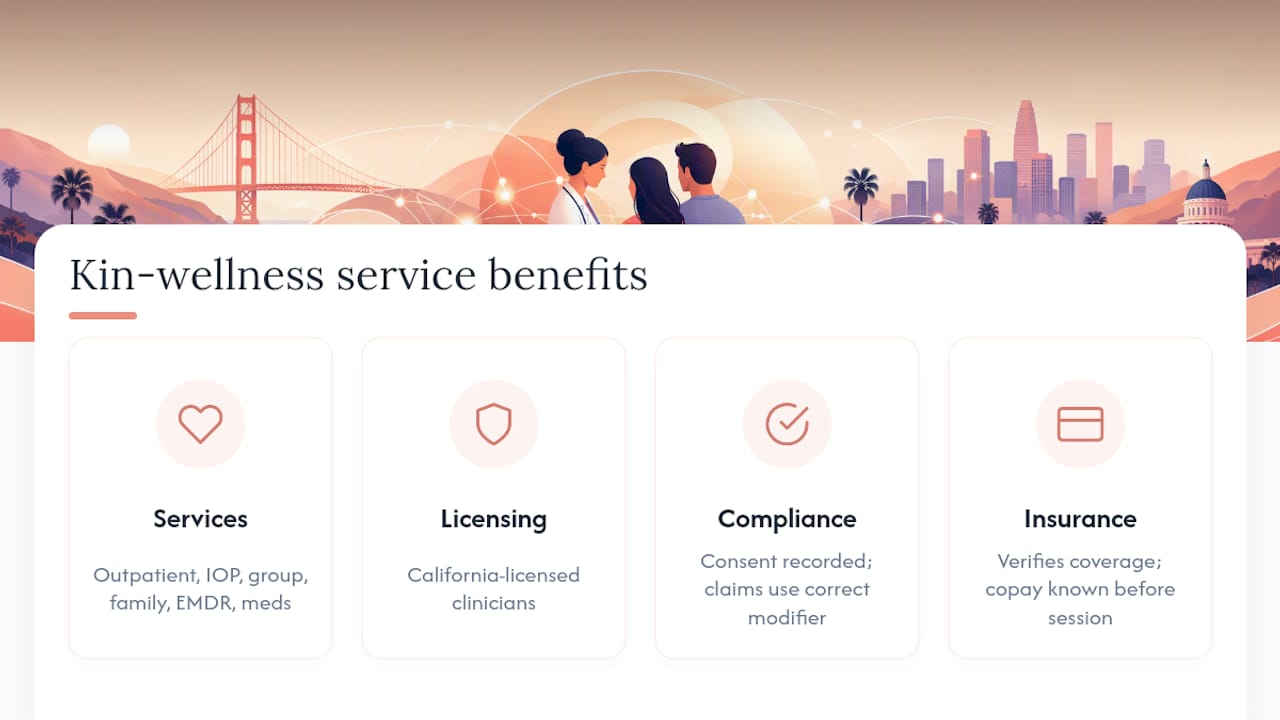
Kin-wellness provides virtual outpatient and intensive outpatient therapy, group therapy, family therapy, EMDR, and medication management, delivered by California-licensed clinicians who already build their documentation and billing around the state's parity statutes. That means your consent is recorded correctly, your claim goes out with the right modifier, and your cost-sharing matches what the law requires rather than what a vague benefits call implied. Our team also handles insurance verification directly, so you know your copay and coverage details before your first session rather than after a confusing bill arrives.
If you're ready to start care or want your benefits checked first, explore Kin-wellness services and schedule a session that fits your week.
Where to verify California telehealth rules and billing guidance
For anyone who wants to check these rules directly rather than take a summary on faith:
- Insurance Code 10123.855 and Health and Safety Code 1374.14, the statutory basis for coverage parity.
- DHCS Telehealth FAQ for Medi-Cal modality and payment rules.
- DHCS Payment and Claims guidance for code-level billing detail.
- California Telehealth Resource Center for implementation tools and provider training.
- DHCS Telephone Service Center, (800) 541-5555, for claim-specific Medi-Cal billing questions.
This article is general information, not a substitute for advice from a qualified doctor. Consult a qualified healthcare professional about your own circumstances before acting on anything here.
Sources
- California Insurance Code section 10123.855
- Telehealth Frequently Asked Questions | DHCS
- Payment and Claims | DHCS