

A deductible for therapy is the amount you pay out of pocket for sessions before your insurance starts sharing the cost. The first thing to check isn't your deductible amount. It's whether your plan even applies one to therapy at all, since many plans treat mental health visits as copay first instead. Look at your Summary of Benefits and Coverage or check Publication 502 and Healthcare for how coverage rules actually work.
TL;DR:
- Many insurance plans treat therapy as copay rather than applying a deductible, making it important to verify whether your plan even uses one for mental health visits.
- Out-of-network therapy typically requires paying the full rate upfront, then submitting an itemized bill for partial reimbursement based on the allowed amount, which can be significantly lower than the charge.
- To determine your deductible status, log into your portal or call member services, asking explicitly if outpatient therapy is subject to the deductible or only requires a copay.
- Therapy costs can be tax-deductible only if they treat a diagnosed condition and total more than 7.5% of your adjusted gross income, with some plans covering therapy through HSA or FSA funds.
- In plans where therapy is exempt from the deductible, you pay a flat copay, often making ongoing sessions more affordable, especially if your deductible is high or not met yet.
Table of Contents
- Deductible vs. Copay vs. Coinsurance: How the Costs Stack
- In-Network vs. Out-of-Network: What Changes and What It Costs
- How to Find Your Deductible and Check If Therapy Applies
- Tax and Pre-Tax Rules: HSA, FSA, and Deducting Therapy Costs
- Three Cost Scenarios: What You'll Pay Before and After the Deductible
- What to Do If Your Deductible Is Too High to Afford
- Why Trust This Guidance: Kin Wellness and Practical Billing Experience
- When Does Your Deductible Reset, and Why Timing Matters
- How Your Deductible Feeds Into Your Out-of-Pocket Maximum
- Services and Situations That Skip the Deductible Entirely
- What Actually Matters Once You Understand Your Deductible
- Get a Straight Answer on Your Therapy Costs From Kin Wellness
- Where to Verify These Rules Yourself
- Sources
Deductible vs. Copay vs. Coinsurance: How the Costs Stack
Your deductible is the yearly amount you pay before your insurer contributes anything toward covered care. If your plan has a $1,500 deductible, you're on the hook for the full allowed cost of your sessions until you've paid $1,500 for the year. After that, cost sharing usually shifts to one of two models.
A copay is a flat fee per visit, often a moderate amount for in-network therapy. Coinsurance is a percentage of the allowed amount that you keep paying even after the deductible is met. Whether therapy triggers your deductible at all depends on your specific plan design.
The order these apply matters:
- You pay the full negotiated rate for each session until your deductible is met.
- Once met, you switch to copay or coinsurance for the rest of the plan year.
- Some plans exempt outpatient mental health from the deductible entirely, charging only a copay from session one.
- PPO, HMO, and EPO plans handle this differently, and network status changes the math substantially.
Because Marketplace plans must offer parity between mental health and medical benefits, your therapy deductible generally can't be higher, or your visit limits stricter, than what applies to comparable medical care. That's a real protection, but it doesn't mean therapy is automatically deductible free. It means the rules can't be worse than they are for a broken arm.
In-Network vs. Out-of-Network: What Changes and What It Costs
In-network therapists bill your insurer directly. You typically pay a copay or coinsurance at the time of service, and the paperwork stops there. Out-of-network care works differently: you pay the therapist's full rate up front, then request an itemized receipt called a superbill to submit for reimbursement.
That reimbursement isn't the full amount you paid. Insurers apply an "allowed amount," often lower than what the therapist actually charges, and reimburse a portion of that reduced figure rather than your full bill. According to LegalClarity, out-of-network reimbursement typically covers a substantial portion of the allowed amount, and that allowed amount can sit well below market rate for out-of-network billing.
A few things to keep in mind:
- Out-of-network care usually runs against a separate, often higher, deductible than in-network care.
- The gap between what you paid and what comes back can be substantial, especially early in the year before any deductible is met.
- If your plan's network genuinely lacks providers who treat your condition, you can ask your insurer about a single-case agreement that pays an out-of-network therapist at in-network rates.
Pro Tip: Before your first session with an out-of-network therapist, ask what your specific diagnosis and procedure codes typically reimburse at. Many practices, including Kin-wellness, can estimate this for you before you commit to paying out of pocket.
How to Find Your Deductible and Check If Therapy Applies
You can usually get a clear answer in under 15 minutes. Here's the order that works:
- Log into your insurance member portal and pull up your Summary of Benefits and Coverage. Look for the deductible amount, what's already been applied, and any separate mental health or behavioral health column.
- Call member services using your member ID and group number. Ask directly: "Is outpatient therapy subject to my deductible, or is it copay only?" Insurers sometimes use terms like "behavioral health outpatient" rather than "therapy," so ask them to search that way if the first term draws a blank.
- Ask any therapist you're considering to run a benefits check on your behalf. Most practices do this routinely and can tell you your remaining deductible, expected copay, and any authorization requirements before you book.
- Request that estimate in writing. A written cost estimate, not just a verbal quote, protects you if the first bill doesn't match what you were told.
One detail that trips people up: your remaining deductible tracks against the allowed amount your insurer sets, not the billed amount your provider charges. Two visits at the same office might apply differently to your deductible if the codes billed differ.
Tax and Pre-Tax Rules: HSA, FSA, and Deducting Therapy Costs
Therapy payments can qualify as deductible medical expenses on Schedule A, but only under specific conditions. Publication 502 states that therapy counts as a deductible medical expense when it treats a diagnosed condition, and only the portion of your total medical expenses exceeding 7.5% of your adjusted gross income is deductible.
That threshold is a real bar. If your AGI is $60,000, the first $4,500 of medical costs, therapy included, isn't deductible at all.
- HSA, FSA, Archer MSA, and HRA funds can generally pay for therapy when it qualifies as medical care, according to IRS guidance on medical expenses.
- Keep every superbill and any documentation showing a diagnosis, since your account administrator or the IRS may ask for it later.
- Marital or couples counseling often doesn't qualify unless it's treating a diagnosed mental health disorder in one partner.
A tax professional should weigh in on your specific return.
Three Cost Scenarios: What You'll Pay Before and After the Deductible
The math changes a lot depending on plan design and network status. Here are three common setups.
- Copay-only in-network plan. Your plan exempts therapy from the deductible entirely. You pay a flat $30 copay every session, all year, regardless of what else you've spent on medical care. Twenty sessions costs $600 total, full stop.
- In-network plan with a $1,500 deductible, then a $30 copay. If sessions run $150 each under your plan's allowed amount, you pay full price for the first 10 sessions ($1,500), then $30 per session after that. Twenty sessions costs $1,500 plus 10 copays of $30, or $1,800 total.
- Out-of-network provider charging $175 per session, 60% reimbursement after a separate $1,000 out-of-network deductible. You pay $175 up front every time. The first roughly six sessions ($1,050) go toward your deductible with no reimbursement. After that, you get back 60% of the allowed amount, which is often lower than $175, leaving a real gap between what you paid and what came back.
A simple formula to model your own year: (deductible remaining ÷ session cost, rounded up) gives you the number of full-price sessions left before cost sharing kicks in.
What to Do If Your Deductible Is Too High to Afford
A high deductible doesn't mean therapy is out of reach. It means you need a different approach for the months before it resets.
- Ask directly about sliding scale fees or a payment plan. Many practices, along with community mental health centers and university training clinics, offer reduced rates that never touch your insurance at all.
- Submit every out-of-network superbill for reimbursement, even partial reimbursement adds up, and save the same documentation for HSA, FSA, or Schedule A purposes later.
- Call your insurer about single-case agreements if no in-network provider meets your specific clinical need.
- Consider telehealth, group therapy, or a short-term intensive outpatient format. These often cost less per session and can still make meaningful clinical progress.
Pro Tip: Group therapy frequently runs $40 to $80 per session even before insurance, since the cost splits across participants. If your deductible feels out of reach this year, ask any prospective therapist whether a group option exists for your specific concern.
Why Trust This Guidance: Kin Wellness and Practical Billing Experience
Kin Wellness provides virtual outpatient and intensive outpatient care for adults in California, including individual, group, and family therapy, EMDR, and medication management, all backed by direct insurance billing support. That billing support isn't theoretical. Every new client gets a benefits check before their first session, so they know their deductible status, expected copay, and any authorization needs before a bill ever arrives.
Author Dakota has written extensively on the practical side of accessing care, including how superbills actually work and what out-of-network reimbursement really pays out. That focus on the paperwork, not just the clinical side, comes from watching how often cost confusion is what keeps people from booking a first appointment at all.
When Does Your Deductible Reset, and Why Timing Matters
Most deductibles reset on January 1, tied to the calendar year rather than when you first used your benefits. That reset erases any progress you made toward meeting it, whether you paid $200 or $1,400 of a $1,500 deductible by December.
Timing has real consequences for therapy specifically, since it's ongoing care rather than a one-time procedure. If you start therapy in October, you might hit your deductible right as the year ends, only to reset back to zero in January and face full-price sessions again. Some plans use a non-calendar plan year tied to an employer's benefits cycle, so check your Summary of Benefits and Coverage rather than assuming January 1 applies.
There's a strategic angle here too. If you've already met your deductible for the year, later sessions cost far less out of pocket since your insurer is covering a larger share. That's one reason some people front-load appointments, adding a session or two before December 31, once the deductible is already satisfied, since the marginal cost of each additional visit drops once cost sharing shifts to copay or coinsurance. If you're weighing whether to increase session frequency, a therapist familiar with working professionals' schedules can help you figure out whether that timing makes sense clinically, not just financially.
How Your Deductible Feeds Into Your Out-of-Pocket Maximum
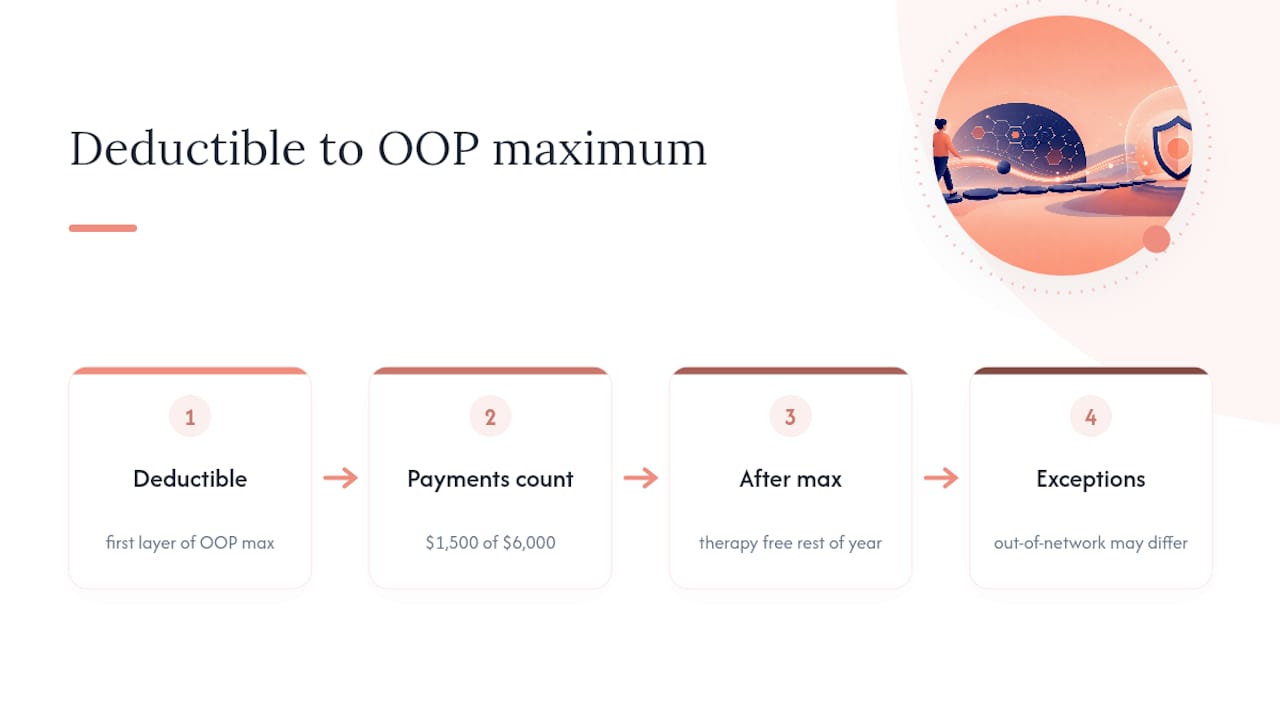
Your deductible isn't separate from your out-of-pocket maximum. It's the first layer of it. Every dollar you pay toward your deductible also counts toward your annual out-of-pocket max, the hard ceiling on what you'll pay for covered care in a plan year.
Here's how that plays out for therapy specifically. Say your plan has a $1,500 deductible and a $6,000 out-of-pocket maximum. The $1,500 you pay toward therapy sessions before the deductible is met counts fully toward that $6,000 ceiling. So do any copays or coinsurance payments you make afterward, for therapy or any other covered care.
This matters most for people managing therapy alongside other ongoing care, like a chronic condition requiring specialist visits or medication. Reaching your out-of-pocket max sooner, through combined medical and mental health spending, means therapy becomes free for the remainder of the year. It's worth tracking your cumulative spending in your member portal rather than treating therapy costs in isolation, since a surgery or ER visit earlier in the year could put you close to your max before your next session even happens.
Out-of-network spending sometimes has its own separate out-of-pocket maximum that doesn't combine with your in-network max, so check your plan documents rather than assuming one ceiling covers everything.
Services and Situations That Skip the Deductible Entirely
Not everything related to therapy gets bundled into deductible math. A handful of common exceptions matter enough to flag.
Many plans classify an initial mental health screening or assessment, sometimes billed as an annual wellness visit, as preventive care exempt from the deductible under Affordable Care Act rules, even when the therapy sessions that follow are not. Crisis intervention services, including some emergency behavioral health visits, are occasionally carved out and covered at a flat rate or fully covered depending on the plan.
Employee Assistance Programs, common at larger employers, typically offer a set number of free counseling sessions, often three to eight, entirely outside your deductible and separate from your health plan altogether. If your employer offers an EAP, using those sessions first can delay when you start paying toward your deductible at all.
Telehealth-specific parity laws in some states also require certain virtual visits to be covered identically to in-person visits, which can affect how a plan applies cost sharing depending on where you live. And copay-only plan designs, as covered earlier, exempt routine outpatient therapy from the deductible by design, applying only a flat fee from the very first visit.
None of these exceptions are universal. The only reliable way to know which apply to you is checking your Summary of Benefits and Coverage or asking your insurer directly, using the same benefits check process outlined earlier in this guide.
What Actually Matters Once You Understand Your Deductible
The conventional advice on therapy costs stops at "call your insurance company," and that's where most people give up, because insurance representatives routinely misuse the term "therapy" versus "behavioral health outpatient" and give inconsistent answers to the same question asked twice. The fix isn't calling more. It's asking a more precise question, and writing down the exact language the representative uses so you can repeat it if you call back.
The bigger blind spot is timing. Most guides treat the deductible as a static number to look up once. It's not. It resets every year, and where you are in your own deductible cycle changes what the smartest move is, whether that's front-loading sessions in December or holding off intensive treatment until January if you can safely wait.
If your deductible feels unaffordable, the fastest path forward usually isn't negotiating with your insurer. It's asking a prospective therapist directly about sliding scale rates or a benefits check before you assume the sticker price is fixed. That single conversation resolves more cost confusion than any amount of research on your own.
— Dakota
Get a Straight Answer on Your Therapy Costs From Kin Wellness
Figuring out your deductible on your own means piecing together portal screenshots, a phone call to member services, and guesswork about what your therapist will actually charge. Kin Wellness runs that benefits check for you before your first session, so you know your remaining deductible, expected copay, and any authorization requirements in writing before you commit to anything.

Kin Wellness offers virtual outpatient and intensive outpatient care for adults in California, including individual, group, and family therapy, EMDR, and medication management, with insurance billing support built into the process from day one. When you reach out, expect a straightforward conversation: what your plan covers, what you'll likely pay per session before and after your deductible, and available scheduling that fits your work or family demands. For a broader look at how the care pathway typically unfolds once insurance is confirmed, this step-by-step guide from a partner practice covers what to expect next.
Explore Kin Wellness services to start your benefits check and get a written cost estimate before your first appointment.
Where to Verify These Rules Yourself
For the tax rules covered here, read IRS Publication 502 directly. For coverage and parity protections, HealthCare.gov's mental health page lays out your rights. To check your own remaining deductible, log into your member portal or call using your member ID and group number.
This article is general information, not a substitute for advice from a qualified doctor. Consult a qualified healthcare professional about your own circumstances before acting on anything here.
Sources
- Publication 502 (Medical and Dental Expenses) | Internal Revenue Service
- Healthcare
- How to check if your insurance covers therapy | LegalClarity