

A copay is a fixed dollar amount you pay per therapy session, while coinsurance is a percentage of the bill you owe after meeting your deductible. For anyone in ongoing therapy, that difference matters: a copay makes budgeting simple, while coinsurance can swing wildly depending on where you stand with your deductible. Before your first session, pull up your plan's Summary of Benefits and Coverage or log into your member portal to see which one applies to you.
TL;DR:
- Understanding whether your health plan applies a copay or coinsurance for mental health visits requires reviewing your plan's benefits or member portal before booking sessions.
- Coinsurance usually begins after meeting your deductible, meaning early in the year you may pay full session rates, unlike fixed copays that are predictable from the start.
- Billing codes and session types, such as medication management or telehealth, influence your cost-sharing amount, so confirming CPT codes with your provider can prevent surprises.
- For consistent budgeting, a copay plan often offers more stability for regular therapy, while coinsurance might be cheaper if you've already met your deductible earlier in the year.
- Verifying your deductible status and benefit details beforehand is critical because that single number determines the actual cost of your upcoming therapy sessions.
Table of Contents
- How Copays Work for Therapy Visits
- How Coinsurance Works and Why It Varies for Therapy
- How Copays and Coinsurance Apply to Therapy Specifically
- Copay vs. Coinsurance: The Actual Math for Ongoing Therapy
- Where to Find Your Exact Plan Rules
- Budgeting for Copay vs. Coinsurance Therapy Costs
- How Kin-wellness Helps You Sort Out Copays and Coinsurance
- Your Next Steps Before Booking a Session
- What Standard Advice Gets Wrong About This
- Sources
How Copays Work for Therapy Visits
A copay is the flat amount your plan charges at the time of service, and you typically hand it over (or get billed for it) right after the session ends. It doesn't fluctuate based on what your therapist charges or what your insurer's negotiated rate looks like.
Mental health copays commonly run in a moderate range per visit, though specialist rates can run higher than a primary care copay on the same plan. Whether that copay counts toward your deductible or your out-of-pocket maximum depends entirely on your specific plan design, and copays and coinsurance usually both count toward that annual cap once you hit it.
A few things worth checking on your plan:
- Does the copay apply from session one, or only after the deductible is met?
- Is the mental health copay the same as your primary care copay, or closer to the specialist rate?
- Does a telehealth session carry a different copay than an in-person visit?
Pro Tip: If your Explanation of Benefits shows a copay one month and a coinsurance charge the next for the same type of visit, call your insurer. That inconsistency usually means the deductible got met partway through, not a billing error.
How Coinsurance Works and Why It Varies for Therapy
Coinsurance is your percentage share of the insurer's "allowed amount," the negotiated rate your plan agrees to pay a provider, not the sticker price on the bill. It almost always kicks in after you've met your annual deductible, which means the first several sessions of the year might cost you the full allowed rate out of pocket before coinsurance even starts.

Typical coinsurance for outpatient mental health visits clusters between 10% and 40%, often structured as an 80/20 or 70/30 split between insurer and patient. Medicare Part B, for comparison, generally applies a deductible followed by 20% coinsurance for outpatient mental health services, per Medicare.
Because coinsurance depends on a rate you rarely see in advance, billing can lag behind the visit:
- Your therapist submits a claim after the session.
- Your insurer processes it and applies the allowed amount.
- You get a bill for your percentage, sometimes weeks later.
That delay is exactly why coinsurance surprises people more than copays do.
How Copays and Coinsurance Apply to Therapy Specifically
In-network therapy almost always means a set copay or a defined coinsurance percentage negotiated in advance. Go out-of-network and you're often paying the full session fee upfront, then filing for partial reimbursement, a process our out-of-network reimbursement guide walks through in detail.
Some plans waive the deductible for mental health visits entirely and charge a copay starting with session one; others fold therapy into the same deductible as your other medical care. The Mental Health Parity rules require mental health benefits not to be more restrictive than medical benefits, but they don't force insurers to use the same cost-sharing structure across every plan. Check the SBC before assuming anything.
Billing codes also matter more than people expect, as covered in detail in hypnotherapy insurance coverage:
- Psychotherapy sessions typically bill under a different CPT code than medication management.
- A visit coded as med management might trigger your specialist copay instead of your therapy copay.
- Telehealth sessions sometimes carry their own cost-sharing rules separate from in-person care.
Pro Tip: Ask your therapist's billing office which CPT code they plan to use before your first session. That single number often determines whether you owe a copay or a coinsurance percentage.
Copay vs. Coinsurance: The Actual Math for Ongoing Therapy
Numbers make this concrete. Say your plan charges a flat $40 copay for outpatient therapy.
- Weekly sessions at $40 run $160 a month and $2,080 across a 52-week year, regardless of what your therapist's full rate is.
- Now compare a plan with coinsurance on an allowed amount and a deductible. Early in the year, before you've hit that deductible, you're paying the full $130 per session out of pocket.
- Once you cross the deductible (after some sessions), your cost per session drops to a percentage of the allowed amount.
| Scenario | Cost per session | Annual cost estimate |
|---|---|---|
| $40 flat copay | $40 | annual cost depends on frequency |
| 20% coinsurance, before deductible met | full session allowed rate | until deductible is met |
| 20% coinsurance, after deductible met | percentage of allowed rate | ongoing sessions |
Your out-of-pocket maximum caps the damage either way.
Where to Find Your Exact Plan Rules
Your Summary of Benefits and Coverage spells out whether outpatient mental health carries a copay, coinsurance, or both, usually in a chart near the top labeled "outpatient services" or "mental/behavioral health." Your Explanation of Benefits, issued after each claim, shows what your insurer actually paid versus what you owe.
If the SBC language is vague, call member services and ask directly:
- "Is outpatient mental health covered in-network with a flat copay or with coinsurance?"
- "Does the copay apply before the deductible is met, or only after?"
- "What's my current deductible balance, and has it been met this year?"
Then confirm with your therapist's billing team separately: network status, the CPT code they'll use, and whether the session counts as therapy or medication management.
Pro Tip: Screenshot the SBC page that covers mental health before your first appointment. Insurer portals get updated, and having the original language saved protects you if a claim gets processed incorrectly.
Budgeting for Copay vs. Coinsurance Therapy Costs
Weekly or biweekly therapy usually favors a flat copay because you can predict the exact monthly hit to your budget. Coinsurance tends to fit better for short-term or infrequent care, especially if you've already cleared your deductible through other medical expenses that year.
A few practical moves:
- Run therapy expenses through an FSA or HSA if your plan offers one; both let you pay with pretax dollars.
- Time non-urgent care later in the year if your deductible resets in January and you're paying full rate under coinsurance.
- If out-of-network coinsurance is eating your budget, ask your clinic about switching to an in-network provider or filing OON claims consistently.
How Kin-wellness Helps You Sort Out Copays and Coinsurance
Confusing insurance language shouldn't stand between you and starting therapy. Kin-wellness's billing team verifies your benefits before your first session, so you know your copay or coinsurance responsibility in advance rather than guessing from a phone call with your insurer.
During intake, the team typically:
- Confirms in-network status and runs a benefits check against your specific plan.
- Explains whether your visits will be billed as psychotherapy or medication management, and what that means for your cost share.
- Walks you through out-of-network reimbursement options if that applies to your coverage.
Clients often arrive assuming their insurance card tells the whole story. It rarely does. The real answer sits in the plan's fine print, and a billing team that reads that fine print before your first appointment saves you from a surprise bill three weeks later.
Your Next Steps Before Booking a Session
A few minutes of homework now beats a confusing bill later.
- Pull your SBC and search for "outpatient mental health" or "behavioral health" cost-sharing terms.
- Call member services with the exact questions above, and write down the answers.
- Use the worked examples here to estimate your monthly and annual therapy costs.
- Check if an FSA or HSA can offset your share, whether copay or coinsurance.
What Standard Advice Gets Wrong About This
Most explainers treat copay versus coinsurance as a neutral definitions exercise, two terms to memorize and move on. That undersells the actual decision in front of someone starting therapy. The research here supports a sharper claim: for people committing to weekly or biweekly sessions, a copay plan is almost always the safer financial bet, because it turns therapy into a fixed line item instead of a moving target tied to deductible status.
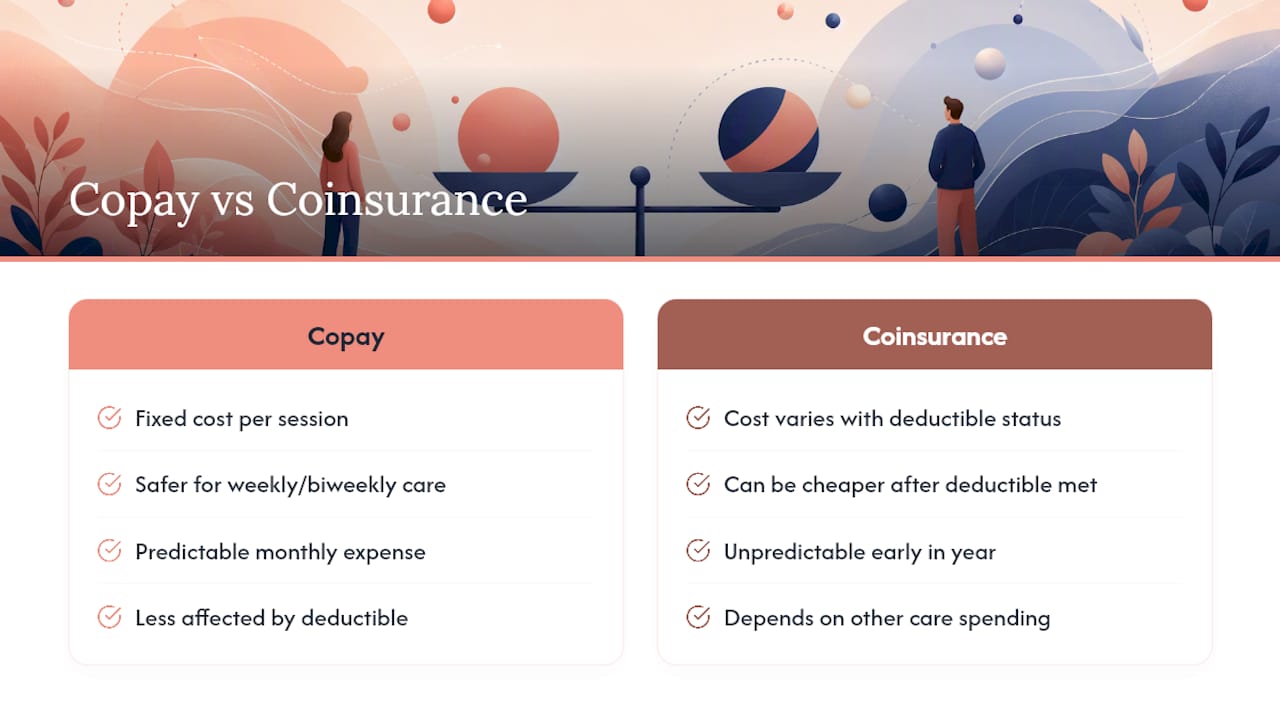
Where conventional advice falls short is in treating coinsurance as simply "worse." It isn't, if you've already cleared your deductible through other care that year, coinsurance can end up cheaper per session than a copay. The mistake is assuming your plan behaves consistently across the calendar year.
Prioritize this first: find out exactly where you stand on your deductible before you book anything. That single number, more than the copay or coinsurance label itself, determines what your next several sessions will actually cost you.
— Dakota
This article is general information, not a substitute for advice from a qualified doctor. Consult a qualified healthcare professional about your own circumstances before acting on anything here.
Sources
- Healthcare
- Copayment vs. coinsurance: What's the difference? | Medical News Today
- Mental Health Parity | Centers for Medicare & Medicaid Services (CMS)