

Choose a therapist by matching their licensure, evidence-based approach, and personal fit to your specific goals. The ABCT recommends verifying all three before booking a first session.
Start here, within the next hour:
- Identify your primary concern (anxiety, depression, trauma, relationship issues, burnout) and write it down in one sentence.
- Confirm the clinician holds an active state license before anything else.
- Ask whether they use evidence-based treatments for your specific concern.
- Check insurance coverage or ask about sliding-scale fees.
- Book a 15-minute consultation call to assess fit before committing to a full session.
That five-step screen eliminates most mismatches before you spend time or money on a session that goes nowhere.
Key Takeaways
Choosing the right therapist comes down to three non-negotiable factors: confirmed licensure, an evidence-based approach matched to your concern, and a working relationship you can trust.
| Point | Details |
|---|---|
| Verify licensure first | Confirm an active state license before booking; it is the baseline quality signal. |
| Match approach to your concern | Ask whether the clinician uses evidence-based treatments for your specific diagnosis or goal. |
| Assess fit over 3 to 6 sessions | The therapeutic alliance predicts outcomes; give it enough time, but switch if red flags appear. |
| Clarify costs before session one | Confirm in-network status, session limits, and telehealth coverage with your insurer upfront. |
| Kin-wellness for intensive or specialized needs | Kin-wellness offers virtual outpatient, IOP, EMDR, and medication management for adults in California. |
Table of Contents
- What type of clinician do you actually need?
- Which therapy approach fits your goals?
- Where to find a licensed therapist you can trust
- What to ask before you book a first session
- How do you know if a therapist is actually working for you?
- What will therapy actually cost, and what should you verify?
- When do you need more than weekly outpatient therapy?
- How to prepare for your first session
- The part of therapist selection most guides get wrong
- Kin-wellness offers a direct path to the right level of care
- Sources
What type of clinician do you actually need?
The credential on a therapist's door tells you more than you might expect. It signals what they can do, what they cannot do, and whether they are the right starting point for your situation.
| Clinician type | Common credentials | What they provide | Best fit |
|---|---|---|---|
| Psychologist | PhD, PsyD | Therapy, psychological testing, assessment | Complex diagnosis, testing needs, trauma |
| Psychiatrist | MD, DO | Medication management, diagnosis (limited therapy) | Medication evaluation, treatment-resistant conditions |
| Licensed clinical social worker | LCSW | Therapy, case management, advocacy | Life stressors, family issues, access to community resources |
| Licensed professional counselor / marriage and family therapist | LPC, LMFT | Individual, couples, and family therapy | Relationship issues, life transitions, general mental health |
| Psychiatric mental health nurse practitioner | PMHNP | Medication management, some therapy | Medication needs with nursing-model care |
State licensing matters because it means the clinician has met a minimum standard of training, passed a board exam, and is accountable to a regulatory body that can investigate complaints. A license is not a guarantee of quality, but its absence is a clear disqualifier.
Pro Tip: If you need both therapy and medication, you do not have to choose between a prescriber and a therapist. Team-based care, where a therapist and a prescriber coordinate on your treatment, is common and often more effective than either alone. Ask any prospective provider whether they collaborate with prescribers or can refer you to one.
Which therapy approach fits your goals?
Therapy is not a single method. Clinicians often integrate techniques, and the NIMH confirms that multiple psychotherapy types are evidence-based for conditions like depression and anxiety. Knowing the major approaches helps you ask sharper questions.
- Cognitive Behavioral Therapy (CBT): Targets the link between thoughts, feelings, and behaviors. Strong evidence for depression, anxiety disorders, OCD, and insomnia. Sessions often include structured homework.
- Acceptance and Commitment Therapy (ACT): Builds psychological flexibility by helping you accept difficult thoughts rather than fight them. Useful for chronic pain, anxiety, and burnout.
- Eye Movement Desensitization and Reprocessing (EMDR): A trauma-focused approach that uses bilateral stimulation to reprocess distressing memories. Look for EMDR Institute-trained or EMDRIA-certified clinicians for trauma work. Kin-wellness offers EMDR in-person and via telehealth.
- Dialectical Behavior Therapy (DBT): Combines CBT with mindfulness and distress-tolerance skills. Developed for borderline personality disorder; also used for self-harm, eating disorders, and intense emotional dysregulation.
- Psychodynamic therapy: Explores how past experiences and unconscious patterns shape current behavior. Suited for long-standing relationship difficulties, identity concerns, and chronic low mood.
- Couples and family therapy: Addresses relational dynamics rather than individual pathology. Useful for communication breakdowns, parenting conflicts, and major life transitions.
For conditions like PTSD, OCD, or eating disorders, specialized training matters. Ask directly whether the clinician has completed additional certification or supervision hours in the approach they are recommending for you.
Where to find a licensed therapist you can trust
The source you use to find a therapist shapes the quality of the match. Some directories verify licensure; others do not.
- APA Psychologist Locator: Searches licensed psychologists by location, specialty, and insurance. Maintained by the American Psychological Association, so listings are vetted.
- ABCT Find a CBT Therapist: The Association for Behavioral and Cognitive Therapies directory lists clinicians who have self-identified as CBT-trained. Useful when you specifically want a cognitive-behavioral approach.
- Psychology Today therapist directory: Large, searchable database with filters for insurance, telehealth, specialty, and identity. Profiles are self-reported, so still verify the license independently.
- SAMHSA treatment locator: The Substance Abuse and Mental Health Services Administration's Findtreatment is the right starting point when substance use, crisis services, or lower-cost community mental health centers are part of the picture.
- NAMI resources: The National Alliance on Mental Illness HelpLine and state affiliates can point you toward local providers and peer support, especially for serious mental illness.
- Referrals from your primary care provider or EAP: A PCP who knows your history can make a targeted referral. An Employee Assistance Program often provides a set number of free sessions and a curated list of in-network providers.
When reviewing any profile, filter by insurance acceptance, telehealth availability, and cultural competence. A clinician who does not speak your language or has no experience with your cultural background is a practical mismatch regardless of their credentials.
What to ask before you book a first session
A short phone call before the first appointment saves hours of wasted time. Here is a simple script to open the conversation:
"Hi, I'm looking for a therapist who works with [your concern]. I have a few quick questions before scheduling. Is now a good time?"
Then work through this list in order of priority:
- Are you currently licensed in [your state], and what is your license number?
- Do you use evidence-based treatments for [your specific concern]?
- What is your primary therapeutic approach, and how does it apply to my situation?
- Do you have experience working with [your population or diagnosis]?
- Do you accept [your insurance], and what will my out-of-pocket cost be per session?
- Do you offer telehealth, in-person, or both?
- What is your cancellation policy, and how do you handle between-session crises?
Keep a simple notes document with one row per clinician: name, license number, approach, cost, and your gut impression from the call. Zocdoc's guidance recommends comparing credentials, specialties, and availability side by side before deciding.
Pro Tip: Ask about session frequency and expected treatment length upfront. CBT for a specific phobia might run 12 sessions; psychodynamic work for long-standing patterns can extend over years. Knowing the timeline helps you plan financially and logistically.
How do you know if a therapist is actually working for you?
The therapeutic alliance, the quality of the working relationship between you and your therapist, is one of the strongest predictors of good outcomes in psychotherapy. NAMI is direct about this: the alliance is foundational, and it is normal to try more than one provider before finding someone you genuinely trust.
Give a new therapist several sessions to evaluate progress before drawing a firm conclusion. That window is long enough to move past first-session nerves and short enough to avoid months of unproductive work. If a safety concern arises, do not wait.
Red flags that warrant switching sooner:
- The therapist makes dismissive or judgmental comments about your experiences.
- They disclose personal information in ways that shift the focus to themselves.
- They are unclear about confidentiality limits or seem to minimize them.
- Sessions are frequently canceled or rescheduled at short notice.
- You feel worse after most sessions with no explanation of why that might be part of the process.
Switching therapists is not a failure. It is a clinical decision. A good therapist will support the transition and, if asked, provide a referral or a brief summary to help the next provider get up to speed quickly.
Changing providers is straightforward: you can simply tell your current therapist you are ending treatment, or send a brief written notice. You are not obligated to explain your reasons.
What will therapy actually cost, and what should you verify?
Cost surprises are one of the most common reasons people drop out of therapy early. Verify the financial picture before the first session, not after.
Insurance questions to ask your carrier directly:
- Is this provider in-network, and what is my copay or coinsurance per session?
- Does my plan require prior authorization for mental health services?
- How many outpatient therapy sessions does my plan cover per year?
- Does my plan cover telehealth therapy at the same rate as in-person?
- If I use an out-of-network provider, what is my reimbursement rate, and do I need a superbill?
Out-of-network coverage can still offset a significant portion of cost. A guide on out-of-network reimbursement walks through how to file for benefits and what documentation your insurer typically requires.
Other cost considerations:
- Sliding-scale fees are common among private-practice therapists and community mental health centers; ask directly whether a reduced rate is available based on income.
- Medication management visits with a psychiatrist or PMHNP are typically billed separately from therapy sessions and often at a higher rate.
- Telehealth sessions are generally billed at the same rate as in-person under most major plans, but confirm this with your insurer since coverage rules vary by state and plan type.
For a detailed comparison of how major California insurers handle virtual therapy coverage, the differences in prior authorization requirements and session limits are worth reviewing before you choose a plan or provider.
When do you need more than weekly outpatient therapy?
Standard weekly therapy is the right fit for most people. But certain situations call for a higher level of care, and recognizing those signs early prevents a slow deterioration that becomes harder to treat.
Signs that intensive or specialized care may be appropriate:
- Active safety concerns, including thoughts of self-harm or suicide that feel difficult to manage between sessions.
- Severe functional impairment, such as inability to work, maintain basic self-care, or sustain relationships.
- A condition that has not responded to multiple courses of outpatient therapy or medication.
- A need for structured daily or weekly programming to build skills that weekly sessions cannot provide at the right pace.
- Co-occurring substance use that requires coordinated medical and behavioral treatment.
Intensive outpatient programs (IOP) offer structured group and individual treatment several days per week while allowing you to stay in your home and maintain work or family responsibilities. An IOP schedule typically runs 9 to 15 hours per week, making it a practical option for working professionals who cannot step away for residential care.
Pro Tip: If you are a working professional, parent, executive, or healthcare worker experiencing burnout alongside a clinical condition, the combination often requires a clinician with specific experience in occupational mental health, not just general therapy. Matching specialty to situation matters here more than in most cases.

Kin-wellness provides virtual outpatient and intensive outpatient services for adults in California, including individual therapy, group therapy, family therapy, EMDR, and medication management. Services are available through private insurance or direct pay. If you are unsure whether your situation calls for outpatient or IOP-level care, a brief intake call can clarify the right level.
How to prepare for your first session
Arriving prepared makes the first session more productive and reduces the anxiety of not knowing what to expect.
Bring or have ready:
- A one or two sentence description of your primary concern and what you want to be different.
- A list of current medications, including dosages.
- Relevant history: prior therapy, hospitalizations, major life events that feel connected to your concern.
- Your insurance card and a photo ID.
- An emergency contact name and number.
- Your preferred method of communication between sessions.
One safety note: therapists are legally required to break confidentiality in specific circumstances, including imminent risk of harm to yourself or others and suspected child or elder abuse. This is not a reason to withhold information; it is a standard limit that your therapist should explain at the start of treatment.
For telehealth sessions, test your audio and video connection before the appointment, find a private space where you will not be overheard, and have a backup plan (phone call) if the connection drops.
Pro Tip: Write down two or three specific goals before the first session. "I want to stop avoiding social situations" is more useful to a therapist than "I want to feel better." Specific goals help the clinician propose a treatment approach and give you both a way to measure progress.
The part of therapist selection most guides get wrong
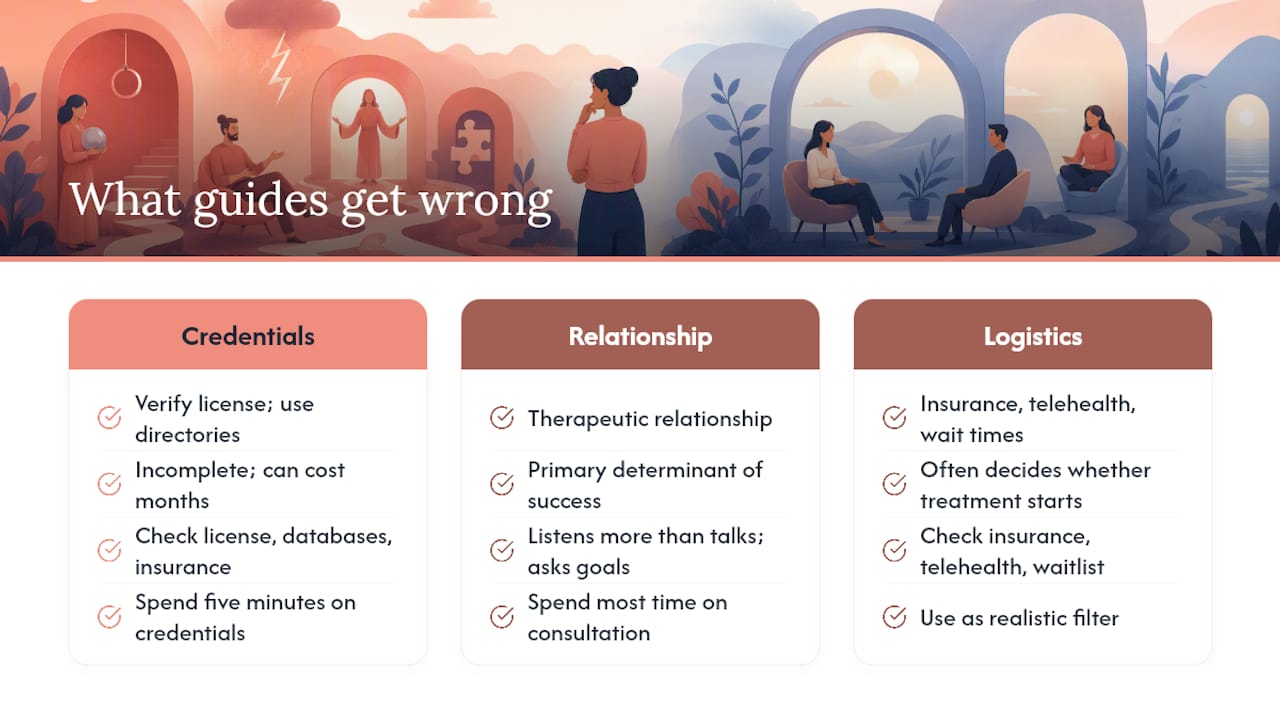
Most advice on finding a therapist focuses almost entirely on credentials and directories. Verify the license, use the right database, check insurance. That advice is not wrong, it is just incomplete in a way that costs people months of wasted effort.
The part that actually determines whether therapy works is the relationship. Healthline's practical guide puts the therapist-client bond at the center of its recommendations, and clinical bodies consistently back that up. A technically qualified therapist who makes you feel judged or unheard will produce worse outcomes than a slightly less decorated one who earns your trust.
The conventional wisdom also underweights logistics. Insurance status, telehealth availability, and wait times are treated as secondary concerns when they are often the deciding factor in whether someone actually starts and stays in treatment. A clinician who is a perfect clinical match but has a six-week waitlist and does not take your insurance is not a realistic option for most people.
What I would tell anyone starting this process: spend five minutes on credentials, then spend the rest of your energy on the consultation call. Notice whether the therapist listens more than they talk, whether they ask about your goals rather than immediately prescribing a method, and whether you leave the call feeling slightly more hopeful than when you started. That feeling is data.
Kin-wellness offers a direct path to the right level of care
Most adults searching for a therapist are weighing the same tradeoffs: finding someone qualified, getting an appointment within a reasonable timeframe, and making the finances work. Kin-wellness removes several of those friction points at once.

Kin-wellness provides virtual outpatient and intensive outpatient mental health services for adults in California, built specifically for working professionals, parents, executives, and healthcare workers who need clinical-grade care without putting their lives on hold. Services include individual therapy, group therapy, family therapy, EMDR (in-person and telehealth), and medication management, all with insurance billing support for PPO and HMO plans. If you have been circling the question of whether weekly therapy is enough or whether you need something more structured, an intake conversation will give you a clear answer fast.
Explore Kin-wellness services or visit Kin-wellness to check availability and book a consultation.
This article is general information, not a substitute for advice from a qualified doctor. Consult a qualified healthcare professional about your own circumstances before acting on anything here.
Sources
- Guidelines for Choosing a Therapist | Fact Sheet - ABCT
- How can I find a therapist who is a good fit for me? - NAMI HelpLine
- How Do I Find a Good Therapist? - APA
- Psychotherapies - NIMH
- How to Choose a Therapist | Zocdoc