
If your health plan includes out-of-network benefits, you can usually get reimbursed for care from providers outside your insurer's network. The amount you recover depends on your plan's allowed amount, your deductible, and your coinsurance percentage — and you will almost always owe something out of pocket beyond what the insurer pays.
Here is where to start:
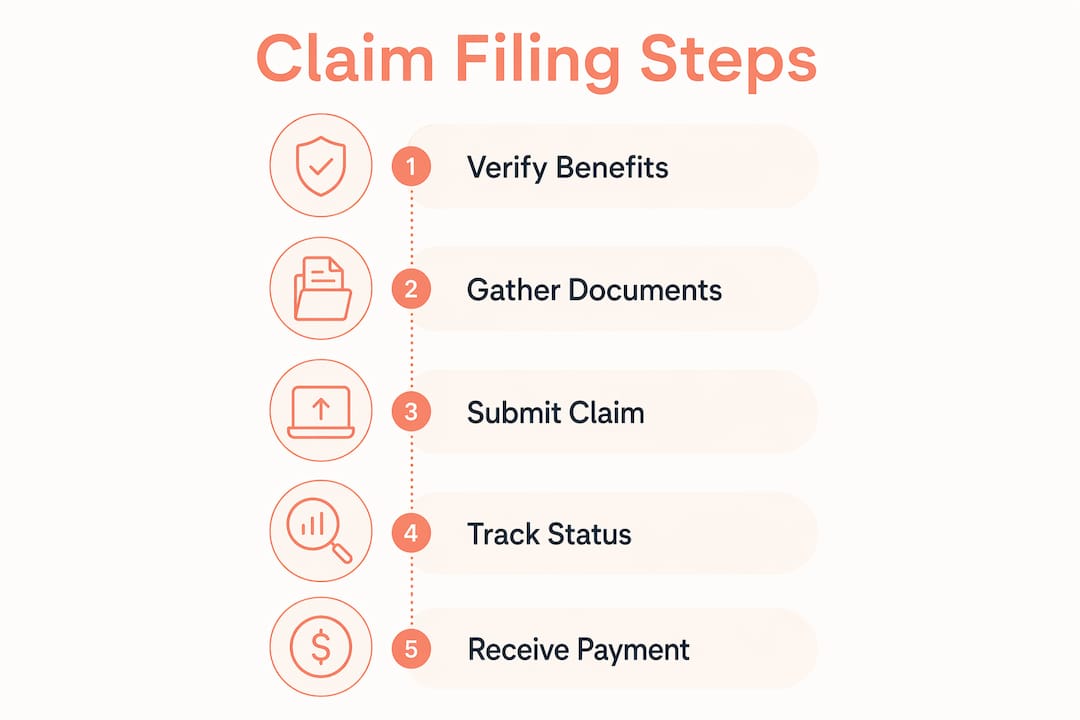
- Verify your OON benefits by calling the member services number on your insurance card before your appointment.
- Get a superbill from your provider (or ask them to submit the claim directly), and attach any receipts.
- Save your Explanation of Benefits (EOB) once the insurer processes the claim — it shows exactly what was paid and what you still owe.
One cost expectation to set now: reimbursement for out-of-network services is based on the insurer's allowed amount, not what your provider actually charged. The gap between those two numbers is your balance bill, and you are responsible for it.
Table of Contents
- 1. How out-of-network reimbursement actually works
- 2. Check your plan's out-of-network benefits before you schedule
- 3. Two ways to file a non-network claim — and how to choose
- 4. What to include with a claim or superbill
- 5. How insurers calculate what they pay — and what you still owe
- 6. How long reimbursement takes and how to track a claim
- 7. If a claim is denied — common reasons and how to appeal
- 8. Apps and billing platforms that reduce the paperwork
- 9. Legal protections you need to know about
- Key Takeaways
- What the billing process looks like from a clinic's perspective
- Kin-wellness makes the insurance side of therapy less complicated
- Authoritative sources and where to read more
1. How out-of-network reimbursement actually works
When a provider is in-network, they have a contract with your insurer that sets pre-negotiated rates. Out-of-network providers have no such deal, which means higher costs and a different payment flow.
The typical path looks like this: you pay the provider at the time of service, then file a claim with your insurer, and the insurer reimburses you directly. Less commonly, a provider will bill the insurer on your behalf — this is called assignment of benefits — and the insurer pays the provider directly, leaving you responsible only for your share.
Reimbursement for out-of-network care is not automatic. You typically pay the provider up front, file a claim using a superbill, and wait for the insurer to process it. The insurer then reimburses you — not the provider — unless assignment of benefits has been arranged. Payment arrives as a mailed check or electronic deposit, and choosing electronic delivery can cut the wait by several days.
The key distinction from in-network care: in-network providers bill your insurer directly and you pay only your cost-share at the visit. With out-of-network care, you are the one chasing the reimbursement.

2. Check your plan's out-of-network benefits before you schedule
Calling your insurer before care is the single step most people skip — and the one that prevents the most expensive surprises. Pull up the member services number on your insurance card and ask these questions:
- Does my plan include any out-of-network benefits, or is coverage limited to emergencies only?
- Is there a separate out-of-network deductible, and how much of it have I met?
- What coinsurance percentage applies to out-of-network services after the deductible?
- How does the plan define the allowed or UCR (usual, customary, and reasonable) amount for the specific CPT codes I need?
- Does this service require prior authorization from an out-of-network provider?
- What is the claim submission deadline after the date of service?
Ask the representative for a reference number for the call and request written confirmation of your benefits by mail or through the member portal. That document becomes your evidence if the insurer later disputes coverage.
Pro Tip: Ask specifically, "What is the out-of-network allowed amount for CPT code [your code]?" Insurers are required to provide this estimate, and it lets you calculate your likely out-of-pocket cost before you ever walk into the office.
Many plans require a separate, often higher, out-of-network deductible before the insurer pays anything. Knowing that number upfront prevents the shock of a full-cost EOB on your first claim.
3. Two ways to file a non-network claim — and how to choose
There are two practical workflows for submitting an out-of-network claim. Which one you use depends on whether your provider is willing to help and whether you want to manage the paperwork yourself.
Workflow A: You file with a superbill (DIY)
- Request an itemized superbill from your provider at or after the appointment.
- Download your insurer's claim form from the member portal or by calling member services.
- Transfer the superbill details onto the claim form (patient info, provider NPI, CPT codes, ICD-10 codes, dates, charges).
- Attach the superbill, any receipts, and — for behavioral health or complex outpatient services — clinical notes if your insurer requires them.
- Submit via the member portal (faster) or by mail to the address on the claim form.
- Note the submission date and confirmation number.
Workflow B: Provider or billing app submits on your behalf
- Ask your provider if they will file the claim directly or assign benefits to you.
- If using a billing app like Reimbursify, create an account, photograph the superbill, and follow the in-app submission steps.
- Confirm the claim was received by the insurer (the app or provider should provide a confirmation).
- Monitor the claim status through your insurer's member portal.
Coordination of benefits note: If you carry two insurance policies, list both on the claim form. The primary insurer processes the claim first; the secondary insurer covers some or all of the remaining balance. Failing to disclose dual coverage can delay or void reimbursement.
| Factor | Workflow A (DIY superbill) | Workflow B (provider/app submits) |
|---|---|---|
| Speed | Moderate (depends on mail vs. portal) | Often faster — app submissions are electronic |
| Control | High — you track every step | Lower — you depend on provider or app accuracy |
| Cost | Free | Apps may charge a fee per claim; providers may charge an admin fee |
| Error risk | Higher if you misread codes | Lower if provider knows billing; higher if app auto-fills incorrectly |
| Best for | Patients comfortable with paperwork | Patients who want less administrative work |

Pro Tip: If your claim involves multiple sessions or a complex diagnosis, consider a clinic billing specialist or a paid claims service. The fee is often less than the reimbursement you would lose to a preventable denial.
4. What to include with a claim or superbill
A complete superbill is the difference between a clean approval and a denial that costs you weeks. Every field below must be present and accurate.
Required superbill fields:
- Patient full name and date of birth
- Patient insurance member ID and group number
- Provider full name and credentials
- Provider NPI (National Provider Identifier)
- Provider tax ID (EIN or SSN)
- Practice name, address, and phone number
- Date(s) of service
- CPT/HCPCS procedure code(s) for each service
- ICD-10 diagnosis code(s) matching the CPT codes
- Itemized charges per service
- Amount already paid by the patient
- Provider signature
Sample superbill entry for an outpatient therapy session:
Common errors that trigger denials — and the fix:
- Wrong date of birth: cross-check the superbill against your insurance card before submitting.
- Missing or mismatched NPI: verify the provider's NPI at the NPPES NPI Registry before attaching the superbill.
- CPT and ICD-10 codes that don't align: ask your provider to confirm the codes match the service rendered.
- No itemized charges: a lump-sum receipt is not sufficient; each service needs its own line.
A clean claim free of errors typically processes in 14–30 business days. Missing ICD-10 or CPT codes are among the most common causes of delays and denials.
5. How insurers calculate what they pay — and what you still owe
Insurers do not simply pay whatever your provider charges. They apply their own allowed amount, often called the UCR (usual, customary, and reasonable) rate, which reflects what providers in your geographic area typically charge for a specific procedure. Some plans use a percentage of the Medicare fee schedule instead.
Here is how the math works in practice:
Example calculation:
- Provider charge: $200
- Insurer's allowed/UCR amount: $130
- Your OON deductible remaining: $50
- Insurer coinsurance after deductible: 70% (insurer pays) / 30% (you pay)
Step 1: Apply deductible. You owe the first $50 of the $130 allowed amount. Step 2: Apply coinsurance to the remaining $80. Insurer pays $56 (70%); you pay $24 (30%). Step 3: Balance bill. The provider charged $200 but the insurer only recognizes $130. You owe the $70 difference directly to the provider.
Total patient responsibility: $50 + $24 + $70 = $144 out of pocket on a $200 session.
Out-of-network providers can legally charge more than the insurer deems usual and customary, and the patient is responsible for that excess. This is balance billing, and it is legal for voluntary out-of-network care.
Mental-health billing note: Therapy claims are processed using the same insurer rules for allowed amounts and UCR as other outpatient services. Do not assume your behavioral health claims receive different or more favorable treatment — check your plan's specific language for outpatient mental-health coverage.
You can estimate your out-of-pocket costs before treatment using the FAIR Health Consumer cost lookup tool, which shows UCR-based and Medicare-based reimbursement rates by procedure code and ZIP code.
6. How long reimbursement takes and how to track a claim
| Scenario | Typical timeline |
|---|---|
| Clean electronic submission (portal) | 14–30 business days |
| Clean paper/mail submission | 14–30 business days |
| Electronic fund transfer (EFT) payment | 2–5 business days after approval |
| Mailed check payment | 7–14 business days after approval |
Claim tracking checklist:
- Record your claim ID or confirmation number at submission.
- Save the insurer's member services phone number and your member ID.
- Log into the member portal every 7–10 business days to check claim status.
- Note the date, time, and representative name for every call you make.
- If the portal shows "pending" past 30 business days, call member services and ask for the specific reason for the delay.
Follow-up call script: "I'm calling to check on claim number [ID], submitted on [date] for services on [date of service]. Can you confirm receipt and tell me the current status? If it's pending review, what documentation is still needed?"
If the claim remains unresolved after 60 days, file a written complaint with your state insurance commissioner. Most states require insurers to process clean claims within a defined window, and a commissioner complaint often accelerates resolution.
7. If a claim is denied — common reasons and how to appeal
Most denials are fixable. Before you file a formal appeal, call member services with your claim number and ask for the specific denial reason. Many administrative denials resolve with a corrected superbill or a quick clarification call.
Common denial reasons and fastest fixes:
- Wrong CPT or ICD-10 code: Request a corrected superbill from your provider and resubmit.
- Missing prior authorization: Ask your provider to submit a retroactive authorization request with clinical notes.
- Non-covered service: Review your plan's Summary of Benefits and Coverage (SBC) to confirm the service is listed; if it should be covered, escalate to an appeal.
- Timely filing exceeded: Check your plan's filing deadline (often 90–365 days from date of service); if you missed it, request a waiver with documentation of extenuating circumstances.
- Medical necessity not established: Ask your provider to write a letter of medical necessity and attach clinical notes.
Step-by-step appeal process:
- Request the denial letter in writing if you have not received one.
- Correct any administrative errors and resubmit before filing a formal appeal — this is faster.
- If resubmission fails, file an internal appeal with your insurer within the deadline stated on the denial letter (typically 180 days).
- Attach: the original claim, the denial letter, a corrected superbill, clinical notes, and a brief cover letter explaining the error or the medical necessity.
- If the internal appeal is denied, request an external review through your state's independent review organization (IRO) or through the federal process administered by CMS.
- If the external review fails, file a complaint with your state insurance commissioner.
Sample appeal cover letter opening:
For emergency care and certain non-consensual out-of-network situations, the No Surprises Act created an Independent Dispute Resolution (IDR) process. Providers and insurers can use IDR to resolve payment disputes, and patients in those scenarios are protected from balance bills above in-network cost-sharing amounts.
8. Apps and billing platforms that reduce the paperwork
Filing a claim yourself is free but time-consuming. Several tools exist to reduce that burden.
Reimbursify is a patient-facing mobile app designed specifically for out-of-network claim submission. You photograph the superbill, enter your insurance details, and the app submits the claim electronically. It handles the claim form completion and tracks status on your behalf. Reimbursify charges a per-claim fee for submissions beyond its free tier.
SimplePractice is a practice management platform used by therapists and other outpatient providers. When your provider uses SimplePractice, they can generate a superbill directly from the session record and send it to you electronically, which reduces transcription errors on your end. SimplePractice does not submit claims on behalf of patients directly, but it makes the superbill generation process faster and more accurate for the provider.
Pros of using an app or billing service:
- Electronic submission is faster than mailing paper forms.
- Apps reduce manual data-entry errors on claim forms.
- Status tracking is centralized in one place.
Cons:
- Per-claim fees add up across multiple sessions.
- You hand over sensitive health data to a third-party platform — review the privacy policy before uploading.
- Apps cannot fix a denial that stems from a clinical documentation gap; you still need your provider's involvement.
Pro Tip: If your provider is on a platform like SimplePractice, ask them to email you a PDF superbill after every session. Store them in a dedicated folder so you always have clean documentation ready to submit or appeal.
Kin-wellness supports insured therapy clients with billing assistance, including superbill generation and guidance on submitting claims to PPO plans. For patients navigating mental health coverage for the first time, having a clinic that understands the billing side removes a significant barrier to care.
9. Legal protections you need to know about
The No Surprises Act took effect in January 2022 and bans balance billing for emergency services at out-of-network facilities and for certain non-consensual out-of-network care — situations where you did not choose the out-of-network provider (for example, an out-of-network anesthesiologist at an in-network hospital). In those cases, your cost share is capped at the in-network amount.
What the Act does NOT cover: voluntary choices to see an out-of-network provider. If you choose to see a therapist, psychiatrist, or specialist who is not in your network, balance billing protections generally do not apply.
Your appeal rights under federal law:
- You have the right to an internal appeal with your insurer.
- If the internal appeal is denied, you have the right to an external review by an independent organization.
- CMS administers the federal external review process for plans not subject to state law.
- File complaints with your state insurance commissioner if an insurer violates timely processing rules or denies a valid appeal.
Mental-health parity reminder: Federal parity law requires that insurers apply the same reimbursement rules to behavioral health services as to comparable medical services. If your plan reimburses 70% of UCR for an out-of-network orthopedic visit, it must apply the same percentage to an out-of-network therapy session. Check your plan's ACA mental-health coverage language if you suspect your behavioral health claims are being reimbursed at a lower rate than medical claims.
For ground ambulance transport, the No Surprises Act protections have notable gaps. Patients transported by ground ambulance to an out-of-network facility can still face significant balance billing exposure — a nuance worth knowing before an emergency.
This article is general information, not legal or financial advice. Confirm the current rules with your insurer, your state insurance commissioner, or a qualified benefits professional for your specific situation.
Key Takeaways
Out-of-network reimbursement requires verifying your benefits, submitting a complete superbill with correct CPT and ICD-10 codes, and tracking the claim through your insurer's portal — most clean claims process in 14–30 business days.
| Point | Details |
|---|---|
| Verify benefits first | Call member services before care to confirm OON coverage, deductible, and coinsurance. |
| Complete superbill required | Include CPT codes, ICD-10 codes, provider NPI, and itemized charges to avoid administrative denials. |
| Clean claims process usually takes a few weeks | Electronic portal submissions are faster than mailed paper claims. |
| Balance billing is your responsibility | You owe the gap between the provider's charge and the insurer's allowed amount on voluntary OON care. |
| Kin-wellness billing support | Kin-wellness assists insured therapy clients with superbill generation and PPO claim guidance in California. |
What the billing process looks like from a clinic's perspective
Most patients who come to Kin-wellness with insurance questions are not confused about their benefits — they are confused about the paperwork. The gap between "my plan covers out-of-network care" and "I actually received a reimbursement check" is where things fall apart, and it almost always comes down to one of three things: a missing code on the superbill, a deductible the patient did not know was separate for out-of-network services, or a claim that was submitted once and never followed up on.
At Kin-wellness, the billing team works with clients to generate accurate superbills after each session, explain what the EOB means when it arrives, and flag claims that need a corrected resubmission before they become formal denials. That kind of support matters most for clients using PPO plans to access intensive outpatient or individual therapy services, where the session volume makes billing errors expensive fast.
If you are working through a mental-health claim and the process feels stuck, the Kin-wellness billing team is a direct resource. Contact the clinic to ask about billing intake and what documents to bring.
Kin-wellness makes the insurance side of therapy less complicated
Filing out-of-network claims for mental-health care is not complicated once you know the steps — but it does take time, and one wrong code can delay reimbursement by weeks. Kin-wellness offers virtual outpatient mental-health services for adults in California, including individual therapy, group therapy, EMDR, and medication management, with built-in billing support for PPO and out-of-network insurance clients.

The clinic's billing team handles superbill generation, helps clients understand their EOBs, and guides them through resubmissions when a claim needs correction. You focus on the therapy. The paperwork has a process.
Ready to get started? Explore Kin-wellness services and ask about insurance billing support when you book your intake appointment. If you want to review specific therapy options first, the services page breaks down what is available and how billing works for each.
Authoritative sources and where to read more
- Washington State Office of the Insurance Commissioner — Plain-language guide to how health insurance claims work, including out-of-network filing steps and balance billing rules. Start here for state-level context.
- CMS — No Surprises Act and Independent Dispute Resolution — The federal government's official explanation of IDR, balance-billing protections, and which states use the federal process vs. their own.
- LegalClarity — Insurance Reimbursement Explained — Detailed walkthrough of the claims and appeals process, including common denial reasons and how to fix them.
- FAIR Health Consumer — Free tool to look up UCR and Medicare-based reimbursement rates by CPT code and ZIP code before your appointment.
- Child Mind Institute — Understanding Out-of-Network Benefits — Practical guide focused on behavioral health and therapy claims, including superbill basics and parity law context.
- Kin-wellness — California-based outpatient mental-health clinic with billing support for PPO and out-of-network therapy clients.
Always check your plan's Summary of Benefits and Coverage (SBC) first, and use your insurer's member portal to download the correct claim form and set up electronic payment preferences. Your plan documents are the authoritative source for your specific deductibles, coinsurance rates, and filing deadlines.