

Before your first therapy session, do three things: confirm your logistics, gather your documents, and spend five minutes writing down why you're going. That's it. Everything else is optional.
Quick pre-session checklist:
- Confirm the date, time, location, or telehealth link
- Have your insurance card and photo ID ready
- Write out your current medications with doses
- Pull any prior therapy or medical records you have access to
- Jot down your top two concerns and a one-sentence "why now"
- Write one or two questions you want to ask the therapist
- For telehealth: test your camera, mic, and link at least 10 minutes early
- For in-person: plan to arrive 10–15 minutes before your appointment
Pro Tip: If you're doing a telehealth session, put your phone on "Do Not Disturb," use headphones, and sit with your back to the door. It takes 90 seconds and makes the session feel more private.
Key Takeaways
Preparing for your first therapy session comes down to three things: handle the logistics, gather your documents, and spend five minutes getting clear on why you're going.
| Point | Details |
|---|---|
| Session length and structure | Most intakes run 45–60 minutes and focus on history, goals, and fit — not immediate treatment. |
| Documents to bring | Bring your insurance card, photo ID, medication list with doses, and any prior records you have. |
| Emotional prep | Use the 3-3-3 grounding technique before the session and write down your top two concerns. |
| Fit takes a few sessions | Evaluate fit on whether you felt heard and safe; most people need 2–4 sessions to decide. |
| Kin-wellness next step | Kin-wellness offers virtual outpatient therapy in California with insurance billing support and telehealth-ready clinicians. |
Table of Contents
- What actually happens during a first therapy intake?
- What should you bring to your first therapy appointment?
- How do you reduce anxiety before your first therapy session?
- How much should you share in the first session?
- What questions should you bring to your first therapy session?
- How do you know if the therapist is a good fit?
- What does the research say about first therapy sessions?
- One person's experience walking into a first session
- Kin-wellness makes your first session easier to schedule
- Sources
What actually happens during a first therapy intake?
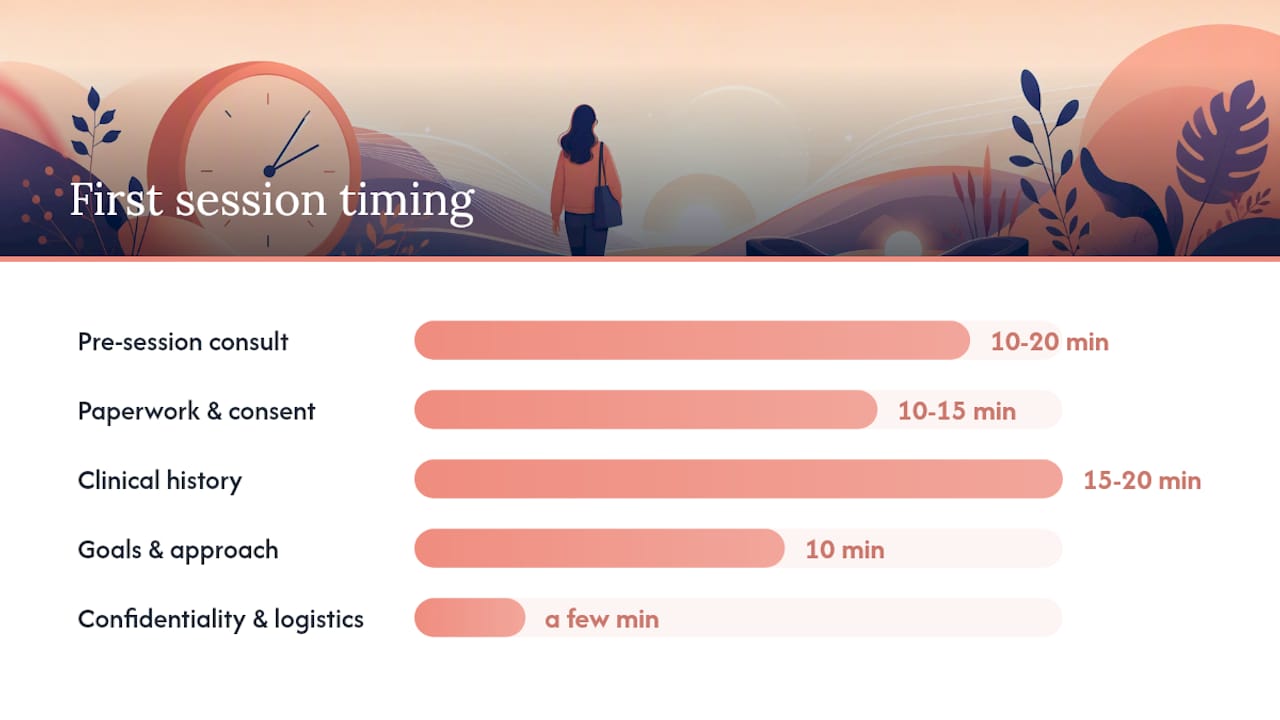
The first session is mostly information-gathering and a mutual fit-check, not treatment. Most intakes run 45–60 minutes, and some clinicians offer a 10–20 minute complimentary consultation call beforehand so you can ask basic questions before committing to a full appointment.
Here's how a typical intake flows:
| Stage | What happens | Approximate time |
|---|---|---|
| Pre-session consult call | Fit check, basic questions, scheduling | 10–20 minutes |
| Paperwork and consent | Intake forms, informed consent, HIPAA notice | 10–15 minutes |
| Confidentiality review | Therapist explains privacy limits and exceptions | a few minutes |
| Clinical history | Current symptoms, relevant background, medications | 15–20 minutes |
| Goals and approach | What you want from therapy; therapist explains their style | 10 minutes |
| Logistics and next steps | Session frequency, communication, follow-up scheduling | a few minutes |
One part that surprises many people is the confidentiality discussion. Your therapist is legally required to explain what stays private and what doesn't. Under federal HIPAA rules, your records are protected, but therapists must disclose information in specific legally mandated situations, including imminent risk of harm to yourself or others, and certain cases involving minors. This isn't a warning sign — it's a legal and ethical standard every licensed clinician follows.
Don't expect to leave the first session with a treatment plan or a diagnosis. The goal is to start a working relationship, not to solve the problem in 60 minutes.
What should you bring to your first therapy appointment?
Gather your insurance card, photo ID, a current list of medications with doses, and any prior therapy or medical records you can access. That's the core of what your therapist needs to understand your history and bill your insurance correctly.
| Item | Why it matters | How to prepare it |
|---|---|---|
| Insurance card (front and back) | Needed for billing and verifying benefits | Screenshot both sides on your phone |
| Photo ID | Standard intake requirement | Driver's license or passport |
| Medication list (name, dose, frequency) | Informs clinical picture; avoids dangerous interactions | Export from pharmacy app or write it out |
| Prior therapy or medical records | Helps therapist understand your history faster | Request from previous provider or bring notes |
| Payment method | Copay or self-pay due at time of service | Check your plan's copay in advance |
| Intake forms | Often sent ahead via email or patient portal | Complete before the session, not in the waiting room |
For insurance, knowing your copay and whether your plan covers outpatient mental health before you walk in saves an awkward conversation at the front desk. If you're unsure about your benefits, a quick call to the member services number on the back of your card takes about five minutes. For more on how insurance works for virtual therapy in California, the Kaiser vs. Blue Shield comparison breaks down what to look for in your plan.
Telehealth-specific prep:
- Test your camera and microphone the day before, not five minutes before
- Join the session link 10 minutes early to troubleshoot any access issues
- Use headphones to protect your privacy and reduce echo
- Sit in a room where you can close the door; a car works if home isn't private
- Have a backup plan (phone number to call in) if the video drops
Pro Tip: Screenshot your insurance card and save it to your phone's photos. If you forget the physical card, you'll still have everything the front desk needs.
How do you reduce anxiety before your first therapy session?
Practice one grounding technique and spend five minutes journaling before the session. Both reduce pre-session anxiety and help you walk in with something to say.

The 3-3-3 grounding technique is one of the simplest tools available: name three things you see, identify three sounds you hear, then move three parts of your body. It takes under two minutes and interrupts the anxiety loop that tends to spike right before a new appointment. Use it in the parking lot, in the waiting room, or right before you click "join" on a telehealth link.
For journaling, you don't need more than a few sentences. Try answering these three prompts:
- Why now? What made you decide to book this appointment at this point in your life?
- What are my top two concerns? Not an exhaustive list — just the two things you most want help with.
- What would be different if things improved? A simple sentence like "I'd feel less overwhelmed at work" or "I'd stop repeating the same argument with my partner" is enough.
These prompts come from a practical approach used in therapy preparation guides that help clients communicate goals clearly from the first session. You don't need to read your notes aloud — just having written them down makes it easier to find the words when the therapist asks.
On emotions: a wide range of feelings after the first session is completely normal. Some people feel relieved. Some feel drained. Some feel oddly detached, like nothing happened. None of those reactions mean the session went badly. The intake's purpose is to begin a collaborative process, not to produce an immediate emotional shift.
Pro Tip: Block 10 minutes after your session before your next obligation. A short walk or a few quiet minutes to decompress makes a real difference, especially if the session brought up something unexpected.
For more quick techniques to manage pre-session nerves, anxiety-reduction strategies that work in under five minutes can help you build a short ritual that fits your schedule.
How much should you share in the first session?
You never need to tell everything on day one. Be honest about what you're comfortable sharing, and your therapist will pace the questions from there.
Start with what's happening right now: your current symptoms, the main reason you booked, and any medications you're taking. Relevant history helps, but you don't need to reconstruct your entire life story. If a topic feels too raw to get into yet, you can say exactly that: "I'm not ready to talk about that today." A trained therapist will note it and move on without pressure.
A few practical rules of thumb:
- Lead with current problems, not backstory
- Mention medications, even if they seem unrelated
- Skip details you're not ready for — just say so
- You don't need a diagnosis or a polished explanation to start
Some common myths worth clearing up:
- Myth: "I need a diagnosis before I can go." Fact: Showing up is enough. Therapists help clarify what's going on over time.
- Myth: "I have to explain everything perfectly." Fact: "I feel stuck" is a complete and useful opening.
- Myth: "If I cry, I'll make things awkward." Fact: Therapists expect emotional responses and are trained to hold space for them.
- Myth: "I shouldn't bring up trauma in the first session." Fact: You can mention it exists without going into detail. Saying "there's some past trauma I'd like to work on eventually" is enough.
For sensitive topics like self-harm or suicidal thoughts, therapists are trained to respond safely and without judgment. Disclosing imminent risk does trigger a legal duty to act, but mentioning that something has happened in the past or that you've had certain thoughts does not automatically mean hospitalization. If you're unsure how to bring something up, trauma-informed care approaches explain how clinicians are trained to handle disclosure at the client's pace.
What questions should you bring to your first therapy session?
Bring 6–10 short questions covering the therapist's approach, logistics, and how they measure progress. Think of the first session as a two-way interview: you're evaluating fit just as much as they're gathering your history.
Therapeutic approach:
- What is your primary therapeutic orientation? (e.g., CBT, psychodynamic, EMDR)
- Have you worked with clients dealing with [your specific concern]?
- How do you typically structure sessions?
Logistics and communication:
- How often would you recommend we meet, at least initially?
- What's your policy on between-session contact if something comes up?
- Do you assign homework or exercises between sessions?
- What's your cancellation and rescheduling policy?
Fees and insurance:
- Do you accept my insurance, and what will my out-of-pocket cost be?
- Do you offer a sliding scale if my situation changes?
Goals and progress:
- How will we know if therapy is working?
- What does progress typically look like for someone with my concerns?
You don't need to ask all of these. Pick the three or four that matter most to you and write them on your phone before the session. Ask at the start if you want to set the tone, or at the end if you'd rather let the session unfold naturally first. Either approach works. The Caltech Wellness therapy preparation guide recommends treating the first session as a mutual assessment — your questions are part of that process, not an interruption.
How do you know if the therapist is a good fit?
Evaluate fit on whether you felt heard, understood, and safe. Most people need 2–4 sessions to make a confident call, but you'll usually have a strong gut signal after the first one.
Concrete signs the fit is working:
- The therapist explained their approach without being asked
- They invited your questions and answered them directly
- They set collaborative goals rather than telling you what your problem is
- You felt comfortable enough to be at least partially honest
Red flags worth paying attention to:
- They seemed rushed or distracted
- They dismissed something you said or minimized your concern
- They pushed a specific diagnosis or treatment before gathering enough history
- You felt judged rather than heard
After the first session, a typical next-steps conversation covers how often to meet (weekly is common at the start), whether there's any between-session work, and how to reach the therapist if something urgent comes up. Early therapeutic alliance — the sense that you and your therapist are working toward the same goal — is one of the strongest predictors of treatment success. Getting that foundation right matters more than finding a therapist with the most impressive credentials.
If the fit isn't right, asking for a referral is normal clinical practice. You can say: "I don't think this is the right match for me, but I'd appreciate a referral to someone who might be." Therapists hear this regularly and are professionally obligated to help you find appropriate care. Shopping for a therapist is not a failure — it's how the process is supposed to work.
For working professionals trying to fit sessions into a demanding schedule, the IOP scheduling guide covers how to build a treatment cadence that doesn't require blowing up your calendar.
What does the research say about first therapy sessions?
The first session is for assessment and alliance-building, not symptom relief. That's not a limitation — it's how effective therapy starts.
Research on therapy processes and outcomes consistently shows that between-session practice and active client engagement are associated with better results. The intake session is where that engagement begins: clients who arrive with a clear sense of what they want from therapy tend to build the working alliance faster.
Key finding: Therapeutic alliance established early in treatment is one of the strongest predictors of positive outcomes — more predictive, in many studies, than the specific therapeutic technique used.
A few evidence-backed points clinicians emphasize:
- Goal clarity matters early. Clients who articulate even a rough goal in the first session give the therapist something concrete to work with. "I want to feel less overwhelmed" is a workable starting point.
- Homework works. Between-session practice — journaling, tracking moods, practicing a coping skill — is associated with better outcomes across multiple therapy modalities.
- You don't need a diagnosis to start. Saying "I feel stuck" is a clinically useful opening. Therapists are trained to explore from there.
- Fit predicts engagement. Client readiness and early alliance predict whether someone stays in therapy long enough to benefit. Evaluating fit early isn't optional — it's part of the clinical process.
Clinicians also note that clients often underestimate how much the therapist is doing in that first session. While you're answering questions about your history, the therapist is simultaneously assessing your communication style, emotional regulation, and what kind of therapeutic relationship you might respond to. The intake is a clinical tool, not just a formality.
One person's experience walking into a first session
The morning of the appointment, I had my notes on my phone: two concerns, one question about approach, and the 3-3-3 exercise ready to use in the parking lot. I arrived 12 minutes early, which gave me time to fill out the intake form without rushing.
When the therapist asked what brought me in, I didn't have a perfect answer. I said something close to "I keep hitting the same wall and I'm not sure why." It wasn't polished. It didn't need to be. The therapist asked a follow-up question, and the conversation started from there.
I didn't feel dramatically better afterward. I felt a little tired, a little lighter, and mostly curious about what the next session would look like. That turned out to be exactly the right reaction — the first session opened a door; it didn't walk through it for me.
If you leave your first session without a breakthrough, that's not a sign it failed. It's a sign it worked the way it's supposed to. Give yourself a few sessions before you decide whether the fit is right, and give yourself permission to ask for a referral if it isn't.
Kin-wellness makes your first session easier to schedule
Getting to that first session is often the hardest part. Kin-wellness offers virtual outpatient mental health care for adults in California, including individual therapy, EMDR, medication management, and group therapy — all with insurance billing support built in so you're not navigating that alone.

The intake process at Kin-wellness is designed for working adults: telehealth-ready clinicians, flexible scheduling, and a team that helps you verify your insurance benefits before your first appointment. Whether you're a professional managing burnout, a parent stretched thin, or someone who's been putting this off for months, the path to a first session doesn't have to be complicated.
Explore Kin-wellness services to see what's available and how to book, or visit Kin-wellness to get started.
Sources
- Center for Cognitive Therapy — FAQ
- Preparing for a Therapy Appointment (Caltech Wellness PDF)
- HHS — HIPAA privacy laws and regulations
This article is general information, not a substitute for advice from a qualified doctor. Consult a qualified healthcare professional about your own circumstances before acting on anything here.