

A superbill is an itemized invoice your therapist gives you so you can bill your own insurance company for out-of-network reimbursement. Yes, it usually helps, but only if it has every required field and your plan actually offers out-of-network mental health benefits.
Before you request one, check that it will include:
- Your therapist's name, credentials, and National Provider Identifier (NPI)
- CPT code(s) for the session type and an ICD-10 diagnosis code
- Date of service, fee charged, and proof of payment
- Your full legal name and insurance member ID
Quick fact: insurer claim systems are largely automated, and a single wrong digit in an NPI or a mismatched patient name is one of the most common triggers for an instant, no-human-involved rejection.
Your next move: call the member services number on your insurance card, ask about your out-of-network mental health benefits, and confirm exactly how they want the superbill submitted.
Key Takeaways
A superbill only gets you reimbursed if every required field, especially the provider's NPI and matching CPT/ICD-10 codes, is accurate and submitted within your plan's filing window.
| Point | Details |
|---|---|
| Verify benefits first | Call member services before your first session to confirm out-of-network mental health coverage and submission method. |
| Request superbills promptly | Ask for documentation within 48 hours of each session so errors get caught while details are fresh. |
| Check the critical fields | Confirm NPI, patient name, CPT/ICD-10 codes, and telehealth modifiers before submitting anything. |
| Track every claim | Save confirmation numbers and check your EOB around the 30 to 45 day mark. |
| Get built-in billing support | Kin-wellness generates e-superbills from clinical records and reviews them for completeness before you submit. |
Table of Contents
- What a Superbill Is and When It's Used in Mental Health Care
- Do Therapists Have to Give You a Superbill?
- What Information Must Appear on a Superbill?
- How to Request a Superbill from Your Therapist
- Submitting a Superbill to Your Insurance Company
- What Reimbursement Amounts and Timelines Actually Look Like
- Why a Single Typo Can Sink Your Claim
- A Fast Checklist to Cut Rejection Risk
- How Kin-wellness Supports Clients Navigating Superbills
- How Kin-wellness Can Help With Your Superbill
- Where to Find Official Coding and Appeals Guidance
- Frequently Asked Questions
- Sources
What a Superbill Is and When It's Used in Mental Health Care
A superbill is not a bill you owe. It's a receipt-plus-coding-sheet, documenting the CPT and ICD-10 codes, dates, and fees for a session so your insurer can process it as an out-of-network claim, according to a standard overview of superbill formats. A regular receipt just proves you paid; a superbill proves what clinical service you paid for.
Therapists typically issue superbills in three situations: when they're out-of-network with your plan, when you're paying cash and want to try for partial reimbursement anyway, or when you're doing telehealth sessions with a provider licensed in your state but not contracted with your insurer.
A common example: you see a licensed therapist for weekly EMDR sessions, pay $180 per session out of pocket, and submit monthly superbills to your PPO plan for partial reimbursement against your out-of-network deductible.
Do Therapists Have to Give You a Superbill?
Most licensed mental health providers, including LPCs, LCSWs, psychologists, and psychiatrists, provide superbills as a routine part of out-of-network practice. No federal law requires every therapist to generate one, but declining to provide basic documentation of services you paid for is rare and usually a red flag about the practice's billing competence.
A few practical exceptions exist. Some group practices only issue superbills monthly rather than per session. Some newer or solo therapists may not have billing software set up yet and need a nudge on format.
- Ask at your very first session whether superbills are available and how often they're generated.
- Request the superbill in writing (email works) so there's a timestamp if delays happen.
- If a therapist seems unfamiliar with the term, ask specifically for "an itemized statement with CPT and ICD-10 codes and my provider's NPI."
Pro Tip: Ask for your superbill within 48 hours of each session while the visit details are fresh. Waiting until year-end to request twelve months of superbills at once is how errors and missing sessions slip through.
What Information Must Appear on a Superbill?
Insurers process thousands of these documents through automated systems, and missing even one field can bounce the whole claim. Here's what a complete superbill needs.
| Category | Required fields |
|---|---|
| Provider info | Name, license type, NPI, tax ID/EIN, practice address, phone number |
| Patient info | Full legal name (matching insurance card), date of birth, member ID |
| Service details | Date of service, CPT code(s), ICD-10 diagnosis code(s), fee charged, amount paid |
| Coding specifics | Place-of-service code, telehealth modifier if applicable, units or session minutes |
| Sign-off | Provider signature or electronic equivalent, date the superbill was prepared |
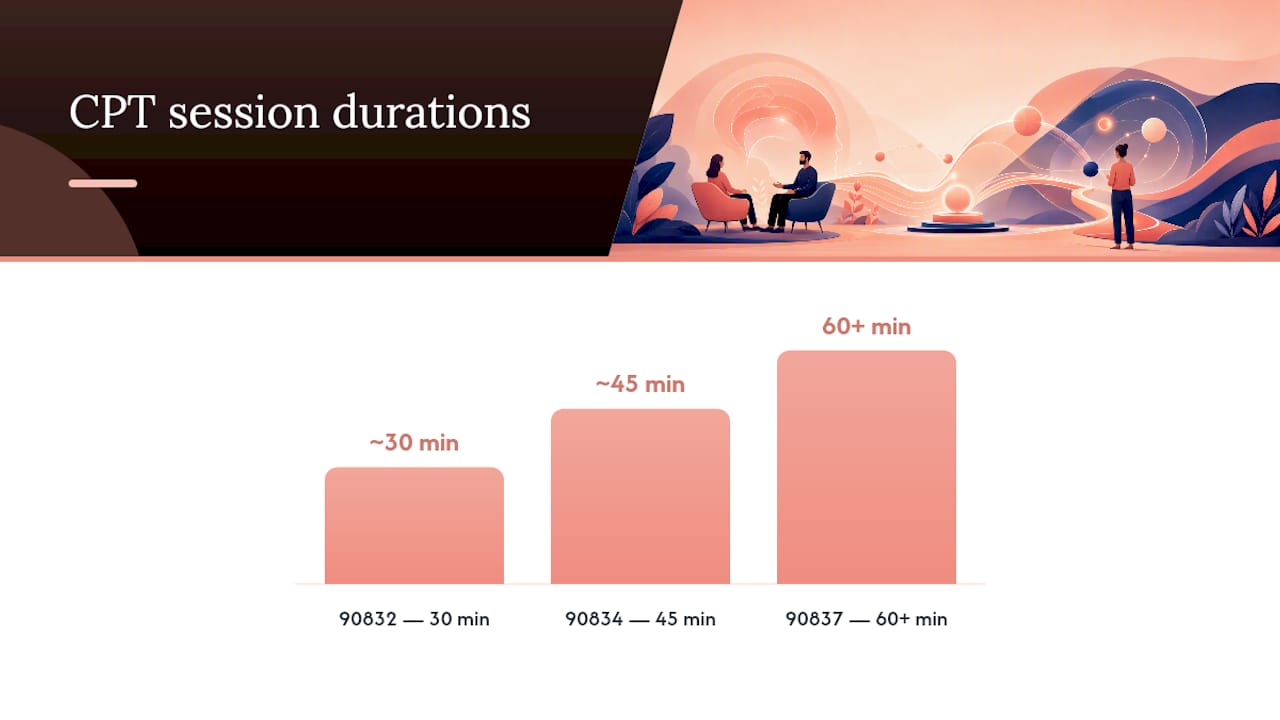
The CPT codes matter more than most patients realize. Standard psychotherapy sessions use time-based codes: 90832 for roughly 30 minutes, 90834 for around 45 minutes, and 90837 for 60 minutes or longer, per coding guidance from APA Services. Billing 90837 for a session that only ran 35 minutes is a documentation mismatch that can trigger a denial or an audit flag later.
Telehealth sessions need the correct place-of-service code, and often a modifier (commonly "95") indicating the session happened over video rather than in person. Skip that modifier and some plans will reject the claim outright, even if everything else is correct.
Diagnosis codes come from the ICD-10 system, and the AMA's CPT coding standards govern how procedure codes map to those diagnoses. If your superbill lists two CPT codes, it should also indicate which diagnosis code applies to which service, called a diagnosis pointer.
How to Request a Superbill from Your Therapist
Timing and clarity make this easy. Ask at intake whether superbills are automatic or something you have to request, and how often they're generated, per-session or monthly.
When you ask, confirm three things: the file format (PDF is standard), whether the practice submits claims for you or only hands you the document, and whether they can also provide proof of payment separately if your insurer requires it.
A simple script works fine: "Could you send me a superbill for my sessions this month, including your NPI, the CPT and diagnosis codes used, and confirmation of what I paid?"
- Request electronic delivery (e-superbill) over a printed copy when possible.
- E-superbills pulled directly from a practice's electronic health record system carry fewer transcription errors, since the codes flow straight from the chart instead of being retyped by hand.
- Keep a folder, digital or physical, of every superbill and payment receipt in case your insurer asks for backup documentation later.
Submitting a Superbill to Your Insurance Company
Filing the claim is a four-step process, and skipping the first step is the most common reason people waste weeks waiting on money that was never coming.
- Verify your benefits first. Call member services and ask specifically about out-of-network mental health coverage: your deductible, coinsurance percentage, and whether they accept superbills directly or require their own claim form alongside it.
- Gather your documents. You'll typically need the superbill itself, a completed claim form (often called a CMS-1500 or the insurer's own version) if your plan requires one, and proof of payment.
- Submit through the preferred channel. Most major insurers now offer a member portal for uploading claims, which is faster and gives you a digital confirmation number. Mail and fax are still accepted by many plans but take longer and offer no receipt unless you use certified mail.
- Track it. Save the confirmation number, and check your insurer's portal or your Explanation of Benefits after 30 to 45 days, the typical window most out-of-network claims take to process.
Pro Tip: If a claim hasn't shown up after five weeks, call and ask specifically: "Can you confirm the claim number, the date received, and whether any information is missing?" Have your superbill and confirmation number ready before you dial.
For a deeper walkthrough of the adjudication process itself, see this guide on filing out-of-network claims.
What Reimbursement Amounts and Timelines Actually Look Like
Reimbursement rarely means getting your full session fee back. Here's a realistic example: if your plan has a $500 out-of-network deductible and 70% coinsurance after that, your first few claims might apply entirely to the deductible with $0 paid out, and only later sessions get the 70% reimbursement on the plan's "allowed amount," which is often lower than what you actually paid your therapist.
Most claims resolve within 30 to 45 days, though some plans take longer during high-volume periods.
Common reasons claims bounce back, and quick fixes:
- Missing or incorrect NPI: ask your therapist to double-check the number against their official records.
- Patient name mismatch: your name on the superbill must match your insurance card exactly, including middle initials.
- Missing telehealth modifier: confirm your therapist added it if sessions were virtual.
- Late filing: many plans set a submission window of 90 to 365 days from the date of service, so don't let superbills pile up unsubmitted.
If a claim is denied, Healthcare outlines your right to a formal internal appeal. Include the original superbill, the EOB showing the denial reason, and a short letter explaining the correction, then follow your plan's stated appeal deadline, often 180 days from the denial date.
Why a Single Typo Can Sink Your Claim
Insurance claim systems screen submissions automatically before any person looks at them, which means a clerical error often causes rejection before a human reviewer ever sees the file. The CMS standard for the National Provider Identifier makes this number the primary way payers match a claim to a provider, so a transposed digit is enough to stop automated processing cold.
The fields that break claims most often aren't complicated ones. It's the NPI, the patient's legal name, and the ICD-10 to CPT match. Get those three exactly right and most other issues become fixable.
Quick fact: industry billing guidance identifies missing provider identifiers, name mismatches, and CPT-to-diagnosis mismatches as the leading causes of member-submitted superbills failing on first pass, per billing industry documentation.
A Fast Checklist to Cut Rejection Risk
Small mismatches cause most denials, so run through this before you submit anything.
- Confirm your name on the superbill matches your insurance card letter for letter.
- Double-check your member ID and group number against your card.
- Ask your therapist to verify their NPI, tax ID, and correct CPT/ICD-10 pairing before sending.
- Confirm the telehealth modifier and place-of-service code are included for virtual sessions.
- Submit through your insurer's online portal when available, and save the confirmation number.
Pro Tip: Take a photo of your insurance card front and back and keep it in the same folder as your superbills. Half of all mismatches trace back to an outdated or misremembered member ID.
How Kin-wellness Supports Clients Navigating Superbills
In our experience helping California clients use out-of-network benefits, the biggest obstacle isn't understanding superbills, it's getting one that's actually complete on the first try. We've seen claims bounce over a single missing modifier that took five minutes to fix once someone caught it.
Our clinical team generates e-superbills directly from session records, reviews them for completeness before they go out, and can walk clients through appeal language if a claim gets denied unfairly. If you want help with a superbill, just ask your care coordinator during your next visit.
How Kin-wellness Can Help With Your Superbill
Between verifying benefits, chasing down the right CPT code, and formatting a superbill your insurer won't kick back, out-of-network reimbursement can turn into a part-time job. Kin-wellness handles the documentation side so you're not troubleshooting a rejected claim alone.

Kin-wellness provides virtual outpatient therapy, medication management, and EMDR for adults across California, and every session comes with billing support built in: e-superbills generated directly from your clinical record, correct NPI and CPT/ICD-10 pairing, and guidance on submitting to your specific plan. We can't guarantee what your insurer will pay, no one honestly can, but we can guarantee the paperwork on our end is accurate and complete. If you're ready to start therapy or want to see how billing support works before booking, visit Kin Wellness to explore services and schedule an initial session.
Where to Find Official Coding and Appeals Guidance
For readers who want to verify coding details directly, a handful of official sources cover the specifics this article touches on.
- The CMS National Provider Identifier standard explains why provider identifiers must be exact.
- CMS place-of-service codes clarify telehealth coding requirements.
- The AMA's CPT code resources cover procedure code definitions used on every superbill.
- Healthcare walks through what to do after a denial.
- The IRS Form W-9 shows how providers document their tax ID, which sometimes appears on superbills.
Frequently Asked Questions
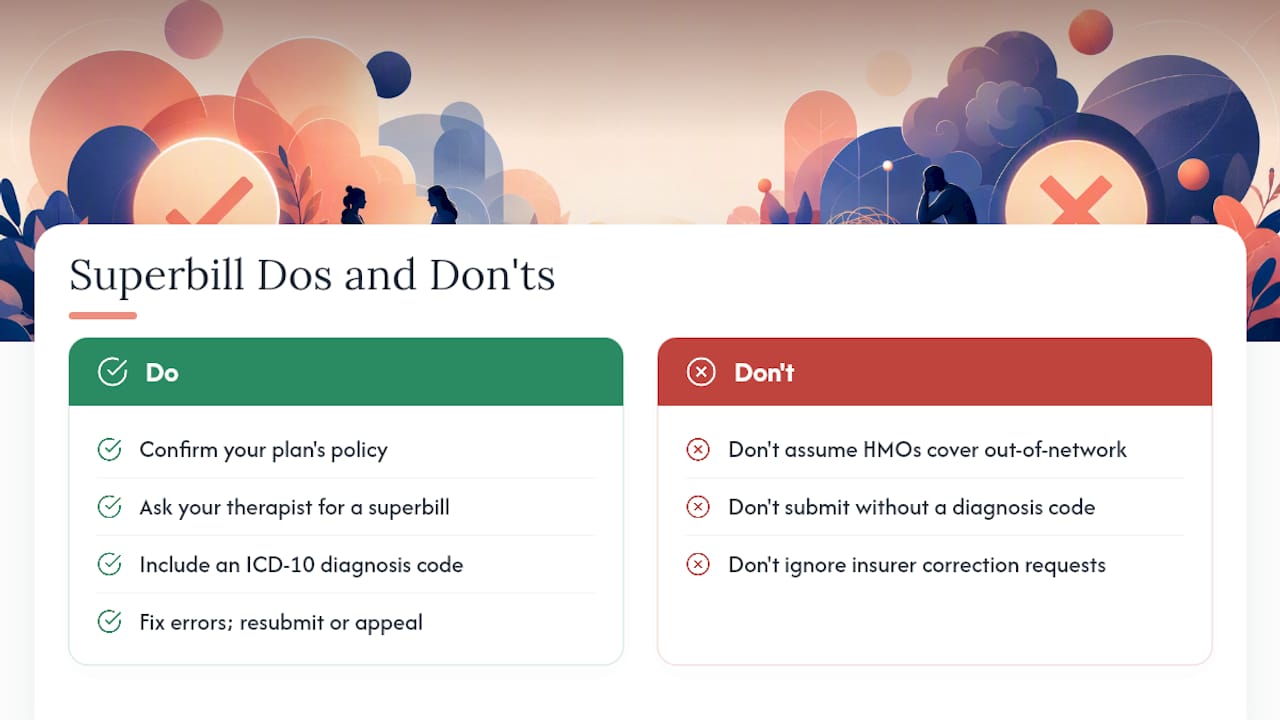
Do insurance companies actually accept superbills? Most PPO plans with out-of-network mental health benefits accept superbills, but HMO plans often don't cover out-of-network care at all. Always confirm your specific plan's policy before assuming reimbursement.
Do therapists legally have to provide a superbill? No federal law mandates it, but nearly all licensed therapists working with out-of-network or cash-pay clients provide one as standard practice when asked.
Does a superbill need a diagnosis code? Yes. An ICD-10 diagnosis code is required, and it must correspond correctly to the CPT procedure code billed for that session.
What's the difference between a superbill and an Explanation of Benefits? A superbill is the document you submit to start a claim. An Explanation of Benefits is what your insurer sends back after processing it, showing what they covered, what applied to your deductible, and what you still owe.
Can I use a superbill if I have in-network benefits instead? Superbills are built for out-of-network claims. If your therapist is in-network, your provider bills the insurer directly and you generally won't need one.
What if my superbill gets rejected for a small error? Fix the error with your therapist's help and resubmit, or file a formal appeal if the insurer denied it outright rather than requesting a correction. Keep your original documentation on hand either way.
This article is general information, not a substitute for advice from a qualified doctor. Consult a qualified healthcare professional about your own circumstances before acting on anything here.
Sources
- National Provider Identifier Standard (CMS)
- Place of Service code set (CMS)
- CPT codes (AMA)
- Healthcare
- Superbill - Wikipedia