

Therapy is legally provided wherever the client is sitting during the session, not wherever the clinician is licensed. That single rule determines whether you can legally see a client who has crossed a state line, and it means the burden of verification falls entirely on you before the session starts, not after.
Three pathways make cross-state practice lawful:
- Full licensure in the client's state, obtained through the standard application process for your profession.
- Interstate compact privilege, through PSYPACT, the Counseling Compact, or the Social Work Licensure Compact, if both your home state and the client's state participate.
- Telehealth-only registration or a temporary practice authorization, offered by some states as a lighter-weight alternative to full licensure.
If you're not certain which pathway applies to a specific client right now, pause the session and check before you proceed. According to Telehealth, providers typically must be authorized in the patient's state through one of these routes: full license, temporary practice law, reciprocity, compact membership, or telehealth registration. There is no blanket federal exception that lets you skip this step.
Key Takeaways
Cross-state teletherapy is governed by the client's physical location, and lawful practice requires matching that location to a valid license, compact privilege, or telehealth registration before every session.
| Point | Details |
|---|---|
| Location controls jurisdiction | The client's physical location during the session, not the clinician's, sets the legal authorization requirement. |
| Three lawful pathways exist | Full state licensure, interstate compact privilege (PSYPACT, Counseling Compact, Social Work Compact), or telehealth registration. |
| Emergency exceptions rarely apply | Most states do not extend emergency provisions to routine outpatient teletherapy, despite common assumptions. |
| Verification must be ongoing | Confirm client location and authorization status before each session, and keep dated documentation on file. |
| Kin-wellness models compliant operations | Kin-wellness runs its California outpatient and IOP programs on the same location-verification and documentation discipline this guide recommends. |
Table of Contents
- How Does Teletherapy Across State Lines Actually Work Legally?
- What Are the Authorization Pathways for Cross-State Practice?
- How Do State Rules Apply to Common Clinical Scenarios?
- What Should Be on Your Pre-Session Compliance Checklist?
- Where Can You Verify State-Specific Teletherapy Rules?
- What Do Billing and Prescribing Look Like Across State Lines?
- What Ethical and Continuity-of-Care Risks Come with Interstate Teletherapy?
- What Clinicians Get Wrong About Cross-State Teletherapy
- Get Compliance-Minded Care Without Managing It Yourself
- Frequently Asked Questions
- Sources
How Does Teletherapy Across State Lines Actually Work Legally?
The jurisdictional principle is simple to state and easy to violate by accident: the location of the client, not the clinician, sets the legal rules for that session. If your client opens their laptop from a hotel room in a state where you hold no license, no compact privilege, and no registration, you are practicing without authorization in that state, even if the session lasts five minutes and covers nothing more than a medication check-in.
This matters more than most clinicians assume, because licensing boards treat telehealth as an extension of in-person practice rather than a separate, more lenient category. Telehealth.HHS.gov confirms that the patient's physical location controls jurisdiction, and state boards have disciplined providers for treating this as a gray area.
States have not converged on one model. What you'll find, state by state, falls into a handful of recognizable patterns:
- Full independent licensure, requiring the same application, background check, and jurisprudence exam process as any in-state applicant.
- Compact reciprocity, available only if the client's state and your home state both belong to the same compact.
- Telehealth-only registration, a lighter credential that permits remote practice but usually bars you from opening a physical office in that state.
- Temporary or emergency practice windows, narrow exceptions tied to specific circumstances like natural disasters, not routine outpatient care.
Rural access gaps partly explain why the landscape stayed this fragmented. The Government Accountability Office has documented that states vary widely in how aggressively they've simplified cross-border telehealth, largely because rural communities have the most to gain from looser rules and the most political friction preventing them.
Two resources should sit in your bookmarks bar right now: telehealth.hhs.gov, which maintains a running summary of state-by-state licensure pathways, and the Center for Connected Health Policy, whose policy finder tracks telehealth-specific rules that general licensing pages sometimes miss.
What Are the Authorization Pathways for Cross-State Practice?
Each pathway carries its own eligibility rules, paperwork, and failure points. Here's what each actually demands.
Full state licensure
Full licensure remains the only option in states that don't participate in any relevant compact and don't offer a telehealth-specific registration for your profession. Expect a standard application, verification of your existing license and education, a jurisprudence exam in many states, and a processing timeline that can run anywhere from a few weeks to several months depending on the board's backlog.
Full licensure is also your only real option if you plan to build an ongoing, significant caseload in that state. Compacts and registrations work well for occasional or transitional care, but they're not designed to substitute for a genuine multi-state practice at scale. If more than a small fraction of your caseload lives in one particular state, get licensed there.
Interstate compacts: PSYPACT, Counseling Compact, and Social Work Compact
Three compacts now cover the bulk of licensed mental health disciplines:
- PSYPACT covers psychologists and requires an E.Passport or Authority to Practice Interjurisdictional Telepsychology (APIT) credential, layered on top of an active home-state license. According to PSYPACT's own guidance, providers must self-determine their eligibility before applying, and both credentials require ongoing maintenance rather than a one-time approval.
- The Counseling Compact extends similar privileges to licensed professional counselors, though participating states and specific eligibility rules differ from PSYPACT's.
- The Social Work Licensure Compact does the same for licensed clinical social workers, with its own separate list of member states.
None of these compacts function as a universal telehealth passport. Each one only helps you if both your home state and the client's state have joined that specific compact, and joining is not a "set it and forget it" credential. You still have to keep your home-state license active, renew your compact credential on schedule, and confirm that the specific service you're providing falls within that state's recognized scope of practice. PSYPACT's own eligibility framework is explicit that maintenance is ongoing, not a one-time gate.
Pro Tip: Check compact membership before you check anything else. A client relocating to a compact member state is a five-minute fix; a client relocating to a non-member state might mean referring them out entirely.
Telehealth-only registrations and temporary practice laws
A growing number of states let out-of-state clinicians register for telehealth-only practice without going through full licensure. These registrations typically require proof of professional liability insurance that specifically covers out-of-state telepractice and an explicit prohibition against opening any physical office in that state. The CCHP's cross-state licensing tracker documents that requirements and fee structures vary considerably from state to state, and a registration valid in one state tells you nothing about the next one over.
Temporary practice laws are narrower still. They often apply only to a defined window, sometimes tied to a client's temporary relocation, and they rarely function as a long-term substitute for a real credential. Treat a temporary authorization as a bridge to something more durable, not a permanent solution.
When to choose which pathway
If you have one or two clients scattered across states you don't expect to serve regularly, a telehealth registration or compact privilege (where available) is usually the lower-friction choice. If a state has neither a compact you belong to nor a telehealth registration for your profession, full licensure is your only lawful path, however slow. And if your practice is building toward a genuine multi-state presence, don't lean on registrations indefinitely. They're built for narrower use cases and the paperwork burden of maintaining several at once often exceeds what a single full license would cost you in the states where your caseload is concentrated.
How Do State Rules Apply to Common Clinical Scenarios?
Rules that look clear on paper get messy fast in real practice. Here's how the major scenarios actually play out.
A client traveling for a week or two. The client's physical location during the session controls jurisdiction, full stop, even for a short trip. A single check-in call while your client is on vacation in a state where you hold no authorization is technically an unauthorized session. Confirm the client's location verbally at the start of any session where travel is a possibility, and don't assume a client mentioning "I'm out of town" is giving you enough information. Ask which state.
A client relocating permanently. Some compacts and telehealth registrations offer continuity-of-care windows that let you keep treating a relocating client for a limited period while you sort out longer-term authorization. Where no such window exists, the responsible move is a documented transfer: help the client find a provider licensed in their new state, and keep a record showing you handled the transition appropriately rather than simply dropping care.

College students and seasonal residents. A student attending school in one state but claiming legal residency in another creates real ambiguity, and some states treat student status as a distinct factor separate from simple physical presence. Don't assume "the client's parents live in my state" solves the problem. The session location, not the billing address, is usually what a licensing board cares about.
Clients near a state border. Border-area practice tempts clinicians into complacency because the client is "basically local." Treat it exactly like any other cross-state situation: check the neighboring state's rules before you continue, and don't let geographic proximity substitute for actual verification.
Across every one of these scenarios, resist the instinct to lean on an emergency exception. Regulatory guidance from CCHP is consistent on this point: most states do not extend broad emergency exceptions to routine outpatient teletherapy, and assuming otherwise is one of the more common and consequential misunderstandings in this field. Emergency provisions are typically narrow, time-limited, and tied to declared disasters, not everyday scheduling conflicts.
What Should Be on Your Pre-Session Compliance Checklist?
A verification habit built into your intake workflow prevents almost every violation before it happens. Build these steps into your process rather than treating them as one-time research.
- Confirm the client's physical location verbally at the start of every session, not just at intake. Locations change, and assuming otherwise is how violations happen.
- Verify your authorization pathway for that specific state before the session, whether that's an active license, confirmed compact privilege, or current telehealth registration.
- Save documentation of that verification, including screenshots of the state board's licensure lookup tool or the compact's official eligibility page, dated and filed with the client's record.
- Confirm your malpractice policy explicitly covers interstate telepractice, and keep written confirmation from your insurer on file. Some policies quietly exclude out-of-state telehealth unless you request an endorsement.
- Build informed consent language specific to cross-state teletherapy into your intake paperwork, disclosing the authorization basis for treatment and what happens if the client relocates.
- Log any change in client location mid-treatment as a discrete, dated event in the clinical record, not a footnote.
- Write a clear internal policy for pausing care, covering what you do if a client's location falls outside your authorization and whether a referral, a temporary exception, or a hard pause is the right response.
Insurance is where clinicians most often assume coverage that isn't actually there. Registration requirements in many states explicitly demand proof of liability insurance covering out-of-state practice, according to Telehealth.HHS.gov, and a standard malpractice policy written for single-state practice doesn't automatically extend that coverage. Clinicians weighing insurance networks and coverage questions more broadly may find this comparison of major California insurers useful background on how payer relationships intersect with practice logistics.
Pro Tip: Keep a single running document, one row per state, listing your authorization type, expiration date, and the direct URL you used to verify it. Five minutes updating that sheet saves you from a scramble later.
The administrative weight of doing this correctly is heavier than it looks from the outside. Between annual registration fees, insurance endorsement costs, and the renewal tracking required to keep multiple compact credentials current, clinicians who serve clients in several states often underestimate how much ongoing administrative work that requires, a pattern Telehealth.HHS.gov's guidance implicitly acknowledges by listing fees and insurance proof as standard registration conditions rather than exceptions.
Where Can You Verify State-Specific Teletherapy Rules?
Checking a state's requirements should take minutes, not hours, once you know where to look.
Start with Telehealth for a federal-level orientation to cross-state pathways, then move to the CCHP policy finder for state-specific telehealth rules that general licensing summaries often leave out. From there, go directly to your profession's licensing board page in the target state and search specifically for "telehealth," "out-of-state," or "temporary practice," since these provisions are frequently buried outside the main licensing section. Finally, confirm compact participation directly on the compact's own site rather than relying on a secondhand list, since member states change.
- Check Telehealth for the federal overview of licensure pathways.
- Search the CCHP policy finder for state-specific telehealth registration and reciprocity rules.
- Confirm compact membership directly on PSYPACT's site, the Counseling Compact's site, or the Social Work Compact's site.
- Save your evidence: registration confirmation numbers, paid receipts, and a written insurer confirmation of out-of-state coverage.
Some states are intentionally restrictive about out-of-state telehealth for certain professions, and California is one clinicians frequently misjudge. The safer default when a state's page is ambiguous is to assume restriction until you find a specific registration or exception in writing, not the reverse.
Publisher and clinical operations perspective
This guidance reflects the operational reality of running a licensed outpatient program, not just a summary of statutes. Kin-wellness provides intensive outpatient and outpatient mental health services, including individual, group, and family therapy, EMDR, and medication management, for adults in California, and every clinician on staff works inside exactly the verification discipline this article describes. Confirming a client's physical location, checking authorization before every session, and keeping documentation current isn't theoretical for a program billing insurance across a caseload of working professionals, parents, and healthcare workers. It's a daily operational requirement.
Dakota, who authors Kin-wellness's clinical content including pieces like Therapy for Professionals: Manage Burnout and Protect Performance, covers this territory regularly because the compliance questions clinicians ask about interstate practice mirror the questions Kin-wellness's own clinical team answers internally. The practical takeaway for any clinician building or refining their own workflow: model your intake and session documentation on a program that already treats this as a non-negotiable operational layer, not an afterthought bolted onto existing paperwork. Kin-wellness's services illustrate what that looks like when it's built into a program from the ground up rather than added after a licensing complaint.
What Do Billing and Prescribing Look Like Across State Lines?
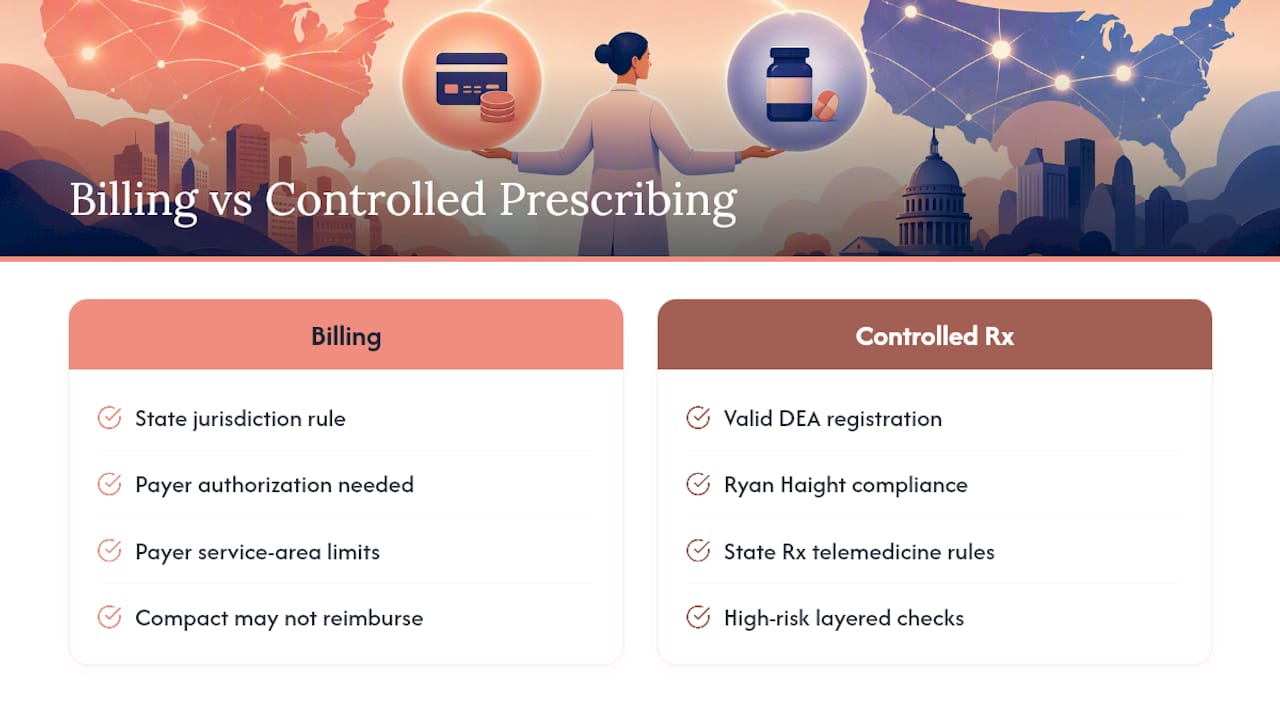
Insurance reimbursement follows the same jurisdictional logic as licensure, but payers add their own wrinkles on top of it. Most payers require the treating clinician to be authorized in the state where the client physically received care, meaning a session delivered without proper cross-state authorization risks denial even if your credentials are impeccable in your home state. Some payer contracts also restrict reimbursement to sessions rendered within a specific service area, regardless of your licensure status elsewhere, so a compact privilege that satisfies your licensing board might still leave you unreimbursed under a particular plan.
Controlled substance prescribing across state lines adds federal rules to an already layered picture. Prescribers must typically hold a valid DEA registration and comply with the Ryan Haight Act's requirements around remote prescribing, on top of whatever state medical or nursing board authorization applies to the client's location. Medication management delivered via telehealth across a state line is one of the higher-risk scenarios covered in this guide, precisely because it stacks licensing, DEA, and payer requirements on top of each other. A prescriber who has confirmed licensure in the client's state may still need to verify separately that their DEA registration and any state-specific telemedicine prescribing rules for controlled substances are satisfied before issuing a prescription remotely.
What Ethical and Continuity-of-Care Risks Come with Interstate Teletherapy?
Practicing without proper authorization is a licensing violation, but it's also an ethics violation under most professional codes, which generally require clinicians to practice within the bounds of their legal authority. A malpractice claim arising from unauthorized cross-state practice can be harder to defend, since your insurer may argue the policy never covered that jurisdiction in the first place, leaving you personally exposed regardless of the clinical care's quality.
Continuity of care suffers in its own way when cross-state rules force an abrupt referral. A client who relocates to a state where you have no pathway to follow them needs a genuine transition, not just a name and a phone number. Coordinating with the client's new local provider, sending records promptly, and documenting the handoff protects the client's continuity of care and protects you from a claim that you abandoned treatment. Data privacy adds another layer: HIPAA sets the federal floor, but several states layer additional protections on top of it for telehealth-specific data, meaning a platform and consent process compliant in your home state may not automatically satisfy a stricter state's requirements for the client's location.
What Clinicians Get Wrong About Cross-State Teletherapy
Most guidance on this topic treats interstate practice as a one-time compliance check: get the compact credential, check a box, move on. That framing undersells how often client circumstances change mid-treatment, and how rarely clinicians revisit authorization once a case is already open.
The bigger blind spot isn't licensure itself. It's the assumption that a compact credential or a telehealth registration is permanent once obtained. It isn't. Renewal dates lapse, member states change, and a client's relocation six months into treatment can silently invalidate an arrangement that was perfectly legal on day one. Clinicians should build location and authorization checks into ongoing treatment planning, not just intake.
The other overcorrection worth naming: some clinicians respond to this complexity by refusing any client who travels, which sacrifices continuity of care that a five-minute verification could have preserved. The goal isn't maximum caution. It's accurate, current verification, treated as routine as checking insurance eligibility.
Get Compliance-Minded Care Without Managing It Yourself
If you're a clinician trying to build these verification habits into a solo or small-group practice, the administrative load is real, and it only grows as your caseload spans more states. Kin-wellness takes a different approach for clients themselves: rather than a single therapist juggling licensure across jurisdictions, Kin-wellness operates as a licensed outpatient and intensive outpatient program built specifically for California adults, including working professionals, parents, executives, and healthcare workers, with therapists and prescribers who are already authorized where their clients live.

That structure matters if you're a clinician considering referring a client whose location no longer fits your own authorization, or if you're evaluating how a compliant multi-clinician practice actually operates day to day. Kin-wellness offers individual therapy, group therapy, family therapy, EMDR, and medication management, with insurance billing support built into intake rather than handled after the fact. Explore Kin-wellness's services to see how the program structures care for California clients, or visit the main Kin-wellness site to check current availability for a referral or consultation.
Frequently Asked Questions
Can therapists practice online across state lines without any additional authorization? No. Providing teletherapy to a client physically located in a state where you hold no license, compact privilege, or telehealth registration is practicing without authorization in that state, according to Telehealth.HHS.gov.
Does telehealth across state lines in California follow different rules than other states? California is generally considered restrictive for out-of-state clinicians treating California residents, and clinicians should assume restriction unless they find a specific registration or exception listed on the relevant California licensing board's page.
What happens if my client travels to a state where I'm not authorized? Pause routine sessions until you confirm authorization for that state, since most states don't extend emergency exceptions to ordinary outpatient care, per guidance from CCHP.
Do interstate compacts like PSYPACT cover every state automatically? No. Compacts only apply when both your home state and the client's state are members, and eligibility requires active credentials like PSYPACT's E.Passport or APIT, maintained on an ongoing basis rather than granted once.
Does my malpractice insurance automatically cover interstate teletherapy? Not necessarily. Many telehealth registrations require specific proof that your liability coverage extends to out-of-state practice, and standard single-state policies sometimes exclude it unless you request an endorsement.
This article is general information, not a substitute for advice from a qualified doctor. Consult a qualified healthcare professional about your own circumstances before acting on anything here.
Sources
- Telehealth
- State Telehealth Policies for Cross-State Licensing - CCHP
- Practicing Telepsychology Under PSYPACT - PSYPACT