

An intensive outpatient program (IOP) is a structured, time-limited treatment that delivers 9 or more hours of therapy per week while you continue living at home. It's the right level of care for adults who need more support than a weekly therapy appointment provides but don't require 24/7 medical supervision.
Core elements you'll find in most IOPs:
- Group therapy (the backbone of most programs, typically 2–3 hours per session)
- Individual therapy (weekly or biweekly one-on-one sessions)
- Medication management with a prescriber when clinically indicated
- Psychoeducation and skills training (CBT, DBT, or ACT-based modules)
- Case management and aftercare planning
Key Takeaways
An intensive outpatient program delivers structured, evidence-based treatment at 9 or more hours per week, making it the right level of care for adults who need more than weekly therapy but don't require inpatient supervision.
| Point | Details |
|---|---|
| Minimum hours per week | SAMHSA sets 9 hours/week for adults; many programs run 12–15 hours in early treatment. |
| Who it fits | Adults with moderate to severe symptoms, stable housing, no active detox needs, and ability to attend sessions. |
| Evidence base | SAMHSA states IOP outcomes can be comparable to residential care for appropriately selected clients. |
| Insurance coverage | Medicare Part B, most private plans, and many Medicaid programs cover IOP; prior authorization is common. |
| Kin-wellness | Offers virtual outpatient mental health care in California with licensed clinicians, medication management, and insurance billing support. |
Table of Contents
- What is an intensive outpatient program and how does it work?
- How does IOP fit on the continuum of care?
- What actually happens during an IOP week?
- How many hours per week does an IOP require?
- Who is a good candidate for IOP?
- What to expect during enrollment and day one
- How much does an IOP cost and what does insurance cover?
- What does the evidence say about IOP outcomes?
- How to find a quality IOP and 10 questions to ask
- Making IOP work when life doesn't pause
- Kin-wellness offers flexible virtual IOP-style care for California adults
- Sources
What is an intensive outpatient program and how does it work?
An IOP sits between standard weekly therapy and a partial hospitalization program (PHP) on the care continuum. The goal is rapid, structured skill-building over a defined treatment period, not open-ended support. Most programs run a few weeks, though clinical need drives the actual length.
SAMHSA's clinical guidance defines IOP core services as individual counseling, group therapy, family psychoeducation, and case management, with a minimum of 9 hours per week for adults. That structure is what separates an IOP from a standard outpatient caseload.
The therapeutic work in an IOP typically draws on three evidence-based modalities:
- Cognitive Behavioral Therapy (CBT): Identifying and restructuring thought patterns that drive distress or substance use
- Dialectical Behavior Therapy (DBT): Emotion regulation, distress tolerance, and interpersonal effectiveness skills
- Acceptance and Commitment Therapy (ACT): Building psychological flexibility and values-based action
These aren't just theoretical frameworks. In a typical group session, a DBT module might walk participants through a specific skill, practice it in role-play, and assign a real-world application before the next meeting. The evidence-based therapy approaches used in IOPs are the same ones validated in clinical trials for depression, anxiety, PTSD, and substance use disorders.
Family sessions and medication check-ins round out the picture. Not every program includes all components, so confirming what's actually offered during intake matters.
How does IOP fit on the continuum of care?
Understanding where an IOP sits helps you figure out whether it's the right fit right now or whether you need to start somewhere else first.
University of Texas Health's psychiatry program describes IOP as a frequent step-down after inpatient or residential care, and equally as a step-up when standard outpatient therapy isn't holding. Both directions are common.
| Level of care | Hours per week | Supervision | Typical length | Best suited for |
|---|---|---|---|---|
| Standard outpatient | 1–3 hours | Minimal | Ongoing | Mild to moderate symptoms, stable functioning |
| Intensive outpatient (IOP) | 9–15+ hours | Moderate, self-managed attendance | several weeks | Moderate symptoms, safe home environment |
| Partial hospitalization (PHP) | 20–30 hours | High, daily clinical oversight | 2–6 weeks | Acute symptoms, recent discharge, daily monitoring needed |
| Inpatient/residential | 24/7 | Full medical supervision | Days to months | Crisis stabilization, medical detox, severe impairment |
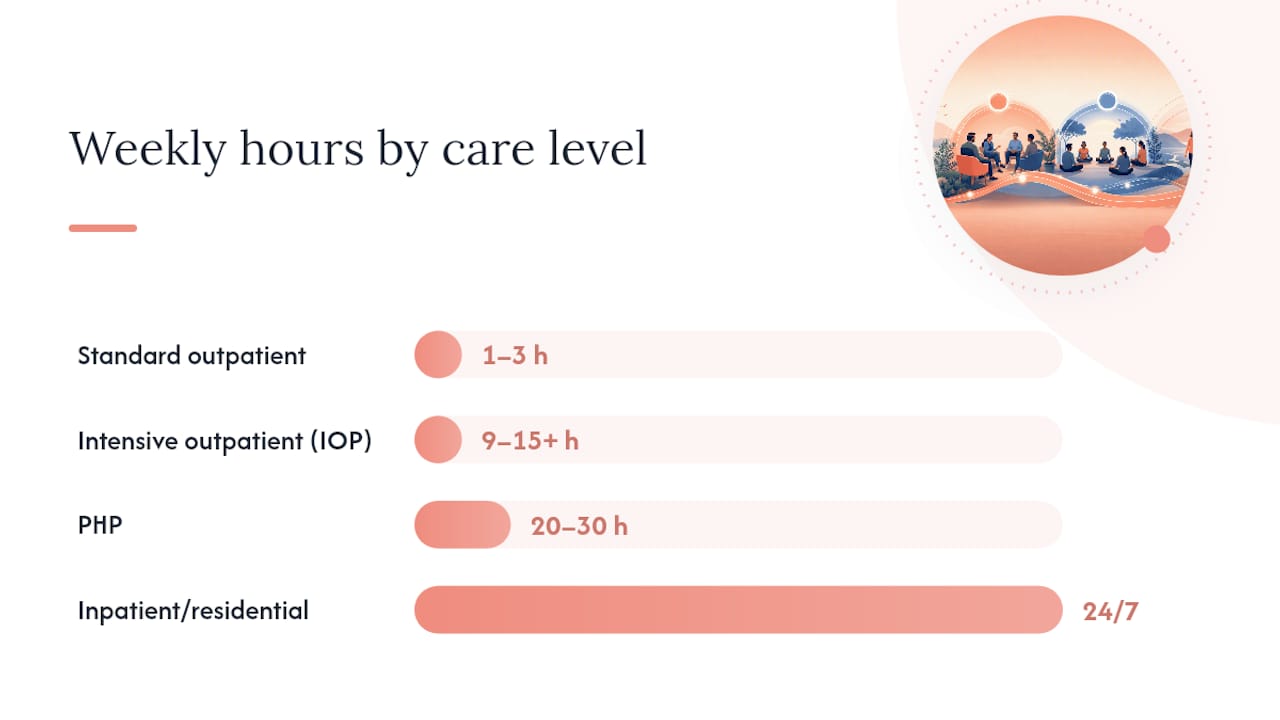
The practical decision rule: if you've just left an inpatient unit and aren't ready to drop to once-a-week therapy, IOP is usually the right next step. If you've been in weekly therapy for months and your symptoms are worsening, IOP is the step up that adds structure without pulling you out of your life.
What actually happens during an IOP week?
A typical week runs three to five days, with sessions grouped into two- to three-hour blocks. Most programs anchor the schedule around group therapy, then layer in individual sessions and any medication appointments.
A sample week might look like this:
- Monday/Wednesday/Friday: 3-hour group therapy block (skills training, process group, or psychoeducation)
- Tuesday: 50-minute individual therapy session
- Ongoing: Biweekly medication management check-in with a prescriber
UNC Health's program runs three-hour group sessions three times weekly plus individual therapy across a six-week program, using CBT, DBT, and ACT as the primary modalities. That structure is representative of what most adult IOPs deliver.
Your treatment team typically includes a licensed therapist (LCSW, LPC, or MFT), a psychiatrist or nurse practitioner for medication, and a case manager who handles coordination and aftercare planning. In larger programs, a peer support specialist may also be part of the team.

Delivery formats have expanded considerably. In-person, fully virtual, and hybrid models all exist. Virtual IOP options now allow synchronous group sessions over secure video platforms, which has meaningfully improved access for adults with demanding schedules or limited transportation. Strong virtual programs maintain the same group norms and privacy safeguards as in-person care.
Pro Tip: Group therapy works best when you treat it like a skill lab, not a support circle. The repetition of practicing a coping skill in front of peers, getting feedback, and applying it before the next session is what accelerates change. If you find yourself going through the motions, tell your individual therapist — that's a signal to adjust the approach, not to drop out.
The benefits of group therapy extend beyond shared experience. Accountability to peers, real-time feedback, and the normalization of struggle all contribute to outcomes in ways that individual sessions alone can't replicate.
How many hours per week does an IOP require?
For adults, SAMHSA sets the minimum at 9 hours per week, though many programs run 12–15 hours, especially in the early weeks when clinical intensity is highest. Adolescent programs carry a lower minimum of 6 hours per week.
| Schedule pattern | Hours per week | Session structure | Typical program length |
|---|---|---|---|
| Standard adult IOP | 9–12 hours | 3x/week, 3–4 hour blocks | 8–12 weeks |
| Intensive adult IOP | 12–15+ hours | 4–5x/week, 3-hour blocks | 6–10 weeks |
| Evening/working adult | 9–12 hours | 3x/week, evening blocks | 8–12 weeks |
| Virtual IOP | 9–12 hours | 3x/week, synchronous video | several weeks |
SAMHSA's Treatment Episode Data Set recorded a median length of stay for adults who completed substance use IOP treatment. Mental health IOPs often run shorter, commonly 6–8 weeks, though clinical progress determines the actual endpoint.
Evening and weekend schedules exist specifically for working adults. If a program only offers 9 AM weekday sessions with no alternatives, that's worth flagging during intake. Scheduling flexibility is a legitimate clinical consideration, not just a convenience preference. For a deeper look at fitting treatment into a full schedule, IOP scheduling strategies are worth reviewing before you commit to a program.
Who is a good candidate for IOP?
IOP works best for adults who are medically stable, motivated to engage, and have a safe, supportive home environment. The clinical intake assessment makes the final determination, but you can use this checklist to self-screen.
Good candidate indicators:
- Moderate to severe mental health symptoms or substance use that hasn't responded to weekly therapy
- Able to attend sessions consistently (transportation, schedule, or telehealth access)
- Safe, stable housing with no active domestic violence or substance use in the home
- No current need for medical detox (alcohol, benzodiazepines, or opioids requiring supervised withdrawal)
- Motivated to participate in group settings and complete between-session assignments
- Not in acute psychiatric crisis requiring 24/7 monitoring
Contraindications that usually require a higher level of care first:
- Active suicidal ideation with a specific plan or intent
- Medical detox needs (withdrawal from alcohol or certain substances requires inpatient supervision)
- Unstable housing or a home environment that actively undermines recovery
- Severe cognitive impairment that prevents meaningful group participation
- Recent psychiatric hospitalization with unresolved acute symptoms
A licensed clinician conducts the intake assessment and makes the placement recommendation. That assessment covers psychiatric history, substance use, medical status, social supports, and prior treatment. It's not a formality — it's the mechanism that matches you to the right level of care. If IOP isn't the right fit at intake, the clinician will say so and explain what comes first.
What to expect during enrollment and day one
Most IOPs accept self-referrals, meaning you don't need a physician's order to call and start the process. Referrals from hospitals, therapists, or primary care providers are also common.
The intake process typically unfolds in three steps: a phone screening (15–30 minutes) to confirm basic eligibility, a full clinical assessment (60–90 minutes) with a licensed clinician, and an insurance or financial verification before your start date. Some programs complete all three in one day; others schedule them across a few days.
Bring to your intake appointment:
- Government-issued ID
- Insurance card (front and back)
- Current medication list with dosages
- Emergency contact information
- Any prior treatment records you have access to
Preparing for your first therapy intake reduces first-session anxiety considerably. Knowing what questions to expect and what paperwork is coming makes the process feel less clinical and more like a practical onboarding.
Programs vary between rolling admissions (you start when the assessment clears) and cohort-based starts (a new group begins every 2–4 weeks). Rolling admissions are more common for adult mental health IOPs. If there's a waitlist, ask whether you can begin individual therapy in the interim.
How much does an IOP cost and what does insurance cover?
Cost depends heavily on your insurance plan, the program's network status, and your state. Here's how the major payer pathways work.
Private insurance (PPO/HMO): Most commercial plans cover IOP under behavioral health benefits, subject to medical necessity criteria and prior authorization. In-network programs typically involve a copay or coinsurance per day of service. Out-of-network benefits vary widely. Comparing payer options for virtual therapy can clarify what your specific plan covers before you commit.
Medicare Part B: Medicare covers IOP services including intensive psychiatric care, counseling, and therapy in outpatient settings. After the Part B deductible, beneficiaries typically pay coinsurance for covered services.
Medicaid: Coverage varies by state. Most state Medicaid programs cover IOP for substance use disorders; mental health IOP coverage is less consistent. Check your state's behavioral health benefit directly through Healthcare or your state Medicaid office.
Questions to ask your insurer before starting:
- Does my plan cover intensive outpatient program services under behavioral health?
- Is this specific program in-network?
- What are the prior authorization requirements and how long does approval take?
- What is my copay or coinsurance per day of service?
- Is there a session or day limit per calendar year?
- What documentation does the program need to submit for billing?
Pro Tip: Before your first session, ask the program for a written benefits verification summary and an itemized cost estimate. Programs that bill insurance routinely run this check — if a program is reluctant to provide it in writing, that's a red flag about their billing practices.
What does the evidence say about IOP outcomes?
The evidence base for IOP is solid, particularly for substance use disorders. SAMHSA's clinical advisory states that IOP outcomes can be comparable to residential services for appropriately selected clients. That finding holds across multiple studies when the placement criteria are followed correctly.
For mental health conditions, NIMH-supported research consistently supports the core modalities used in IOPs. CBT, DBT, and ACT each carry strong evidence for depression, anxiety disorders, PTSD, and borderline personality disorder. The IOP format amplifies those modalities through repetition and group accountability.
The key phrase in the SAMHSA finding is "appropriately selected clients." IOP doesn't outperform inpatient care for people who need inpatient care. The outcomes data is strong precisely because good programs use rigorous intake criteria to match clients to the right level.
Clinicians often describe IOP as a momentum-building phase. The structured repetition of skills across multiple sessions per week accelerates behavioral change in ways that weekly therapy simply can't match. The explicit goal, though, is to transition clients back to lower-intensity care once that momentum is established. IOP is a sprint, not a marathon.
How to find a quality IOP and 10 questions to ask
Where to search:
- SAMHSA's treatment locator at findtreatment.gov filters by location, condition, and payment type
- Medicare's provider search for Medicare-certified outpatient programs
- HRSA's find-a-health-center tool for federally supported community health centers with behavioral health services
- State behavioral health authority websites (search "[your state] behavioral health provider directory")
- Your insurance company's in-network provider directory filtered by "intensive outpatient"
10 questions to ask any program:
- What are your program hours and do you offer evening or virtual options?
- What licenses and credentials do your therapists and prescribers hold?
- Which evidence-based treatments do you use (CBT, DBT, ACT)?
- How do you handle psychiatric crises between sessions?
- Do you offer medication management on-site or through a referral?
- What does your aftercare planning process look like?
- How do you handle insurance billing and prior authorization?
- Is telehealth available for all or part of the program?
- What is the typical group size?
- How do you track and measure clinical outcomes?
Red flags to watch for:
- No licensed clinicians listed on staff (look for LCSW, LPC, MFT, MD, or APRN credentials)
- Vague or evasive answers about crisis coverage after hours
- Inability to provide a written cost estimate before you start
- No mention of evidence-based modalities in program materials
- Pressure to commit before completing a full clinical assessment
Making IOP work when life doesn't pause
The adults who get the most out of IOP are the ones who treat it like a non-negotiable appointment, not a flexible add-on. That sounds obvious, but the structure of IOP means missing two sessions in a week can set back your progress by more than two sessions' worth of work. Group continuity matters.
A few things that consistently make the difference for working adults and parents:
Schedule it like surgery. Block the time in your calendar before anything else. If your employer offers an Employee Assistance Program (EAP) or FMLA leave, use it. California workers have specific mental health leave protections worth understanding before you start. For professionals managing burnout alongside treatment, therapy strategies for professionals can help you frame the commitment to yourself and your employer.
Involve one support person. You don't need to tell everyone. But having one person who knows your schedule, can cover childcare on session days, or simply checks in after a hard group session significantly improves attendance and follow-through.
Start aftercare planning in week two, not week ten. The transition out of IOP is where many people stall. Ask your case manager in the first two weeks: what does the step-down plan look like? Who will be your outpatient therapist after IOP ends? Is there a support group you'll transition into? Programs that wait until the final week to address this are doing their clients a disservice.
Dos and don'ts:
- Do tell your individual therapist when group sessions feel unproductive — that feedback shapes the treatment
- Do complete between-session assignments even when they feel tedious; the skill-building happens in the practice, not the session
- Don't drop out when things get harder in weeks 3–4; that discomfort is often the sign that real work is happening
- Don't treat IOP as the finish line; the aftercare plan is what protects the gains you make
Kin-wellness offers flexible virtual IOP-style care for California adults
Working professionals, parents, and healthcare workers in California often need clinical-grade mental health support that fits around a real schedule, not the other way around.
Kin-wellness provides virtual outpatient mental health services built for exactly that situation. Services include individual therapy, group therapy, family therapy, EMDR (available in-person or via telehealth), and medication management, all delivered by licensed therapists and prescribers. Insurance billing support is handled directly, so you're not navigating prior authorizations alone.
The intake process is straightforward: a clinical assessment with a licensed clinician, insurance verification, and a clear plan before your first session. Kin-wellness accepts PPO and HMO plans and works with clients on out-of-network benefits when applicable.
If you're ready to get evaluated and find out which level of care fits your situation, explore Kin-wellness services or review the full services and care options to see what's available and book your intake.
Sources
- Intensive Outpatient Program Services | Medicare Coverage
- CLINICAL ISSUES IN INTENSIVE OUTPATIENT TREATMENT FOR SUBSTANCE USE DISORDERS
- Intensive Outpatient Program (IOP)
- IOP Program Details | Department of Psychiatry
This article is general information, not a substitute for advice from a qualified doctor. Consult a qualified healthcare professional about your own circumstances before acting on anything here.