
Most adult intensive outpatient programs meet 3–5 days per week, with sessions running roughly 2–4 hours each, putting your total weekly commitment at 9–15 hours. That's the baseline. SAMHSA sets the floor at 9 hours per week for adults, and most programs build from there based on your clinical needs.
Three things to know before you read further:
- Morning and evening tracks both exist. If you work a standard 9-to-5, an evening program (typically 5:30–8:45 PM) is a real option, not an exception.
- Group therapy is the core. Individual sessions, medication management, and family sessions are scheduled around it, not the other way around.
- Your schedule will change. Most programs step down your hours as you demonstrate progress, so the commitment you start with is not the commitment you finish with.
Table of Contents
- How IOP fits into the broader care continuum
- What a typical IOP schedule looks like week to week
- What actually happens during an IOP session
- Who benefits most from IOP, and who may need a different level
- How long IOP lasts and how discharge is decided
- How to attend IOP while working or parenting
- How to start: intake, insurance, and what to ask
- Aftercare and relapse prevention
- Why group therapy is the backbone of IOP: the evidence
- Key Takeaways
- What consistent attendance actually looks like from the clinical side
- Kin-wellness offers flexible virtual IOP for California adults
- Useful sources and further reading
How IOP fits into the broader care continuum
Knowing where IOP sits on the care spectrum explains why the hours are structured the way they are.
| Level of Care | Setting | Typical Weekly Hours |
|---|---|---|
| Inpatient / Residential | 24/7 facility | — |
| Partial Hospitalization (PHP) | Day program | 20+ hours/week |
| Intensive Outpatient (IOP) | Outpatient | 9–15 hours/week |
| Standard Outpatient | Clinic or telehealth | 1–2 sessions/week |
IOP occupies the middle ground by design. Clinically, it functions as a step-down from inpatient care when someone is stable enough to sleep at home but still needs daily structure, and as a step-up from weekly therapy when one session a week isn't enough to hold progress. The scheduling logic follows from that: enough hours to deliver real clinical work, not so many that you can't hold a job or care for your family.
SAMHSA's guidance on minimum weekly hours isn't arbitrary. Nine hours per week for adults reflects the dose of structured treatment research associates with meaningful outcomes for substance use and co-occurring mental health conditions. Programs that fall below that threshold are generally considered standard outpatient, not IOP.
What a typical IOP schedule looks like week to week
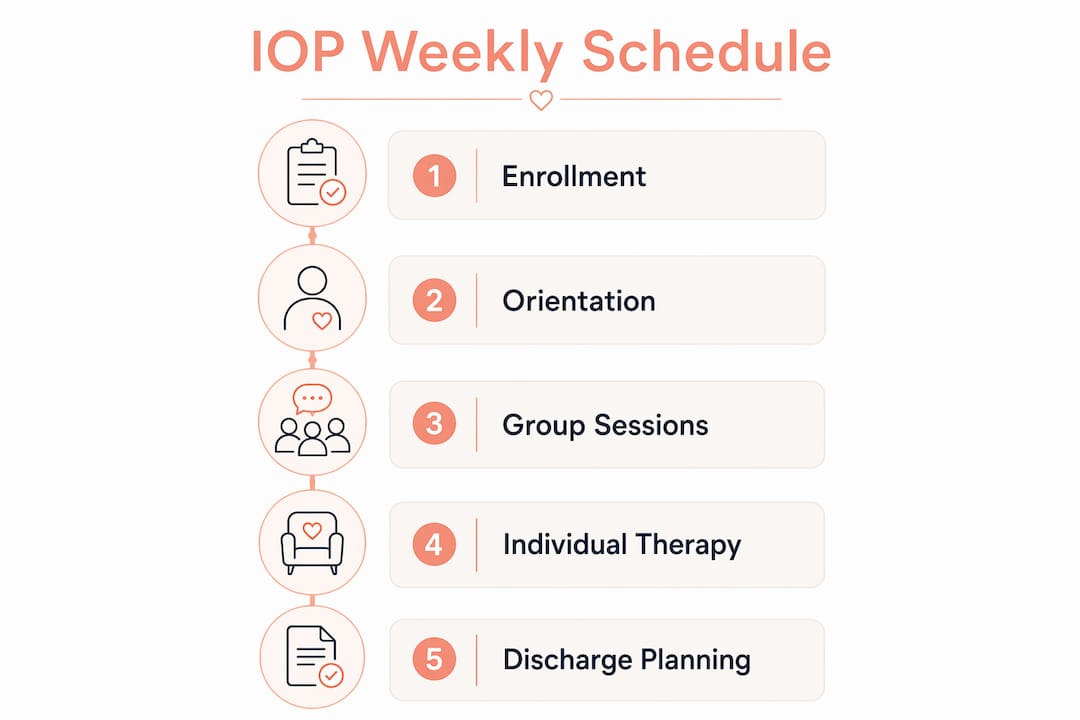
Two tracks dominate most programs: morning and evening. Here's how each plays out across a real week.

Morning Track (Sample)
| Day | Time | Activity |
|---|---|---|
| Monday | 9:00 AM – 12:00 PM | Check-in, group therapy, psychoeducation |
| Wednesday | 9:00 AM – 12:00 PM | Group therapy, skill practice |
| Friday | 9:00 AM – 12:00 PM | Relapse prevention group, wrap-up |
| Tuesday or Thursday | By appointment | Individual counseling or medication management |
Evening Track (Sample)
| Day | Time | Activity |
|---|---|---|
| Monday | 5:30 PM – 8:45 PM | Check-in, process group, family education |
| Wednesday | 5:30 PM – 8:45 PM | Skills group, break, second group |
| Thursday | 5:30 PM – 8:45 PM | Relapse prevention, wrap-up |
| Flexible | By appointment | Individual session or medication review |
The evening schedule structure typically runs check-in and a process group from 5:30 to 7:00 PM, a short break, then a second group or family education session from 7:15 to 8:45 PM. Individual assessments are scheduled separately by appointment.
Some programs spread sessions across Monday, Wednesday, and Friday. Others use consecutive days like Monday through Wednesday. Full-week options (five days) are less common in IOP and more typical of PHP.
Pro Tip: Ask admissions whether you can mix morning and evening days if your schedule shifts mid-week. Some programs allow this; many don't. Knowing upfront saves you from a scheduling conflict in week two.
What actually happens during an IOP session
A 2–4 hour block sounds long until you see how it's divided. Most IOP groups run 60–90 minutes with 6–12 participants, led by a licensed counselor. A typical session block looks like this:
- Check-in (10–15 minutes): Brief emotional temperature check; participants share one word or a sentence about where they are today.
- Focused group work (60–90 minutes): A structured topic or skill practice session. Common modalities include CBT (identifying and reframing distorted thoughts), DBT skills (distress tolerance, emotion regulation), relapse prevention planning, and mindfulness practice.
- Short break (10 minutes)
- Second group or psychoeducation (45–60 minutes): May cover family dynamics, medication education, or a rotating curriculum topic.
- Wrap-up and assignment (10–15 minutes): A takeaway commitment or brief homework tied to the session's theme.
The rotating curriculum covers categories like Recovery Education, Emotional Regulation, Relationships, Relapse Prevention, Wellness, and Spirituality. Repetition is intentional: by the end of an 8–12-week program, you've practiced each theme multiple times from different angles, which is how skills actually stick.
Individual counseling, medication management, and case management are typically scheduled outside the group block, either before or after, or on a non-group day.
Who benefits most from IOP, and who may need a different level
IOP works best for adults who are medically stable, have a safe place to sleep, and need more than one or two therapy sessions a week to maintain progress.
Typical candidates:
- Adults stepping down from inpatient or residential care who still need daily structure
- People whose symptoms haven't stabilized with weekly outpatient therapy alone
- Working adults, parents, or caregivers who can't take extended leave but need intensive support
- Those managing co-occurring mental health and substance use conditions
Red flags where IOP is usually not the right fit:
- Active medically managed withdrawal requiring 24/7 monitoring
- Unstable housing or a home environment that actively undermines recovery
- Severe suicidality or active psychosis requiring inpatient stabilization
- Inability to attend consistently due to transportation or scheduling barriers
Eligibility is determined through a clinical assessment at intake, not a self-assessment checklist. Insurance coverage and the availability of home supports also factor in. If you're unsure whether IOP or PHP is the right level, ask the admissions team to walk you through the criteria they use.
Pro Tip: Ask specifically about the program's emergency protocol for after-hours crises. A well-run IOP has a clear plan for what happens between sessions, not just during them.
How long IOP lasts and how discharge is decided
Many programs run for several weeks on average, though duration varies widely depending on clinical need and payer authorization. Some datasets report median completion around 81 days for adults who finish treatment.
Progress isn't measured by calendar alone. Clinicians typically assess:
- Goal attainment: Are you meeting the treatment goals set at intake?
- Attendance: Consistent attendance is both a metric and a predictor of outcome.
- Skill application: Can you demonstrate the coping skills outside of session?
- Clinician assessment: Formal mid-program reviews, usually at weeks 4 and 8, evaluate whether to continue, step down, or step up care.
The step-down process is gradual. You might move from three group days per week to two, then to weekly outpatient therapy, with a formal aftercare plan in place before your last session. Discharge without an aftercare plan is a gap worth flagging if you don't hear it mentioned by week six.
How to attend IOP while working or parenting
The scheduling flexibility of IOP is one of its clinical advantages, but it still requires planning.
Scheduling strategies that work:
- Choose consistent days at enrollment so your employer or childcare provider can plan around them.
- Request an evening track if your job runs standard hours; most programs offer at least one.
- Ask whether telehealth attendance is allowed for some sessions, particularly individual appointments.
- Build a buffer of 30 minutes before and after each session for transit or decompression.
On telehealth and hybrid options: Synchronous online IOP sessions are increasingly common and are covered by many insurers when delivered by a licensed provider on a HIPAA-compliant platform. Before enrolling in a virtual track, confirm that your insurance covers telehealth IOP specifically (not just standard telehealth therapy), that the platform is secure, and that you have a private space at home for group sessions.
Talking to your employer: You don't have to disclose a diagnosis. You can request protected time for a medical appointment under FMLA or your employer's leave policy. HR typically needs documentation of medical necessity from your provider, not a specific diagnosis. A brief letter from your clinician stating that you require structured outpatient medical appointments three times per week is usually sufficient.

Pro Tip: Line up childcare or transportation before your first session, not after. The first week of IOP is the hardest logistically, and a missed session in week one sets a pattern you don't want.
How to start: intake, insurance, and what to ask
Getting into an IOP is a multi-step process, but it moves faster than most people expect.
Step-by-step intake:
- Phone screening: A brief call to confirm you're seeking the right level of care and to gather basic insurance information.
- Clinical assessment: A licensed clinician conducts a structured interview covering mental health history, substance use, current symptoms, and home supports. This determines your level of care and track assignment.
- Insurance and prior authorization: The program's admissions team typically handles prior auth, but you should ask about medical necessity criteria, in-network vs. out-of-network status, and how sessions are billed (per session or per day).
- Scheduling orientation: You're assigned to a morning or evening track and given your weekly schedule.
- Baseline measures: Many programs collect standardized symptom measures at intake to track progress.
Questions to ask at admission:
- What are the minimum weekly hours, and how are they structured?
- What is the makeup policy if I miss a session?
- How does the program handle a crisis between sessions?
- Is telehealth available for any sessions, and does my insurance cover it?
- How and when can family members be involved?
- What does the discharge and aftercare process look like?
Pro Tip: Ask for the weekly schedule in writing before you commit. A program that can't hand you a clear timetable at intake is a program that may struggle to hold structure once you're enrolled.
Aftercare and relapse prevention
Relapse prevention isn't a single session at the end of IOP. It's woven into the curriculum from week one and practiced repeatedly.
Core skills practiced throughout IOP:
- Trigger mapping: identifying people, places, emotions, and situations that increase risk
- Coping skills: behavioral and cognitive strategies to use in the moment
- Safety planning: a written protocol for high-risk moments, including who to call
- Routine-building: structuring daily life to reduce unstructured time
Aftercare options after IOP:
- Step-down to weekly individual outpatient therapy
- Booster groups: periodic group sessions (monthly or biweekly) to maintain skills
- Peer support meetings: AA, NA, SMART Recovery, or other community-based programs
- Medication management follow-up with a prescriber
- Continued family therapy if indicated
A practical relapse-prevention checklist before a high-risk event:
- Identify the specific trigger or stressor in advance
- Review your coping plan and safety contacts
- Tell a trusted person where you're going and when you'll check in
- Have an exit strategy if the situation escalates
- Schedule a debrief with your therapist or support person afterward
Why group therapy is the backbone of IOP: the evidence
SAMHSA's clinical guidance is explicit: group therapy is the central service in IOP, not a supplement to individual counseling. The minimum 9-hours-per-week standard for adults is built around group-based treatment, with individual sessions, medication management, and case management layered in.
Group therapy in IOP works because it replicates real-world social dynamics in a structured, safe environment. Participants practice skills with peers, receive honest feedback, and experience accountability that a one-on-one session simply can't replicate. The peer element is not incidental — it is the mechanism.
Clinicians who work in IOP settings consistently point to group accountability and peer support as the primary drivers of change, not the modality alone. A CBT group works partly because CBT is evidence-based, and partly because practicing a skill in front of peers who share your experience is categorically different from practicing it alone.
Schedule individualization matters here too. Clinicians extend or shorten care based on measurable progress and safety needs, not a fixed calendar. A client who enters IOP in acute distress may need 12 weeks; someone stepping down from a well-managed residential stay may be ready for outpatient after six. The schedule serves the clinical plan, not the other way around.
Key Takeaways
Most adults in IOP attend 3–5 days per week for 2–4 hours per session, meeting SAMHSA's 9-hour weekly minimum, with group therapy as the core and schedules that step down as progress is demonstrated.
| Point | Details |
|---|---|
| Weekly commitment | Most adult IOPs run 9–15 hours per week across 3–5 days. |
| Session structure | Each block includes check-in, focused group work, and a wrap-up; individual sessions are scheduled separately. |
| Program length | Most programs average 8–12 weeks, though duration ranges from 2 weeks to 6 months based on clinical need. |
| Track options | Morning and evening tracks exist; ask admissions which days and times are available before enrolling. |
| Kin-wellness | Kin-wellness offers virtual IOP and outpatient services for California adults, with insurance billing support and flexible scheduling. |
What consistent attendance actually looks like from the clinical side
From the program side, the first week of IOP tells clinicians a great deal. Not about diagnosis or history, but about readiness. Adults who show up on time, engage in check-in, and attempt the homework between sessions, even imperfectly, tend to progress faster than those who attend but stay disengaged.
The intake-to-week-four arc is where most of the visible change happens. By week two, most clients have a clearer sense of their triggers and have practiced at least one coping skill in a real situation. By week four, the group itself becomes a resource, not just a requirement. Clinicians watch for that shift because it signals the peer accountability mechanism is working.
Common early challenges: transportation logistics, the discomfort of sharing in a group setting, and the temptation to skip on hard days. The last one is worth naming directly. The sessions you most want to skip are usually the ones you most need. Consistent attendance isn't a rule for its own sake; it's what makes the treatment work.
Clinicians also track homework completion, not to grade it, but because skill practice between sessions is where IOP's intensity actually lives. The group hours are the scaffold. What you do with the skills outside those hours is the building.
Kin-wellness offers flexible virtual IOP for California adults
If you're a working professional, parent, or caregiver in California who needs structured mental health treatment without pausing your life, Kin-wellness is built for exactly that situation.
Kin-wellness provides virtual intensive outpatient and outpatient mental health services, including group therapy, individual therapy, family therapy, EMDR, and medication management, all delivered by licensed therapists and prescribers. Evening tracks and telehealth options mean you can attend from home after work, without a commute or a gap in your schedule. Insurance billing support is included: the admissions team works with your PPO or HMO to handle prior authorization and explain your out-of-pocket costs before your first session.
Getting started takes one call. You'll complete a phone screening, a clinical assessment, and a track assignment, then receive your weekly schedule in writing. To check availability or book an intake, visit Kin-wellness services or go directly to the Kin-wellness home page to get started today.
Useful sources and further reading
The sources below back the clinical claims and schedule examples in this article. Each one is worth bookmarking if you're comparing programs or preparing for an intake conversation.
| Source | What it covers | Why it's useful |
|---|---|---|
| SAMHSA IOP Clinical Guidance | Minimum weekly hours, core services, and program standards | The authoritative policy document behind the 9-hour adult minimum |
| SAMHSA Co-Occurring Disorders | Treatment for co-occurring mental health and substance use | Useful if your IOP need involves both conditions |
| Verywell Mind: How IOP Works | Program structure, step-down/step-up logic, typical hours | Clear consumer-facing overview of the IOP model |
| IOP Group Topics: What to Expect | Rotating curriculum categories and group session structure | Explains what group topics look like week to week |
| Kin-wellness Services | Virtual IOP and outpatient services for California adults | Starting point for booking an intake or comparing tracks |