
For most adults starting antidepressant treatment, an SSRI is the typical first choice — not because it works better than an SNRI, but because it tends to be better tolerated and has decades of prescribing experience behind it. That said, SNRIs are equally effective and often preferred when pain, low energy, or poor concentration are part of the picture.
TL;DR:
- Both classes are first-line treatments for depression and anxiety in the U.S.
- No large class-level efficacy gap exists in head-to-head trials for major depressive disorder.
- SNRIs add norepinephrine reuptake inhibition, which makes them useful for comorbid pain conditions and fatigue.
- The right choice depends on your symptom profile, medical history, and how you've tolerated medications before.
No article can replace a conversation with your prescriber. What follows is the clinical context that makes that conversation more productive.
Table of Contents
- How do SSRIs and SNRIs actually work?
- Common SSRIs and SNRIs available in the U.S.
- When do clinicians pick SSRIs vs SNRIs?
- What side effects should you expect from each class?
- Stopping or switching antidepressants — what you need to know
- What to monitor and which drug combinations to avoid
- How prescribers actually choose between an SSRI and SNRI for you
- Kin-wellness's approach to medication management
- Key Takeaways
- What the medication conversation with your clinician should actually look like
- Medication management at Kin-wellness, built for working adults
How do SSRIs and SNRIs actually work?
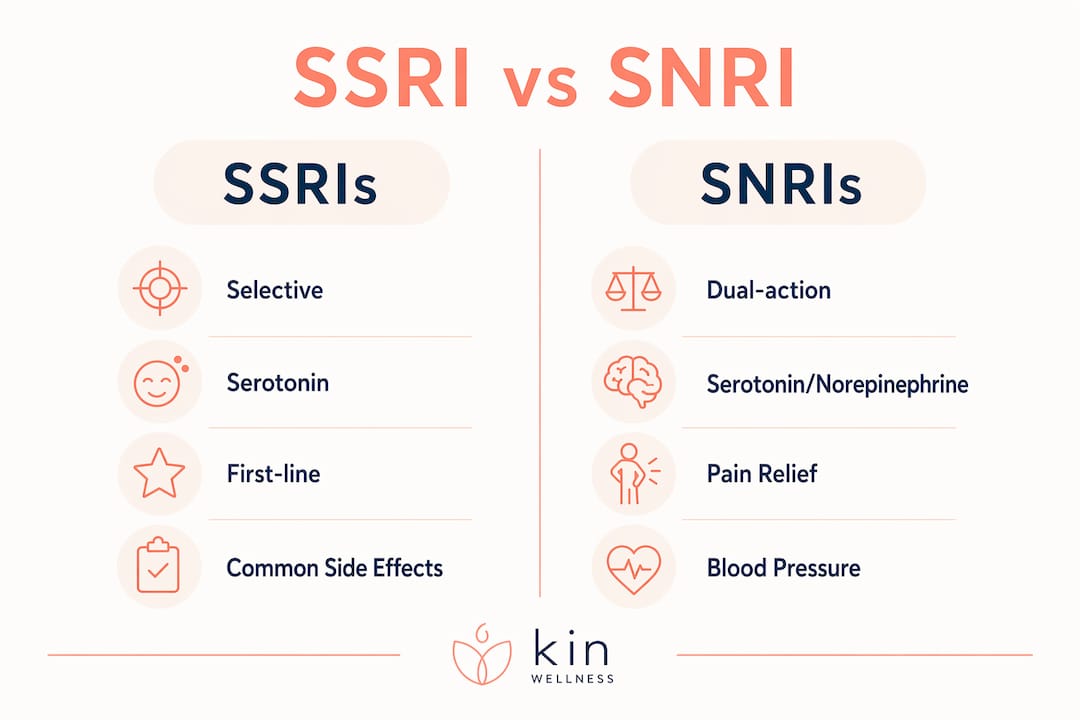
SSRIs block the reuptake of serotonin in the brain, leaving more of it available between neurons. SNRIs do the same thing, but they also block the reuptake of norepinephrine, a second neurotransmitter tied to alertness, energy, and the body's stress response.
That second target matters more than it might sound. Norepinephrine acts on the sympathetic nervous system, which is why SNRIs can raise blood pressure and heart rate in some people. It's also why SNRIs tend to have a more noticeable effect on fatigue and concentration — two symptoms that serotonin alone doesn't address as directly.
Clinical note: Norepinephrine reuptake inhibition can improve energy and focus, but it also means SNRIs require baseline blood pressure monitoring before starting and rechecks during the first few weeks of titration.
One expectation worth setting early: neither class works overnight. Full therapeutic effect typically takes 4–8 weeks, though initial side effects often ease within the first 1–2 weeks. Patients who stop after two weeks because they "don't feel anything" are stopping before the drug has had a real chance to work.

Common SSRIs and SNRIs available in the U.S.
Every drug in these classes has a generic name and at least one brand name. Knowing both helps when your insurance formulary lists one but not the other.

| Generic Name | U.S. Brand Name(s) | Typical Indications | Notable |
|---|---|---|---|
| Fluoxetine | Prozac | Depression, OCD, panic disorder, bulimia | Longest half-life in class; lower discontinuation risk |
| Sertraline | Zoloft | Depression, PTSD, OCD, social anxiety | Most prescribed SSRI in the U.S.; more diarrhea than some peers |
| Escitalopram | Lexapro | Depression, generalized anxiety disorder | Generally well tolerated; often cited for clean side-effect profile |
| Paroxetine | Paxil | Depression, panic disorder, PTSD, social anxiety | Higher discontinuation risk; more anticholinergic effects |
| Citalopram | Celexa | Depression | Dose-limited due to QT-interval concerns above certain doses |
| Venlafaxine | Effexor | Depression, generalized anxiety, social anxiety, panic | Higher nausea rates; significant discontinuation risk |
| Duloxetine | Cymbalta | Depression, anxiety, diabetic neuropathy, fibromyalgia | FDA-approved for chronic pain conditions |
| Desvenlafaxine | Pristiq | Depression | Active metabolite of venlafaxine; similar discontinuation profile |
Even within the same class, drugs behave differently. Sertraline causes more GI upset than escitalopram; venlafaxine causes more nausea than duloxetine. A systematic review found small but real differences in side-effect rates across drugs even when overall efficacy was comparable. Your prescriber's choice of a specific drug within a class is not arbitrary.
When do clinicians pick SSRIs vs SNRIs?
The short answer: no substantial class-level efficacy difference exists for acute major depressive disorder. A meta-analysis of head-to-head randomized trials found that when publication bias was adjusted for, remission rates between SSRIs and SNRIs were statistically indistinguishable. The choice comes down to what else is going on with the patient.
What the evidence actually shows: Adjusted intention-to-treat analyses across head-to-head SSRI vs SNRI trials found an odds ratio for remission of 1.11 (95% CI 0.91–1.35) — no clinically significant difference between the two classes for major depressive disorder.
Clinical scenarios where an SSRI is typically chosen first:
- Straightforward depression or anxiety without significant pain
- Patients with hypertension or cardiovascular concerns (avoiding norepinephrine effects)
- Older adults where blood pressure fluctuation is a risk
- Patients who prioritize a milder side-effect profile to start
Clinical scenarios where an SNRI is often preferred:
- Depression with comorbid chronic pain, diabetic neuropathy, or fibromyalgia
- Pronounced fatigue or concentration problems as core symptoms
- Generalized anxiety with physical tension or somatic symptoms
- Prior SSRI trial that produced inadequate response
A note on special populations: Pregnancy decisions require weighing fetal exposure risk against untreated depression risk — a conversation for an OB-GYN and psychiatrist together, not a general article. For older adults, SSRIs like sertraline and escitalopram are generally preferred because of their lower anticholinergic burden and more predictable blood pressure profile.
What side effects should you expect from each class?
Both classes share a core side-effect profile, but SNRIs carry a few additional risks worth knowing before you start.
Side effects common to both SSRIs and SNRIs:
- Nausea (usually worst in the first 1–2 weeks)
- Sexual dysfunction (reduced libido, delayed orgasm)
- Insomnia or drowsiness, depending on the drug
- Headache
- Weight changes with long-term use
Side effects more characteristic of SNRIs:
- Increased blood pressure and elevated heart rate
- Dizziness, particularly on standing
- Sweating
- Higher rates of nausea (especially venlafaxine)
Rare but serious risks for both classes:
- Serotonin syndrome: a potentially life-threatening reaction from excess serotonergic activity, most often triggered by combining two serotonergic agents. Symptoms include agitation, rapid heart rate, high fever, and muscle rigidity.
- Suicidality: The FDA black box warning requires monitoring for increased suicidal thoughts, particularly in young adults under 25, especially during the first few weeks of treatment or after dose changes.
Pro Tip: If you're starting an SNRI, ask your prescriber to record a baseline blood pressure reading before your first dose. That number becomes your reference point for every follow-up check.
Sexual dysfunction is one of the most common reasons people stop SSRIs without telling their prescriber. It affects a significant portion of patients on both classes, and there are management strategies — dose adjustment, timing changes, or switching to a drug with a different profile — that work better than quietly stopping.
Stopping or switching antidepressants — what you need to know
Both classes can cause discontinuation syndrome when stopped abruptly. The symptoms are not dangerous in most cases, but they're uncomfortable enough that people sometimes mistake them for relapse.
Common discontinuation symptoms:
- Dizziness and "brain zaps" (brief electrical-shock sensations)
- Irritability and mood swings
- Flu-like symptoms (fatigue, muscle aches, sweating)
- Nausea and vivid dreams
The drugs with the highest discontinuation risk are paroxetine (SSRI), venlafaxine, and desvenlafaxine (both SNRIs). Their shorter half-lives mean blood levels drop faster when a dose is missed or stopped, which is what triggers the symptoms. Fluoxetine, with its long half-life, has the lowest discontinuation risk in the SSRI class.
Practical tapering steps clinicians typically use:
- Reduce the dose gradually over weeks to months, not days — the slower the taper, the milder the symptoms.
- For venlafaxine, consider splitting doses or switching to the extended-release formulation before tapering.
- When switching between classes, use a cross-tapering strategy: slowly increase the new drug while slowly decreasing the old one, with timing adjusted based on interaction risk.
- If switching from any drug to an MAOI, a washout period of at least 14 days is required to avoid serotonin syndrome.
Pro Tip: If you experience severe mood destabilization, suicidal thoughts, or symptoms that feel like more than mild discomfort during a taper, contact your prescriber before the next scheduled appointment. Tapering timelines are adjustable.
What to monitor and which drug combinations to avoid
The three monitoring priorities for anyone on an SSRI or SNRI are suicidality, blood pressure (for SNRIs specifically), and drug interactions.
On serotonin syndrome: Combining two serotonergic agents — such as an SSRI with a triptan migraine medication, tramadol, or St. John's wort — can push serotonin activity high enough to trigger a medical emergency. The combination of any antidepressant with an MAOI is the highest-risk interaction and requires a mandatory washout period between drugs.
Monitoring checklist:
- Before starting an SNRI: baseline blood pressure reading
- Weeks 1–2: check in with your prescriber for side-effect review and early suicidality screening
- Weeks 4–8: effectiveness assessment; BP recheck for SNRI users
- Ongoing: routine BP monitoring at each visit if on an SNRI; annual medication review
Drug interactions to flag with your prescriber or pharmacist:
- MAOIs (phenelzine, tranylcypromine): never combine with SSRIs or SNRIs; fatal interaction risk
- Other antidepressants or serotonergic drugs (tramadol, linezolid, triptans)
- St. John's wort: an OTC supplement that increases serotonin activity and is frequently overlooked
- Blood thinners (warfarin): SSRIs can increase bleeding risk by affecting platelet function
Always give your pharmacist a complete medication list, including supplements. Serotonin syndrome from an overlooked supplement interaction is preventable.
How prescribers actually choose between an SSRI and SNRI for you
Clinicians individualize treatment by matching drug characteristics to the patient's specific priorities and risks. The decision is rarely about which class is "better" in the abstract.
Decision factors your prescriber weighs:
- Symptom profile: Is pain, fatigue, or concentration a prominent feature? If yes, the norepinephrine component of an SNRI becomes relevant.
- Prior medication history: Did you tolerate or respond to a specific drug before? That's the strongest predictor of what to try next.
- Comorbid conditions: Hypertension or heart disease pushes toward SSRIs. Fibromyalgia or diabetic neuropathy pushes toward duloxetine.
- Sexual side-effect priorities: Both classes cause sexual dysfunction, but individual drugs vary. If this is a priority, say so upfront.
- Pregnancy or breastfeeding plans: Some drugs have more safety data in pregnancy than others; this changes the calculus.
- Cost and insurance: Most SSRIs are available as low-cost generics. SNRIs like duloxetine are also widely generic now, but formulary coverage varies.
Questions worth asking your prescriber:
- "Given my symptoms and medical history, which class makes more sense to start with?"
- "What side effects are most likely with this specific drug?"
- "How will we know if it's working, and when should I follow up?"
- "What's the plan if this doesn't work or I can't tolerate it?"
Expect some trial and error. Adjusting doses or switching drugs within or between classes is a normal part of optimizing treatment, not a sign that something went wrong. Most prescribers assess response at 4–8 weeks and adjust from there.
Kin-wellness's approach to medication management
Structured follow-up paired with therapy consistently produces better long-term outcomes than medication alone. That's not a marketing claim — it's what 50 years of SSRI research and clinical guidelines consistently show.
At Kin-wellness: Medication management is delivered through a coordinated care model — not a standalone prescription service. Every patient starts with a comprehensive assessment that establishes baseline health data, symptom severity, and treatment history before any medication decision is made.
The practical workflow at Kin-wellness follows a structured timeline:
- Initial assessment: full psychiatric evaluation, baseline BP recording (required before any SNRI), medication history review, and coordination with the therapy team
- Weeks 1–2: prescriber check-in focused on early side effects, tolerability, and suicidality screening
- Weeks 4–8: effectiveness review, dose adjustment if needed, BP recheck for SNRI patients
- Ongoing: routine follow-ups coordinated with individual or group therapy sessions
Kin-wellness serves working professionals, parents, executives, and healthcare workers across California through virtual outpatient and intensive outpatient services. Insurance billing support (PPO, HMO, and out-of-network benefits) is built into the intake process, so coverage questions get answered before the first appointment, not after.
Key Takeaways
SSRIs are the standard first-line choice for most adults, but SNRIs are equally valid and often preferred when pain, fatigue, or prior SSRI failure are part of the picture.
| Point | Details |
|---|---|
| No class-level efficacy gap | Head-to-head trials show no clinically significant difference in remission rates between SSRIs and SNRIs for major depressive disorder. |
| SNRIs add norepinephrine | The second mechanism makes SNRIs useful for comorbid pain, fatigue, and concentration problems — but also raises blood pressure monitoring needs. |
| Discontinuation risk varies by drug | Paroxetine, venlafaxine, and desvenlafaxine carry the highest withdrawal risk; fluoxetine the lowest. Slow tapering under prescriber guidance prevents most symptoms. |
| Onset takes 4–8 weeks | Both classes require 4–8 weeks for full therapeutic effect; stopping early is the most common reason treatment fails. |
| Kin-wellness coordinates care | Kin-wellness integrates medication management with therapy and structured follow-up for adults in California — a model that improves outcomes beyond medication alone. |
What the medication conversation with your clinician should actually look like
Most people walk into a first prescriber appointment expecting to be handed a prescription. The better appointments feel more like a negotiation — you bring your symptom priorities, your concerns about side effects, and any prior medication history; your prescriber brings the clinical framework.
A good clinician will tell you upfront that the first drug tried might not be the right one. That's not pessimism. It's honesty about how antidepressant prescribing actually works. The goal of the first appointment is to pick a reasonable starting point, not a permanent answer.
What you should expect your prescriber to cover: the likely side effects of the specific drug (not just the class), when to call if something feels wrong, and a clear follow-up date. If those three things aren't addressed, ask for them directly.
When a referral to a psychiatrist makes sense: complex cases involving multiple failed medication trials, significant comorbid conditions like bipolar disorder or psychosis, or pregnancy all warrant specialist involvement. A primary care prescriber managing straightforward depression or anxiety is appropriate; a complicated medication history is not the same situation.
The most important thing you can do before any appointment is write down your symptoms, their severity, and how long they've been present. Prescribers work with what you tell them. The more specific you are, the more targeted the recommendation.
Medication management at Kin-wellness, built for working adults
Choosing between an SSRI and SNRI is only the first step. Getting the monitoring, follow-up, and therapy coordination right is what determines whether the medication actually works for you.

Kin-wellness offers virtual outpatient medication management for adults in California, with licensed prescribers who handle the full process: initial psychiatric evaluation, baseline monitoring, dose adjustments, and coordination with your therapy team. Insurance billing support for PPO, HMO, and out-of-network plans is included from the start.
What to bring to your first appointment:
- A current list of all medications and supplements (including OTC products like St. John's wort)
- Recent blood pressure readings if you've been on or are considering an SNRI
- A written symptom checklist: what you're experiencing, how long, and how severe
- Any prior medication history, including what worked, what didn't, and why you stopped
Ready to get started? Explore Kin-wellness services or visit Kin-wellness to learn more about what to expect from an initial visit.
This article is general health information, not medical advice. Confirm current treatment options and guidelines with a licensed prescriber for your specific situation.
Sources and further reading
- Antidepressants — StatPearls, NCBI Bookshelf — FDA black box warnings, suicidality monitoring, and discontinuation guidance
- Second-Generation Antidepressants in the Pharmacologic Treatment of Adult Depression — NCBI Bookshelf — Onset of action, tapering, and intra-class side-effect differences
- Comparison of SSRIs and SNRIs in Major Depressive Disorder: A Meta-Analysis — NCBI Bookshelf — Head-to-head remission rate data and publication-bias-adjusted efficacy analysis
- SSRI vs. SNRI: What's the Difference? — Cleveland Clinic — First-line classification, prescriber decision factors, and combined therapy evidence
- SSRI vs. SNRI: Differences, How They Work, and Side Effects — Medical News Today — Blood pressure monitoring, duloxetine pain indications, and side-effect comparisons
- 50 Years of SSRIs: Weighing Benefits and Harms — The Lancet00981-X/fulltext) — Long-term safety context, over-prescription debate, and nonpharmacologic care access