

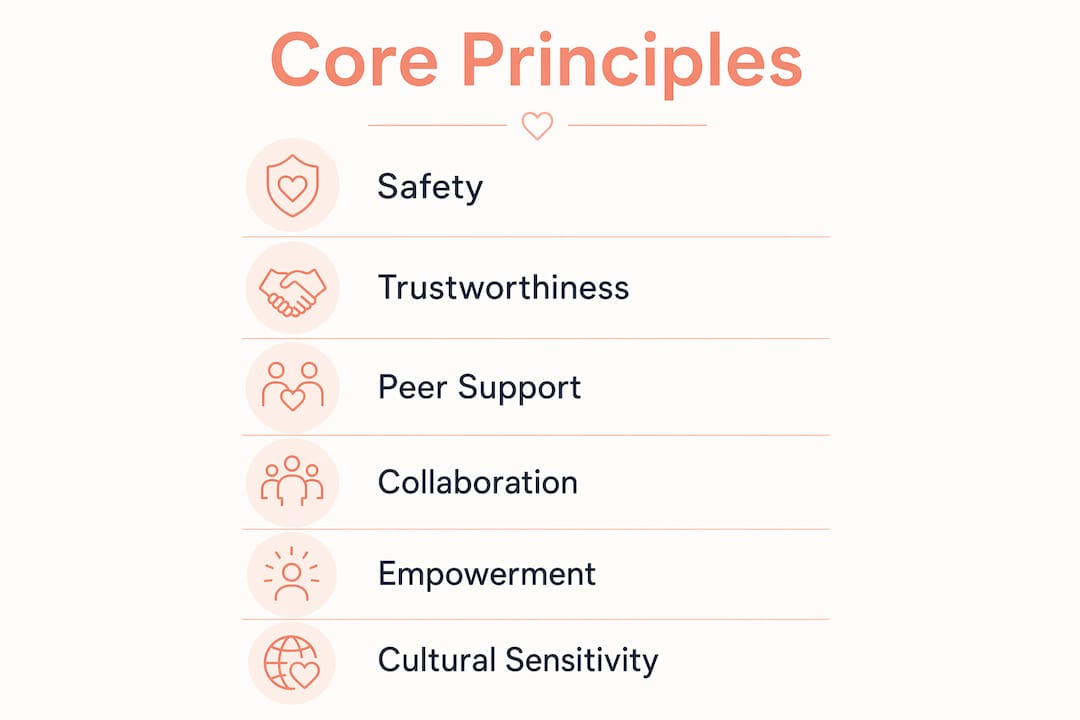
Trauma-informed care is a framework that shifts the entire orientation of a service system, asking not “What’s wrong with you?” but “What happened to you?” At its core, it recognizes that trauma is widespread, that its effects shape how people think, feel, and behave, and that any setting delivering care has a responsibility to avoid making things worse. SAMHSA’s foundational guidance identifies six core principles driving this approach: safety, trustworthiness and transparency, peer support, collaboration and mutuality, empowerment, and cultural, historical, and gender sensitivity. These principles apply organization-wide, not just to clinicians.
Key features of trauma-informed care at a glance:
-
Recognizes the widespread impact of trauma across populations
-
Integrates trauma awareness into policies, procedures, and physical environments
-
Actively works to prevent retraumatization at every point of contact
-
Builds safety and trust before expecting engagement or disclosure
-
Centers client choice, voice, and collaboration in care decisions
-
Addresses cultural, racial, and historical dimensions of trauma
Table of Contents
-
How do you implement trauma-informed care in your organization?
-
Trauma-informed care vs. trauma-focused therapy: what’s the difference?
-
What training do staff need to deliver trauma-informed care?
-
How do you measure whether trauma-informed care is actually working?
-
Self-care and secondary trauma support for caregivers and staff
-
Kin-wellness supports adults who are ready to go beyond awareness
What are the six core principles of trauma-informed care?
SAMHSA’s six principles are not a checklist. They are a lens through which every policy, physical space, and staff interaction gets re-examined.
Safety means both physical and psychological. A waiting room with locked doors, no windows, and no explanation of what happens next is not a safe environment for someone with a trauma history. Safety requires deliberate design: clear signage, predictable routines, and staff who explain what they’re doing before they do it.
Trustworthiness and transparency go hand in hand. Organizations build trust by doing what they say, explaining decisions, and not overpromising. For a trauma survivor who has experienced betrayal or unpredictability, a provider who follows through on small commitments builds the foundation for deeper engagement.
Peer support acknowledges that people with lived experience of trauma carry a form of credibility no clinician can replicate. Peer specialists, support groups, and community connections are not supplemental; they are central to recovery.
Collaboration and mutuality flatten the power hierarchy. The assumption that the professional always knows best is itself a trauma trigger for many clients. Shared decision-making, co-created care plans, and genuine listening are what this principle looks like in practice.

Empowerment means building on strengths rather than cataloging deficits. Clients who feel heard and validated are more likely to engage, take risks in treatment, and sustain progress.
Cultural, historical, and gender sensitivity requires organizations to move past stereotypes and recognize that systemic trauma, including historical racism, gender-based violence, and intergenerational harm, shapes how individuals experience care. Cultural and DEIAJ considerations are not add-ons; they are integral to minimizing retraumatization and building genuine equity in care delivery.
Pro Tip: When reviewing your organization’s intake process, walk through it as if you were a first-time client with a trauma history. Note every moment where you feel confused, powerless, or watched. Those are your redesign priorities.
What are the real benefits of trauma-informed care?
The benefits operate on two levels: individual and organizational. For clients, the most immediate gain is reduced retraumatization. Without a safe environment, clients may avoid essential medical or mental health services entirely, fearing that the care itself will harm them. Trauma-responsive practices lower that barrier.
Specific benefits for individuals and organizations include:
-
Clients engage more consistently with treatment when they feel physically and psychologically safe
-
Providers who understand trauma responses are less likely to misinterpret avoidance, aggression, or dissociation as non-compliance
-
Reducing seclusion and restraint practices decreases psychological harm and physical injury, particularly for trauma survivors who are disproportionately affected by coercive interventions
-
Staff experience lower rates of burnout when they understand the context behind difficult client behaviors
-
Organizations see improved treatment retention and outcomes when trauma awareness is embedded in culture rather than bolted on as a training module
-
Trust between clients and providers increases, which directly improves disclosure, accurate diagnosis, and appropriate referrals
There is an honest caveat worth stating: a 2024 systematic review funded by the National Institute of Mental Health found that evidence on TIC effectiveness across patient health outcomes remains insufficient to draw firm conclusions. That does not mean the approach is ineffective; it means rigorous outcome research has not kept pace with widespread implementation. The clinical rationale and practitioner consensus remain strong.
How do you implement trauma-informed care in your organization?
Embedding trauma-informed values organization-wide typically takes three to five years. That timeline reflects the depth of change required: it is not a training day, it is a culture shift.
-
Conduct a trauma-informed organizational assessment. Before changing anything, map where your current policies, environments, and practices may be causing harm. SAMHSA’s ten implementation domains provide a structured starting point, covering governance, policy, physical environment, engagement, cross-sector collaboration, screening, training, and evaluation.
-
Secure leadership commitment. Trauma-informed change stalls without buy-in from the top. Leaders must model the principles, allocate resources, and protect the process from being deprioritized when things get busy.
-
Involve clients and staff at every level. People with lived experience of trauma should have a genuine voice in redesigning services. Staff closest to clients often see what leadership misses.
-
Review and revise policies and protocols. Intake forms, consent processes, crisis response procedures, and documentation practices all carry assumptions that may conflict with trauma-informed principles. Revise them with the six principles as your guide.
-
Adjust the physical environment. Lighting, furniture arrangement, private spaces for sensitive conversations, and clear wayfinding all affect whether a person feels safe the moment they walk in.
-
Provide phased, ongoing staff training. One workshop does not create a trauma-informed workforce. Training needs to be layered: foundational awareness first, then role-specific application, then reflective supervision to sustain it.
-
Integrate DEIAJ considerations throughout. Cultural humility, anti-racism practices, and attention to gender and sexuality must be woven into every domain, not addressed in a separate diversity module.
-
Establish screening and referral pathways. Trauma-informed care includes identifying trauma exposure and connecting clients to appropriate trauma-focused treatment when indicated. Screening without a clear referral pathway is an incomplete system.
-
Build in evaluation from the start. Define what success looks like before you begin. Track staff knowledge, client experience, and organizational practices over time.
-
Plan for sustainability. Staff turnover, budget cycles, and leadership changes all threaten trauma-informed culture. Build mentorship structures, supervision practices, and documentation that outlast any single champion.
Trauma-informed care vs. trauma-focused therapy: what’s the difference?
This distinction matters more than most people realize, and confusing the two leads to real gaps in care.
Trauma-informed care is not a clinical intervention. It is the foundational environment, analogous to infection control in medicine: universal, non-negotiable, and not itself a treatment. Trauma-focused therapy, by contrast, is a specific clinical approach that directly processes traumatic memories and symptoms using evidence-based methods such as EMDR, Trauma-Focused Cognitive Behavioral Therapy (TF-CBT), Prolonged Exposure, or Cognitive Processing Therapy.
Trauma-informed care creates the conditions for healing. Trauma-focused therapy does the healing. Both are necessary, and neither replaces the other. A client receiving EMDR in a setting that is not trauma-informed may be retraumatized by the care environment itself, undermining the therapy. Conversely, a trauma-informed setting that never connects clients to evidence-based treatment leaves PTSD symptoms unaddressed.
| Dimension | Trauma-informed care | Trauma-focused therapy |
|---|---|---|
| Purpose | Create safety; prevent retraumatization | Process traumatic memories; reduce PTSD symptoms |
| Scope | Organization-wide framework | Individual clinical intervention |
| Who delivers it | All staff at all levels | Licensed clinicians with specialized training |
| Techniques | Environmental design, policy, communication practices | EMDR, TF-CBT, Prolonged Exposure, CPT |
| Training required | Foundational trauma awareness for all staff | Advanced clinical training and supervision |
| Treats PTSD? | No | Yes, when evidence-based methods are used |
| When it applies | Every client encounter, regardless of trauma history | When trauma symptoms are the clinical target |
Complementary approaches such as mindfulness, peer support groups, relaxation techniques, and exercise-based activities may support resilience but do not replace evidence-based trauma-focused treatment for PTSD and severe symptoms. The most effective recovery outcomes arise when trauma-focused therapies like EMDR are delivered within an actively managed trauma-informed care environment.
What training do staff need to deliver trauma-informed care?
Training is not a one-time event, and the depth required varies by role. Every staff member, from front desk to clinical director, needs foundational awareness: what trauma is, how it manifests behaviorally, and how their own responses can either support or undermine a client’s sense of safety. This baseline layer typically covers the neurobiology of trauma, the four R’s from SAMHSA’s framework (realize, recognize, respond, resist retraumatization), and communication practices that reduce power imbalances.
Clinicians need a second layer: role-specific application of trauma-informed principles to assessment, treatment planning, and therapeutic communication. Those delivering trauma-focused therapies like EMDR or TF-CBT require additional specialized training and ongoing clinical supervision. The National Center for PTSD offers toolkits and training resources across healthcare, rural mental health, justice, and pastoral care settings, many of which are freely available.
Reflective supervision is the piece most organizations underinvest in. Regular structured supervision where staff can process their own reactions to client trauma is what sustains trauma-informed practice over time. Without it, secondary traumatic stress accumulates quietly, and the culture erodes.
For organizations managing secure communication and documentation as part of trauma-informed protocols, compliance with HIPAA-aligned practices is a practical training component that often gets overlooked until it becomes a problem.
What makes implementing trauma-informed care difficult?
The barriers are real, and naming them honestly is part of doing this work well.
Organizational inertia is the biggest one. Existing policies, hierarchies, and workflows were built without trauma awareness, and changing them requires sustained effort from people who already have full jobs. The three-to-five-year implementation timeline exists precisely because culture change cannot be rushed.
Staff resistance often stems from misunderstanding. Some clinicians interpret trauma-informed care as lowering clinical standards or excusing behavior. Others feel that acknowledging their own secondary trauma is a sign of weakness. Both reactions are understandable and both need to be addressed directly in training and supervision.
Resource constraints hit hardest in the settings where trauma-informed care is most needed: underfunded community mental health centers, child welfare agencies, and public schools. Training costs money. Redesigning physical spaces costs money. Hiring peer specialists costs money. Without dedicated funding, implementation stalls at the awareness stage.
Measurement gaps create accountability problems. If an organization cannot define what trauma-informed care looks like in practice, it cannot evaluate whether it is happening. Many organizations adopt the language without the substance.
Secondary traumatic stress in staff is both a barrier and a consequence of inadequate implementation. Providers who are themselves overwhelmed by vicarious trauma cannot consistently model the safety and attunement that trauma-informed care requires.
How does trauma-informed care look in different settings?
The principles stay constant; the application shifts considerably by context.
Healthcare settings focus on reducing the trauma inherent in clinical encounters. Invisible triggers in healthcare include power dynamics during physical exams, rigid intake forms that offer no choice, and lack of patient control over pacing. Trauma-informed practices here include explaining every procedure before performing it, offering choices wherever possible, and training nurses and physicians to recognize dissociation or hypervigilance as trauma responses rather than non-compliance. The VA’s PTSD awareness resources for health care settings offer practical tools for medical staff working with Veterans and others with trauma histories.
Education settings apply trauma-responsive practices through restorative discipline models that replace punitive responses with curiosity about what a student is experiencing. Teachers trained in trauma awareness understand that a child who shuts down or acts out may be responding to a threat cue, not choosing to be difficult. Schools implementing these approaches redesign classroom environments for predictability and safety, build strong adult-student relationships, and connect families to community resources.
Social services and child welfare settings face some of the highest trauma loads of any sector, both in clients and staff. Trauma-informed child welfare practice means involving families in case planning, explaining decisions transparently, and reducing the use of placement disruptions that themselves become traumatic events. Peer support from parents with lived experience of the child welfare system is particularly powerful in this context.
Criminal justice settings increasingly recognize that the majority of incarcerated individuals have significant trauma histories. Trauma-informed corrections practice focuses on reducing coercive interventions, providing trauma-specific programming, and training officers to de-escalate rather than react punitively to trauma-driven behavior.
How do you measure whether trauma-informed care is actually working?
Evaluation is the step most organizations skip, and it is the step that determines whether the work is real or performative.
Organizational assessments are the starting point. Tools like SAMHSA’s Trauma-Informed Organizational Assessment and the Trauma-Informed System Change Instrument measure staff knowledge, organizational policies, and physical environment across the six principles. These are administered at baseline and repeated at regular intervals to track change.
Client experience data matters as much as staff knowledge scores. Surveys that ask clients whether they felt safe, respected, and in control of their care decisions capture the outcome that trauma-informed care is actually designed to produce. Exit interviews and complaint data often reveal gaps that internal assessments miss.
Clinical outcome tracking connects trauma-informed practices to the health outcomes that justify the investment: treatment retention rates, rates of crisis episodes, use of coercive interventions, and client-reported wellbeing. The challenge is attribution; many factors affect these outcomes, and isolating the effect of trauma-informed practices requires careful study design.
Workforce metrics, including staff turnover, burnout rates, and secondary traumatic stress scores, round out the picture. A trauma-informed organization takes care of its staff, and the data should reflect that.
Self-care and secondary trauma support for caregivers and staff
Secondary traumatic stress is not a personal failing. It is an occupational hazard of working closely with people who have experienced trauma, and it deserves the same systematic attention as any other workplace safety issue.
The symptoms mirror PTSD: intrusive thoughts about clients’ experiences, emotional numbing, hypervigilance, and a gradual erosion of the capacity for empathy. Left unaddressed, it drives turnover, degrades care quality, and can cause providers to inadvertently retraumatize the clients they are trying to help.
Effective organizational responses include structured reflective supervision, clear boundaries around caseload size, access to employee assistance programs, and explicit permission to discuss the emotional weight of the work. The VA’s Provider Self-Care Toolkit and its online course on burnout and secondary traumatic stress offer concrete strategies for mental health providers navigating these challenges.
Individual practices matter too: regular physical activity, sleep hygiene, deliberate disconnection from work outside of hours, and peer connection with colleagues who understand the work. For providers working with clients who have PTSD or complex trauma, understanding how PTSD intersects with other treatment approaches can also inform how they support clients holistically.
The deeper point is this: a trauma-informed organization cannot ask its staff to hold space for others’ pain without holding space for their own. Self-care is not a luxury; it is a structural requirement of sustainable trauma-informed practice.
Kin-wellness supports adults who are ready to go beyond awareness
Understanding trauma-informed care is the first step. Getting actual clinical support is the next one, and that is where Kin-wellness comes in. Kin-wellness provides virtual outpatient and intensive outpatient mental health services for adults in California, including working professionals, parents, executives, and healthcare workers who need more than a once-a-month check-in.
The clinical team at Kin-wellness delivers individual therapy, group therapy, family therapy, EMDR (available both in-person and via telehealth), and medication management, all within a care environment built on the principles this article describes. Insurance billing support is included, covering PPO and HMO plans as well as out-of-network benefits, so the path from decision to first session is as clear as possible.
If you are a provider looking to understand what trauma-informed care looks like in a clinical setting, or an adult in California who has been carrying the weight of past trauma and is ready to work through it with a licensed therapist, explore what Kin-wellness offers and take the first step toward booking a session.
Key Takeaways
Trauma-informed care is a system-wide framework built on six SAMHSA principles that creates safety and prevents retraumatization, but it requires pairing with evidence-based trauma-focused therapy to actually treat PTSD symptoms.
| Point | Details |
|---|---|
| Six core principles | SAMHSA’s framework covers safety, trustworthiness, peer support, collaboration, empowerment, and cultural sensitivity. |
| Implementation timeline | Embedding trauma-informed values organization-wide typically requires several years of sustained effort. |
| TIC vs. trauma-focused therapy | Trauma-informed care creates the conditions for healing; trauma-focused therapies like EMDR and TF-CBT treat the symptoms. |
| Staff training is layered | All staff need foundational awareness; clinicians need role-specific training; trauma-focused therapists need specialized supervision. |
| Kin-wellness | Kin-wellness delivers EMDR, individual, group, and family therapy for adults in California within a trauma-informed care environment. |