

If you want lower monthly costs and coordinated care, an HMO is usually the right call. If you need the freedom to see any doctor, skip referrals, or get care across state lines, a PPO is worth the higher premium.
Two differences define the choice:
-
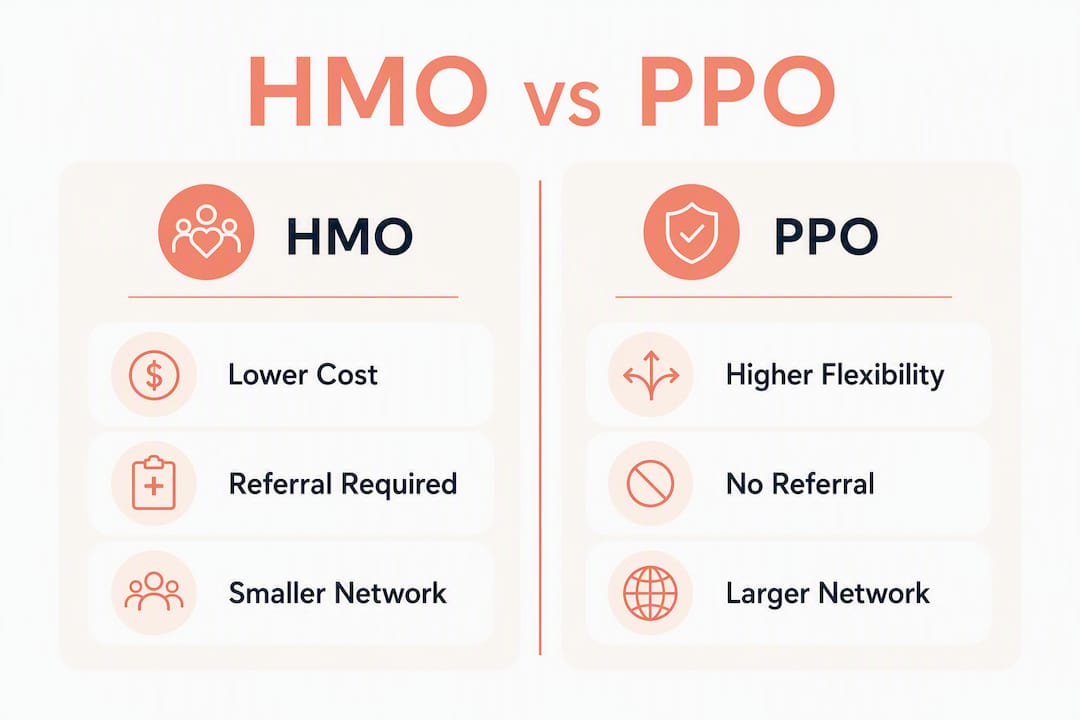
Network: HMOs restrict coverage to in-network providers except in life-threatening emergencies. PPOs cover out-of-network care too, though at a higher cost to you.
-
PCP and referrals: HMOs require you to pick a primary care physician (PCP) who coordinates your care and refers you to specialists. PPOs require neither.
Quick profile match: if you’re healthy and budget-conscious, an HMO saves you money every month. If you see specialists regularly or manage a chronic condition, a PPO’s flexibility tends to justify the extra cost. If you travel frequently or split time between states, a PPO is almost always the better fit.
MoneyGeek reports that Silver-tier HMO plans average $674/month for a 40-year-old, while Silver-tier PPO plans average $789/month. That $115/month gap adds up to $1,380 per year before you factor in deductibles and copays.
For readers comparing plans specifically to access therapy or medication management, Kin-wellness accepts both PPO and HMO insurance and provides billing support to help you understand your coverage before your first session.
Table of Contents
-
HMO vs PPO side by side: the comparison that actually matters
-
How costs actually break down: premiums, deductibles, copays, and more
-
Networks, referrals, and seeing specialists without surprises
-
How HMO and PPO coverage works for therapy and mental-health services
-
Kin-wellness can help you verify coverage before your first session
What is an HMO and how does it actually work?
An HMO, or Health Maintenance Organization, is a managed-care plan built around a single coordinating doctor and a defined network of providers. Healthcare.gov describes HMOs as plans that generally limit coverage to care from doctors who work for or contract with the plan, with no coverage for out-of-network care except in genuine emergencies.
How PCPs and referrals work
Your PCP is the gatekeeper. Before you can see a cardiologist, dermatologist, or therapist, your PCP typically must issue a referral. Without one, the visit may not be covered at all. This structure keeps costs predictable but adds a step every time you need specialized care.
-
You choose a PCP from the plan’s network when you enroll.
-
Your PCP manages routine care and coordinates specialist visits.
-
Specialist visits require a referral from your PCP in most cases.
-
Out-of-network care is not covered except for true emergencies.
-
Lower premiums and predictable copays are the trade-off for these restrictions.
A simple HMO specialist visit scenario
-
You notice a skin issue and call your PCP.
-
Your PCP sees you at a $25 copay and decides a dermatologist is needed.
-
Your PCP issues a referral; you schedule the dermatologist appointment.
-
You pay a $40 specialist copay. Total out-of-pocket: $65.
Without the referral, that dermatologist visit could be denied entirely.
Emergency care and your Evidence of Coverage
HMOs do cover emergency care even when you’re out of network, but the definition of “emergency” matters. A broken arm at an out-of-state urgent care qualifies; a routine visit to a non-network clinic does not. Always check your plan’s Evidence of Coverage (EOC) for the exact language your insurer uses to define an emergency. You can request the EOC directly from your insurer or find it in your online member portal.
What is a PPO and how does it work differently?
A PPO, or Preferred Provider Organization, trades the HMO’s cost discipline for flexibility. You can see any doctor, in-network or out, without a referral. Healthcare.gov notes that PPOs usually cover a larger network and allow out-of-network care, though at higher cost-sharing for the member.

How out-of-network claims work
When you see an in-network provider, the insurer pays its contracted rate and you pay your share. When you go out of network, the math changes. PPO plans cover out-of-network providers but typically with higher patient cost-sharing, and sometimes you’ll need to file the claim yourself to get reimbursed. That means collecting an itemized bill and the provider’s tax ID, then submitting paperwork to your insurer.
-
No PCP assignment required.
-
No referrals needed to see specialists.
-
Out-of-network care is covered, usually at a higher coinsurance rate.
-
You may need to file claims manually for out-of-network visits.
-
Premiums and deductibles are generally higher than HMO equivalents.
A PPO out-of-network specialist scenario
-
You want to see a specific neurologist who is out of network.
-
You schedule directly, no referral needed.
-
The visit costs $350. Your PPO covers 60% of the allowed amount after your deductible; you pay the rest plus any balance billing.
-
You submit the claim with the itemized bill. Reimbursement arrives in 2–4 weeks.
Who PPOs fit best
PPOs are often the right call for people who travel for work, live in rural areas with thin in-network options, or already have established relationships with out-of-network specialists. PPOs typically have larger networks and greater geographic portability than HMOs, which makes them practical for anyone who can’t predict where they’ll need care.
HMO vs PPO side by side: the comparison that actually matters
| Feature | HMO | PPO |
|---|---|---|
| Network size | Smaller, localized | Larger, broader geographic reach |
| Out-of-network coverage | Emergencies only | Yes, at higher cost-sharing |
| PCP required | Yes | No |
| Referrals required | Yes (for specialists) | No |
| Monthly premium tendency | Lower | Higher |
| Deductible/copay tendency | Lower copays, often no deductible | Higher deductibles, coinsurance |
| Out-of-pocket maximum | Typically lower | Can be higher |
| Travel/relocation flexibility | Limited | Strong |
| Best-fit profile | Budget-conscious, healthy, local care | Specialist-heavy, traveler, chronic conditions |
What the premium gap looks like annually
At MoneyGeek’s Silver-tier averages of $674/month (HMO) and $789/month (PPO), a family of four paying those rates would see a $1,380/year difference per adult enrolled. Over five years, that’s $6,900 per adult in premium savings alone on the HMO side, before any difference in deductibles or copays.
HMO pros and cons
-
Pros: Lower monthly premiums, predictable copays, coordinated care through a PCP, less paperwork.
-
Cons: No out-of-network coverage (except emergencies), referrals required, limited provider choice, less useful for travelers.
PPO pros and cons
-
Pros: See any doctor without a referral, out-of-network coverage available, better for travel and multi-state care, more specialist access.
-
Cons: Higher premiums, higher deductibles, potential for surprise bills when going out of network, possible claims paperwork.
Consumer summaries consistently frame the trade-off as cost-efficiency versus clinical autonomy. Neither plan is universally better.
How costs actually break down: premiums, deductibles, copays, and more
Understanding the premium difference is just the start. The five cost components below determine your real annual spend.
-
Premium: The monthly amount you pay regardless of whether you use care. HMOs charge less here.
-
Deductible: The amount you pay out-of-pocket before insurance kicks in. Many HMOs have low or no deductibles; PPOs often carry deductibles of $500–$2,000 or more.
-
Copay: A flat fee per visit (e.g., $25 for a PCP visit). HMOs rely heavily on copays.
-
Coinsurance: A percentage of the bill you pay after meeting your deductible. PPOs use coinsurance more often, especially for out-of-network care.
-
Out-of-pocket maximum: The most you’ll pay in a plan year. Once you hit it, the insurer covers 100%. Both plan types have this cap, but the amounts differ.
Two annual cost scenarios
| Scenario | HMO | PPO |
|---|---|---|
| Monthly premium (Silver, age 40) | Lower average premium typical for HMO | Higher average premium typical for PPO |
| Annual premium | Lower typical annual premium for HMO | Higher typical annual premium for PPO |
| Deductible | Lower typical deductible for HMO | Higher typical deductible for PPO |
| 4 specialist visits (copay/coinsurance) | Typical copay-based costs for HMO specialists visits | Typical coinsurance-based costs for PPO specialist visits |
| Estimated annual total | Lower estimated annual cost typical for HMO | Higher estimated annual cost typical for PPO |
These figures use MoneyGeek’s Silver-tier averages for premiums. Deductible and copay figures are illustrative ranges typical of Silver-tier plans; your actual plan documents will show exact amounts.
When a higher premium saves you money
If you use a lot of services, a PPO’s higher premium can still cost less overall than an HMO where you’d need to pay out of pocket for out-of-network visits. The math flips when your out-of-network costs exceed the annual premium difference.
Estimating your own annual cost
-
Pull your plan’s Summary of Benefits and Coverage (SBC).
-
Note the deductible, copay amounts, coinsurance rates, and out-of-pocket maximum.
-
Estimate how many PCP visits, specialist visits, and prescriptions you use per year.
-
Multiply visits by their copay or coinsurance cost, then add the annual premium.
-
Compare that total across the HMO and PPO options available to you.
Networks, referrals, and seeing specialists without surprises
The network is where most people get tripped up. A plan’s premium looks great until you discover your doctor isn’t in it.
In-network vs. out-of-network: what it means in practice
For HMO members, out-of-network means uncovered, period. For PPO members, it means covered but more expensive, often with coinsurance rates of 30–50% instead of the 10–20% you’d pay in-network. Equifax’s consumer education confirms that PPOs typically provide out-of-network coverage at higher cost, while HMOs do not.

Referral rules and the PCP gatekeeper
In an HMO, your PCP controls access to specialists. Healthcare.gov confirms that HMOs generally require a PCP referral before you can see a specialist. PPOs skip this entirely. You call the specialist directly, schedule, and go. That difference matters most when you need to see multiple specialists quickly or when you already have a specialist relationship you want to keep.
How to verify your providers before enrolling
-
Use your insurer’s online provider directory to search by doctor name, specialty, and zip code.
-
Call the provider’s office directly and ask: “Do you accept [plan name] as in-network?”
-
Ask specifically about the facility, not just the doctor. A surgeon may be in-network while the hospital where they operate is not.
-
Review the plan’s formulary (drug list) if you take prescriptions.
-
Read the Evidence of Coverage for the exact definition of covered services and emergency care.
Pro Tip: Always confirm that the lab or facility your doctor uses is also in-network. A common billing surprise: your in-network physician orders bloodwork, but the lab they send it to is out-of-network. That facility charge lands entirely on you. Call the lab before your appointment and ask if they participate in your plan.
What happens when you need care out of state
On an HMO, out-of-state care is generally not covered unless it’s a genuine emergency. On a PPO, you can see an out-of-network provider in another state and still receive partial reimbursement. For anyone who travels regularly for work or spends months in a second location, PPOs’ geographic portability is a real, practical advantage.
How to choose between HMO and PPO: a practical checklist
Six questions will get you most of the way to the right answer.
-
How often do you use healthcare? Rarely? An HMO’s lower premium makes sense. Frequently? The PPO’s broader access may save you money on out-of-network visits.
-
Do you have a preferred doctor or specialist? Check whether they’re in-network for each plan before anything else.
-
Do you manage a chronic condition or see specialists regularly? If yes, a PPO’s referral-free access is worth the premium difference.
-
Do you travel or live in multiple locations? HMOs are poorly suited for this. A PPO is the practical choice.
-
What prescriptions do you take? Check each plan’s formulary. Drug coverage varies significantly between plans, not just plan types.
-
What’s your budget tolerance for monthly premiums vs. unexpected bills? HMOs offer predictability; PPOs offer flexibility but less cost certainty.
Scenario-based recommendations
-
Healthy single adult, rarely sees a doctor: HMO. Lower premiums, minimal care coordination friction.
-
Parent with kids who see pediatricians and occasional specialists: HMO can work if your pediatrician and preferred specialists are in-network. PPO if you want flexibility without referral delays.
-
Person with frequent specialist visits or a chronic condition: PPO. Referral-free access and out-of-network coverage reduce friction and potential gaps.
-
Frequent traveler or remote worker in multiple states: PPO. HMO coverage outside your home network is essentially nonexistent for non-emergencies.
-
Someone prioritizing mental-health therapy or medication management: Verify whether your preferred therapist or prescriber is in-network. Both plan types cover mental health, but authorization requirements differ.
Actionable next steps
-
Pull the Summary of Benefits and Coverage for each plan you’re considering.
-
Download or request the provider network directory.
-
Check the formulary for your current prescriptions.
-
Call your preferred doctors and ask about in-network status for each specific plan.
-
Run the annual cost estimate formula from the costs section above.
-
If you’re in open enrollment, note the deadline. Mid-year switches are only allowed after a qualifying life event (job loss, marriage, birth of a child).
How HMO and PPO rules apply in Medicare Advantage
Medicare Advantage plans follow the same core logic as employer-market HMOs and PPOs, with a few Medicare-specific wrinkles worth knowing.
- Where to confirm details: Medicare.gov and each plan’s Summary of Benefits are the authoritative sources. Plan documents for Medicare Advantage are updated annually, so check them each fall during open enrollment.
The enrollment rules also differ. Medicare Advantage has its own enrollment periods that don’t align with employer open enrollment. If you’re approaching Medicare eligibility, confirm whether your current HMO or PPO coverage affects your Medicare enrollment window.
How HMO and PPO coverage works for therapy and mental-health services
Mental-health coverage adds a layer of complexity that neither plan type handles identically, and the differences matter if therapy or medication management is part of your care.
Authorization and continued-care reviews
HMOs often require prior authorization for outpatient therapy, especially for intensive outpatient programs (IOP). Your PCP may need to initiate the referral, and the insurer may conduct continued-coverage reviews after a set number of sessions. PPOs typically allow you to start therapy without a referral, though some still require authorization for IOPs or extended treatment.
Checklist for therapy patients comparing plans
-
Confirm whether your preferred therapist or prescriber is in-network for each plan.
-
Ask your insurer how many outpatient therapy sessions are covered per year before prior authorization is required.
-
Ask specifically about intensive outpatient programs if that level of care is relevant to you.
-
Review the formulary for any psychiatric medications you take or may need.
-
Confirm whether telehealth and virtual therapy sessions are covered at the same rate as in-person visits.
-
Ask whether medication management visits with a prescriber require a separate authorization.
Pro Tip: Before your first therapy appointment, call your insurer and ask these two questions directly: “Does this provider require prior authorization for outpatient therapy?” and “Is there a session limit before I need to request continued authorization?” Write down the representative’s name and the date of the call. That record protects you if a claim is later disputed.
Kin-wellness provides virtual outpatient mental-health services in California, including individual therapy, group therapy, EMDR, and medication management. The team handles insurance verification and billing support, so you know what your plan covers before your first session rather than after your first bill.
Both HMO and PPO members can access Kin-wellness services. If you have out-of-network benefits through a PPO, those may apply even if Kin-wellness is not in your plan’s primary network. The billing team can walk you through exactly what your plan covers.
Key Takeaways
HMOs cost less per month but restrict you to a defined network with referral requirements; PPOs cost more but give you direct access to any provider, including out-of-network care.
| Point | Details |
|---|---|
| HMO vs PPO premium gap | Silver-tier HMOs average $674/month, PPOs $789/month for a 40-year-old—a $115/month or $1,380/year difference per adult enrolled. |
| Network and referral rules | HMOs require a PCP and referrals; PPOs allow direct specialist access and partial out-of-network coverage. |
| Best fit by profile | Budget-conscious or healthy adults favor HMOs; frequent travelers, specialist users, and chronic-condition patients favor PPOs. |
| Always verify your Evidence of Coverage | Check your plan’s EOC and provider directory before enrolling to avoid surprise bills. |
| Mental-health access with Kin-wellness | Kin-wellness accepts PPO and HMO insurance and provides billing support for therapy and medication management in California. |
The real trade-off most people underestimate
The PPO vs HMO debate gets framed as “flexibility vs. savings,” and that framing is mostly right but incomplete. What people underestimate is how much the referral requirement actually costs in time, not just money.
An HMO’s PCP gatekeeper adds friction at every specialist visit. For someone who’s healthy and sees a doctor twice a year, that friction is nearly invisible. For someone managing anxiety, depression, or a chronic physical condition who needs to coordinate care across multiple providers, that friction compounds. Waiting for a referral, scheduling a PCP visit first, then scheduling the specialist can add weeks to a care timeline that already feels urgent.
The cost math also deserves more scrutiny than most people give it. The $115/month premium difference sounds significant until you realize that a single out-of-network emergency on an HMO can cost thousands of dollars that the plan won’t touch. Conversely, a PPO’s higher premium is genuinely wasteful if you’re healthy and never use out-of-network care. The right answer depends entirely on your actual utilization pattern, not on which plan sounds better in a summary.
My honest counsel: run the annual cost estimate before you decide, not after. Pull last year’s EOB (Explanation of Benefits) statements, count your actual visits, and do the math with the specific plan documents in front of you. Generic averages are a starting point. Your numbers are the answer.
Kin-wellness can help you verify coverage before your first session
Choosing between a PPO and an HMO is complicated enough. Figuring out whether your mental-health provider is covered under either plan adds another layer most people don’t have time to navigate alone.
Kin-wellness offers virtual outpatient mental-health services for adults in California, including individual therapy, group therapy, family therapy, EMDR, and medication management, all provided by licensed therapists and prescribers. The team works directly with PPO and HMO insurance plans and handles the verification process so you know your coverage before you commit to a session, not after you receive a bill.
If you have out-of-network benefits through a PPO, those benefits may apply to Kin-wellness services even if the practice isn’t listed in your plan’s primary directory. The billing team can confirm this for you. Explore Kin-wellness services or visit kin-wellness.com to check availability and start the intake process.
This article provides general information about health insurance plan types and is not a substitute for advice from a licensed insurance professional or your plan’s official documents. Confirm all coverage details with your insurer before enrolling.
Useful sources and further reading
These are the primary authoritative sources used for factual claims in this article. Keep your plan’s Summary of Benefits and Coverage handy when you call your insurer.
-
Healthcare.gov — Plan Types: The federal reference for HMO and PPO definitions, network rules, and PCP/referral requirements. Start here for plan-type basics.
-
MoneyGeek — What Is HMO Insurance?: Source for Silver-tier average premium figures and HMO cost breakdowns.
-
MoneyGeek — HMO vs. PPO: Comparative analysis of network size, geographic portability, and plan trade-offs.
-
Forbes Advisor — HMO vs. PPO: Practitioner-oriented guidance on referral rules, out-of-network claims paperwork, and facility billing surprises.
-
Verywell Health — What Is an HMO?: Consumer-friendly explanation of HMO cost structures and care coordination.
-
Equifax — HMO vs. PPO Insurance Plans: Consumer education overview of out-of-network coverage differences.
-
Medicare.gov: The official source for Medicare Advantage plan rules, enrollment periods, and provider participation details.
-
HealthInsuranceFAQs — Pros and Cons of HMOs: Concise consumer-facing summary of HMO advantages and drawbacks.