

Your heart is slamming, your chest feels tight, and you're convinced something is seriously wrong. Here's the fastest way through it: name what's happening ("this is a panic attack, not an emergency"), slow your exhale, and get yourself somewhere quieter if you safely can. Panic attacks peak within about ten minutes and resolve within 20 to 30, so the goal isn't to stop it cold. It's to ride it out without making things worse.
If you can step away, take a short, unremarkable exit. A bathroom break, a walk to refill your water bottle, an empty conference room. You don't owe anyone a real-time explanation. If you're stuck in the meeting or on the call, breathe through your nose for a count of four, then exhale slowly for six or seven. That longer exhale does more physiological work than people expect.
Here's a short script you can adapt on the spot:
- "Give me two minutes, I need to grab something from my desk."
- "Can we pick this up right after the next item? I need a quick break."
- "I'm stepping out for a minute, back shortly."
None of these require disclosure. They buy you time and privacy.
Pro Tip: Keep a folded index card or phone note with your go-to exit phrase and breathing pattern. Rehearsing it once when you're calm makes it far easier to grab under pressure.
If these episodes are becoming frequent, that's a signal worth acting on, not white-knuckling through. Work-focused CBT is associated with the strongest return-to-work outcomes for people dealing with recurring panic, and getting ahead of it now tends to be far easier than managing it after months of avoidance.
Key Takeaways
Panic attacks at work peak within about ten minutes and resolve within 30, and work-focused CBT combined with a calm, accommodation-friendly workplace produces the best long-term outcomes.
| Point | Details |
|---|---|
| Name it fast | Silently identifying "this is panic, not an emergency" interrupts the fear loop and speeds recovery. |
| Exhale longer than you inhale | A four-count inhale and six to seven count exhale signals your nervous system to downshift. |
| Return after brief exits | Going back to the task once steady prevents avoidance from becoming a long-term pattern. |
| Treatment works | Work-focused CBT and, when needed, SSRIs or SNRIs improve return-to-work outcomes more than general anxiety therapy alone. |
| Accommodations don't require full disclosure | ADA and JAN guidance support flexible breaks, advance meeting notice, and telework with minimal detail shared. |
| Kin-wellness offers a direct next step | Virtual outpatient and intensive outpatient care, including work-focused therapy and medication management, built for working adults. |
Where to Learn More
- Panic Disorder overview — NIMH
- Workplace accommodation guidance — Job Accommodation Network
- Work-focused CBT and return-to-work evidence — PMC
- Kin-wellness services for working adults
This article is general information, not a substitute for advice from a qualified doctor. Consult a qualified healthcare professional about your own circumstances before acting on anything here.
Table of Contents
- What Is a Panic Attack, and What Does It Look Like at Your Desk?
- How to Manage a Panic Attack Discreetly at Your Desk or in a Meeting
- What to Do After the Attack Passes
- What Actually Treats Recurring Panic at Work
- Your Rights at Work: ADA, JAN, and Reasonable Accommodations
- How Managers Should Respond When an Employee Has a Panic Attack
- Reducing Panic Triggers Before They Start
- Sources
What Is a Panic Attack, and What Does It Look Like at Your Desk?
A panic attack is a sudden surge of intense fear or physical discomfort that arrives with little or no warning, according to the National Institute of Mental Health (NIMH). It's not a character flaw or a sign you can't handle your job. It's a nervous system misfire, and open offices, back-to-back meetings, and high-stakes presentations make the perfect environment for one to surface, since you often can't leave, move, or speak freely when it hits.
The symptoms cluster into a fairly recognizable pattern:
- A racing or pounding heart
- Chest tightness or a feeling of pressure
- Shortness of breath or a sense you can't get enough air
- Dizziness or lightheadedness
- Tingling in your hands, feet, or face
- Sweating, trembling, or hot and cold flashes
- Derealization, that strange sense of being disconnected from the room or from yourself
Most attacks peak around the ten minute mark and taper off within 20 to 30 minutes. Afterward, it's common to feel drained, shaky, or foggy for an hour or two. That's your body coming down from a genuine adrenaline surge, not a sign you're broken.
A small number of situations need more than breathing and grounding. Get emergency care if you experience new, severe chest pain that doesn't match your usual panic pattern, if you actually faint rather than just feeling faint, or if you lose function for an extended period and can't reorient yourself. Panic attacks are frightening but self-limited. Cardiac events and other emergencies are not, and it's always better to get checked than to assume.
How to Manage a Panic Attack Discreetly at Your Desk or in a Meeting
You don't need a private office or a wellness room to get through this. Most of what works fits inside a normal workday without anyone noticing.
Step 1: Name it and remind yourself of the physiology. Silently or under your breath, say "this is panic, it will peak and pass." That single sentence interrupts the fear-of-the-fear loop that makes attacks feel endless. You're not in danger. You're having a physical reaction that has a predictable shape and a predictable end.
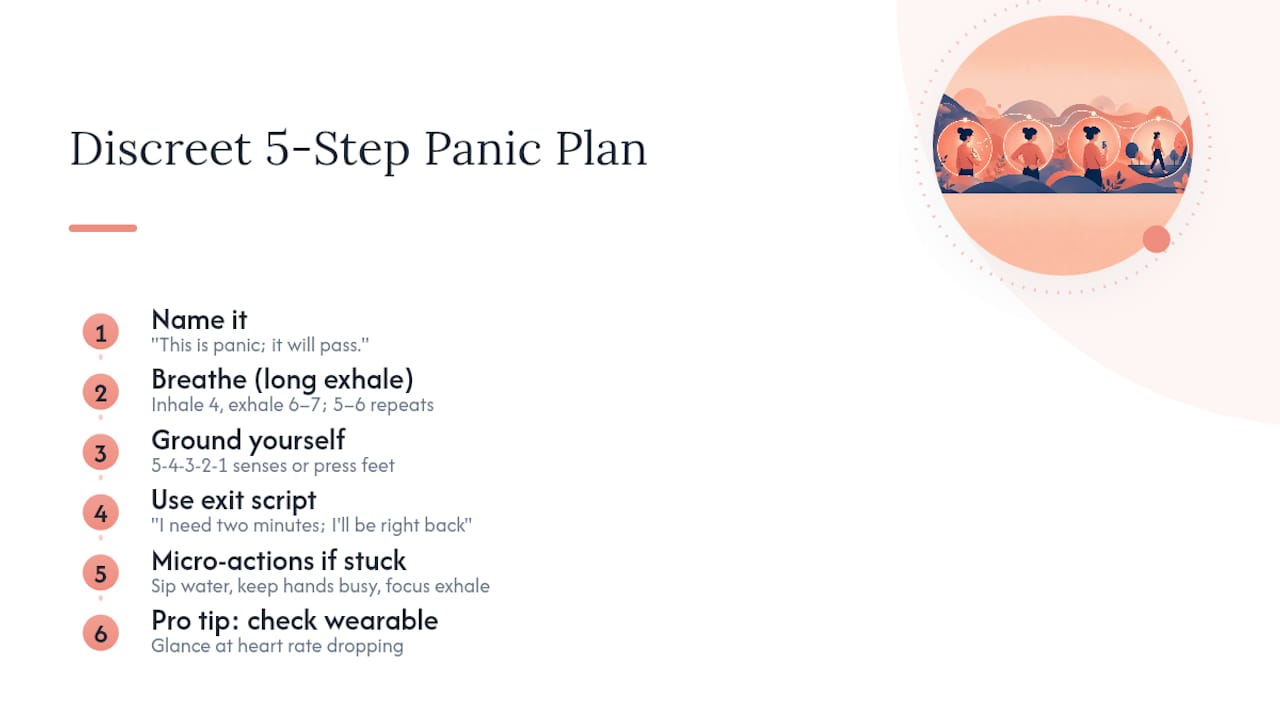
Step 2: Breathe with a longer exhale than inhale. Inhale through your nose for a count of four, then exhale slowly through pursed lips for six or seven. Do this five or six times. You can do it at your keyboard, on a video call with your camera adjusted slightly, or standing at a printer. Nobody needs to know you're doing it. The extended exhale is the part that matters most, since it signals your nervous system to downshift.
Step 3: Ground yourself in the room. The classic 5-4-3-2-1 method works seated or standing: silently note five things you can see, four you can hear, three you can touch, two you can smell, and one you can taste. If that feels like too much to track, simpler versions work too. Press your feet flat into the floor and notice the pressure. Hold a pen, a stress ball, or the edge of your desk and focus on the texture. Grounding pulls your attention out of the spiral and back into your physical surroundings, which is often enough to blunt the intensity.

Step 4: Use a short exit script if you need distance. "I need two minutes, I'll be right back" works in almost any setting, whether it's a one-on-one, a client call, or a team standup. Step into a bathroom, an empty room, or outside if you have access. Once there, keep breathing and grounding for another minute or two before deciding whether to return. Most people are ready to go back once the peak intensity has passed, usually well inside that ten-minute window.
Step 5: If you truly cannot leave, use micro-actions. Sip water slowly. Keep your hands moving on something steady, like taking notes even if they're messy. Look down at your desk or notepad rather than around the room, and focus purely on your exhale. These small physical anchors keep you functional even mid-attack, and colleagues rarely notice anything beyond someone who looks briefly distracted.

Pro Tip: If you use a wearable that tracks heart rate, glance at it once symptoms ease. Watching your heart rate actually decline can shortcut the fear that "something is still wrong," since you get real-time proof your body is settling.
None of these steps require you to disclose anything to coworkers. They're designed to work in silence, which matters when privacy is part of what makes an attack feel survivable.
What to Do After the Attack Passes
Once the peak has faded, give yourself a few minutes of actual recovery before diving back into work. Drink water, sit or stand somewhere calm if you can, and let your body finish settling. A short walk, even just to the break room and back, helps burn off the leftover adrenaline. Keep the exhale-focused breathing going for another minute or two.
Here's the part that surprises people: going back to your task or meeting, once you're steady enough, is usually the better move. Consistently bolting from every situation that triggers panic can reinforce an avoidance cycle, where your brain learns that the only way to feel safe is to escape. Clinicians generally advise a brief, safe exit followed by returning when possible, which teaches your nervous system that the trigger wasn't actually dangerous.
A few habits make this easier to manage over time:
- Keep a short log: date, time, what you were doing, and roughly what triggered it. Patterns show up faster than you'd expect.
- Note your recovery time so you and a clinician can track whether treatment is helping.
- Rate the intensity on a simple 1 to 10 scale so you have something concrete to report later.
- Flag anything unusual (new symptoms, longer recovery, more frequent episodes) for your next appointment.
Sometimes the right call is to take the rest of the day. If you're genuinely too shaky to focus, tell your manager plainly and briefly: "I'm not feeling well and need to head out, I'll follow up tomorrow." You don't need to detail the panic attack itself. Protecting your privacy and protecting your job aren't in conflict here.
What Actually Treats Recurring Panic at Work
If panic attacks are showing up more than once or twice, self-management tactics stop being enough on their own, and that's the point to bring in professional support rather than a sign you've failed at coping alone.
Work-focused CBT (w-CBT) is the standout option here. Unlike general anxiety therapy, it specifically targets workplace triggers and teaches problem-solving skills for the demands of your job, whether that's public speaking, tight deadlines, or open-office exposure. It's associated with the best return-to-work outcomes among panic treatments, largely because it addresses avoidance directly rather than treating work as an afterthought. Interoceptive exposure, a technique often folded into w-CBT, gradually trains you to tolerate the physical sensations of panic (racing heart, shortness of breath) without the fear response taking over.
Medication is often part of the picture too. SSRIs and SNRIs are standard first-line options for panic disorder, though they typically take several weeks to reach full effect, so they work best paired with therapy rather than as a standalone fix.
The clinical evidence backs this combined approach clearly:
- Work-focused CBT reduces avoidance more reliably than therapies that don't specifically address workplace context.
- Panic-specific psychotherapy has been linked to measurable improvements in work ability after a course of treatment.
- Combined medication and therapy tends to outperform either approach alone for recurring cases.
A clinical study of panic-focused psychotherapies found improvements in work ability after treatment, supporting the idea that targeted therapy produces real occupational gains, not just symptom relief on paper.
When you're looking for a clinician, ask directly whether they use work-focused approaches, whether telehealth is available for scheduling flexibility, and whether they handle insurance billing so you're not left navigating claims on your own. Kin-wellness's therapy for working professionals page walks through what that kind of specialized care looks like in practice.
Your Rights at Work: ADA, JAN, and Reasonable Accommodations
Panic disorder and related anxiety conditions can qualify for protection under the Americans with Disabilities Act (ADA) when they substantially limit a major life activity, and that opens the door to what's called the interactive process, a conversation between you and your employer about reasonable accommodations.
The Job Accommodation Network (JAN) documents accommodations that employers commonly grant for panic and anxiety, and none of them require detailing your diagnosis:
- Advance notice before meetings, so you can mentally prepare rather than getting ambushed
- Flexible or additional break schedules
- A quieter workspace or permission to use noise-canceling headphones
- Temporary telework, especially during a flare-up period
- Modified public-facing duties, such as fewer presentations or client-facing calls for a defined stretch
A brief note from your clinician describing functional limitations (not a full diagnosis) is usually enough to support a request. It can be as simple as stating you need flexibility around meeting scheduling due to a medical condition.
If you're limiting what you disclose, a script like this works well: "I have a medical condition that occasionally affects my focus during long meetings. I'd like to talk about a few adjustments that would help." That's specific enough to trigger the interactive process without oversharing.
Document your requests in writing, even a short follow-up email after a verbal conversation, so there's a record if you need to reference it later. California readers should also check state-specific mental health leave rights, which sometimes offer more protection than federal ADA baselines alone.
How Managers Should Respond When an Employee Has a Panic Attack
If you supervise someone who has a panic attack at work, your response in that moment shapes whether they trust you with the next one.
- Stay calm and give space. Lower your voice, step back physically, and avoid crowding them. Don't touch them unless they ask you to.
- Offer a quiet spot, if one's available, without insisting they explain what's happening in front of others.
- Check in privately later, not in the moment and not in front of the team. A quiet "how are you doing, is there anything you need" goes a long way.
- Mention available resources, like an Employee Assistance Program (EAP) or benefits information, without pressuring disclosure of a diagnosis.
- Loop in HR only when necessary, generally for formal accommodation requests, and keep documentation separate from general personnel files to protect confidentiality.
Avoid a few common missteps: don't demand an explanation on the spot, don't comment on it in front of coworkers, and don't let it factor into performance reviews or disciplinary action. Stigma remains one of the biggest reasons employees delay seeking help, and a manager's calm, discreet response does more to reduce future absences than any policy memo.
Reducing Panic Triggers Before They Start
Prevention rarely means eliminating stress entirely; practical strategies like those in workplace stress management for GPs and employers can help lower your baseline enough that ordinary workplace pressure doesn't tip into a full episode. It means lowering your baseline enough that ordinary workplace pressure doesn't tip into a full episode.
Sleep and caffeine deserve attention first. Poor sleep and heavy caffeine intake both amplify the physical symptoms that mimic or trigger panic, like a racing heart or jitteriness. Scheduling short movement breaks, even a five-minute walk between meetings, helps metabolize stress hormones before they build up.
A few other habits worth building into your day:
- A 60 second breathing or grounding ritual before high-stakes meetings, done at your desk beforehand
- Adjusting your workspace to reduce sensory overload (dimmer lighting, fewer notifications, headphones)
- Blocking micro-breaks between back-to-back calls instead of stacking them
- Reassessing whether therapy or medication belongs in your routine if lifestyle changes alone aren't cutting it
Kin-wellness's guide to mindfulness exercises for anxiety has longer breathing and grounding routines worth practicing outside of a crisis moment, since they work better under pressure once they're already familiar.
A Note From Dakota
Panic at work has a specific kind of shame attached to it. You're supposed to look competent, and instead your hands are shaking under the conference table. What helped me most wasn't some elaborate technique. It was accepting that stepping out for two minutes isn't a failure, it's maintenance. Naming it out loud, even just to myself, took away half its power. If this is happening more than once in a while, please don't just white-knuckle it. Kin-wellness exists for exactly this.
— Dakota
How Kin-wellness Supports Working Adults Through Workplace Panic
If panic attacks are becoming a regular part of your workday, Kin-wellness offers a more direct path than trying to piece together coping strategies alone. Kin-wellness provides virtual outpatient and intensive outpatient care built specifically for working professionals, parents, executives, and healthcare workers, including work-focused therapy, medication management, and insurance billing support so you're not navigating claims solo.
Intake typically starts with a short consultation to match you with a licensed therapist or prescriber who understands the pressures of your specific role, whether that's client-facing deadlines, clinical shifts, or executive-level scrutiny. Sessions happen by telehealth, which means no commute eating into a lunch break just to get care. If you're ready to stop managing this alone, explore Kin-wellness's services and get matched with a clinician who treats work-related panic as the specific, addressable issue it is.
Sources
- Panic Disorder: When Fear Overwhelms — NIMH
- Panic at Work: What to Do When an Attack Arrives at the Desk — AnxietyResource
- Evidence summary on work-focused CBT and return-to-work outcomes — PMC
- Panic attacks: They don't always wait until after hours — Job Accommodation Network (JAN)
- Panic-specific psychotherapies and work ability — Journal article DOI