

High-functioning anxiety describes clinically significant anxiety hidden behind competence, achievement, and a packed calendar. It is not a separate condition in the DSM-5, just a pattern where the outside looks fine while the inside runs on dread. If that sounds familiar, three things help immediately:
- Book a check-in with a therapist or prescriber this week, even a short one.
- Try the 3-3-3 rule right now: name three things you see, three you hear, three you can move.
- Pick one boundary to test today, like leaving work on time once.
Left alone, this pattern tends to compound into burnout, depression, or physical health problems. Small moves now change that trajectory.
Key Takeaways
High-functioning anxiety hides real clinical distress behind productivity, and treating it requires recognizing the mask, understanding the fight response driving it, and getting evaluated rather than self-diagnosing.
| Point | Details |
|---|---|
| Not a formal diagnosis | High-functioning anxiety overlaps with GAD but requires a clinical evaluation for actual treatment access. |
| Overwork is the tell | The "fight" or compulsive productivity response, not avoidance, often signals this specific anxiety pattern. |
| Techniques need backup | Grounding and breathing help acutely, but therapy targets the underlying beliefs driving the mask. |
| Watch for red flags | Sleep disruption, substance use, or suicidal thoughts mean it's time to call a clinician or 988 immediately. |
| Kin-wellness offers a next step | Virtual outpatient therapy and medication management from licensed providers fit around demanding work schedules. |
Table of Contents
- What Does High-Functioning Anxiety Feel Like?
- What Causes High-Functioning Anxiety?
- Is It Anxiety, GAD, or ADHD?
- How Do You Treat High-Functioning Anxiety?
- Why Does Overwork Hide Anxiety So Well?
- When Should You Get Professional Help?
- You're Not Failing, You're Coping the Only Way You've Learned
- Get Support Built for People Who Don't Stop
- Frequently Asked Questions
- Sources
What Does High-Functioning Anxiety Feel Like?
Internally, it runs on a loop most people never see. Chronic worry sits underneath everyday decisions, perfectionism turns normal tasks into pass/fail tests, and self-criticism fills any gap between "good" and "perfect." Anticipatory anxiety shows up before meetings, emails, even weekends, because a quiet moment leaves room for intrusive negative thoughts.
Outwardly, the same person looks like your most reliable coworker. Over-preparation becomes a personality trait. Saying no feels physically uncomfortable, so the calendar fills until boundaries disappear entirely. People-pleasing and high output become the mask, and the mask works, which is exactly the problem: nobody intervenes when someone looks this capable.
The body keeps a separate ledger. Common physical symptoms include:
- Insomnia or restless, shallow sleep
- Muscle tension, especially in the jaw, neck, and shoulders
- Stomach upset and digestive complaints
- Headaches and a racing or pounding heart
High-functioning anxiety by the numbers: anxiety disorders are among the most common mental health conditions, and only a minority of people with anxiety ever receive treatment, largely because symptoms like these get dismissed as personality traits rather than treated as a clinical pattern. The stomach and headache complaints are not incidental. Research on gut-brain signaling shows the digestive system and the nervous system talk to each other constantly, which is why anxious people often get diagnosed with irritable stomachs before anyone asks about their sleep.
Picture a hospital charge nurse who never misses a shift, triple-checks every chart, and answers texts from coworkers at midnight. She hasn't taken a sick day in two years. She also hasn't slept more than five hours a night in six months, and she assumes the tight chest before rounds is just caffeine.

What Causes High-Functioning Anxiety?
Genetics load part of the gun. A family history of anxiety raises risk, and neurobiological research on stress response points to real changes in how the brain's threat-detection networks fire under chronic pressure.
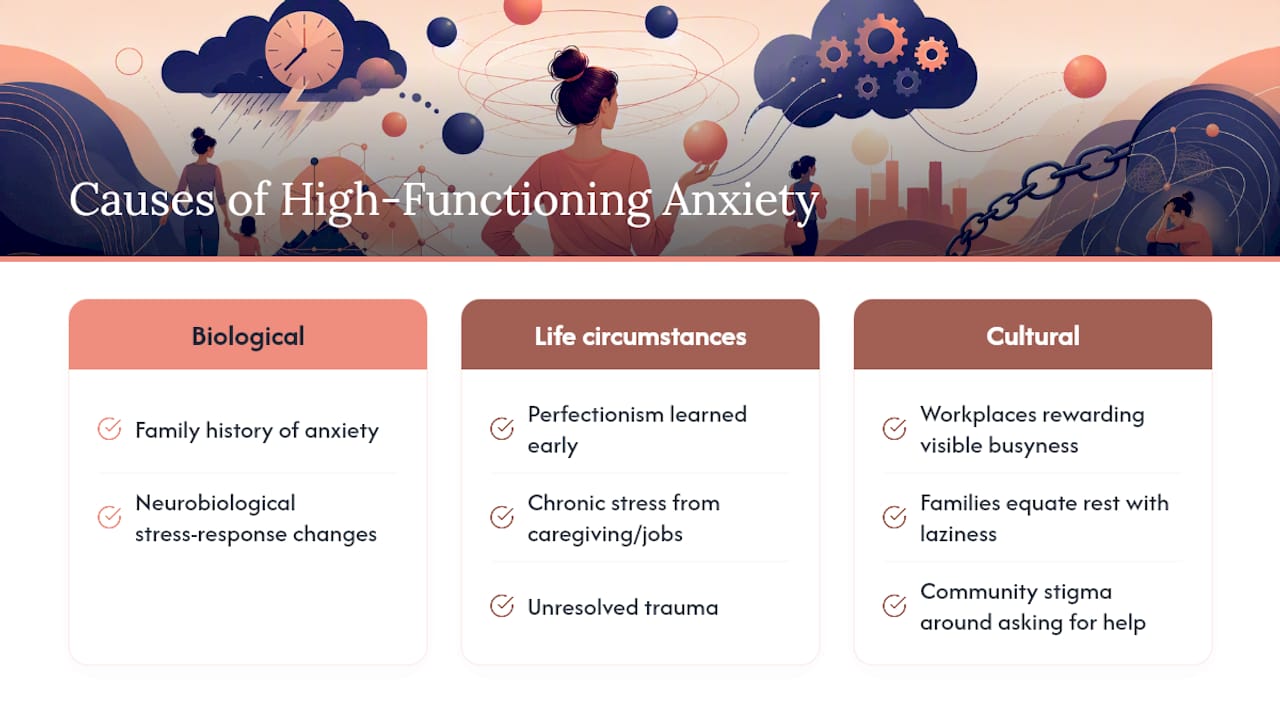
Life circumstances pull the trigger. Perfectionism learned early, chronic stress from caregiving or high-stakes jobs, and unresolved trauma all feed the pattern. So does culture: workplaces that reward visible busyness, families that equate rest with laziness, and communities where asking for help still carries stigma.
When a clinician evaluates anxiety, they're not looking for a dramatic breakdown. They ask about sleep, concentration, physical symptoms, and how much effort it takes to maintain the appearance of being fine. That last question usually reveals the most.
Is It Anxiety, GAD, or ADHD?
Generalized anxiety disorder and high-functioning anxiety overlap heavily. Both involve chronic worry and physical tension. The difference clinicians watch for is behavioral: GAD often produces avoidance, while high-functioning anxiety tends to trigger a "fight" or compulsive productivity response instead of pulling back.
ADHD complicates the picture further. Restlessness, racing thoughts, and difficulty relaxing can look identical across both, but ADHD stems from attention regulation, not fear-based worry, which changes what treatment actually helps.
High-functioning anxiety isn't in the DSM-5, so it can't be billed or diagnosed on its own. That matters for insurance and treatment access. What usually gets diagnosed instead is generalized anxiety disorder, and a proper evaluation, including screening tools and a real history, sorts out which pattern is driving the symptoms.
- GAD: worry plus avoidance of triggering situations
- High-functioning anxiety: worry plus overwork as the coping response
- ADHD: attention and impulsity issues that mimic anxious restlessness
A formal evaluation is worth pursuing when symptoms interfere with sleep, relationships, or work performance, regardless of which label ends up fitting.
How Do You Treat High-Functioning Anxiety?
Therapy works, and which kind depends on what's driving the pattern. Cognitive behavioral therapy targets the perfectionism and catastrophic thinking underneath the busyness. Acceptance and commitment therapy helps when avoidance of discomfort, not just avoidance of tasks, is the issue. EMDR fits when trauma history feeds the anxiety. Group therapy or an intensive outpatient program makes sense when symptoms have escalated beyond what weekly sessions can address.
Medication callout: SSRIs and SNRIs are frequently combined with therapy for moderate to severe anxiety. A comparison of SSRI and SNRI options is worth reviewing before a prescriber appointment, since the two classes affect side effects and energy levels differently. Medication decisions should always run through a licensed prescriber, not a symptom checklist.
Daily techniques matter just as much as clinical treatment:
- The 3-3-3 rule for acute moments: three things seen, three heard, three moved.
- Paced breathing: four seconds in, six seconds out, repeated for two minutes.
- A mindfulness check before opening email in the morning.
- A boundary script for work: "I can take this on next week, not today."
- Fixed sleep and wake times, even on weekends.
Behavioral tools like breathing exercises and grounding are most effective when practiced daily, not just during a crisis, which is why clinicians often teach them inside structured therapy rather than as standalone fixes.
A realistic weekly plan: therapy every Tuesday evening, one 20-minute walk daily, a Sunday boundary review, and the 3-3-3 rule on standby for meetings that spike anxiety.

Pro Tip: Don't lead with self-help alone. Start therapy first, then layer breathing exercises and boundary scripts on top. Doing it backward often just gives anxiety a better disguise instead of treating it.
Why Does Overwork Hide Anxiety So Well?
The clinical distinction matters: high-functioning anxiety typically drives a fight response, not the avoidance seen in classic GAD presentations. Instead of shrinking from stress, the person overworks their way through it.
Overwork feels like control. It isn't. It's a coping mechanism that runs out of runway eventually, and masking symptoms behind constant busyness makes people less likely to seek help until the facade cracks.
That's why simply "stopping the busyness" rarely works on its own. Therapy has to target the belief that slowing down is dangerous. Standard outpatient therapy fits most cases; escalating functional decline usually calls for IOP-level intensity.
When Should You Get Professional Help?
Some signals mean it's time to act now, not eventually:
- A noticeable decline in work or home functioning
- Disrupted sleep or eating that isn't improving
- Any thoughts of suicide or self-harm
- Increased alcohol or substance use to cope
- Physical symptoms that don't respond to rest or self-care
If any of those apply, here's how to move fast:
- Call or text 988 if there's any risk to your safety right now.
- Book an appointment and bring a symptom log, current medications, and recent stressors.
- Ask your doctor directly for a referral to a mental health provider.
Telling a manager or family member doesn't require full disclosure. A simple "I'm managing a health issue and adjusting my workload" is enough to start a conversation about accommodations.
You're Not Failing, You're Coping the Only Way You've Learned
Looking successful while feeling like you're barely holding it together isn't a personal failure. It's a pattern, and patterns can change. The exhaustion behind the achievement is real, and naming it is the first honest thing you can do for yourself today.
Try one small boundary this week, even a five-minute one. Or spend sixty seconds on paced breathing before your next high-stakes meeting. Neither fixes everything, but both prove to your nervous system that slowing down doesn't mean falling apart.
Get Support Built for People Who Don't Stop
Kin-wellness works with working professionals, parents, executives, and healthcare workers whose anxiety hides behind their achievements, not despite them. Virtual outpatient therapy, medication management, and tailored program options fit around a schedule that doesn't leave room for a traditional commute-to-therapy routine.

Sessions run on telehealth or in person depending on your needs, and licensed therapists and prescribers coordinate care so you're not managing therapy and medication as two disconnected systems. Insurance billing support handles the paperwork side, so the appointment itself is the hard part, not the logistics. If the signs in this article sound like your week, explore Kin Wellness services and request a consultation to talk through what level of care actually fits.
Frequently Asked Questions
Is high-functioning anxiety a real diagnosis? No. It's a widely used clinical term describing an anxiety pattern, not a standalone entry in the DSM-5. Most people with this presentation get formally diagnosed with generalized anxiety disorder after evaluation.
How is high-functioning anxiety different from ADHD? ADHD stems from attention regulation difficulties, while high-functioning anxiety stems from fear-based worry that gets channeled into overwork. Both can involve restlessness, which is why a proper assessment matters more than self-diagnosis.
Can high-functioning anxiety go away on its own? Rarely. Masking symptoms behind productivity tends to delay treatment and can lead to burnout or depression over time. Therapy and, when appropriate, medication address it more reliably than willpower alone.
What's the fastest way to calm anxiety in the moment? The 3-3-3 rule and paced breathing both work quickly for acute spikes. Neither replaces therapy, but both buy you room to think clearly during a stressful moment.
This article is general information, not a substitute for advice from a qualified doctor. Consult a qualified healthcare professional about your own circumstances before acting on anything here.
Sources
- What is high-functioning anxiety? — Cleveland Clinic
- Tips and Strategies to Manage Anxiety and Stress — ADAA
- Anxiety disorders — NIMH