

Yes, most nurses recover from burnout, and recovery usually starts before any therapy or program begins. The first move is stabilizing: get safe, get rest, tell your manager something has to change, and get a clinical evaluation if you're not functioning at work or at home. Everything else in nurse burnout recovery builds from that first step.
TL;DR:
- Recognizing emotional exhaustion, depersonalization, or reduced personal accomplishment early allows nurses to seek immediate stabilization and prevent severe burnout.
- Understaffing and mandatory overtime are primary drivers of burnout, with organizational factors like workplace culture and staffing ratios influencing recovery outcomes.
- Rapid recovery involves addressing sleep, nutrition, and mental health through brief interventions and requesting temporary schedule adjustments within the first two weeks.
- Monitoring burnout severity with validated tools like the MBI or ProQOL helps track progress, with persistent or worsening scores indicating need for clinical intervention.
- Peer support and management-led systemic changes are crucial for sustaining recovery and preventing relapse, along with professional therapy if symptoms do not improve after several weeks.
Table of Contents
- What Are the Warning Signs You Need to Address Now?
- Why Do Nurses Burn Out in the First Place?
- What Should You Do in the First Two Weeks?
- How Long Does Nurse Burnout Recovery Actually Take?
- How Do You Prevent Burnout From Coming Back?
- How Do You Get Your Employer to Actually Change Something?
- What Do Nurses Get Wrong About Recovering From Burnout?
- Peer Support: The Recovery Tool Nurses Underuse
- Time Management Tactics That Actually Fit a 12-Hour Shift
- How Do You Know Recovery Is Holding, Not Just Pausing?
- Why Recovering From Burnout Is a Patient Safety Issue, Not Just a Self-Care One
- Does Your Unit's Leadership Style Make Burnout Better or Worse?
- When Does Burnout Need a Therapist, Not Just Rest?
- What Tools Can You Use to Measure Your Own Burnout Severity?
- Where Kin Wellness Fits Into Your Recovery
- Sources
What Are the Warning Signs You Need to Address Now?
Burnout shows up differently in different nurses, which is part of why so many miss it until it's severe. The Maslach model breaks it into three dimensions: emotional exhaustion, depersonalization (that flat, detached feeling toward patients you used to care about deeply), and a shrinking sense of personal accomplishment. You don't need all three to be in trouble.
Emotional signs come first for most people: chronic exhaustion that sleep doesn't fix, cynicism about the job, numbness where empathy used to be. Physical signs follow close behind, including disrupted sleep, tension headaches, and appetite swings in either direction. Behavioral and professional signs are the ones coworkers notice first: more medication errors, withdrawing from the unit, calling out more often.
Nurse burnout affects a significant portion of U.S. nurses, varying by specialty and study methodology, according to the National Academies' Future of Nursing 2020-2030 report. That range is wide because burnout is measured inconsistently across hospitals, but even the low end represents more than a third of the workforce.
A few signals mean you shouldn't wait for a staged plan:
- Thoughts of self-harm or suicide, even passing ones
- Inability to get out of bed or function at home for several days running
- Making or nearly making a serious medication or documentation error
- Drinking or using substances to get through a shift
Any one of those is a reason to seek same-day or urgent mental health evaluation, not a wellness app. If you're unsure whether what you're feeling is burnout or something clinical, the difference between burnout and depression often comes down to whether symptoms lift on days off. Burnout typically eases with distance from work; depression usually doesn't.
Why Do Nurses Burn Out in the First Place?
Understaffing sits at the root of most nurse burnout, but it rarely travels alone. Twelve-hour shifts stacked back to back, documentation requirements that eat into patient time, and floating to units you're not trained for all compound the exhaustion. The American Nurses Association frames chronic self-neglect among nurses as a direct patient-safety issue, not a personal failing, because tired, depleted nurses make more errors.
Common drivers include:
- Chronic understaffing that forces unsafe patient ratios
- Mandatory overtime and unpredictable scheduling
- Documentation and administrative burden that crowds out actual care
- Moral injury from repeatedly acting against your own values because of resource limits
- Lack of control over assignments, breaks, or scheduling
Moral injury deserves its own definition here because it gets confused with garden-variety stress. It's the wound that comes from being forced, again and again, to make choices that violate your ethics as a caregiver, like discharging a patient you know isn't ready because the bed is needed, or skipping a family conversation you know they deserved. That's different from being tired. You can rest away exhaustion. Moral injury needs acknowledgment and, often, structural change.
The National Academies is explicit that organization-focused interventions outperform individual-only approaches for exactly this reason: no amount of personal resilience training fixes a staffing ratio.
What Should You Do in the First Two Weeks?
Acute burnout responds best to fast, unglamorous action. This isn't the phase for a five-year career overhaul; it's damage control.
- Tell your manager something is wrong, even in general terms. You don't need a diagnosis to say you're struggling and need support.
- Document your symptoms briefly in your own words and dates: sleep disruption, missed meals, a near-miss error. Keep it factual, not exhaustive.
- Request reduced acuity or a short leave. A few days off a high-intensity unit, or a brief medical leave, can interrupt the spiral before it becomes a crisis.
- Stabilize sleep and food first. These sound basic because they are, and they're also the fastest lever you have.
- Get a clinical evaluation if red-flag symptoms are present, or if two weeks of rest hasn't moved the needle at all.
If you're a charge nurse or manager reading this for a colleague, a quick safety checklist helps: confirm they're not a danger to themselves or patients, temporarily reassign high-acuity patients, and loop in employee health or an EAP contact rather than trying to manage it informally on the floor.
Pro Tip: When documenting for FMLA or short-term leave, stick to function, not diagnosis. "Unable to safely manage a full patient load due to a health condition" protects your privacy far better than a detailed symptom list, and it's all HR usually needs to process the paperwork.
How Long Does Nurse Burnout Recovery Actually Take?
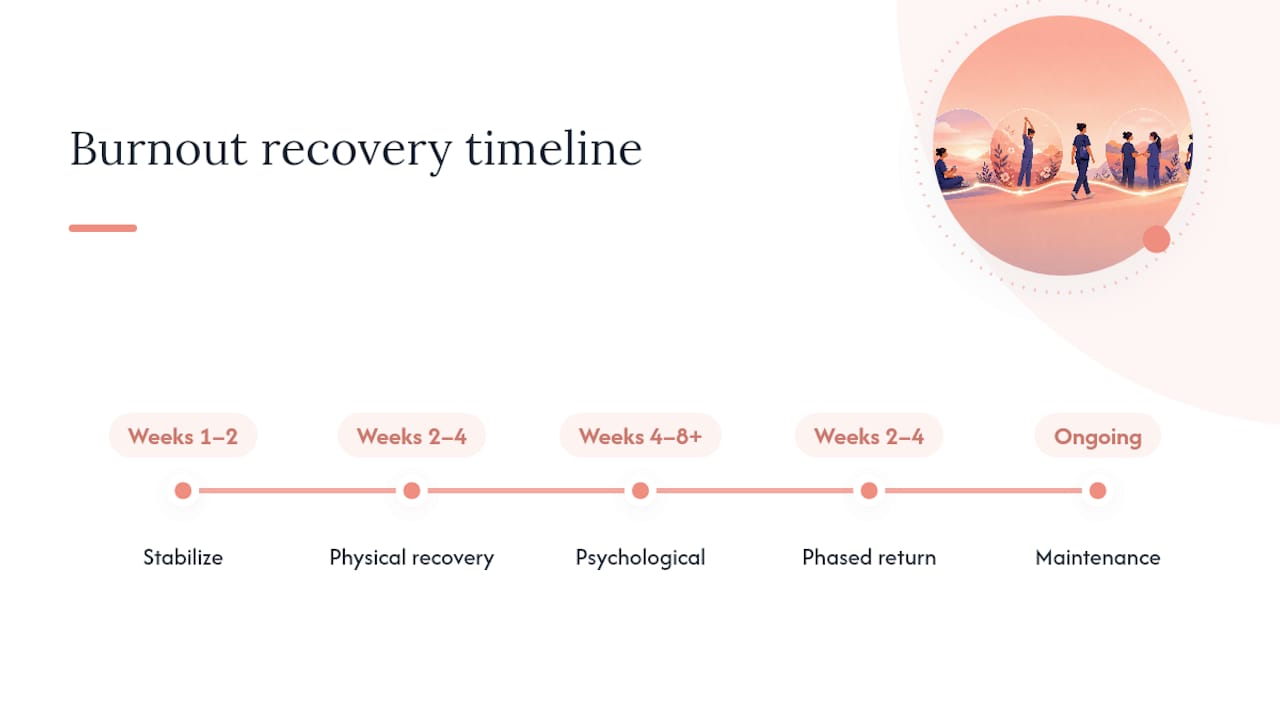
Recovery moves in stages, and the realistic timeline runs weeks to months, not days. Nurses who expect a long weekend to fix it usually relapse within a month because they skipped the middle stages.
Stage 1: Stabilize (weeks 1 to 2). This is the safety work described above, plus a baseline read on severity using a validated tool like the Maslach Burnout Inventory (MBI) or the Professional Quality of Life Scale (ProQOL). Knowing your starting number matters later, when you want to confirm you're actually improving and not just telling yourself you are.
Stage 2: Physical recovery (weeks 2 to 4). Sleep, nutrition, and light movement come first because they're the foundation everything else sits on. Nurses sleeping under seven hours a night show roughly double the burnout risk of those getting adequate rest, which makes sleep repair one of the highest-leverage moves in the entire roadmap.
Stage 3: Psychological intervention (weeks 4 through 8, sometimes longer). This is where the real evidence concentrates. An umbrella review covering 11 systematic reviews found that person-directed strategies, mindfulness-based stress reduction (MBSR) and yoga chief among them, reduced emotional exhaustion in 74% of included studies and work stress in 76%. Cognitive behavioral therapy (CBT) shows similarly consistent results for exhaustion and depersonalization, though a separate systematic review of reviews notes the evidence for restoring a sense of personal accomplishment is less consistent. Expect meaningful movement, not a full reset, on that third dimension.
Stage 4: Phased return (weeks 2 to 4, often overlapping Stage 3). Negotiate reduced acuity or hours before jumping back to a full load, and track symptoms weekly rather than assuming you're fine because you made it through a shift.
Stage 5: Maintenance (ongoing). Peer support, periodic reassessment, and continued professional development keep gains from eroding. Some reviews suggest intervention effects fade after roughly six months without follow-up, which is the practical argument for building maintenance into your calendar rather than treating recovery as a one-time project.
How Do You Prevent Burnout From Coming Back?
Prevention is less about willpower and more about a handful of unglamorous habits done consistently. Aim for seven or more hours of sleep, actual micro-breaks during a shift rather than working through them, and roughly 150 minutes a week of moderate physical activity, a target with real support behind it from the same intervention research driving the recovery roadmap.
On the unit level, small structural changes protect against relapse better than individual grit does:
- Scheduled, protected meal breaks (not "when you can grab it")
- Rotating peer check-ins, especially after a difficult code or death
- Mentor pairing for newer or returning nurses
- Manager-led debriefs after high-acuity events
If your facility doesn't offer any of this, you can request it. MBSR programs, yoga sessions, and competence-based training are increasingly common asks in unit-level wellness proposals, and they carry some of the strongest evidence behind them for actually moving the needle on exhaustion.
Pro Tip: Boundary-setting is a skill nurses are rarely taught. Saying no to a fourth mandatory overtime shift in a week isn't a character flaw; it's the same risk management you'd apply to a patient assignment. Practice the sentence in advance: "I'm not able to pick up that shift. I need the recovery time."
For structured mindfulness practice, guided exercises built for anxiety and stress offer an accessible starting point if a formal MBSR course isn't available at your facility yet.
How Do You Get Your Employer to Actually Change Something?
Individual recovery only holds if the environment that caused the burnout shifts too. That means having a specific, low-drama conversation with your manager rather than a vague complaint.
- Lead with data, not just feeling. "My ProQOL score put me in the high-risk range for compassion fatigue" lands differently than "I'm stressed."
- Name one concrete ask. Reduced float assignments for 30 days, a schedule change, or access to an EAP session. Specific asks get answered; general venting doesn't.
- Request accommodations in writing if you need FMLA or a temporary modified duty status, and keep the documentation function-focused as covered earlier.
- Push for or participate in staff well-being surveys. Aggregated, anonymous data is what turns "a few nurses are struggling" into "the unit needs two more FTEs," and it's far harder for leadership to dismiss.
The National Academies specifically recommends tasking leadership with acting on survey results, not just collecting them. If your unit runs a wellness survey and nothing changes afterward, that's worth raising directly. A manager and clinician guide to healthcare worker burnout can help frame that conversation from the other side of the desk, too, if you want to hand something to your charge nurse or director.
What Do Nurses Get Wrong About Recovering From Burnout?
Two mistakes show up constantly in clinical work with nurses: self-blame and returning too fast. Nurses are trained to fix things for other people, so when they burn out, the instinct is to treat it as a personal failure to manage stress well enough. It isn't. The evidence is clear that system factors, staffing above all, drive most of this, and no amount of self-improvement offsets an unsafe ratio.
The second mistake is rushing back at full intensity the moment symptoms lift slightly, which almost guarantees relapse. Real progress looks like a falling MBI or ProQOL score over weeks, not a single good shift. Care for working clinicians may be staged deliberately, with therapy modalities matched to recovery stages, scheduling accounting for shift patterns, and insurance support handled up front to avoid additional logistics stress.
— Dakota
Peer Support: The Recovery Tool Nurses Underuse
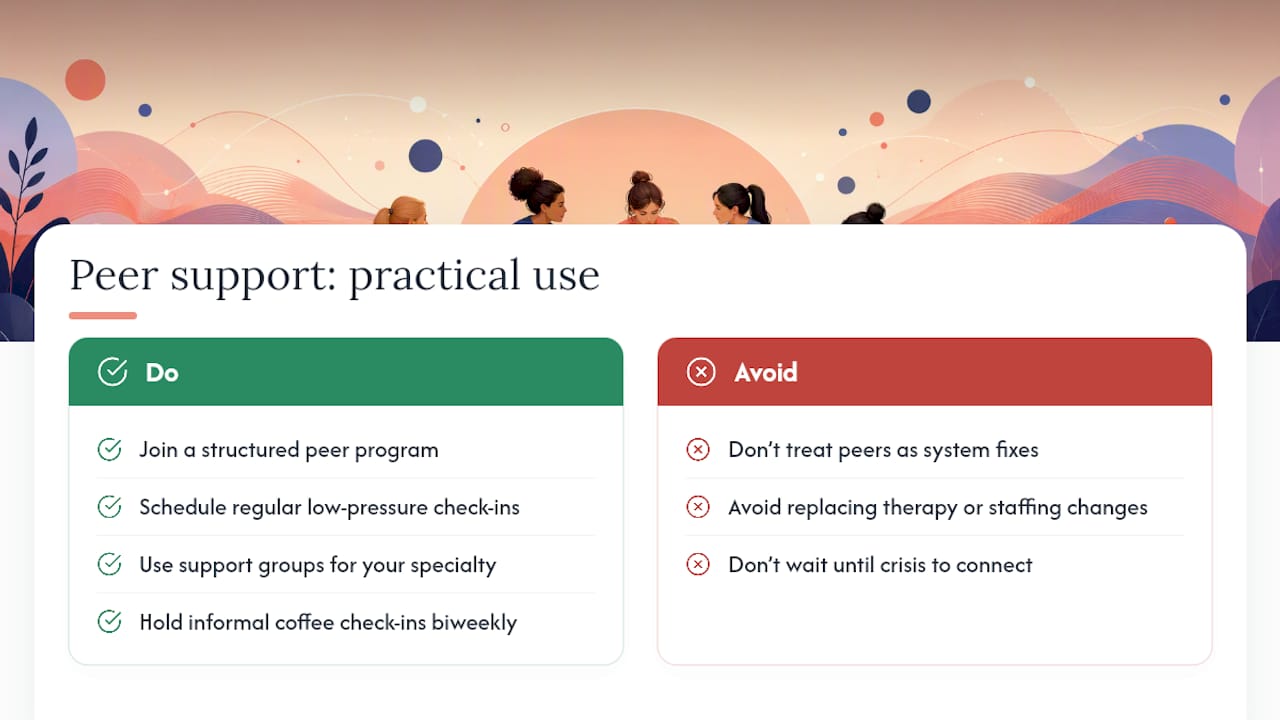
Formal peer mentoring programs do something individual therapy can't: they normalize the experience with someone who has actually worked your floor. A new nurse struggling six months in benefits differently from a peer who survived the same unit than from a well-meaning manager who hasn't touched a bedside in a decade.
Structured programs typically pair a struggling nurse with a trained peer mentor for regular, low-pressure check-ins, often monthly, sometimes weekly during a rough stretch. Some hospitals run these informally through unit champions; others build them into onboarding for every new hire, not just those already in crisis. Support groups, whether hospital-run or specialty-specific (ICU, oncology, emergency), offer something similar at scale: a room where "I almost walked out mid-shift last week" doesn't need explaining.
Experts who work directly with burned-out nurses caution that peer programs work best as a complement to, not a replacement for, system-level fixes. A great peer mentor can't fix a chronic staffing shortfall. What peer support does well is catch early warning signs, since a mentor who checks in regularly often notices withdrawal or cynicism creeping in before the nurse does, and reduce the isolation that makes burnout feel unsurvivable.
If your facility doesn't have a formal program, informal versions work too. A standing coffee check-in with one trusted coworker, even fifteen minutes every couple of weeks, gives you an early warning system and somewhere to say the things you wouldn't put in an incident report.
Time Management Tactics That Actually Fit a 12-Hour Shift
Generic time management advice mostly assumes a desk job with a lunch break you control. Nursing shifts don't work that way, so the tactics have to be shift-specific.
Batch your documentation in short bursts rather than saving it all for the end of shift. Charting immediately after each patient interaction, even two sentences, prevents the two-hour documentation pileup that turns a 12-hour shift into a 14-hour one. Use the huddle at shift start to actually prioritize, not just receive report; flag your two or three highest-risk patients out loud so the plan for the day is set before the chaos starts.
Protect your break, actively. That means physically leaving the unit if you can, eating something before hour six, and treating a 15-minute break as non-negotiable rather than the first thing sacrificed when things get busy. Nurses who skip breaks consistently report higher exhaustion scores, and the habit compounds over a career rather than resetting shift to shift.
Delegate what's actually delegable. If a task doesn't require your license, hand it to a tech or aide rather than absorbing it because asking feels like more effort than doing it yourself in the moment. And build a five-minute decompression ritual into the drive home or the walk to your car: a specific playlist, a breathing exercise, anything that draws a line between the shift and the rest of your day. Nurses who skip this transition report carrying shift stress into the evening far more than those with even a small ritual.
How Do You Know Recovery Is Holding, Not Just Pausing?
Recovery isn't a finish line, it's a state you maintain, and the maintenance phase is where most relapses start quietly. The clearest sign of real progress is a falling score on a validated tool like the MBI or ProQOL, checked periodically rather than once and forgotten.
Watch for early relapse signals specifically:
- Dread returning on shift-eve nights after weeks of feeling neutral about it
- Slipping back into skipping breaks or meals "just this once"
- Irritability with patients or coworkers that wasn't there a month ago
- Sleep quality dropping again even without an obvious trigger
Any one of these, caught early, is manageable with a quick course correction: a peer check-in, a return to whatever mindfulness or movement practice worked in Stage 3, or a single therapy session to talk through what changed. Caught late, they tend to snowball back into full burnout within weeks. The single best predictor of durable recovery isn't the intensity of the original treatment, it's whether someone keeps light-touch maintenance going after they feel better, the equivalent of continuing physical therapy exercises after the pain stops.
Why Recovering From Burnout Is a Patient Safety Issue, Not Just a Self-Care One
Burned-out nurses make more errors, and that's not a moral judgment, it's a documented pattern. The American Nurses Association explicitly links chronic self-neglect among nurses to higher error rates and worse patient outcomes, framing self-care as a clinical safety practice rather than an indulgence.
Depersonalization, one of the three core burnout dimensions, is the mechanism that matters most here. A nurse who has gone numb to patient suffering as a defense mechanism is also the nurse most likely to miss a subtle change in condition, because noticing requires the kind of attentive presence exhaustion erodes first. Add sleep deprivation on top, and reaction time and clinical judgment both suffer measurably.
This is exactly why "just push through it" is such bad advice, medically and ethically. A nurse who forces themselves through a shift on empty isn't protecting patients by showing up; they may be putting them at greater risk than a properly staffed, rested colleague would. Framing your own recovery as patient-safety work, not selfish downtime, tends to cut through the guilt that keeps nurses from asking for help in the first place. It's also a stronger case to bring to a manager than "I'm tired," because it reframes the ask in terms leadership is trained to prioritize.
Does Your Unit's Leadership Style Make Burnout Better or Worse?
Leadership style changes burnout outcomes as much as staffing numbers do, sometimes more. A unit with tight ratios but a manager who actively runs interference with admin demands and defends staff during difficult family interactions often reports lower burnout than a better-staffed unit with a hands-off or punitive leadership style.
Cultures that treat wellness surveys as a box to check, collecting data and doing nothing with it, tend to produce more cynicism than not surveying at all, because staff correctly read the exercise as performative. The National Academies recommends the opposite: tasking specific leaders with acting on survey results and reporting back what changed, which closes the loop and rebuilds trust that speaking up matters.
Blame-oriented cultures, where a medication error triggers punishment before investigation, actively suppress the reporting that catches burnout-driven mistakes early. Nurses in those environments hide struggles rather than disclose them, which delays intervention until a crisis forces the issue. Psychologically safer units, where near-misses get reviewed without immediate punitive action, surface burnout signals sooner and give leadership a real chance to intervene before someone leaves the profession entirely.
If your unit's culture skews toward the punitive end, that's a legitimate factor in your own recovery plan, not something to just personally push past. Sometimes the most effective recovery step is a transfer request, not another coping technique.
When Does Burnout Need a Therapist, Not Just Rest?
Rest and boundary-setting resolve a lot of burnout, but not all of it, and knowing the line matters. If two to four weeks of the stabilization and physical-recovery steps above haven't moved your symptoms, or if you're noticing depression-range symptoms like persistent hopelessness that doesn't lift on days off, it's time for a clinical evaluation rather than another attempt at self-management.
Mayo Clinic frames severely impaired function, meaning you can't consistently work, sleep, or maintain relationships, as a clear signal to seek professional help rather than continuing to self-treat. Therapy, particularly CBT, has some of the most consistent evidence behind it for reducing emotional exhaustion and depersonalization specifically. Medication management may help when symptoms cross into clinical depression or anxiety, which often overlaps with but isn't identical to burnout.
For nurses whose symptoms are severe enough that weekly outpatient therapy isn't enough, but who don't need inpatient care, an intensive outpatient program (IOP) fills the gap. IOPs typically run several hours a few days a week, combining group and individual therapy, and are built for working professionals who need more support than a single weekly session but can't take extended leave. If your own attempts at recovery have stalled for a month or more, that's the point to ask about a program at this level rather than waiting for things to worsen further.
What Tools Can You Use to Measure Your Own Burnout Severity?
You don't need to wait for an employer-run survey to know where you stand. The Maslach Burnout Inventory (MBI) is the most widely used research tool, scoring across all three dimensions: emotional exhaustion, depersonalization, and personal accomplishment. Many health systems license it for staff wellness programs, so ask occupational health whether it's available to you directly.
The Professional Quality of Life Scale (ProQOL) is built specifically for helping professions and adds a compassion satisfaction score alongside burnout and secondary traumatic stress, which makes it useful for distinguishing garden-variety burnout from compassion fatigue, a related but distinct condition more tied to trauma exposure than workload.
Both tools take under 15 minutes and are available through many hospital wellness portals or occupational health departments; some are also accessible as free validated versions online for personal tracking. The real value isn't the one-time score, it's using the same tool every few months to see direction of movement. A score that's dropping, even slowly, tells you the recovery plan is working. A flat or rising score after a month of genuine effort is the signal to escalate to clinical care rather than adjusting the self-care routine again.
Where Kin Wellness Fits Into Your Recovery
If you've gotten through the stages above and you're still stuck, or you know within the first week that rest alone won't cut it, Specialized care can be provided to healthcare workers navigating this situation, with services structured around the reality of shift work rather than a standard nine-to-five outpatient model.

Services may include individual therapy, group therapy, EMDR for moral injury or trauma exposure, medication management, and intensive outpatient care tailored to nurses needing more than weekly sessions but not extended leave. Scheduling can accommodate clinician shift patterns rather than a standard workweek. Insurance verification support may be provided before the first appointment to clarify coverage. Sessions are confidential and HIPAA-protected, separate from employer and personnel files.
If you're ready to find out what's covered and get on the schedule, you can check your insurance and book an intake with Kin Wellness directly through the website. Intake typically starts with a short assessment to match you with the right level of care, whether that's weekly therapy or something more intensive, so you're not guessing at what you need before you walk in.
This article is general information, not a substitute for advice from a qualified doctor. Consult a qualified healthcare professional about your own circumstances before acting on anything here.
Sources
- Effectiveness of Individual-Based Strategies to Reduce Nurse Burnout: An Umbrella Review - PMC
- Supporting the Health and Professional Well-Being of Nurses - The Future of Nursing 2020-2030 - NCBI Bookshelf
- Nurse burnout: What Is It & How to Prevent It | ANA
- Burnout - Mayo Clinic