

Compassion fatigue is driven by exposure to other people's trauma; burnout is driven by chronic workplace stress. That distinction changes everything about how you recover, because the fix for one rarely fixes the other.
A few facts ground this: the World Health Organization classifies burnout as an occupational phenomenon tied to job stress, not a medical diagnosis. Compassion fatigue, sometimes called secondary traumatic stress, comes from absorbing someone else's pain, session after session, shift after shift. Both can wreck your sleep and your patience. Only one usually clears up once you take a real vacation.
- Burnout tends to fix itself, at least partially, with workload changes, more autonomy, and time off.
- Compassion fatigue often persists until you process the trauma exposure directly, not just rest from it.
- If you're not sure which one you're facing, that uncertainty itself is worth a conversation with a supervisor or therapist this week.
Key Takeaways
Compassion fatigue stems from trauma exposure and often needs trauma-focused treatment, while burnout stems from workplace stress and usually improves with structural change.
| Point | Details |
|---|---|
| Different root causes | Compassion fatigue comes from empathy and trauma exposure; burnout comes from chronic workplace stress. |
| Onset timing varies | Compassion fatigue can appear suddenly after one hard case; burnout builds gradually over months. |
| Rest alone often fails | Burnout responds to schedule and workload changes; compassion fatigue usually needs trauma processing too. |
| The two can overlap | Unresolved burnout frequently precedes and feeds into compassion fatigue in high-exposure roles. |
| Document before you decide | Track symptoms for two weeks before talking to a supervisor or therapist about next steps. |
Table of Contents
- What Is Compassion Fatigue in Caregiving Work?
- What Is Burnout and How Does the Workplace Cause It?
- Compassion Fatigue vs Burnout: Six Key Differences
- Can You Have Both Compassion Fatigue and Burnout?
- Signs and Symptoms Checklist: Which One Are You Facing?
- Who Is Most at Risk for Compassion Fatigue and Burnout?
- How to Recover From Compassion Fatigue and Prevent Burnout
- How Do Clinicians Treat Compassion Fatigue and Burnout?
- When Should You Seek Professional Help?
- A Publisher's Note on Getting the Right Support
- Frequently Asked Questions
- Sources
What Is Compassion Fatigue in Caregiving Work?
Compassion fatigue is the emotional residue of absorbing other people's suffering. Clinicians sometimes call it "the cost of caring." It shows up after repeated exposure to patients' or clients' trauma. Duke Health describes it as an empathy-driven form of secondary traumatic stress, distinct from garden-variety job stress.
The triggers are specific to helping work: a pediatric oncology nurse who has sat with three dying children this month, a caseworker who just removed another child from an unsafe home, an ER doctor who can't stop replaying a code that didn't go well. It can hit suddenly after one brutal case, or build slowly across a caseload heavy with trauma.
Common signs include:
- Recurring, intrusive thoughts about specific patients or clients
- Withdrawal from friends and family, even though work performance holds steady
- A creeping numbness or apathy toward cases that used to move you
- Physical complaints like headaches, stomach issues, or fatigue that don't resolve with sleep
Pro Tip: Start a two-minute peer debrief after any case that shakes you, before you leave the building. Naming what happened out loud, even briefly, keeps it from lodging as an intrusive thought later.
What Is Burnout and How Does the Workplace Cause It?
Burnout is an occupational syndrome, not a personal failing. The WHO's ICD-11 definition names three markers: energy depletion, growing mental distance from your job, and reduced professional effectiveness. It comes from chronic, unmanaged workplace stress, not from any single traumatic event.
The usual drivers are structural:
- Unsustainable caseloads or patient ratios
- Little control over scheduling, assignments, or decisions
- Weak support from supervisors or colleagues
- A mismatch between your values and what the job actually rewards
Burnout builds gradually, over months or years of grinding conditions. A single weekend off rarely touches it, because the problem is the system you go back to on Monday, not your personal resilience.
Compassion Fatigue vs Burnout: Six Key Differences
The clearest way to tell them apart is to look at cause, timeline, and what actually helps.
- Cause: Compassion fatigue comes from empathy and trauma exposure; burnout comes from workplace stress and loss of control.
- Onset: Compassion fatigue can hit suddenly after one hard case; burnout accumulates gradually.
- Emotional core: Compassion fatigue tends toward numbness and intrusive thoughts; burnout tends toward cynicism and detachment from the job itself.
- Behavior: Compassion fatigue often lets you keep showing up for patients while your personal life erodes; burnout tends to show up in the work itself first, through errors and disengagement.
- Physical symptoms: Both produce fatigue and sleep trouble, but compassion fatigue's exhaustion has been described in nursing research as a kind that doesn't lift with ordinary rest.
- Recovery: Burnout typically improves with workplace change; compassion fatigue often needs trauma-focused processing.
Dr. Jennifer Lycette has observed that clinicians with compassion fatigue often keep delivering solid patient care long after their personal life has started to fray, while burnout usually erodes job performance and motivation earlier and more visibly.
A common trajectory: a hospice nurse burns out first, feeling detached and cynical about the job. She pushes through without support. Months later, the accumulated trauma exposure tips her into full compassion fatigue, with intrusive thoughts and a numbness that a week at the beach doesn't touch.
Can You Have Both Compassion Fatigue and Burnout?
Yes, and in high-exposure fields it's common. A comparative concept analysis of nursing literature found the two conditions overlap heavily and that unresolved burnout frequently acts as an antecedent to compassion fatigue.
- Shared features: chronic exhaustion, emotional numbing, reduced engagement with work and people
- The pathway: burnout wears down your defenses, then trauma exposure has less resistance to work against
- The practical implication: treatment plans that only fix the schedule, or only process the trauma, tend to miss half the problem
Signs and Symptoms Checklist: Which One Are You Facing?
Run through this quickly. You don't need every item to have a real concern.
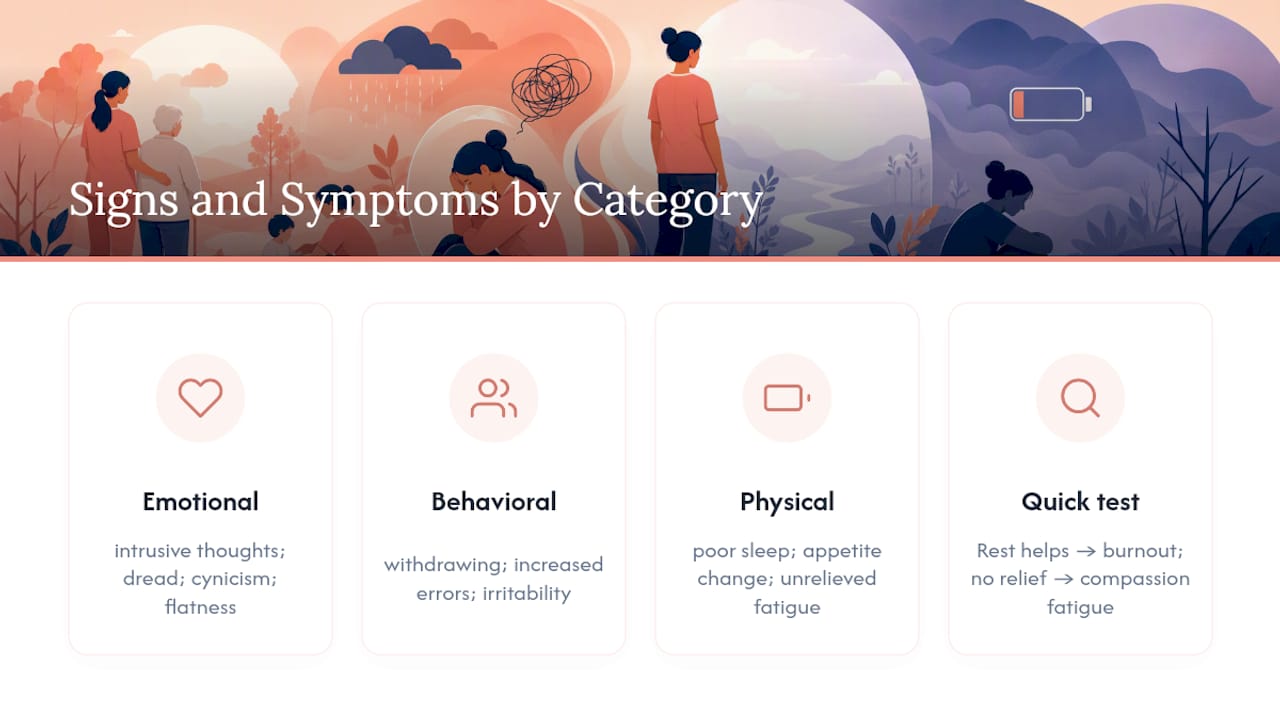
Emotional: intrusive thoughts about specific cases, dread before shifts, cynicism about whether your work matters, emotional flatness with people you love.
Behavioral: withdrawing from colleagues or family, increased errors or missed details, avoiding certain patients or tasks, irritability that feels out of character.
Physical: disrupted sleep, appetite changes, headaches or stomach problems, a fatigue that doesn't lift after a weekend off.
Treat any of these as urgent: thoughts of self-harm, persistent depersonalization, or a performance decline steep enough that patient safety is at risk. Ask yourself: does rest help at all, even briefly? If yes, lean toward burnout. If the exhaustion sits there regardless, compassion fatigue is more likely the driver.
Pro Tip: Keep a one-line daily log of mood, sleep, and any intrusive thoughts for two weeks. A written pattern is far more useful to a supervisor or therapist than "I've just been off lately."
Who Is Most at Risk for Compassion Fatigue and Burnout?
Emergency medicine, oncology, hospice, social work, child protective services, and first responders carry the highest exposure. Risk climbs further if you already have weak personal boundaries, a history of trauma, unusually high empathy, or little access to clinical supervision. On the organizational side, chronic understaffing, thin supervision, and cultures that punish vulnerability all push both conditions higher across an entire team, not just one struggling employee.

How to Recover From Compassion Fatigue and Prevent Burnout
Recovery works best when personal habits and workplace conditions change together. Rest matters, but on its own it's rarely enough, especially for compassion fatigue, where the underlying driver is trauma exposure, not just hours worked.
Personal steps that actually move the needle:
- Set firm boundaries around after-hours contact and case rumination.
- Build regular peer debriefing into your week, not just after crises.
- Schedule real recovery time, protected on the calendar, not left to chance.
- Consider individual therapy, especially trauma-informed approaches, if intrusive thoughts persist.
Workplace changes worth pushing for:
- Caseload caps tied to acuity, not just headcount
- Regular, protected clinical supervision
- Schedule flexibility and real input into assignments
- A documented trauma-informed policy, not just a poster in the break room
Pro Tip: Reframe boundary-setting as capacity preservation, not selfishness. Helpers who treat limits as part of the job description, rather than a personal failing, tend to catch compassion fatigue earlier.
How Do Clinicians Treat Compassion Fatigue and Burnout?
Treatment splits along the same line as the diagnosis. Burnout usually responds to organizational intervention: workload changes, structured therapy for professionals, and sometimes a formal leave. Compassion fatigue more often calls for trauma-focused work, including EMDR, trauma-focused CBT, and, when symptoms are severe, medication management alongside therapy.
Clinicians typically refer out for specialized trauma care when intrusive memories, hypervigilance, or emotional numbing persist despite time off and workplace adjustments.
Pro Tip: Supervisors: a staff member who's still delivering excellent patient care but has gone quiet and withdrawn outside work is often deeper into compassion fatigue than one who's visibly struggling at their desk. Don't wait for performance to slip before you ask.
When Should You Seek Professional Help?
Seek support if symptoms have lasted more than a few weeks, are intensifying, or are bleeding into your home life or your safety judgment at work.
- Ask your supervisor: "Can we look at my caseload, and what supervision or leave options exist?"
- Ask a prospective therapist: "Do you have experience treating helping professionals, and do you use trauma-focused methods?"
- Write down your specific symptoms and their duration before the appointment.
- Note whether rest has helped at all, even temporarily.
- Bring questions about mental health leave options if you're in California and considering time off.
A Publisher's Note on Getting the Right Support
Kin-wellness builds trauma-informed outpatient care around the realities of helping professions. If either of these patterns sounds familiar, tailored therapy and medication support are available.
Kin-wellness offers exactly this kind of care: virtual outpatient and intensive outpatient services for California adults, including individual therapy, EMDR, group therapy, and medication management, all built around the schedules of working professionals, healthcare workers, and parents. If you're weighing whether what you're feeling is compassion fatigue, burnout, or both, a licensed clinician can help you sort it out and build a plan that fits your caseload and your insurance. Explore Kin Wellness's services to see what outpatient and trauma-informed options look like, or visit Kin Wellness to get started.
Frequently Asked Questions
Is compassion fatigue the same as vicarious trauma? They're closely related. Vicarious trauma describes the shift in worldview from repeated trauma exposure, while compassion fatigue describes the broader exhaustion and numbing that often results, including secondary traumatic stress symptoms.
Can you have compassion fatigue without burnout? Yes. A helper new to a trauma-heavy role can develop compassion fatigue quickly, even with reasonable hours and decent workplace support, simply from the weight of what they're witnessing.
Does taking a vacation fix burnout? Partially and temporarily. Vacation reduces exhaustion short-term, but without changes to workload, control, or support, burnout symptoms typically return once you're back in the same conditions.
How long does compassion fatigue recovery take? It varies widely depending on trauma exposure severity and whether you get trauma-focused treatment. Some people improve in weeks with boundaries and peer support; others need months of therapy, particularly EMDR or trauma-focused CBT.
Should I tell my supervisor if I think I have compassion fatigue? Generally yes, especially if it's affecting your sleep, focus, or safety judgment at work. Framing it around caseload and support needs, rather than personal weakness, tends to get a more useful response.
This article is general information, not a substitute for advice from a qualified doctor. Consult a qualified healthcare professional about your own circumstances before acting on anything here.
Sources
- Compassion Fatigue: A Different Kind of Burnout | Duke Health Referring Physicians
- Burn-out an occupational phenomenon: International Classification of Diseases | WHO
- Burnout or Compassion Fatigue? A Comparative Concept Analysis for Nurses Caring for Patients in High-Stakes Environments
- Compassion Fatigue: Symptoms To Look For | WebMD
- ncbi.nlm.nih.gov