

Burnout in healthcare workers is an occupational syndrome defined by three measurable domains: emotional exhaustion, depersonalization toward patients and colleagues, and a diminished sense of personal accomplishment. It is not a character flaw or a sign of weakness. According to CDC VitalSigns data, A substantial portion of U.S. health workers reported feeling burned out often or very often in recent years, with notable increases over time. That is nearly one in two people keeping the healthcare system running.
If you are a clinician reading this today, the single most useful first step is to name what you are experiencing and document it, because unnamed distress tends to compound. If you are a manager, your first step is to open a structured, non-punitive conversation with your team this week, because trust in leadership is one of the strongest buffers against burnout the research has identified.
Three priorities a manager should activate immediately:
- Measure first. Run a brief, anonymous pulse survey before assuming you know where the pressure points are.
- Remove one friction point. Identify the single most-cited administrative burden on your unit and begin the process of reducing it, even partially.
- Signal psychological safety. Make it explicit, in writing and in team meetings, that reporting distress will not affect performance reviews or credentialing.
Table of Contents
- What is healthcare worker burnout, and how do you recognize it?
- How common is burnout among U.S. healthcare workers?
- Why does burnout matter beyond the individual clinician?
- How do you measure and monitor burnout in your organization?
- What can individual clinicians do while system changes take time?
- Practical checklists: what to do this week
- What does the research say about which interventions work?
- When does burnout become a clinical emergency?
- Where to find the best toolkits and resources
- Key Takeaways
- The part most organizations get wrong
- Kin-wellness supports clinicians who need more than a wellness app
- Useful sources and further reading
What is healthcare worker burnout, and how do you recognize it?
The formal definition comes from two converging sources. The World Health Organization classifies burnout as an occupational phenomenon in ICD-11, not a medical condition, but a syndrome arising specifically from chronic workplace stress that has not been successfully managed. The Maslach Burnout Inventory (MBI), the most widely used measurement instrument in burnout research, operationalizes that definition across three domains: emotional exhaustion (feeling depleted of emotional resources), depersonalization (developing a detached or cynical stance toward patients and coworkers), and reduced personal accomplishment (a persistent sense that your work is no longer effective or meaningful).
Recognizing the symptoms in yourself and your team
Emotional exhaustion tends to show up first. Clinicians describe dreading the start of a shift, feeling nothing after a patient outcome that would previously have moved them, or arriving home too depleted to speak. Depersonalization is subtler and often more alarming to colleagues: a nurse who once advocated fiercely for patients begins referring to them by room number; a physician's documentation becomes clipped and impersonal. Reduced personal accomplishment often arrives last, as a quiet conviction that nothing you do makes a real difference.

Behavioral signs managers can observe include increased absenteeism, a pattern of arriving late or leaving early, a drop in the quality or timeliness of documentation, withdrawal from team conversations, and a rise in interpersonal conflict. A 2025 Frontiers in Public Health review synthesizing early-recognition strategies found that subtle occupational signals, such as minor charting errors and chronic tardiness, often precede a clinician's own report of burnout. Waiting for self-disclosure means waiting too long.
How burnout differs from depression
This distinction matters clinically and practically. Burnout is context-specific: symptoms ease when the person is away from work, on vacation, or in a different role. Depression is pervasive across all life domains and does not lift with a change of setting. Both can coexist, and burnout is a recognized risk factor for developing a depressive episode, but treating them as identical leads to the wrong response. A clinician who is burned out needs workload relief and organizational change. A clinician who is depressed needs clinical care, and possibly both.
When opening a supportive conversation, a manager might say: "I've noticed you seem stretched lately. I want to understand what's driving that, not evaluate it. Can we talk about what's feeling most unmanageable right now?" That framing keeps the conversation in the occupational domain and avoids inadvertently pathologizing normal distress.
How common is burnout among U.S. healthcare workers?
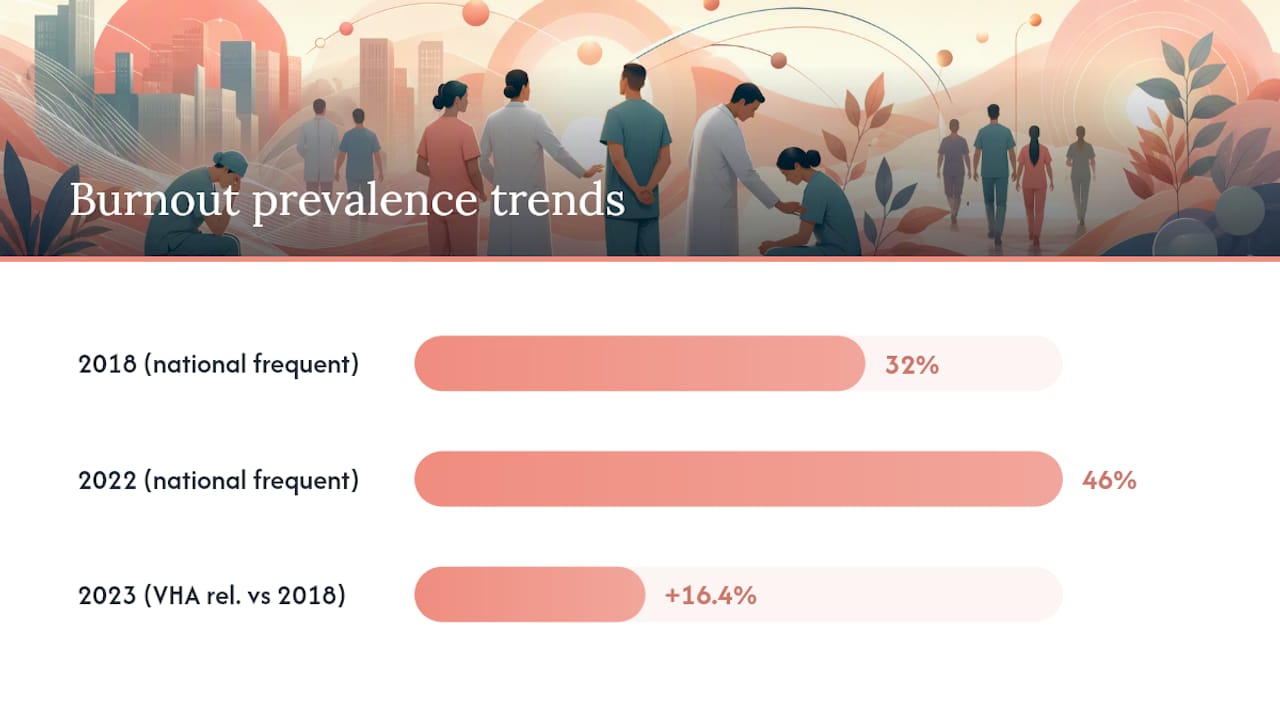
The CDC VitalSigns report provides the clearest national snapshot: 46% of U.S. health workers reported frequent burnout in 2022, compared with 32% in 2018. That 14-percentage-point increase happened across a period that included the COVID-19 pandemic, but the trend was already rising before 2020. The pandemic accelerated something that was already in motion.
Multi-year data from the Veterans Health Administration (VHA) adds important texture. A JAMA Network Open study tracking VHA health care workers found that burnout levels in 2023 remained higher than in 2018, despite some post-pandemic decreases. The slow recovery pattern is one of the most practically important findings in recent burnout research: organizations that reduced acute stressors after 2021 often assumed the problem was resolving, when in fact burnout was simply declining from a peak, not returning to baseline.
U.S. burnout prevalence: key data points
| Year | Population / Sample | Burnout Metric | Rate | Source |
|---|---|---|---|---|
| 2018 | U.S. health workers (national survey) | Frequent burnout | 32% | CDC VitalSigns |
| 2022 | U.S. health workers (national survey) | Frequent burnout | 46% | CDC VitalSigns |
| 2023 | VHA health care workers (longitudinal) | Relative increase vs. 2018 | +16.4% | JAMA Network Open |
For managers translating these national figures to their own organization, the key variables are sample size, survey cadence, and role stratification. A single annual survey of 30 staff members will not give you statistically reliable trend data. Aim for at least quarterly pulse checks, stratify results by unit and role, and set a pre-defined threshold (for example, more than 30% of respondents scoring in the high-exhaustion range on a validated screen) that automatically triggers a workload review. National percentages tell you the scale of the problem; your own data tells you where to act.
Which drivers can you actually change at the unit level?
Some drivers require system-level authority to address: staffing ratios, EHR procurement decisions, and institutional harassment policies sit above the unit manager's desk. But several are modifiable at the unit level right now: scheduling input, break protection, peer support structures, how workload concerns are received and documented, and the tone of daily leadership interactions. Starting there is not a substitute for system change, but it is not nothing either.
Pro Tip: When raising burnout drivers with senior leadership, bring three specific artifacts: (1) your unit's last 90 days of overtime and sick-leave data, (2) results from even a brief anonymous pulse survey, and (3) a one-page summary of the CDC or Surgeon General data on organizational costs. Concrete numbers from your own unit, paired with national context, move conversations that anecdotes alone do not.
Why does burnout matter beyond the individual clinician?
The consequences of burnout spread in three directions: inward to the clinician, outward to patients, and across the organization.
Clinical consequences for the clinician
Burned-out clinicians are at elevated risk for depression, anxiety, and substance use. The relationship between burnout and suicide risk in healthcare workers is a serious concern, though it is worth being precise: burnout itself is not a clinical diagnosis, and suicidal ideation is a clinical emergency that requires immediate professional response regardless of its occupational context. Functional impairment, the inability to concentrate, make decisions, or sustain relationships, often precedes a clinician's recognition that they need help.
Patient safety
Multiple systematic reviews link high burnout scores with increased rates of medical errors, reduced patient satisfaction, and poorer adherence to safety protocols. The mechanism is not mysterious: a clinician who is cognitively depleted, emotionally detached, and running on inadequate sleep makes more errors. Those errors then generate additional documentation, incident reviews, and emotional burden, which feeds back into the exhaustion cycle.
Organizational and economic consequences
Turnover is the most visible organizational cost. Replacing a physician costs an estimated multiple of their annual salary when recruitment, onboarding, and productivity loss are factored in. Nurses and allied health professionals carry lower replacement costs but turn over at higher rates, and the cumulative effect on unit stability is severe. Absenteeism, reduced productivity, and early retirement compound the direct replacement costs. Organizations that treat burnout as a wellness problem rather than a workforce-sustainability problem consistently underestimate what it is costing them.
How do you measure and monitor burnout in your organization?
Validated instruments vs. practical alternatives
The Maslach Burnout Inventory remains the gold standard for research and organizational assessment. It measures all three domains across 22 items, has decades of normative data, and is available in versions tailored to human services, medical, and general populations. Its limitations are practical: it requires a license, takes 10–15 minutes to complete, and generates data that needs interpretation against published norms.
For organizations that need something faster, single-item screens, such as "How often do you feel burned out from your work?" on a five-point frequency scale, have shown reasonable correlation with full MBI scores in several validation studies. They sacrifice granularity but enable higher response rates and more frequent monitoring.
Organizational metrics offer a third layer: turnover rates, sick-day patterns, overtime hours, patient satisfaction trends, and incident report rates. None of these is a burnout measure on its own, but together they form an early-warning system. A Frontiers in Public Health review specifically recommends systematic monitoring using multiple data streams, including predictive analytics where feasible, to catch burnout before it reaches the self-report stage.
Comparison of common monitoring approaches
| Approach | Strengths | Limitations | Best Use |
|---|---|---|---|
| Maslach Burnout Inventory (MBI) | Validated, domain-specific, normative data | Licensed, longer, needs expert scoring | Annual organizational assessment |
| Single-item burnout screen | Fast, high response rate, low burden | No domain breakdown | Quarterly pulse checks |
| Organizational metrics (turnover, sick days) | Continuous, no survey fatigue | Indirect, lagging indicators | Ongoing surveillance |
| Patient satisfaction trends | Reflects care quality impact | Many confounders | Supplementary signal |
Implementation checklist for organizations
- Choose one validated instrument (MBI or a brief validated alternative) for annual administration.
- Add a single-item screen to quarterly pulse surveys to track trend between annual cycles.
- Anonymize all survey data at the unit level; never tie individual responses to identifiable staff.
- Set a minimum response threshold (typically 60–70%) below which results are treated as inconclusive.
- Define action triggers in advance: what score or percentage will automatically prompt a workload review or a manager conversation?
- Build a safe response pathway: staff who score in the high-risk range should receive information about support resources, not a performance flag.
When a screen returns a positive result, the appropriate response is a structured conversation about workload, a review of recent scheduling and overtime data, and a referral to peer support or confidential clinical services, not a wellness app recommendation.
What can individual clinicians do while system changes take time?
System change is slow. That is not an excuse for organizations to delay, but it is a reality clinicians have to work within. Individual strategies do not fix the structural causes of burnout, but they can reduce its severity and protect function while organizational work proceeds.
Effective individual supports include:
- Confidential mental health care. Accessing therapy through an Employee Assistance Program (EAP), a clinician-focused outpatient service, or a telehealth provider gives clinicians a space to process distress without professional risk. Work burnout treatment that combines individual therapy with structured group support has shown particular promise for working professionals.
When individual distress needs clinical care
Burnout that has progressed to suicidal ideation, severe functional impairment, inability to perform clinical duties safely, or significant substance use is no longer a burnout management question. It is a clinical emergency or a clinical condition requiring professional treatment. The threshold for seeking care should be low: if you are asking whether you need help, that question itself is the answer.
Pro Tip: To request a temporary workload adjustment, send a brief written note to your direct supervisor that says: "I want to flag that my current workload is affecting my ability to perform safely and sustainably. I'd like to schedule 20 minutes to discuss a temporary adjustment and document this conversation. I'm happy to bring specific data." Putting it in writing creates a record, signals seriousness without escalation, and gives your manager a clear, low-stakes entry point to respond constructively.
Individual interventions help clinicians cope. They are not substitutes for the structural changes that remove the conditions driving burnout in the first place. Both are necessary, and the research is clear that individual-only programs without organizational change produce smaller, shorter-lived improvements.
Practical checklists: what to do this week
Frontline clinician checklist
- Name and document what you are experiencing, including specific workload incidents, dates, and their impact on your function.
- Schedule a peer check-in with a trusted colleague this week, not a formal debrief, just a real conversation.
- Report any patient safety concerns through your organization's formal safety reporting system, even if you believe the concern stems from systemic overload.
- Contact your EAP or a confidential mental health provider to understand what services are available to you before you need them urgently.
- Identify one boundary you can protect this week, such as a lunch break or a documentation cutoff time, and protect it.
- If your distress is severe, contact 988 (Suicide and Crisis Lifeline) or your organization's clinician support line immediately.
Manager and administrator checklist
- Communicate transparently with your team this week about what you are hearing and what you are doing about it.
- Identify one immediate workload relief measure you can implement without waiting for senior approval, such as redistributing a non-clinical task or protecting a team break.
- Launch or schedule a brief anonymous pulse survey within the next two weeks.
- Review your unit's last 90 days of overtime, sick leave, and turnover data and bring it to your next leadership meeting.
- Protect scheduled breaks for all staff, and make it visible that you are doing so.
- Identify one organizational pilot from the roadmap above and propose it formally to your supervisor with a defined evaluation plan.
Sample clinician-to-leadership email
Subject: Request for workload adjustment meeting
Hi [Manager's name],
I want to flag that my current workload has been consistently exceeding what I can manage safely and sustainably. I'd like to schedule a 20-minute meeting to discuss a temporary adjustment and to document this conversation formally.
I can bring: (1) a brief log of the past two weeks' patient volumes and overtime hours, (2) two or three specific examples of tasks that are creating the most pressure, and (3) a proposed adjustment I believe is feasible within current staffing.
I'm raising this because I want to continue performing well and because I think early documentation protects both of us. Please let me know your availability.
Thank you, [Your name]
Managers who receive this kind of request should respond within 48 hours, acknowledge the concern in writing, and schedule the meeting. A non-response is itself a data point about organizational culture.
What does the research say about which interventions work?
The evidence base for burnout interventions has grown substantially since 2018, and the headline finding is consistent: organizational and system-level intervention packages outperform individual-only approaches. Individual programs, such as mindfulness training or resilience workshops, show modest short-term effects on emotional exhaustion but do not address depersonalization or reduced accomplishment, and their effects tend to fade without structural support.
Effect sizes across the literature are generally small to moderate. That sounds underwhelming until you translate it into operational terms: a moderate reduction in burnout across a 50-person unit could mean two or three fewer resignations per year, a measurable reduction in incident reports, and a detectable improvement in patient satisfaction scores. At scale, small effects have large consequences.
Intervention effectiveness summary
| Intervention Type | Typical Effectiveness | Confidence Level | Notes |
|---|---|---|---|
| Workload redesign (staffing, ratios) | Moderate to high | High | Most consistent evidence; requires system authority |
| EHR/documentation reduction | Moderate | Moderate-high | Scribes and AI tools show consistent results |
| Team-based care redesign | Moderate | Moderate-high | Requires role clarity and leadership alignment |
| Peer support programs | Small to moderate | Moderate | Strongest after critical incidents |
| Individual therapy / CBT | Small to moderate | Moderate | Effective for individual distress; does not fix system |
| Mindfulness/resilience training alone | Small, short-term | Low-moderate | Fades without structural change; insufficient alone |
| Leadership development | Moderate | Moderate | Underutilized; high leverage per dollar invested |
The PMC review of burnout prevalence and preventative strategies notes that even well-designed organizational interventions show slow improvement curves, and burnout often remains above pre-pandemic baselines for years after acute stressors subside. That finding has a direct implication for how organizations should plan: a single intervention cycle is not enough. Sustained, longitudinal programs with regular measurement are what the evidence supports.
For clinicians interested in healthcare professional wellness strategies that combine organizational and individual approaches, the most effective programs tend to pair protected non-clinical time with access to confidential mental health services, not one or the other.
When does burnout become a clinical emergency?
Burnout exists on a spectrum, and part of that spectrum overlaps with conditions that require immediate clinical attention.
Red flags that require prompt action:
- Suicidal ideation, even passive ("I wouldn't mind not waking up")
- Withdrawal from all social contact, including close colleagues and family
- Inability to perform clinical duties safely, including concentration failures, missed steps, or near-misses
- Escalating substance use as a coping mechanism
- Severe sleep disruption lasting more than two to three weeks
- A sudden, marked change in personality or affect observed by colleagues
Research on early recognition strategies consistently finds that colleagues and managers notice behavioral changes before the clinician themselves reports distress. That places a real responsibility on teams to speak up, not to diagnose, but to say: "I've noticed you seem different lately. I'm not going anywhere. What's going on?"
Immediate resources
- CDC VitalSigns: Health Worker Mental Health
- Health Worker Burnout (U.S. Surgeon General advisory)
- Burnout primer (AHRQ / PSNet)
- Healthcare Professional Burnout (NCBI Bookshelf / StatPearls)
- Burnout in healthcare workers: prevalence, impact and preventative strategies (PMC article)
When a manager identifies an employee in crisis, the response sequence is: safety first (ensure the person is not in immediate danger), confidential referral (provide specific resources, not a general suggestion to "get help"), and reasonable accommodations (a temporary reduction in patient load or shift coverage while the person accesses care). Documenting the conversation protects both parties and demonstrates organizational good faith.
Where to find the best toolkits and resources
Every major U.S. health authority has published guidance on burnout. The challenge is not finding resources; it is knowing which one to start with for your specific setting.
Authoritative toolkits at a glance
- U.S. Surgeon General Advisory on Health Worker Burnout: The most comprehensive systems-level framing available. Start here for organizational policy conversations and leadership buy-in.
- AHRQ / PSNet Burnout Primer: Evidence summary with intervention frameworks organized by driver. Best for evidence-based program design.
- SAMHSA: — Guidance on mental health and substance use resources for healthcare workers, including confidential helplines and treatment locators.
- CDC VitalSigns: Health Worker Mental Health: National prevalence data and public health framing. Best for making the case to leadership with credible numbers.
Quick-start resource guide by setting
| Setting | Recommended First Resource | Practical Next Step |
|---|---|---|
| Emergency department | Surgeon General Advisory | Conduct a rapid workload and staffing audit using the advisory's framework |
| Primary care clinic | AMA STEPS Forward | Download the EHR optimization module and pilot with one physician |
| Inpatient unit | AHRQ Burnout Primer | Map your unit's top three drivers against the SAMHSA six-driver framework |
| Outpatient clinic | CDC VitalSigns + AHRQ | Run a baseline pulse survey, then use AHRQ to select a matched intervention |
Key Takeaways
Healthcare worker burnout is a systemic occupational syndrome requiring organizational action, not just individual resilience, to meaningfully reduce its prevalence and impact.
| Point | Details |
|---|---|
| Scale of the problem | 46% of U.S. health workers reported frequent burnout in 2022, up from 32% in 2018, per CDC VitalSigns. |
| System causes, not personal failure | Top drivers are workload, EHR burden, staffing shortages, and lack of control — all organizational in origin. |
| Measurement comes first | Use the MBI or a validated single-item screen quarterly; set pre-defined action thresholds before surveying. |
| Organizational interventions outperform individual ones | Packages combining workload redesign, team-based care, and documentation reduction show the strongest, most durable effects. |
| Kin-wellness for clinical care | Clinicians in California experiencing burnout-related distress can access confidential virtual outpatient therapy and IOP services through Kin-wellness, billed through private insurance. |
The part most organizations get wrong
The conventional framing of burnout as a clinician resilience problem is not just wrong — it is actively harmful. When an organization responds to 46% burnout prevalence with a meditation app and a lunch-and-learn, it sends a clear message to staff: we see the problem, and we have decided it is yours to solve. That message compounds the very sense of powerlessness that drives burnout in the first place.
What the research actually shows is that the clinicians who are burning out are often the most conscientious, the most committed, and the most unwilling to cut corners. They are not failing to cope. They are coping with conditions that were not designed to be coped with indefinitely.
The harder truth for health system leaders is that the business case for addressing burnout is overwhelming, and most organizations are still not acting on it. Turnover costs, error rates, patient satisfaction scores, and early retirement patterns all move in the wrong direction when burnout is high. The Surgeon General's advisory, the AHRQ evidence base, and the JAMA longitudinal data all point to the same conclusion: this is a workforce-sustainability crisis, and individual wellness programs are not the answer.
For clinicians reading this: the fact that you are burned out does not mean you are not strong enough. It means the system asked more of you than any person can sustainably give. Naming that clearly, documenting it, and seeking support, whether through your organization, an EAP, or a confidential clinical service, is not giving up. It is the most professionally responsible thing you can do.
For managers: the single most protective thing you can do for your team this week costs nothing. Ask them how they are doing, mean it, and do something with what they tell you. Trust in leadership is one of the strongest buffers the data has identified. You already have it available.
Kin-wellness supports clinicians who need more than a wellness app
If you are a healthcare worker in California whose burnout has crossed into territory that needs clinical attention, not just a better schedule or a peer conversation, Kin-wellness offers virtual outpatient and intensive outpatient mental health services built for working professionals. Individual therapy, group therapy, EMDR, medication management, and aftercare planning are all available via telehealth, so you can access care without rearranging your clinical schedule or explaining your absence to colleagues.
Kin-wellness works with PPO and HMO insurance plans and supports out-of-network billing, which means the cost barrier that stops many clinicians from seeking care is often lower than they expect. Intake is straightforward: you describe what you are experiencing, and the team matches you with a licensed therapist or prescriber who works with healthcare professionals specifically.
If you are ready to talk to someone, explore Kin-wellness services or visit kin-wellness.com to check availability and start the intake process. You do not need to be in crisis to reach out. You just need to decide that what you are carrying deserves real support.
Useful sources and further reading
The sources below form the core evidence base for this article. Each is linked directly and includes a note on what it supports.
- CDC VitalSigns: Health Worker Mental Health — National prevalence data (32% in 2018 vs. 46% in 2022) and the role of managerial trust as a protective factor. Use this for leadership presentations and organizational benchmarking.
- JAMA Network Open: Burnout trends among U.S. health care workers — Multi-year VHA longitudinal data showing a 16.4% relative increase in burnout from 2018 to 2023. Use this to counter the assumption that post-pandemic recovery is complete.
- U.S. Surgeon General Advisory on Health Worker Burnout — The most authoritative systems-level policy framework available. Use this for board-level conversations and organizational policy development.
- AHRQ / PSNet Burnout Primer — Evidence summary organized by intervention type and driver framework. Use this for program design and evidence-based decision-making.
- Frontiers in Public Health: Seeing burnout coming (2025) — Early recognition strategies and a three-domain framework for proactive monitoring. Use this for measurement planning and manager training.
- NCBI Bookshelf / StatPearls: Healthcare Professional Burnout — Clinical definition, patient safety links, and workforce consequences. Use this for clinical education and safety reporting contexts.
- PMC: Burnout in healthcare workers — prevalence, impact and preventative strategies — Broad review of prevalence data and preventative approaches. Use this for historical context and to support the case for sustained longitudinal programs.
This article provides general occupational health information and is not a substitute for professional medical or mental health advice. For personal clinical concerns, consult a licensed healthcare provider or contact your organization's employee assistance program.