

The most effective depression treatment plans for adults use evidence-based psychotherapy, antidepressant medication, or a combination of both, with specialist brain-stimulation options reserved for treatment-resistant cases. According to NIMH, treatment typically involves psychotherapy, medication, or both, and the right starting point depends on symptom severity, personal preference, and medical history. Here is what that looks like in practice:
- Mild depression: Psychotherapy first (CBT, behavioral activation, or guided self-help); medication optional based on preference.
- Moderate depression: Psychotherapy, antidepressant medication, or both; severity and prior episodes guide the choice.
- Severe depression: Combined psychotherapy plus antidepressant medication is usually preferred for the best chance of response.
- Treatment-resistant depression: Specialist options including esketamine nasal spray, electroconvulsive therapy (ECT), transcranial magnetic stimulation (TMS), or augmentation with atypical antipsychotics.
Seek immediate help if you experience: active suicidal thoughts or a plan, inability to eat, drink, or sleep because of depression, or a severe decline in your ability to function. Call 988 (Suicide and Crisis Lifeline) or go to your nearest emergency department.
Three steps to take now:
- Do a safety check: if suicidal thinking is present, contact a clinician or crisis line before anything else.
- Choose an initial treatment approach based on your symptom severity and preference, ideally with a licensed clinician.
- Set up a monitoring plan: schedule a follow-up within two to four weeks of starting treatment to assess response.
Pro Tip: Ask your clinician to use a validated scale like the PHQ-9 at every visit. Structured outcome monitoring catches a stalled response weeks earlier than clinical impression alone.
Key Takeaways
Combined psychotherapy and antidepressant medication produces greater symptom improvement than either treatment alone for moderate-to-severe depression, with structured outcome monitoring being the factor that most reliably keeps treatment on track.
| Point | Details |
|---|---|
| Start by severity | Mild depression: therapy first; moderate: therapy or medication; severe: consider combining both from the start. |
| Combined treatment advantage | Network meta-analysis data shows combined care outperforms monotherapy with a moderate benefit. |
| Medication takes time | Expect 4–8 weeks for antidepressant benefit; do not judge effectiveness before completing a full trial at adequate dose. |
| Monitor outcomes formally | Use a validated scale like the PHQ-9 at every visit; structured monitoring improves outcomes over unmonitored care. |
| Kin-wellness for California adults | Kin-wellness offers virtual outpatient therapy, medication management, and IOP for adults in California, with insurance billing support. |
Table of Contents
- What are the main psychotherapy options for depression?
- How do antidepressant medications work, and how are they chosen?
- When does combining therapy and medication make sense?
- What options exist when first-line treatments fail?
- Which lifestyle changes actually support depression recovery?
- What does the evidence say about herbal remedies and supplements?
- How do you find and choose the right clinician or program?
- Does teletherapy actually work as well as in-person care?
- How long does treatment take, and what does it cost?
- What do the major guidelines and meta-analyses actually show?
- When should you seek urgent or emergency care?
- Kin-wellness's approach to depression care for adults in California
- Kin-wellness offers virtual depression care for adults in California
- Sources
What are the main psychotherapy options for depression?
Psychotherapy is an effective first-line treatment for many adults with depression and often the preferred starting point when symptoms are mild or when someone wants to avoid medication. The APA clinical practice guideline recommends seven evidence-based psychotherapy interventions for adult depression: behavioral therapy, cognitive therapy, CBT, interpersonal therapy (IPT), mindfulness-based cognitive therapy (MBCT), psychodynamic therapy, and supportive therapy. Each targets a different mechanism, which matters more than most people realize.
Cognitive behavioral therapy (CBT) is the most studied modality. It targets the relationship between distorted thought patterns and depressive behavior, teaching people to identify and restructure unhelpful thinking. CBT is effective across a wide severity range and has the strongest evidence base for preventing relapse when delivered well.
Interpersonal therapy (IPT) focuses on relationship problems, grief, role transitions, and social isolation as drivers of depression. It tends to work well for people whose depressive episodes are clearly tied to relationship stress or major life changes.
Behavioral activation is a stripped-down, highly practical approach: it works by scheduling rewarding and meaningful activities to break the withdrawal-and-low-mood cycle. It is often used when someone is too depleted to engage in the cognitive work of CBT, and evidence supports it as a standalone treatment.
Mindfulness-based cognitive therapy (MBCT) was specifically designed for people with recurrent depression. It combines mindfulness meditation with cognitive techniques to help people recognize early warning signs of relapse. Clinical guidelines recommend it particularly for adults with three or more prior episodes.
Psychodynamic and supportive therapies address deeper patterns, unresolved conflicts, and the therapeutic relationship itself. They tend to be longer-term and suit people who want to understand the roots of their depression rather than just manage symptoms.
Delivery modes and practical considerations
Therapy is available individually or in group format, in person or via telehealth. A large network meta-analysis of 676 RCTs found group CBT effective for less severe depression, which makes it a practical and often more affordable option. Guided self-help and computerized CBT programs also have evidence of benefit, particularly for mild to moderate symptoms. Most acute courses run 8–16 weekly sessions, though MBCT is typically delivered as an 8-week structured program.
Who benefits most from therapy alone? Adults with mild to moderate depression, those who prefer non-medication approaches, people with good social support, and those whose depression is clearly tied to life circumstances. For severe depression or marked functional impairment, combined care tends to outperform therapy alone.
Pro Tip: When choosing a therapist, ask specifically which modality they are trained in and whether they track outcomes with a validated measure. A therapist who cannot name their approach or measure your progress is a red flag, regardless of how warm the intake call feels.
How do antidepressant medications work, and how are they chosen?
Antidepressants are evidence-based first-line treatments for moderate to severe depression and a reasonable option for some people with mild depression, particularly when therapy is unavailable or when prior episodes responded well to medication. The choice of drug class depends on side-effect profile, medical history, prior response, drug interactions, and whether pregnancy is a factor.
Major antidepressant classes
| Drug Class | Primary Mechanism | Common Side Effects | Typical Onset | Key Monitoring |
|---|---|---|---|---|
| SSRIs (e.g., sertraline, escitalopram) | Serotonin reuptake inhibition | Nausea, insomnia, sexual dysfunction | 2–4 weeks for initial response | Mood, suicidality (early weeks), weight |
| SNRIs (e.g., venlafaxine, duloxetine) | Serotonin + norepinephrine reuptake inhibition | Nausea, elevated blood pressure, sweating | 2–4 weeks | Blood pressure, mood |
| TCAs (e.g., amitriptyline, nortriptyline) | Serotonin + norepinephrine reuptake inhibition, multiple receptor effects | Sedation, dry mouth, constipation, cardiac risk | 2–4 weeks | ECG in older adults, toxicity risk |
| Mirtazapine | NaSSA (blocks alpha-2 and serotonin receptors) | Sedation, increased appetite, weight gain | 1–2 weeks for sleep/appetite | Weight, metabolic markers |
| MAOIs (e.g., phenelzine) | Monoamine oxidase inhibition | Dietary restrictions required, orthostatic hypotension | 2–4 weeks | Tyramine diet, drug interactions |
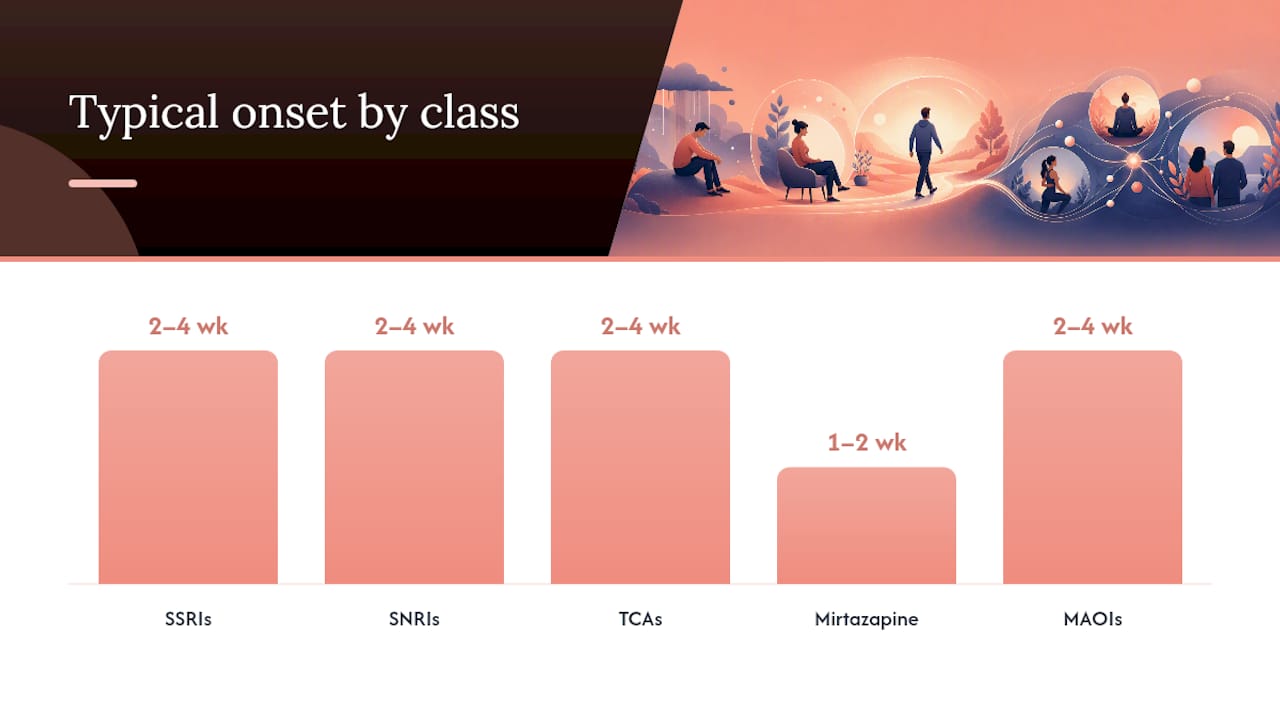
SSRIs and SNRIs are the standard first-line choices because they have a favorable side-effect profile compared with older classes and are well-tolerated by most adults. Mirtazapine is often chosen when insomnia and appetite loss are prominent. TCAs and MAOIs are generally reserved for cases where newer agents have failed, given their higher risk profiles.
What to expect in the first eight weeks
Weeks 1–2 often bring side effects before any mood benefit, which is one of the most common reasons people stop early. Sleep and energy sometimes improve before mood does. A meaningful reduction in depressive symptoms typically takes 4–6 weeks, and a full trial requires at least 6–8 weeks at an adequate dose before concluding a medication is not working. An ACP systematic review found that antidepressants had higher rates of discontinuation due to adverse events compared with nonpharmacologic treatments, which underscores the importance of close follow-up in the first month.
- Do not stop abruptly: Discontinuation syndrome (dizziness, flu-like symptoms, irritability) is common with SSRIs and SNRIs; taper under clinician guidance.
- Drug interactions: St. John's wort combined with SSRIs raises the risk of serotonin syndrome and should never be taken together without prescriber oversight.
- Pregnancy: Some antidepressants carry fetal risk data; decisions during pregnancy require a careful benefit-risk discussion with an OB and prescriber.
- MAOI rules: A washout period of at least 14 days is required before switching between MAOIs and most other antidepressants.
For a deeper comparison of the two most commonly prescribed SSRIs, the Lexapro vs. Zoloft breakdown covers side-effect tradeoffs in detail.
Key figure: The ACP review found that nonpharmacologic treatments did not differ substantially in efficacy from second-generation antidepressants as first-step treatments, though the certainty of evidence was often low.
When does combining therapy and medication make sense?
Combined psychotherapy plus antidepressant medication commonly produces greater symptom improvement than either treatment alone for moderate-to-severe depression. A network meta-analysis published in JAMA found that combined treatment produced greater symptom improvement than medication alone (SMD ≈ 0.33) and than psychotherapy alone (SMD ≈ 0.30) in randomized trials. To put that in clinical terms: the difference is real and meaningful at the population level, but it does not guarantee remission for any individual. What it does mean is that for people with moderate-to-severe depression, starting with only one treatment may leave measurable benefit on the table.
Clinical scenarios where combination care is usually preferred:
- Marked functional impairment (unable to work, care for dependents, or maintain basic self-care)
- Two or more prior depressive episodes
- Long episode duration (more than six months before treatment)
- Elevated suicide risk requiring faster stabilization
- Chronic depression or dysthymia with a superimposed major episode
- Strong patient preference for the highest probability of response
Sequencing vs. simultaneous start
Some clinicians start both treatments at the same time; others begin with one and add the second if response is partial after 4–6 weeks. Both approaches are used in practice. The simultaneous start makes sense when severity is high and waiting is not practical. Sequential addition works well when a patient wants to minimize variables or when access to one treatment is delayed.
Coordinating care between a therapist and prescriber matters. When they are different providers, a shared care plan with explicit communication about medication changes and therapy progress reduces the risk of conflicting advice.
Pro Tip: Schedule a PHQ-9 check at weeks 4, 8, and 12 during combined treatment.
What options exist when first-line treatments fail?
Treatment-resistant depression is generally defined as inadequate response after at least two adequate antidepressant trials at therapeutic doses for sufficient duration. This affects a meaningful subset of adults with depression, and specialist options are appropriate for this group rather than continuing to cycle through similar medications.
Specialist options include:
- Esketamine (Spravato): FDA-approved nasal spray for treatment-resistant depression and major depressive disorder with acute suicidal ideation. Administered in a certified healthcare setting with a two-hour observation period. NIMH lists it among FDA-approved somatic options for treatment-resistant cases.
- Electroconvulsive therapy (ECT): The most effective treatment for severe, treatment-resistant depression, with response rates substantially higher than pharmacotherapy in this population. Requires general anesthesia and is delivered in a hospital or outpatient medical setting. Short-term memory effects are the primary concern and are usually temporary.
- Repetitive transcranial magnetic stimulation (rTMS): Non-invasive brain stimulation delivered in an outpatient clinic, typically over 4–6 weeks of daily sessions. FDA-cleared for treatment-resistant depression. No anesthesia required.
- Augmentation strategies: Adding an atypical antipsychotic (aripiprazole, quetiapine, brexpiprazole) or a mood stabilizer (lithium) to an existing antidepressant. These are among the most commonly used next steps before escalating to somatic therapies.
- Medication switching: Moving to a different antidepressant class (e.g., from an SSRI to an SNRI or mirtazapine) is a standard step before declaring treatment resistance.
Setting note: ECT and esketamine require specialty centers and often need insurance preauthorization. If your current provider cannot offer these, ask for a referral to a psychiatrist or academic medical center with a treatment-resistant depression program.
A specialty evaluation typically includes a safety assessment, a review of prior medication trials, medical workup to rule out contributing conditions (thyroid dysfunction, sleep apnea), and, for ECT, cognitive and anesthesia counseling.
Which lifestyle changes actually support depression recovery?
Lifestyle changes and behavioral activation reliably support depression treatment and, for mild depression, may serve as an initial option before or alongside formal clinical care. They are not a substitute for professional treatment when symptoms are moderate to severe, but dismissing them as secondary misses how much they move the needle.
Exercise has the strongest evidence among lifestyle interventions. Aerobic exercise at moderate intensity, roughly 150 minutes per week (consistent with general physical activity guidelines), shows measurable antidepressant effects in multiple trials. The mechanism likely involves neuroplasticity, HPA-axis regulation, and behavioral activation effects. Even shorter bouts of 20–30 minutes three times per week produce benefit.

Sleep regularity matters more than total sleep hours for many people with depression. Going to bed and waking at consistent times, reducing screen exposure before bed, and limiting alcohol (which fragments sleep architecture) are practical starting points.
Behavioral activation steps:
- Schedule one meaningful or pleasurable activity per day, even if motivation is absent.
- Start with low-effort activities: a short walk, a phone call to a friend, preparing a simple meal.
- Track completion, not mood, in the first two weeks. Mood follows behavior, not the other way around.
- Gradually increase activity complexity as momentum builds.
Social connection is a strong protective factor. Isolation amplifies depressive symptoms. Even brief, low-demand social contact (a text exchange, a short visit) can interrupt the withdrawal cycle.
Alcohol and substance reduction is non-negotiable for many people. Alcohol is a central nervous system depressant; regular use undermines antidepressant response and disrupts sleep.
Pro Tip: Treat exercise like a prescription: write down the type, duration, and days. Vague intentions ("I'll try to move more") have a much lower completion rate than a specific plan ("30-minute walk, Monday, Wednesday, Friday, after work").
Safety reminder: if suicidal thinking or severe functional decline is present, self-help strategies are not sufficient. Contact a clinician or crisis line first.
What does the evidence say about herbal remedies and supplements?
No natural product is FDA-approved for treating depression. Some supplements, particularly St. John's wort, omega-3 fatty acids, and SAMe, have a body of research behind them, but the evidence is mixed and the interaction risks are real.
St. John's wort (Hypericum perforatum) has the most studied evidence base among herbal options. Some European trials show benefit for mild-to-moderate depression, but results are inconsistent across populations, and it is not approved by the FDA for this use. More critically, St. John's wort is a potent inducer of cytochrome P450 enzymes and can reduce the effectiveness of many medications, including oral contraceptives, antiretrovirals, and warfarin. Combined with SSRIs or other serotonergic medications, it raises the risk of serotonin syndrome, a potentially serious condition. Never take it alongside a prescribed antidepressant without explicit prescriber approval.
Omega-3 fatty acids (EPA/DHA) show a modest signal in some meta-analyses, particularly formulations with higher EPA content. The evidence is not strong enough to recommend omega-3 as a standalone treatment, but the safety profile is favorable and it is sometimes used adjunctively.
SAMe (S-adenosylmethionine) has been studied as both a standalone and augmentation agent. Some trials show benefit, but study quality is variable and it can trigger hypomania in people with bipolar disorder.
Vitamin D deficiency is associated with depressive symptoms, but supplementing vitamin D in people who are not deficient does not reliably improve depression. Testing vitamin D levels before supplementing is reasonable.
Interaction warning: A large network meta-analysis found that combined acupuncture with antidepressants was among effective options for more severe depression, suggesting that some complementary approaches may add value when integrated carefully, but evidence quality varied across comparisons.
Practical guidance:
- Always disclose supplement use to your prescriber during medication reconciliation.
- Treat supplements as adjunctive at best, not as replacements for evidence-based treatment.
- Be skeptical of any supplement marketed with a "guaranteed cure" claim for depression.
How do you find and choose the right clinician or program?
Choose a clinician based on training in evidence-based treatments, ability to monitor outcomes, practical fit (schedule, cost, insurance), and cultural competence. The single biggest mistake people make is choosing a therapist based on a warm intake call alone, without asking about their clinical approach or how they measure progress.
Questions to ask during intake:
- Which therapy modalities do you use for depression, and what is your training in them?
- How do you track whether treatment is working? Do you use a validated scale like the PHQ-9?
- Do you have experience treating depression in people with my specific circumstances (work stress, parenting demands, prior trauma)?
- Can you coordinate with a prescriber if medication becomes part of my plan?
- What is your crisis plan if I experience a safety concern between sessions?
- What are your fees, and do you accept my insurance?
Red flags to watch for:
- Promises of a guaranteed cure or a specific timeline for recovery.
- Pressure to purchase supplements, books, or programs as part of treatment.
- No use of outcome measures or structured follow-up.
- Inability to explain their clinical approach in plain language.
- No clear crisis protocol.
Trust signals that indicate quality care:
- Guideline-aligned methods (CBT, IPT, behavioral activation, MBCT).
- Documented licensure (LCSW, MFT, PhD, PsyD, MD/DO with psychiatry training).
- Measurement-based care with regular PHQ-9 or equivalent check-ins.
- Availability of medication management or a clear referral pathway.
- Collaborative care model with communication between providers.
For working professionals navigating therapy alongside demanding schedules, therapy approaches tailored to professionals address the specific barriers this group faces, including stigma, time constraints, and performance anxiety.
If intensive outpatient care is on the table, understanding how an IOP schedule fits into a working life is a practical first step before committing.
Does teletherapy actually work as well as in-person care?
Teletherapy and guided computerized CBT have evidence of benefit comparable to in-person care in many settings. Fully unguided apps have lower effect sizes but may help as adjuncts for mild symptoms or between sessions.
The key distinction is guided versus unguided. Guided digital CBT, where a trained clinician or coach reviews progress and provides feedback, produces outcomes much closer to traditional therapy than self-directed apps used without any human contact. For mild-to-moderate depression, guided online CBT is a legitimate first-line option, particularly when access to in-person care is limited by geography, cost, or schedule.
Good candidates for remote care:
- Adults with mild to moderate depression and stable safety status.
- People with scheduling constraints (shift workers, parents of young children, frequent travelers).
- Those in areas with limited access to specialty mental health providers.
- People who have already established a treatment relationship and are in a stable maintenance phase.
Privacy and quality checklist:
- Confirm the platform is HIPAA-compliant before sharing any health information.
- Verify that the therapist or prescriber is licensed in your state.
- Ask whether outcome measures are tracked and reviewed at each session.
- Check that there is a clear protocol for escalating care if your symptoms worsen.
Limits of digital care: Crisis management, active suicidal ideation, severe psychosis, and situations requiring medication adjustment under close observation generally require in-person or specialty care. Teletherapy is not a substitute for emergency services.
Pro Tip: Before your first telehealth session, test your audio and video setup, find a private space, and have a backup phone number ready. A technical failure in the first five minutes of a session disrupts the therapeutic frame more than most people anticipate.
How long does treatment take, and what does it cost?
Many psychotherapies require 8–16 weeks for measurable change; antidepressants often take 4–8 weeks to show meaningful benefit. Maintenance decisions depend on recurrence risk, and the full course of treatment is usually longer than people expect at the outset.
Typical treatment phases:
- Acute phase (weeks 1–12): The goal is symptom reduction. Therapy sessions are usually weekly; medication adjustments happen within this window.
- Continuation phase (months 4–9): Maintaining the response and preventing early relapse. Most guidelines recommend continuing antidepressants for at least 6–9 months after remission for a first episode.
- Maintenance phase (beyond 9 months): For people with two or more prior episodes, long-term or indefinite maintenance medication is often recommended to prevent recurrence.
What to expect in the first three months:
- Weeks 1–4: Side effects from medication may peak; therapy sessions focus on assessment and establishing the treatment frame.
- Weeks 4–8: First signs of medication benefit; therapy begins targeting core symptom patterns.
- Weeks 8–12: Reassess response. If the PHQ-9 has not dropped by at least 50%, a treatment adjustment is warranted.
Insurance basics for U.S. adults:
- Most commercial insurance plans cover outpatient mental health therapy and psychiatric medication management under the Mental Health Parity and Addiction Equity Act.
- In-network providers cost significantly less out-of-pocket than out-of-network; verify network status before booking.
- ECT and esketamine typically require prior authorization; expect a review process of one to two weeks.
- Telehealth coverage expanded significantly after 2020 and is now covered by most major insurers, though state-specific rules vary.
Practical cost-reduction strategies:
- Ask about sliding-scale fees, which many private therapists offer based on income.
- Group therapy is typically 30–50% less expensive than individual sessions and has comparable evidence for many presentations.
- Employee Assistance Programs (EAPs) often cover 6–12 free therapy sessions per year.
- Community mental health centers offer income-based fees for uninsured or underinsured adults.
- Using in-network prescribers for medication management avoids large out-of-network bills.
Timeline note: The JAMA review found that structured, collaborative care programs with systematic follow-up improve outcomes compared with unmonitored usual care, which means the monitoring schedule is not optional overhead — it is part of what makes treatment work.
What do the major guidelines and meta-analyses actually show?
Major guideline and meta-analytic evidence supports psychotherapy and antidepressants as effective first-line treatments; combined therapy shows a small-to-moderate additional benefit for many patients. Here is what the top sources say, without the noise.
| Intervention | Effect Direction | Evidence Certainty | Key Source |
|---|---|---|---|
| Psychotherapy (CBT, IPT, behavioral activation) | Moderate benefit vs. control | Moderate | APA guideline; ACP systematic review |
| Antidepressant medication (SSRIs/SNRIs) | Moderate benefit vs. placebo | Moderate-to-high | ACP systematic review; JAMA review |
| Combined psychotherapy + medication | Greater benefit than either alone (SMD ≈ 0.30–0.33) | Moderate | JAMA network meta-analysis |
| Brain stimulation (ECT, TMS) | Benefit in treatment-resistant cases | Moderate (ECT higher) | NIMH; JAMA review |
| Esketamine | Rapid benefit in treatment-resistant/acute suicidal ideation | Moderate | NIMH; FDA approval |
What the headline numbers mean in practice: An SMD of 0.30–0.33 for combined treatment over monotherapy is a real, clinically meaningful difference at the population level, but it is not a guarantee of remission for any individual. Many people achieve remission with a single modality; others need multiple adjustments.
Gaps and heterogeneity worth knowing:
- Trial populations often exclude people with severe comorbidities, older adults, and those with active substance use, so real-world outcomes may differ from trial results.
- Delivery mode (in-person vs. digital, individual vs. group) affects outcomes in ways that aggregate effect sizes do not capture.
- The ACP systematic review found that nonpharmacologic treatments did not differ substantially in efficacy from second-generation antidepressants as first-step treatments, but the certainty of evidence was often low across many comparisons.
- A 676-RCT network meta-analysis found that evidence quality varied considerably across comparisons, particularly for complementary and combined interventions.
The practical implication: guidelines give you a starting framework, but individual response requires a trial-and-adjust approach. Clinicians expect some degree of iteration when finding the right treatment, because individual neurobiology affects response in ways that no current routine test can predict.
When should you seek urgent or emergency care?
Seek immediate help if you have active suicidal thoughts, a plan, or intent, or if depression has made it impossible to meet basic needs like eating, drinking, or sleeping. These are not situations to manage with self-help or to wait out until the next scheduled appointment.
Urgent-care checklist:
- Call 988: The Suicide and Crisis Lifeline (U.S.) connects you to a trained counselor 24/7 by call or text.
- Go to the nearest emergency department if you have a plan, access to means, or feel you cannot keep yourself safe.
- Contact your prescriber or therapist directly if you have one; most practices have an after-hours protocol.
- Remove or limit access to means: If firearms, medications, or other means are accessible, ask a trusted person to secure them.
- Involve a trusted person: Tell someone where you are and what you are experiencing. Isolation amplifies risk.
Signs that require urgent evaluation (not just a next-day call):
- Suicidal thoughts with a specific plan or intent.
- Inability to eat, drink, or sleep for more than 24–48 hours due to depression.
- Severe agitation, psychosis, or inability to communicate.
- A significant change in behavior that others around you have noticed.
Pro Tip: Create a written safety plan with your clinician before a crisis happens. It should include your warning signs, coping strategies, people to contact, and crisis line numbers. Keep it somewhere accessible, not just in an app you might not open during a crisis.
Kin-wellness's approach to depression care for adults in California
At Kin-wellness, the focus is on adults who need more than a once-a-month check-in but less than inpatient hospitalization: working professionals, parents, executives, and healthcare workers who are managing real depression while trying to keep their lives running. The services map directly to what this article covers: virtual outpatient individual therapy, group therapy, family therapy, EMDR (in-person or telehealth), medication management with licensed prescribers, and intensive outpatient programming (IOP) for those who need a higher level of structured care.
Every clinician at Kin-wellness uses evidence-based approaches, and medication management is integrated rather than siloed, so your therapist and prescriber are working from the same picture. Insurance billing support is available for PPO and HMO plans, including out-of-network benefits.
If you are in California and ready to talk to someone, the next step is a clinical assessment to match you with the right level of care.
Kin-wellness offers virtual depression care for adults in California
Adults in California dealing with depression have a direct path to evidence-aligned care through Kin-wellness's services: virtual outpatient therapy, medication management, group programs, and IOP, all designed around the schedules of people who cannot put their lives on hold.

What sets Kin-wellness apart from a standard therapy referral is the integration of clinical services under one roof. You do not have to coordinate between a separate therapist and a separate prescriber or navigate a fragmented system when your medication needs adjusting. The team includes licensed therapists and prescribers who work together, with insurance billing support built in for PPO and HMO plans.
Who this is for: adults in California, including professionals, parents, and healthcare workers, who want structured, monitored depression care without the barriers of a traditional outpatient model.
Ready to get started? Schedule an assessment or check your insurance coverage to find out which level of care fits your situation.
Sources
The following sources formed the evidence base for this guide. Each is worth reading directly if you want the primary data behind any recommendation above.
- Management of Depression in Adults: A Review | Depressive Disorders | JAMA | JAMA Network
- Depression Treatments for Adults
- Depression - National Institute of Mental Health (NIMH)
- Network meta-analysis synthesizing 676 RCTs across depression treatments
- Nonpharmacologic and Pharmacologic Treatments of Adult Patients With Major Depressive Disorder: A Systematic Review and Network Meta-analysis for a Clinical Guideline by the American College of Physicians