

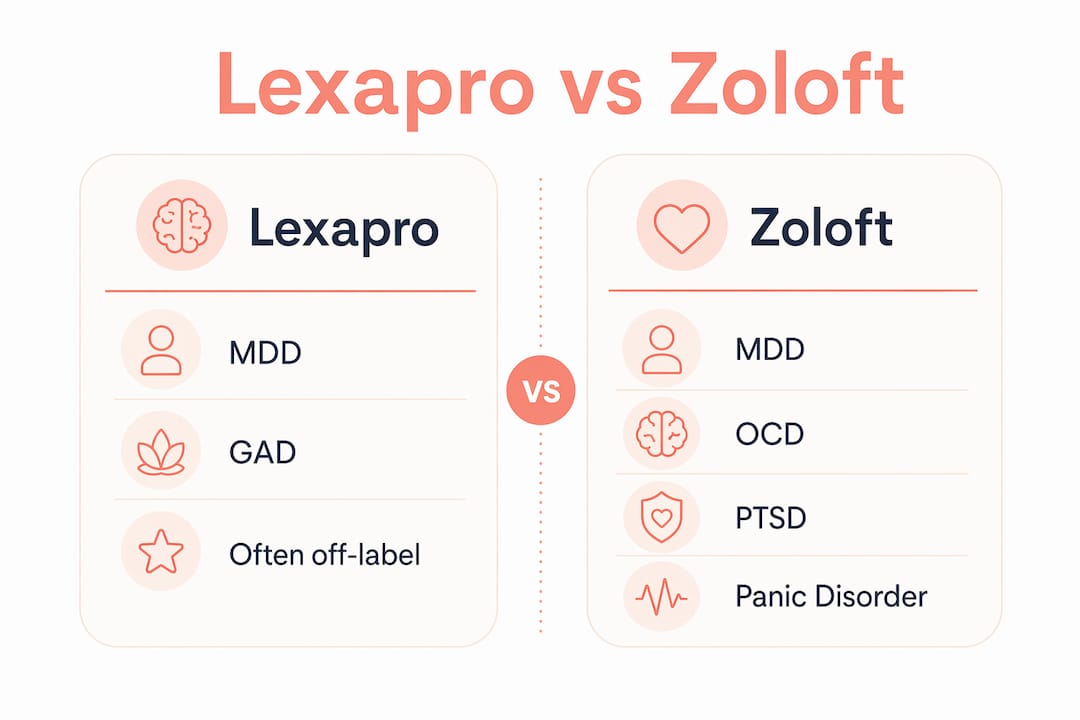
Lexapro (escitalopram) and Zoloft (sertraline) are both SSRIs, but they are not interchangeable. Lexapro tends to be the go-to when generalized anxiety disorder or depression is the primary concern, especially for patients who need a well-tolerated, straightforward medication. Zoloft's broader FDA approvals make it the more natural first choice when OCD, PTSD, panic disorder, social anxiety disorder, or PMDD are driving the diagnosis.
- FDA indications: Lexapro is approved for MDD and GAD only; Zoloft covers MDD, OCD, panic disorder, PTSD, social anxiety disorder, and PMDD.
- Activation vs. sedation: Zoloft tends to feel more activating early on; Lexapro runs more neutral to mildly sedating.
- Insurance and coverage: Zoloft's wider label can matter when prior authorization or step-therapy rules are in play.
The most important thing to know: No SSRI is universally better. The right choice depends on your specific diagnosis, symptom profile, other medications, and how your body responds. Always work with a licensed prescriber before starting, switching, or stopping either medication.
Table of Contents
- How Lexapro and Zoloft compare at a glance
- What each drug is FDA-approved to treat
- How they work, how to dose them, and when you'll start to feel a difference
- Efficacy: what the clinical evidence actually says
- Side effects: what both drugs share and where they differ
- Serious warnings, interactions, and contraindications
- Special populations: pregnancy, breastfeeding, older adults, and children
- Cost, generic availability, and formulations
- How to choose between Lexapro and Zoloft: questions to ask your prescriber
- Stopping or switching: what discontinuation actually feels like
- What prescribers actually consider when choosing between these two drugs
- Key Takeaways
- The tradeoff most people miss when comparing these two drugs
- Kin-wellness offers medication management for adults navigating these decisions
- Useful sources and further reading
How Lexapro and Zoloft compare at a glance
| Dimension | Lexapro (escitalopram) | Zoloft (sertraline) |
|---|---|---|
| FDA-approved uses | MDD, GAD | MDD, OCD, panic disorder, PTSD, social anxiety disorder, PMDD |
| Common starting dose | 10 mg/day | 50 mg/day |
| Typical dose range | 10–20 mg/day | 50–200 mg/day |
| Dosing frequency | Once daily | Once daily |
| Time to early effect | several weeks | several weeks |
| Full therapeutic trial | a sustained treatment period | a sustained treatment period |
| GI side effects | Nausea (common); less diarrhea | Nausea and diarrhea (more frequent) |
| Fatigue/sedation | More commonly reported | Less common; may cause early jitteriness |
| Sexual dysfunction | Common (both drugs) | Common (both drugs) |
| Pregnancy | Risk–benefit discussion required | Risk–benefit discussion required |
| Pediatric approval | MDD (ages 12+), GAD (ages 7+) | OCD (ages 6+) |
| Older adults | Lower starting doses advised | Lower starting doses advised; hyponatremia risk |
| Generic available | Yes (escitalopram) | Yes (sertraline) |
What each drug is FDA-approved to treat
Understanding the approved indications is the fastest way to see whether one drug fits your diagnosis better than the other.
Lexapro (escitalopram) FDA-approved indications:
- Major depressive disorder (MDD) in adults and adolescents ages 12 and older
- Generalized anxiety disorder (GAD) in adults and children ages 7 and older
That is a short list by design. Escitalopram is a highly selective SSRI, and its FDA labeling reflects two well-studied indications rather than a broad portfolio.
Zoloft (sertraline) FDA-approved indications:
- Major depressive disorder (MDD) in adults
- Obsessive-compulsive disorder (OCD) in adults and children ages 6 and older
- Panic disorder in adults
- Post-traumatic stress disorder (PTSD) in adults
- Social anxiety disorder in adults
- Premenstrual dysphoric disorder (PMDD) in adults
Sertraline's wider approval profile is clinically meaningful. When a patient's primary diagnosis is OCD, PTSD, or panic disorder, Zoloft has the on-label evidence base and the formulary standing to match.
Off-label use: Prescribers routinely use both drugs beyond their approved indications. Escitalopram is sometimes used off-label for panic disorder or social anxiety; sertraline is used off-label for GAD. Off-label prescribing is legal and common in psychiatry, but it means the evidence base is thinner, and insurance coverage may be less reliable.
How they work, how to dose them, and when you'll start to feel a difference
Both Lexapro and Zoloft are selective serotonin reuptake inhibitors. They block the reabsorption of serotonin in the synaptic cleft, leaving more serotonin available to bind to receptors. The practical difference is pharmacological selectivity: escitalopram is the active enantiomer of citalopram and is considered highly selective, while sertraline has some additional activity at dopamine and sigma receptors, though the clinical significance of that difference is modest for most patients.
Dosing at a glance:
- Lexapro: Typically starts at 10 mg once daily; the maximum approved dose is 20 mg/day. Available as tablets (5 mg, 10 mg, 20 mg) and an oral solution (1 mg/mL).
- Zoloft: Typically starts at 50 mg once daily for depression and anxiety; doses for OCD and PTSD may go up to 200 mg/day. Available as tablets (25 mg, 50 mg, 100 mg) and an oral concentrate (20 mg/mL).
Timeline — what to realistically expect:
- Weeks 1–4: Side effects often peak before benefits do. Nausea, sleep disruption, and fatigue are common during this window. Patient reviews consistently describe this as the hardest stretch.
- Weeks 2–4: Some patients notice early improvements in sleep or energy before mood fully lifts.
- Weeks 6–12: This is the standard window for a full efficacy assessment. Stopping before six weeks makes it difficult to know whether the drug would have worked.
Prescribers generally advise taking either medication at the same time each day. Some patients find taking Zoloft in the morning reduces sleep disruption; others find Lexapro better tolerated at night if sedation is a concern.

Efficacy: what the clinical evidence actually says
The honest answer is that neither drug consistently outperforms the other across all patients. Head-to-head trials and network meta-analyses comparing SSRIs for depression show that escitalopram ranks among the more effective and better-tolerated options, but the effect-size differences compared to sertraline are modest. In clinical practice, that gap rarely drives the decision.
What the evidence supports: Some meta-analyses rank escitalopram slightly higher for MDD tolerability and average response rates, but differences across SSRIs are small and individual patient response varies considerably. Choosing based on a small average advantage in a trial population is less useful than matching the drug to the patient's actual symptom profile.
For anxiety disorders specifically, both drugs have solid evidence. Sertraline has more FDA-backed trial data across a wider range of anxiety diagnoses. Escitalopram's evidence for GAD is strong, and some clinicians favor it for patients whose anxiety is the dominant feature because of its tolerability profile.
Limits of the evidence worth knowing:
- Most comparative trials are short (8–12 weeks), which may not capture longer-term differences.
- Publication bias tends to favor positive results, so average response rates in published trials may be optimistic.
- Individual variability is large. A drug that works well in 60% of a trial population may not work for a specific patient, and vice versa.
The takeaway: if you have tried one of these drugs and it did not work, that does not mean the other will fail. Switching within the SSRI class is a legitimate and common clinical strategy.
Side effects: what both drugs share and where they differ
Both drugs share the standard SSRI side-effect profile, but the distribution of specific symptoms differs enough to matter when choosing between them.
Shared side effects (both drugs):
- Nausea, especially in the first 1–2 weeks
- Sexual dysfunction (reduced libido, delayed orgasm, or erectile difficulties)
- Sleep changes (insomnia or vivid dreams)
- Increased sweating
- Dry mouth
- Headache
Where they diverge:
- Zoloft is more frequently associated with diarrhea and GI upset than Lexapro. For patients with sensitive GI systems, this is worth flagging upfront.
- Lexapro is more often linked to fatigue or mild sedation, particularly early in treatment. Some patients find this useful if anxiety-driven insomnia is a problem; others find it frustrating.
- Zoloft can feel more activating in the first few weeks, which may present as jitteriness or a slight increase in anxiety before things settle. Prescribers use this distinction to match the drug to the patient's baseline energy and agitation level.
Pro Tip: If nausea is hitting hard in the first week, try taking your medication with food. For Zoloft-related diarrhea, timing the dose in the morning and staying well-hydrated can help. If a side effect is severe or not improving after two weeks, call your prescriber — do not just stop the medication abruptly.
Weight changes are possible with both drugs over longer-term use, though neither is strongly associated with significant weight gain in short-term trials. Sexual dysfunction is common to both and often underreported; it is worth raising with your prescriber rather than quietly tolerating it, since dose adjustments or adjunct strategies exist.

Serious warnings, interactions, and contraindications
Both Lexapro and Zoloft carry an FDA boxed warning for increased risk of suicidal thoughts and behaviors in children, adolescents, and young adults up to age 24. This risk is highest in the first few weeks after starting or after a dose change. Close monitoring during this period is not optional.
High-priority drug interactions to know:
- MAOIs (monoamine oxidase inhibitors): Combining either SSRI with an MAOI can cause serotonin syndrome, a potentially life-threatening condition. A washout period of at least 14 days is required when switching between an MAOI and an SSRI.
- Other serotonergic drugs: Triptans (used for migraines), tramadol, fentanyl, lithium, linezolid, and St. John's Wort all increase serotonin syndrome risk when combined with SSRIs.
- Anticoagulants and NSAIDs: Both sertraline and escitalopram can increase bleeding risk, particularly when combined with warfarin, aspirin, or NSAIDs like ibuprofen. Patients on blood thinners need prescriber review before starting either drug.
- QT-prolonging medications: Escitalopram carries a dose-dependent QT prolongation risk; this is more pronounced at higher doses and in patients with cardiac conditions or electrolyte abnormalities.
Contraindications:
- Concurrent use of MAOIs or pimozide (for Zoloft)
- Known hypersensitivity to escitalopram or sertraline
- Use of IV methylene blue (serotonin syndrome risk)
Warning signs that require urgent attention:
- Sudden worsening of depression or new suicidal thoughts
- Severe agitation, rapid heart rate, high fever, or muscle rigidity (signs of serotonin syndrome)
- Unusual bleeding or bruising
- Severe allergic reaction (rash, swelling, difficulty breathing)
- Symptoms of low sodium: headache, confusion, weakness, or seizures (hyponatremia, especially in older adults)
Tell every prescriber and pharmacist about all medications, supplements, and herbal products you take. This is not a formality — it is how dangerous interactions get caught before they happen.
Special populations: pregnancy, breastfeeding, older adults, and children
Neither drug is risk-free during pregnancy, and neither is automatically off-limits. The decision requires an individualized risk-benefit discussion with your prescriber, weighing untreated depression or anxiety against potential fetal exposure.
Pregnancy and breastfeeding:
- Both drugs cross the placenta. FDA labeling notes that neonates exposed to SSRIs late in pregnancy may experience neonatal adaptation syndrome (irritability, feeding difficulties, respiratory distress).
- A rare but serious risk is persistent pulmonary hypertension of the newborn (PPHN), associated with SSRI use after 20 weeks of pregnancy. The absolute risk remains low, but it is part of the informed-consent conversation.
- Both drugs pass into breast milk in small amounts. Sertraline is often cited in clinical guidance as having relatively low infant exposure levels, but the decision should involve a prescriber and, ideally, a lactation consultant.
- Stopping antidepressants during pregnancy without medical guidance carries its own risks, including relapse of depression or anxiety.
Older adults:
- Lower starting doses are advised for both drugs in older patients, as slower metabolism increases exposure.
- Hyponatremia (low blood sodium) is a real risk with SSRIs in older adults, particularly those on diuretics. Symptoms include confusion, headache, and weakness. Baseline sodium levels and periodic monitoring are reasonable precautions.
- Drug-drug interaction risk is higher in older adults who often take multiple medications. A pharmacist review of the full medication list is worth requesting.
Children and adolescents:
- Lexapro is FDA-approved for MDD in adolescents ages 12 and older, and for GAD in children ages 7 and older.
- Zoloft is FDA-approved for OCD in children ages 6 and older.
- The boxed warning for suicidality applies to all patients under 25. Weekly contact with a prescriber or therapist during the first month is standard practice for younger patients starting an SSRI.
Cost, generic availability, and formulations
Both drugs are available as generics, which is the most important cost fact for most patients. Generic escitalopram and generic sertraline are among the most affordable psychiatric medications on the market.
Formulations:
- Escitalopram: Tablets in 5 mg, 10 mg, and 20 mg strengths; oral solution at 1 mg/mL.
- Sertraline: Tablets in 25 mg, 50 mg, and 100 mg strengths; oral concentrate at 20 mg/mL (requires dilution before use).
Cost and coverage considerations:
- Generic availability for both drugs means out-of-pocket costs with insurance are typically low, often a few dollars per month at major pharmacy chains.
- Without insurance, GoodRx and similar discount programs can bring generic costs down significantly. Brand-name Lexapro and brand-name Zoloft are substantially more expensive and rarely necessary when generics are available.
- Insurance formularies and step-therapy rules can favor one drug over the other based on the diagnosed condition. Zoloft's broader FDA indications mean it may be the required first-line option for OCD, PTSD, or panic disorder before a plan will cover an alternative.
- If your insurer requires prior authorization, your prescriber's office handles that process. Having a clear documented diagnosis that matches the drug's approved indication speeds approval.
Pro Tip: Before filling a prescription, check GoodRx or your insurer's formulary tool. Generic sertraline and generic escitalopram are both Tier 1 on most major plans, but the copay can still vary by pharmacy. A 90-day supply through a mail-order pharmacy is often cheaper than 30-day fills at retail.
How to choose between Lexapro and Zoloft: questions to ask your prescriber
The right drug is the one that matches your diagnosis, your symptom pattern, your other medications, and your tolerance for specific side effects. There is no universal answer, but there is a clear framework for the conversation.
Start here: match diagnosis to indication
If your primary diagnosis is OCD, PTSD, panic disorder, social anxiety disorder, or PMDD, Zoloft has the on-label evidence and the formulary standing. If your primary concern is generalized anxiety or depression, either drug is reasonable, and tolerability often tips the decision toward Lexapro.
Questions to bring to your prescriber:
- "Which medication matches my primary diagnosis and symptom profile most closely?"
- "Given my other medications and health conditions, are there interaction risks I should know about?"
- "What side effects are most likely for me, and what's the plan if they're intolerable?"
- "How will we know if this medication is working, and when should I expect to feel a difference?"
- "If I experience worsening mood or new suicidal thoughts, what's the protocol?"
- "What's the plan if this medication doesn't work after a full trial?"
- "Does my insurance require step therapy, and will that affect which drug we start with?"
- "If I want to stop this medication eventually, how do we do that safely?"
Red flags that require urgent contact with your prescriber or emergency services:
- New or worsening suicidal thoughts, especially in the first few weeks
- Severe agitation, confusion, rapid heart rate, or high fever (possible serotonin syndrome)
- Signs of an allergic reaction: rash, facial swelling, difficulty breathing
- Unusual bleeding that does not stop
- Sudden confusion, weakness, or seizures (possible hyponatremia)
Do not wait for a scheduled appointment if any of these occur. Call your prescriber's after-hours line or go to an emergency room.
Stopping or switching: what discontinuation actually feels like
Both drugs can cause discontinuation symptoms when stopped abruptly, and this catches a lot of patients off guard. The symptoms are not dangerous in most cases, but they are unpleasant enough that many people mistake them for relapse.
Common discontinuation symptoms:
- Dizziness and lightheadedness
- "Brain zaps" (brief electrical-shock sensations in the head)
- Flu-like symptoms: fatigue, muscle aches, chills
- Irritability and mood swings
- Insomnia or vivid dreams
- Nausea
- Heightened anxiety
Sertraline discontinuation symptoms typically last one to two weeks but can extend longer in some patients. Escitalopram has a similar profile. The shorter a drug's half-life, the faster symptoms appear and the more intense they tend to be. Both sertraline and escitalopram have relatively short half-lives compared to fluoxetine, which is why they require more careful tapering.
How tapering works:
- Gradual dose reductions over two to four weeks are the standard approach. For patients with a history of difficult discontinuation or high anxiety sensitivity, slower tapers over several months are sometimes used.
- Switching between SSRIs usually involves cross-titration (slowly introducing the new drug while tapering the old one) rather than a full washout, but the specific approach depends on the drugs involved and the prescriber's judgment.
- Never stop either medication without a plan from your prescriber. The discomfort of discontinuation is manageable with the right taper; stopping cold turkey makes it significantly worse.
Pro Tip: If brain zaps or dizziness are severe during a taper, tell your prescriber. Slowing the taper further or temporarily holding at a lower dose is a legitimate option. Some prescribers use a liquid formulation to allow very small dose reductions that tablets cannot achieve.
What prescribers actually consider when choosing between these two drugs
The clinical decision rarely comes down to which drug is "stronger." Prescriber reasoning centers on four factors: the patient's diagnosis and symptom profile, the activation-versus-sedation tradeoff, drug-drug interaction risk, and insurance formulary realities.
The core clinical principle: Matching the drug to the patient's symptom profile and FDA-approved indication is more predictive of success than chasing small average efficacy differences from population-level trials. A drug that fits the diagnosis and the patient's tolerability needs is the right drug.
Clinician heuristics in practice:
- Prefer Zoloft when the diagnosis is OCD, PTSD, panic disorder, social anxiety disorder, or PMDD. The on-label evidence base is stronger, and formulary rules often require it as first-line for these conditions.
- Prefer Lexapro when GAD is the dominant presentation, when the patient needs a well-tolerated SSRI with a simple dosing range, or when prior SSRI trials suggest sensitivity to activating effects.
- Activation matters: For a patient who is already agitated, jittery, or struggling with insomnia, starting with a potentially activating drug like sertraline can worsen early symptoms. Escitalopram's more neutral profile is often the safer starting point.
- Prior response: If a patient or a first-degree relative responded well to one drug, that is meaningful clinical information. Genetics and family history of drug response are underused in practice.
- Interaction risk: Escitalopram's QT prolongation risk at higher doses is a real consideration for patients with cardiac conditions or those on other QT-prolonging medications.
Prescribers also factor in whether a patient has already tried one of these drugs. A failed trial of sertraline does not predict failure with escitalopram, and vice versa. Switching within the SSRI class is a well-supported strategy before moving to a different drug class entirely.
Key Takeaways
Both Lexapro and Zoloft are effective, affordable SSRIs, but Zoloft's broader FDA approvals make it the standard first choice for OCD, PTSD, panic disorder, and PMDD, while Lexapro's tolerability profile and simpler dosing make it a strong fit for GAD and depression.
| Point | Details |
|---|---|
| Match diagnosis to indication | Zoloft covers OCD, PTSD, panic disorder, PMDD; Lexapro covers MDD and GAD. |
| Side-effect tradeoffs | Zoloft causes more diarrhea; Lexapro more often causes fatigue or mild sedation early on. |
| Generics make both affordable | Both have low-cost generics; insurance step-therapy rules may favor one over the other based on diagnosis. |
| Taper, don't stop abruptly | Both drugs cause discontinuation symptoms; a gradual taper over several weeks reduces risk significantly. |
| Kin-wellness supports this decision | Kin-wellness offers virtual medication management for California adults, with licensed prescribers who guide SSRI selection and monitoring. |
The tradeoff most people miss when comparing these two drugs
The conversation about Lexapro versus Zoloft almost always gets framed as a question of which drug is better. That framing is the wrong starting point, and it leads a lot of people to feel like they failed when their first SSRI does not work perfectly.
What actually matters is whether the drug matches the diagnosis, the symptom pattern, and the patient's specific sensitivities. A person with PTSD who gets prescribed Lexapro off-label when Zoloft has the on-label evidence base may be starting at a disadvantage, not because Lexapro is a worse drug, but because the evidence base and the formulary support are weaker for that specific indication. Conversely, someone with pure GAD who gets started on Zoloft and experiences early jitteriness may abandon a medication that would have worked fine at a lower dose with a slower titration.
The other thing worth saying plainly: six to twelve weeks is a long time to feel uncertain about whether something is working. That adjustment window is where most people give up, and where close prescriber contact matters most. A prescriber who checks in during weeks two and four, adjusts the dose if needed, and normalizes the early discomfort is not a luxury. For working adults managing depression or anxiety alongside jobs and families, that kind of structured support is often the difference between a successful trial and a medication abandoned too soon.
Kin-wellness offers medication management for adults navigating these decisions
Choosing between Lexapro and Zoloft is rarely a one-appointment decision. It involves monitoring, dose adjustments, and sometimes switching, and that process goes better with a prescriber who knows your full picture. Kin-wellness provides virtual medication management for adults in California, including intake evaluations, SSRI prescribing and monitoring, and coordination with therapy when needed. Whether you are starting an antidepressant for the first time or reconsidering a medication that has not been working, the team at Kin-wellness can help you work through the decision with clinical support rather than guesswork.

Kin-wellness works with PPO and HMO insurance plans and accepts private-pay clients. An intake visit covers your diagnosis, medication history, and goals, so your prescriber has what they need to make a grounded recommendation from the start. To get started, visit Kin-wellness and book a consultation.
This article is general health information, not medical advice. Consult a licensed prescriber or pharmacist for guidance specific to your situation, diagnosis, and current medications.
Useful sources and further reading
- FDA prescribing information, sertraline (Zoloft) — Official FDA labeling covering approved indications, dosing, warnings, and contraindications for sertraline.
- FDA prescribing information, escitalopram (Lexapro) — Official FDA labeling for escitalopram, including approved uses, dosing ranges, and safety information.
- NCBI: Escitalopram pharmacology and clinical use — Clinical overview of escitalopram's mechanism, indications, and safety profile from the National Library of Medicine.
- NCBI: Sertraline pharmacology and clinical use — National Library of Medicine summary of sertraline's pharmacology, approved uses, and adverse effects.
- NCBI: SSRI comparative meta-analysis — Network meta-analysis comparing efficacy and tolerability of SSRIs for major depression, including escitalopram and sertraline.
- DailyMed: Escitalopram drug label — Full current prescribing information from the National Library of Medicine's drug labeling database.