
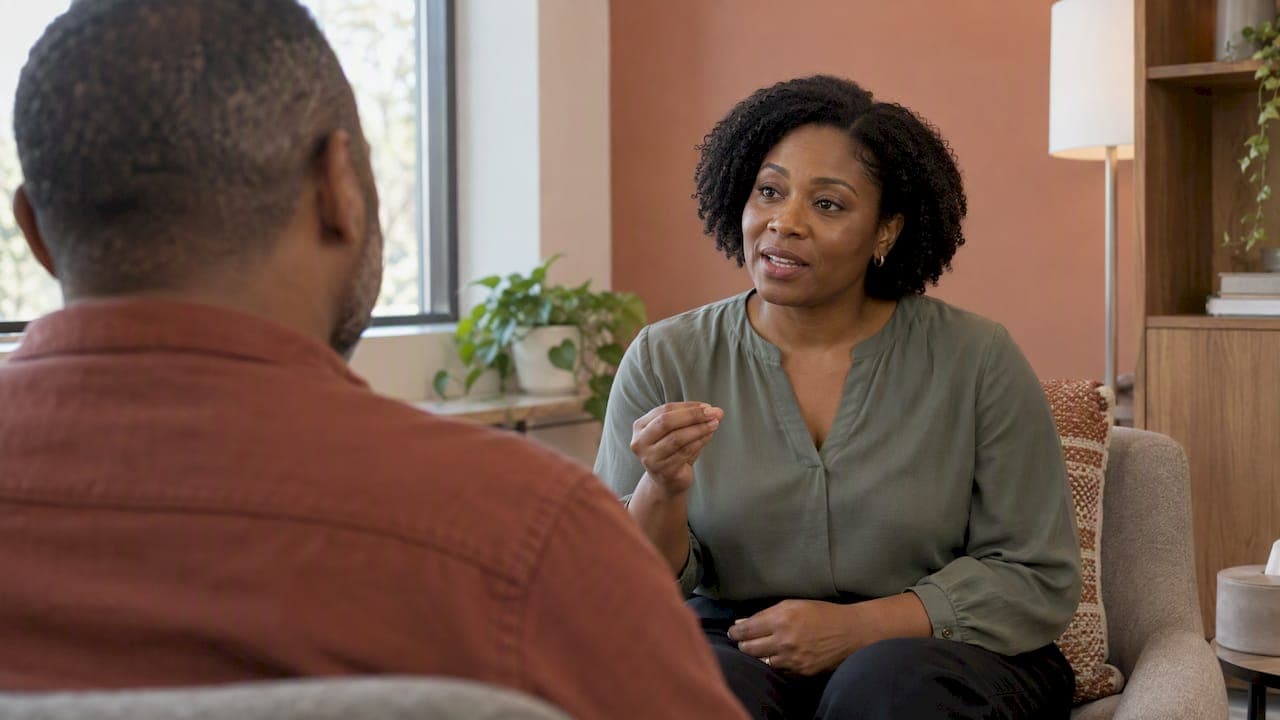
Psychoeducation is the part of mental health care where you learn about your condition: what it is, what causes it, how it is treated and how to manage it day to day. The APA Dictionary of Psychology describes it as giving patients and families information about a mental health disorder, or a health condition with psychological impact, including its treatment, long term course and effects on daily life. Think of it as health class for your own mind, taught by a clinician who knows your situation.
This guide explains the meaning in plain terms, shows real examples, covers the main formats and models, and answers the question many people ask next: how long does therapy last?
TL;DR
- Psychoeducation means teaching you and your family about a mental health condition, its treatment and the skills to manage it.
- It shows up as individual sessions, groups, family sessions, handouts, videos and online programs.
- Research describes four core elements: learning about the illness, problem solving, communication and self assertiveness training.
- Programs range from one session to many months. Brief programs are defined as 10 sessions or fewer.
- At Kin Wellness, education is built into our virtual groups, along with skills from DBT, CBT and ACT.
Table of Contents
- What psychoeducation means in simple terms
- Why it matters
- What psychoeducation includes: the main components
- Psychoeducation examples
- Models of psychoeducation
- Does psychoeducation work?
- How long does psychoeducation, and therapy, last?
- Perspective: why we teach as we treat
- Getting more than weekly education
- How to get the most from psychoeducation
- FAQ
- Sources
What psychoeducation means in simple terms
The word joins "psychological" and "education." If someone asks what the meaning of psychoeducational is, the short answer is: relating to teaching about mental health. It is not a separate diagnosis or a lecture on how you should feel. It is structured information, delivered in a way you can use.
A research review of brief programs defines it as educating a person with a psychiatric disorder about the symptoms, treatments and prognosis of that illness, with the aim of empowering patients, raising awareness and changing behaviors. Clinical guidelines add that it combines elements of cognitive behavioral therapy, group therapy and education, so patients and families can work with mental health professionals.
In practice, that can sound like this:
- "Here is what happens in your body when anxiety spikes, and why it feels so physical."
- "Here is how this medication class generally works, and what to ask your prescriber."
- "Here are early signs that your mood is slipping, so you can act sooner."
The goal is to close the gap between what clinicians know and what you experience. Authors writing in a psychotherapy journal describe the primary goal as bridging objective medical knowledge and the individual's own point of view, which calls for a humane, tailored approach rather than a generic script.
Why it matters
People often arrive at treatment with a name for their problem and little else. Understanding what is happening tends to make the rest of care easier to engage with. A University of Washington training document says psychoeducation is meant to leave patients better prepared, motivated and engaged to work on their problems because they understand their condition and their options.
A paper in Psychiatric Annals identifies it as a tool to support autonomy, strengthen the therapeutic alliance and reduce stigma. Those three things matter for working adults who may feel they "should" be able to handle things alone. Knowing that burnout, panic or low mood have recognizable patterns takes some of the shame out of asking for help.
It also helps the people around you. When a partner or parent understands what you are dealing with, they can support you with fewer guesses. Family focused programs aim to help relatives support recovery and spot early signs of relapse.

What psychoeducation includes: the main components
People also ask about the four components of psychoeducation. The term was first used by Anderson and colleagues to describe a behavioral approach with four elements:
- Briefing patients about their illness
- Problem solving training
- Communication training
- Self assertiveness training
In current practice, the information part usually covers the same ground. Clinical practice guidelines list what is typically taught to patients and families: causes and contributing factors, common signs and symptoms, early warning signs of relapse, coping strategies, treatment options and guidance on taking medication as prescribed.
A useful way to see it is as three layers:
| Layer | What you learn | Example |
|---|---|---|
| Understanding | What the condition is and how it behaves | How trauma affects sleep and attention |
| Skills | What to do when symptoms show up | A grounding exercise, a way to challenge a spiraling thought |
| Planning | How to spot trouble early and respond | A written list of warning signs and first steps |
That last layer connects to relapse prevention. If you want a practical template, our one page relapse prevention plan shows how warning signs and responses can be put on paper.
Psychoeducation examples
Examples are the most common thing people look for after the definition, so here are the formats you are likely to meet.

Individual sessions. Your therapist explains your diagnosis, walks through how your symptoms connect to stress or sleep, and teaches a skill you practice before the next visit. Research notes that psychoeducation is often more extensive at the start of treatment but can be woven in throughout, especially when a new skill is introduced.
Group sessions. A clinician teaches a topic, such as how to tolerate distress or how thoughts shape mood, and members discuss it. Guidelines describe groups of 4 to 12 members, ideally about 8, meeting for 40 to 60 minutes, usually weekly. Hearing that others share your experience is part of the value. Our summary of group therapy research for working adults goes deeper.
Family sessions. Relatives learn about the condition, how to communicate during a hard stretch and how to support without taking over. The same guidelines say family programs average 6 to 12 sessions, sometimes with monthly follow ups. If you are preparing a loved one to join, see our steps for family involvement in therapy and what the research shows on family therapy.
Handouts, audio and video. Delivery can be active, with a clinician interacting with you, or passive, using pamphlets or audio and video materials. Passive material works best as a supplement to a conversation, not a replacement for one.
Online programs. A 2024 review found psychoeducation delivered in individual, group, mixed and electronic formats. Video makes it possible to attend from home or an office between shifts.
Models of psychoeducation
The University of Washington document lists four models:
- Information model: focused on knowledge about the condition.
- Skill training model: focused on managing symptoms.
- Supportive model: built around support groups.
- Comprehensive model: a combination of the three.
The source for these is the University of Washington meta competency guide. Most real treatment is comprehensive: you learn something, practice it, and talk with others who are doing the same.
Does psychoeducation work?
The honest answer is that results vary by person, condition and program. A 2024 review of education programs for severe mental disorders cited findings of better medication adherence and fewer relapses, but also noted that effectiveness was mixed: some programs improved coping and functioning and others showed no significant effect. No program can promise a particular outcome, and none replaces assessment by a licensed clinician.
What the evidence does support is that quality matters. Programs work better when they are tailored, interactive and delivered in language the patient understands. The University of Washington guide stresses that health literacy and language barriers must be addressed so everyone gets understandable information. If a handout feels like jargon, say so. A good clinician will rephrase.
How long does psychoeducation, and therapy, last?
There is no single answer. Here is what the research shows for psychoeducation programs specifically:
| Program type | Typical length | Source |
|---|---|---|
| Very brief | As few as 1 to 2 sessions | Review of family programs |
| Brief | 10 sessions or fewer | Systematic review |
| Typical | About 12 weeks (median in one review) | Systematic review |
| Clinical trials | 6 to 48 sessions | 2024 review |
| Extended family programs | 9 months to 5 years | Psychiatric Services review |
The same systematic review found programs from a single session up to 18 months.
Brief versus long term therapy
Brief approaches are built around a defined goal and a limited number of sessions. They tend to suit a specific problem, such as learning to manage a stress response, or situations where ongoing support is not feasible. Researchers note that models with as few as two sessions exist for that reason.
Longer term work is used when a condition is complex, has come back before, or involves several areas of life at once. Family programs for serious illness, for example, generally run from nine months to five years.
What decides the length for you:
- How many symptoms you have and how much they disrupt work, sleep or relationships
- Whether this is a first episode or a recurring pattern
- Whether you need more than one hour a week to make progress
- Your goals, your schedule and your insurance benefits
- How you respond as you go, which your clinician reviews with you
Nobody can tell you in advance exactly how long you will need. A good provider reassesses regularly and adjusts the plan with you.
Perspective: why we teach as we treat
At Kin Wellness, we see education as part of treatment, not a warm up to it. Many of the adults we work with are professionals, parents and healthcare workers who are used to being the one with answers. When they understand what is happening in their own minds and bodies, they can take a more active role in their care.
That is why our virtual intensive outpatient program is built around groups of three hours, three to five days a week, with morning or evening options. Group time includes teaching, discussion and practice, drawing on DBT, CBT and ACT skills. Sessions meet by video, so learning happens alongside real life instead of requiring you to step away from it.
We also believe the information should fit the person. A medical director, a clinical director and a supervised associate therapist work together, so what you learn about your symptoms, your skills and any medication questions stays consistent. If you take or are considering medication, talk with your prescriber before starting, stopping or changing anything.
Kin Wellness Clinical Team
Getting more than weekly education
Weekly therapy often includes psychoeducation in small doses. Some people want more structure and more hours than one session a week can hold. If that sounds familiar, our virtual IOP for adults in California offers group sessions by video three to five days a week, with individual sessions available by video or in person in Fountain Valley. Medication management and EMDR are part of the program, and weekly individual therapy is offered too.
If you are not sure which level of care fits, our page on when weekly therapy isn't enough walks through the signs. For one on one care, see therapy for adults in California. Kin Wellness serves adults in California only. We do not provide crisis services, and we are not the right fit for eating disorders, a primary substance use disorder or detox, where a specialized program is the better choice. If you are in crisis, call or text 988 or go to your nearest emergency room.
How to get the most from psychoeducation
A few habits make the learning stick:
- Ask for plain language. If a term is unclear, ask your clinician to explain it with an example from your life.
- Write down what you learn. One page of notes on your triggers, early signs and skills is more useful than a memory of a good session.
- Practice between sessions. Skills are learned by using them, not by hearing about them.
- Bring in people you trust. With your consent, a partner or family member can join a session or read the same material.
- Raise medication questions with your prescriber. Information from articles, including this one, is not a substitute for their advice, and you should not start, stop or change any medication without them.
- Review the plan. Ask every few weeks what has changed, what is working and whether the format or length still fits.
FAQ
What is psychoeducation in simple terms?
It is teaching about mental health. A clinician explains your condition, its treatment and the coping skills that go with it, so you and your family understand what is going on and what to do about it. It can happen one on one, in a group, or through written and online material.
Is psychoeducation the same as therapy?
Not exactly. It is a component of therapy and often runs alongside it. Guidelines describe it as combining education with elements of cognitive behavioral and group therapy. Therapy adds the personal work of processing experiences, changing patterns and building a relationship with your clinician.
Who is psychoeducation for?
It is used with people who have a mental health condition and with their families. It can also help anyone dealing with stress or burnout who wants to understand what is happening. Family versions aim to help relatives support recovery and recognize early signs of relapse.
How long should therapy last?
It depends on your goals, your symptoms and how you respond. Research on psychoeducation programs shows lengths from one session to 18 months, with a median of about 12 weeks in one review. Your clinician should check in on progress regularly and adjust the plan with you.
Can psychoeducation be done online?
Yes. Reviews list electronic formats alongside individual, group and mixed delivery. Live video with a clinician is more interactive than reading material alone.
Sources
- APA Dictionary of Psychology: Psychoeducation
- Psychoeducation (brief) for people with serious mental illness
- Clinical Practice Guidelines for Psychoeducation in Psychiatric Disorders
- Psychoeducation: A Basic Psychotherapeutic Intervention
- Meta Competency 7b: Psychoeducation, University of Washington
- Therapeutic patient education for severe mental disorders
- The Integral Role of Psychoeducation in Clinical Care, Psychiatric Annals
- Consumer and Family Psychoeducation: Assessing the Evidence
Wondering whether your plan covers this kind of care? Check your coverage on our insurance page. We work with most PPO and HMO plans, and we do not accept Medi-Cal or Medicare.
Recommended
- EMDR Therapy Explained: What It Is and How It Works
- EMDR vs Prolonged Exposure: How the Two PTSD Therapies Differ
- Parents: 8 Practical Steps to Prepare for Family Involvement in Therapy
- Moral Injury Treatment: Therapies, Steps, and Support
Clinically reviewed by Angelina DeSanto, LCSW, Clinical Director at Kin Wellness. This article is for general information only and is not medical or mental health advice. Kin Wellness serves adults in California. If you are in crisis, call or text 988, or call 911 in an emergency.