
A relapse prevention plan is a written, clinician-informed checklist that maps your triggers, coping steps, emergency contacts, clinical supports, and a review schedule. It works because it turns a vague intention to "stay sober" into several trackable domains including therapy and skills, medication, self-monitoring, peer support, and lifestyle. Start by filling in a single-page template and sharing it with a clinician or sponsor as soon as possible.
TL;DR:
- Both alcohol and opioid relapse plans should explicitly include overdose response steps and medication adjustments, as physical dangers vary by substance.
- A comprehensive plan must monitor objective metrics such as missed appointments, mood logs, and craving intensities, not just vague feelings or subjective impressions.
- Addressing high-risk situations requires exhaustive trigger identification and pattern tracking over weeks, focusing on both internal feelings and external environments.
- Post-slip actions should prioritize immediate safety, honest communication, and quick plan adjustment within 48 hours to prevent the Abstinence Violation Effect.
- Regular review schedules, starting weekly during early recovery and then monthly, should be tailored to stability and significant life changes to keep the plan effective.
Table of Contents
- What Goes Into a Relapse Prevention Plan?
- How Do You Identify Your Personal Triggers?
- What Coping Strategies Work in the Moment?
- Do You Need Medication as Part of Your Plan?
- What Do You Do Immediately After a Slip?
- How Often Should You Review and Update the Plan?
- A Fill-In-the-Blanks Template You Can Use Today
- Does the Plan Change by Substance or Diagnosis?
- Why Peer Support Alone Isn't Enough
- How Do You Stay Motivated Months or Years In?
- A Clinician's View on What Makes Plans Actually Work
- How Kin-wellness Builds and Supports Your Plan
- Sources
- FAQ
What Goes Into a Relapse Prevention Plan?
Every durable relapse prevention plan rests on five domains, not one. Relying on willpower alone, or on a single support group, leaves gaps that stress finds fast. The StatPearls clinical review on addiction relapse prevention organizes recovery planning around therapy and skill development, medication management, self-monitoring, peer support, and lifestyle change, and that five-part structure has held up as the clinical standard for good reason: each domain covers a different failure point.
- Therapy and skill development. Cognitive-behavioral sessions teach you to catch a craving before it becomes a decision. This is usually a clinician's responsibility, delivered in individual or group format.
- Medication management. Certain medications lower the biological pull toward use. A prescriber owns this domain, and it needs regular check-ins, not a one-time prescription.
- Self-monitoring. Daily logs or apps catch drift, the small mood or sleep changes that precede a lapse by days or weeks. This one is on you.
- Peer support. Sponsors, recovery groups, or a trusted friend supply accountability and normalize the hard days. Shared responsibility between you and your support circle.
- Lifestyle and self-control strategies. Sleep, structure, and purpose reduce the baseline stress that makes every other domain harder to maintain.
Underneath these domains sits a framework worth knowing by name: the stages of relapse. Clinical research on relapse prevention for addictive behaviors describes relapse as a process, not an event, moving through emotional, mental, and physical stages. Emotional relapse looks like isolation, irritability, or skipped meals, often weeks before any thought of using appears. Mental relapse is the internal argument, the glamorizing of old habits, the bargaining. Physical relapse is the act itself. A plan built only for the last stage arrives too late.
How Do You Identify Your Personal Triggers?
Most people can name their obvious triggers in about thirty seconds. The dangerous ones are the quiet ones, so the goal here is exhaustiveness, not speed.
- List every situation tied to past use. Write down people, places, times of day, and emotional states, even the ones that seem minor. A Sunday afternoon alone might matter more than a wedding open bar.
- Sort each trigger by category. Internal triggers are feelings (loneliness, boredom, anger). External triggers are environments (a specific bar, a phone contact, a paycheck deposit). Most plans need both columns filled.
- Rate each trigger's intensity on a simple 1 to 5 scale. This tells you which ones deserve an emergency-level response versus a passing note in your log.
- Track daily patterns for two to three weeks using a log or app. Simple mood and sleep trackers work; so does a plain notes app with three lines a day: mood, sleep hours, craving intensity.
- Translate patterns into specific, testable warning signs. Vague entries like "feeling off" are useless under stress. Rewrite them as "skipped two meals in a row" or "haven't called my sponsor in five days," things you can check against a real calendar.
A useful mental model here, drawn from updates to Marlatt's cognitive-behavioral relapse model, treats high-risk situations as signals to intervene rather than evidence you've failed. Working backward from a specific high-risk moment often exposes a distal cause, like chronic overwork or unresolved conflict, that a generic coping skill won't fix. If your trigger inventory keeps surfacing the same three situations, that's the plan telling you where the real problem lives.
What Coping Strategies Work in the Moment?
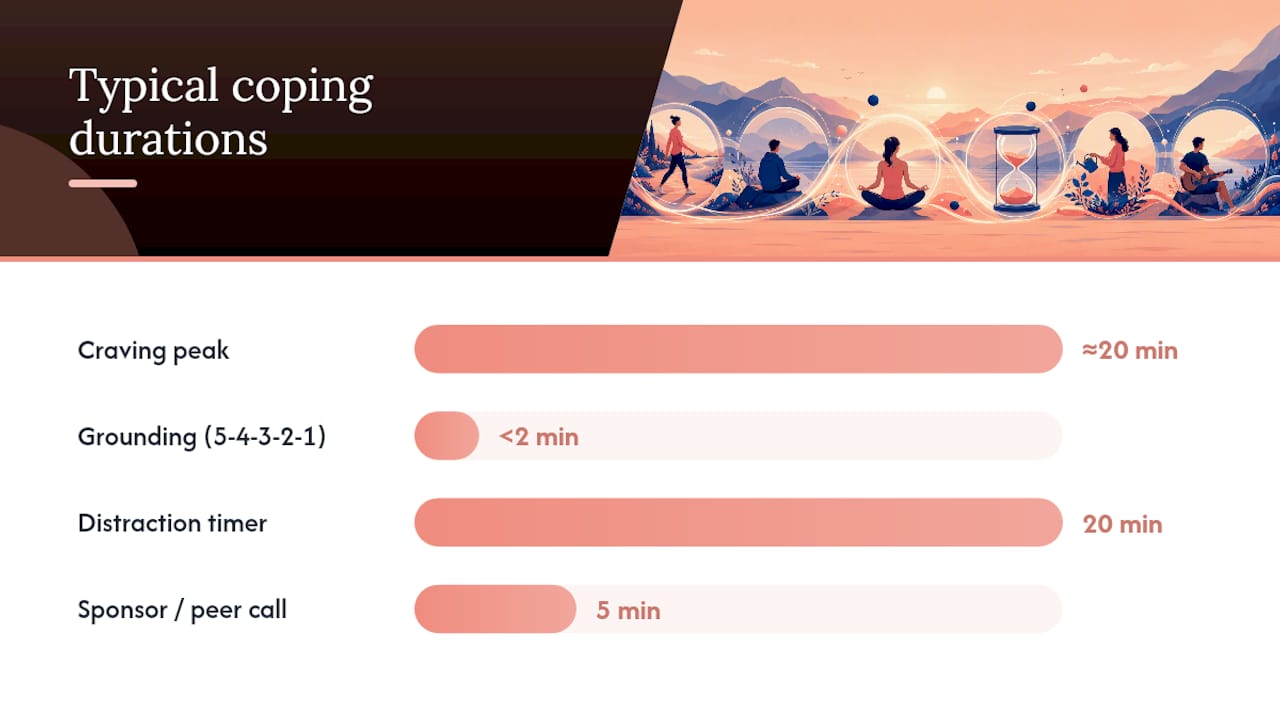
Cravings peak and fade, typically within twenty minutes, whether or not you act on them. The clinical term for riding that wave without acting is urge surfing, a mindfulness-based technique built into many modern relapse prevention programs. Instead of fighting the urge or giving in, you name it ("I'm having a craving right now"), notice where it sits in your body, and watch it move without judgment. Marlatt's model and its later updates treat this as a core coping skill precisely because it doesn't require you to win an argument with your own brain.
Pair urge surfing with a few other tools:
- CBT thought-challenging. Write the automatic thought ("one drink won't hurt") next to the counter-thought ("one drink historically leads to five"). Seeing them side by side breaks the automatic pull.
- Grounding techniques. The 5-4-3-2-1 method, five things you see, four you hear, three you feel, two you smell, one you taste, interrupts a spiraling mental relapse in under two minutes.
- Distraction with a timer. Commit to twenty minutes of something else entirely: a walk, a call, a chore. Most urges lose their grip before the timer runs out.
Daily habits matter as much as in-the-moment tactics. Sleep debt, skipped meals, and idle hours are the terrain where cravings grow. Building a loose daily structure, consistent wake time, planned meals, some physical activity, and at least one purposeful task, keeps your baseline stress lower so a trigger has less to work with. A partner guide on holistic wellness breaks down how health, home, purpose, and community routines reinforce each other, which is worth reading if your plan currently skips the lifestyle column entirely.
Pro Tip: Stack your new coping habit onto something you already do without thinking, like brushing your teeth or making coffee. Doing a two-minute grounding exercise right after your morning coffee turns a skill you might forget into one your routine does for you.
Peer check-ins and simple tracking apps reinforce all of this. A five-minute call with a sponsor after a rough day, or a habit-tracking app that logs streaks, gives the plan teeth beyond good intentions.
Do You Need Medication as Part of Your Plan?
Medication is not a separate track from therapy. It's one of the five domains, and for many substance use disorders it measurably lowers relapse risk. Research on medications in relapse prevention shows naltrexone and acamprosate reduce relapse risk in alcohol use disorder, while methadone and buprenorphine reduce opioid relapse and meaningfully improve treatment retention. None of these decisions belong outside a prescriber's supervision, since dosing and monitoring needs vary by person and by substance.
What matters for your plan isn't memorizing pharmacology, it's knowing when to loop your prescriber back in:
- Cravings intensify despite an existing medication regimen. That's a signal for dose review, not a sign the medication has failed.
- You've missed doses or stopped early. Say so plainly at your next appointment; adjustment beats silence.
- Your plan calls for urine screens or contingency management. These aren't punitive. They're objective markers that catch drift before a full relapse, and structured incentive programs have real evidence behind them for improving retention.
Treatment duration matters here too. NIDA's research-based guide notes that staying in treatment for an adequate period correlates with better long-term outcomes, and a relapse itself often signals a need to re-engage rather than a reason to quit the process.
What Do You Do Immediately After a Slip?
A single lapse and a full relapse are not the same event, but the gap between them closes fast without a plan. The most damaging force in that gap is the Abstinence Violation Effect, or AVE: the shame spiral that turns "I made a mistake" into "I've already failed, so why stop now." The Five Rules of Recovery research treats interrupting AVE as the single most important task after a slip.
- Get physically safe first. If there's any risk of overdose, withdrawal complications, or injury, call emergency services or go to urgent care before doing anything else.
- Stop and remove yourself from the environment. Leave the location, put down the substance, and get somewhere neutral within minutes, not hours.
- Contact one person from your emergency list within the hour. A sponsor, clinician, or trusted contact, whoever you already named, not whoever happens to be free.
- Say the plain truth, not a defense. "I used tonight, I need help getting back on track" is enough. Save the analysis for later.
- Reframe the slip before it compounds. One use does not erase your recovery. Name the trigger that led here, in writing, while it's fresh.
- Adjust the plan within 48 hours. Add the trigger you missed, tighten a warning sign, or schedule an extra check-in. A slip that updates your plan isn't wasted.
How Often Should You Review and Update the Plan?
A plan that never gets reviewed quietly stops matching your actual life. Review cadence should track your stability, not the calendar you'd prefer.
- Early recovery phase: Review weekly, ideally with a clinician or sponsor. Early recovery shifts fast, so frequent review helps keep the plan current.
- After stabilization: Review monthly or as life changes require, such as after a job loss, relationship stress, or health scare that increases risk.
- Track concrete metrics, not vague feelings. Mood logs, appointment attendance, and any objective screens your care team uses all belong in the review.
- Watch for signals that mean stepping up care. Increasing craving intensity, two or more missed appointments in a row, or a second slip within a short window all suggest it's time for more structure, not less. An intensive outpatient program is often the right next step when weekly outpatient visits stop being enough.
Fitting reviews around a working schedule is a real logistical hurdle for a lot of people. Flexible IOP scheduling exists specifically to keep review appointments from becoming the thing that lapses first.
A Fill-In-the-Blanks Template You Can Use Today
Copy the fields below into a document, a notes app, or a printed page you keep somewhere visible. The goal is brevity: a plan you'll actually read during a crisis beats a thorough one buried in a drawer.
- My top 3 to 5 personal triggers: (example: "Friday nights alone," "conflict with my sister," "payday")
- My five earliest warning signs: (example: "skipping meals," "avoiding calls from my sponsor," "sleeping less than five hours," "canceling therapy," "romanticizing past use")
- My immediate coping steps, in order: (example: "1. Name the urge out loud. 2. Text my sponsor. 3. Leave the house for a walk.")
- My emergency contacts and what to say: (example: "Sponsor, Maria, 555-0100: 'I'm struggling tonight, can you talk?'")
- My medication and clinical supports: (example: "Naltrexone, prescribed by Dr. Lee, refill due the 1st of each month")
- My follow-up schedule: (example: "Therapy every Tuesday, prescriber check-in monthly, sponsor call three times a week")
Two filled-in examples show how short this should actually be: "Trigger: driving past my old dealer's block. Warning sign: rehearsing an excuse to drive that route. Step: call Maria, take the highway instead." Or: "Trigger: my sister's birthday dinner. Warning sign: pre-drinking anxiety about the party. Step: bring a sober friend, leave by 9pm."
Save a digital copy somewhere your phone can reach in seconds, share a copy with your sponsor and your clinician, and revisit the aftercare planning steps Kin-wellness uses for a fuller version built for ongoing clinical review.
Does the Plan Change by Substance or Diagnosis?
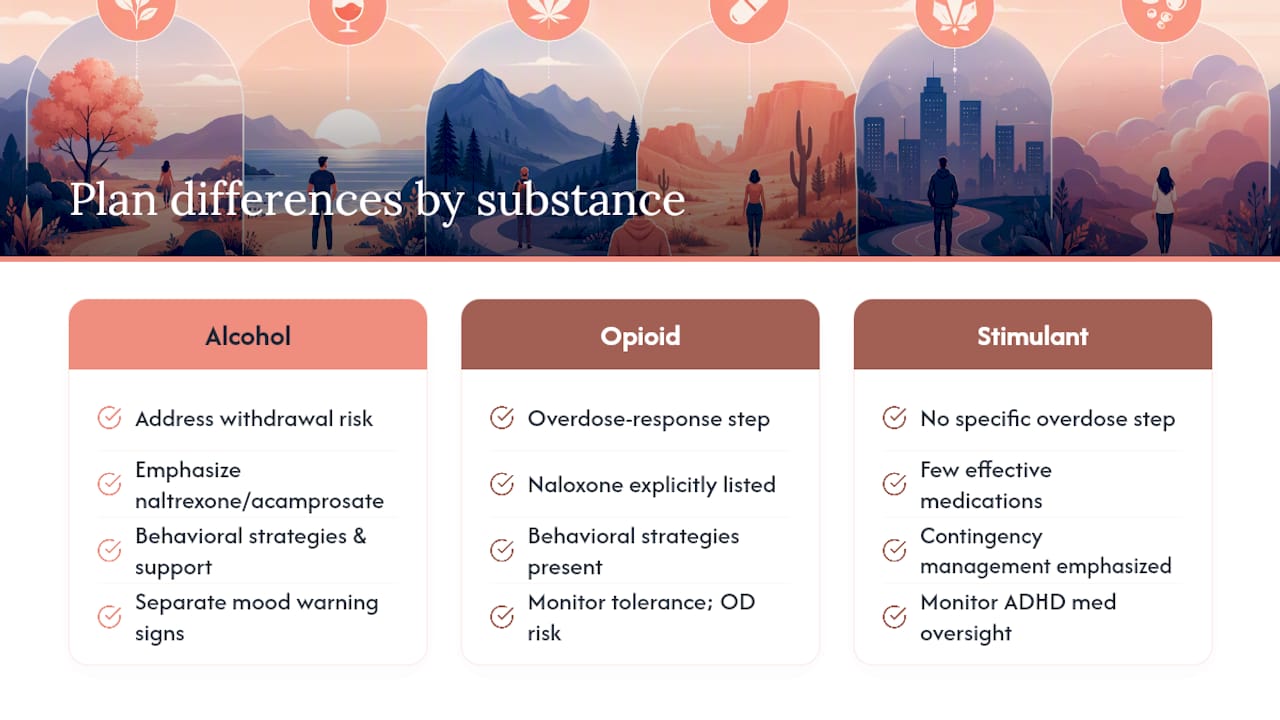
A relapse prevention plan for alcohol use disorder and one for opioid use disorder share the same five-domain skeleton, but the details inside each domain shift. Opioid relapse carries a distinct physical danger: reduced tolerance after any period of abstinence raises overdose risk sharply, so an opioid-focused plan needs an overdose-response step and naloxone access listed explicitly among emergency contacts, not left implied. Alcohol relapse plans lean harder on medication options like naltrexone or acamprosate, since withdrawal itself can carry medical risk that opioid withdrawal typically doesn't share to the same degree.
Co-occurring mental health conditions change the plan further. Someone managing depression alongside a substance use disorder needs warning signs that catch mood decline separately from craving intensity, since the two can spiral together but don't always announce themselves the same way. Someone with ADHD navigating medication management needs a prescriber relationship built around consistent monitoring, since stimulant medication for adults requires a different oversight pattern than non-controlled alternatives.
Stimulant use disorder plans typically lean harder on behavioral strategies and contingency management, since fewer medications currently show strong relapse-prevention evidence there compared to alcohol or opioids. None of this means starting from scratch. It means treating the five-domain template as a skeleton you adapt with a clinician who knows your specific diagnosis, not a generic form you fill out once and forget.
Why Peer Support Alone Isn't Enough
Peer support groups like AA or SMART Recovery genuinely help. They improve retention and give people somewhere to bring the hard days, and the clinical evidence on relapse prevention backs their role even though comparative efficacy studies show mixed results on any one model being superior. But a plan that stops at peer support misses most of what actually rebuilds a life.
Research on recovery and continuing care frames sustainable recovery around four rebuilt domains: health, home, purpose, and community. Peer support covers a slice of community. It doesn't cover stable housing, meaningful daily work, or the medical care that keeps your body functioning well enough to show up for recovery at all. A support network built only from recovery meetings can also become fragile if that one community frays, through a falling out, a move, or simply outgrowing the group.
A stronger network layers several kinds of relationships: a therapist who knows your history, a prescriber tracking your medication, a sponsor or peer group for shared experience, and at least one or two people outside the recovery world entirely, a family member, an old friend, a coworker, who remind you that your identity is bigger than your diagnosis. Purposeful activity belongs in this network too. Volunteering, part-time work, or a hobby that predates your substance use gives the "purpose" domain somewhere to live day to day, not just on paper.
How Do You Stay Motivated Months or Years In?
Motivation runs high in the first weeks of recovery and predictably dips later, usually right when the crisis energy that started the process fades. That dip is normal, not a warning sign on its own, but a plan needs something sturdier than motivation to survive it.
Tie your recovery to something concrete beyond "staying sober" as an abstract goal. A specific reason, repairing a relationship, keeping a job, being present for a child, holds up better under stress than a general commitment to wellness. Revisit that reason in writing during your regular plan reviews, not just when things feel shaky.
Retention-focused approaches like motivational interviewing and contingency management exist because engagement, not willpower, predicts who stays in treatment long enough to benefit. NIDA's research ties consistent engagement directly to reduced early dropout, which is really just another way of saying that showing up on the low-motivation days matters more than any single high-motivation breakthrough.
Small, visible progress markers help too: a habit streak, a month of consistent sleep, a completed course of therapy sessions. And build in permission to adjust the plan itself when motivation flags, since a plan that only works when you feel strong isn't much of a plan for the days you don't.
A Clinician's View on What Makes Plans Actually Work
Most relapse prevention plans fail quietly, not dramatically. Clients undercorrect on the lifestyle domain, treating it as optional compared to therapy or medication, and then wonder why cravings spike during an ordinary stressful month. Clinicians turn a client's initial assessment into a structured plan by working through each domain deliberately, then building it into a staged aftercare process, often something close to Kin-wellness's seven-step aftercare framework, rather than handing over a generic worksheet.
The other common failure point is timing after a slip. Clients wait days to contact anyone, hoping the feeling will pass or the shame will fade first. It rarely works that way. The clients who recover fastest from a lapse are the ones who make contact within hours, not days, and let a clinician help them adjust the plan before the Abstinence Violation Effect has time to take hold.
— Dakota
How Kin-wellness Builds and Supports Your Plan
Kin-wellness is the clinician-led alternative to piecing together a relapse prevention plan on your own from templates and generic advice. Every domain covered in this article, therapy, medication management, monitoring, peer support, and lifestyle rebuilding, maps directly onto virtual outpatient and intensive outpatient services provided for adults across California.

An initial consult works through your trigger inventory and warning signs with a licensed clinician, not a form you fill out alone, and builds toward a structured aftercare plan with a realistic review schedule. Sessions run through individual therapy, group therapy, family therapy, EMDR (in-person or telehealth), and medication management with a prescriber. If your current plan needs more structure than you can build solo, or you're not sure your review cadence matches your actual risk level, explore Kin-wellness's services and schedule a consult to build your plan with a clinician this week.
This article is general information, not a substitute for advice from a qualified doctor. Consult a qualified healthcare professional about your own circumstances before acting on anything here.
Sources
- Addiction relapse prevention (StatPearls / NCBI)
- Relapse prevention for addictive behaviors (PMC review)
- Principles of Drug Addiction: A Research-Based Guide (NIDA)
FAQ
What should be in a relapse prevention plan?
A complete plan covers five domains: therapy or skill development, medication management, self-monitoring, peer support, and lifestyle strategies, plus personal triggers, warning signs, coping steps, emergency contacts, and a review schedule.
What are the 5 D's of relapse prevention?
There's no single clinically standardized "5 D's" framework in the addiction research this article draws on; if you've seen the term elsewhere, treat it as informal shorthand rather than an established clinical model, and rely on the five-domain structure (therapy, medication, monitoring, peer support, lifestyle) instead.
What are five tools for relapse prevention?
Urge surfing, cognitive-behavioral thought-challenging, grounding techniques like the 5-4-3-2-1 method, a daily self-monitoring log or app, and a named emergency contact list all function as practical, everyday tools inside a relapse prevention plan.
What is a relapse prevention curriculum?
A relapse prevention curriculum is the structured sequence of skills, typically trigger identification, coping-skill practice, lapse management, and lifestyle rebuilding, that clinicians teach in individual or group therapy, often organized around models like Marlatt's cognitive-behavioral framework.
How often should I update my relapse prevention plan?
Review it weekly during early recovery, then monthly once your routine stabilizes, and update it immediately after any lapse or major life change.