

EMDR (Eye Movement Desensitization and Reprocessing) is an evidence-based psychotherapy that helps people reduce the emotional intensity of traumatic memories by pairing memory recall with bilateral stimulation, such as guided eye movements, tapping, or alternating audio tones. Clinical authorities including the American Psychological Association, the EMDR International Association (EMDRIA), and the VA’s National Center for PTSD all recognize EMDR as an effective treatment option for PTSD, and research supports its use for a growing range of trauma-related conditions.
Here is the short version for anyone who wants it fast:
-
What it treats: PTSD is the primary indication, with emerging evidence for anxiety, depression, and other trauma-related conditions.
-
How long sessions run: Typically 60–90 minutes each.
-
How many sessions: Often 6–12 for single-event trauma, though complex cases take longer.
-
The structure: Eight phases, from history-taking through reprocessing and re-evaluation.
-
Who offers it: Licensed therapists with specialized EMDR training, credentialed through EMDRIA or the EMDR Institute.
If you want the full picture, including the science, the eight phases, what to expect in a session, and how to find a qualified clinician in the US, read on.
Table of Contents
What is EMDR therapy, really?
EMDR stands for Eye Movement Desensitization and Reprocessing. The name sounds technical, but the core idea is straightforward: when a traumatic event happens, the brain sometimes fails to process it the way it does ordinary memories. Instead of filing it away, the memory stays raw, triggering the same fear, shame, or helplessness it produced at the moment of the event. EMDR is designed to help the brain finish that processing.
The therapy was developed by psychologist Francine Shapiro in the late 1980s after she noticed that moving her eyes back and forth while thinking about a distressing thought seemed to reduce its emotional charge. She went on to develop a structured eight-phase protocol, which is now the standard taught by the EMDR Institute and credentialed through EMDRIA.
“Bilateral stimulation” is the term clinicians use for the back-and-forth sensory input that runs through a session. Eye movements are the most recognized form, but therapists also use hand tappers, knee taps, or alternating audio tones delivered through headphones. The method varies by client preference and clinical setting.
“The goal of EMDR therapy is adaptive resolution — transforming a traumatic memory so it no longer triggers maladaptive beliefs and intense distress, but instead becomes a neutral, integrated part of a person’s history.”
— EMDRIA
One myth worth clearing up immediately: EMDR does not erase memories. The memory stays intact. What changes is its emotional charge and the automatic survival response it triggers. After successful reprocessing, people typically recall the event without the same flooding of distress, and they stop holding the same negative beliefs about themselves that the trauma produced.
The EMDR Institute and EMDRIA both serve as the primary bodies setting protocol standards and training requirements for clinicians in the US. If you see a therapist advertising EMDR, those are the organizations whose credentials matter most.
How EMDR therapy works: the mechanism behind it
The working theory behind EMDR is called the Adaptive Information Processing (AIP) model. It holds that the brain has a natural capacity to process and integrate experiences, but traumatic events can overwhelm that system and leave memories stored in a fragmented, unprocessed state. Those stuck memories retain the original emotions, physical sensations, and distorted beliefs from the moment of trauma, and they get triggered by present-day cues.

Bilateral stimulation, the theory goes, activates the brain’s natural processing system and allows the stuck memory to move toward resolution. Some researchers link this to what happens during REM sleep, when the brain consolidates memories while the eyes move rapidly. Others point to memory reconsolidation, the process by which a recalled memory briefly becomes malleable before being re-stored. The honest answer is that researchers have not fully settled the mechanism question.
Here is a simplified sequence of what happens during reprocessing:
-
The client brings a target memory to mind, including the image, the negative belief it produces (“I am helpless”), and where they feel it in the body.
-
The therapist initiates bilateral stimulation while the client holds the memory.
-
The client notices whatever comes up, without trying to direct it, and reports back between sets.
-
New associations, images, or emotions emerge, and the distress level gradually drops.
-
A more adaptive belief (“I survived. I am safe now.”) replaces the original negative one.
The scientific debate worth knowing about: several studies have tested whether the eye movements themselves are necessary, or whether structured exposure to the memory does most of the work. The evidence is genuinely mixed. What is consistent across the research is that the full EMDR protocol produces meaningful clinical outcomes for PTSD, and that is the metric that matters most for someone deciding whether to try it.
Pro Tip: If you experience motion sickness or find eye tracking uncomfortable, tell your therapist before the first processing session. Audio tones or hand tappers work just as well for most people, and the EMDR Institute notes these are standard alternatives, not workarounds.
The eight phases of EMDR: what happens at each step
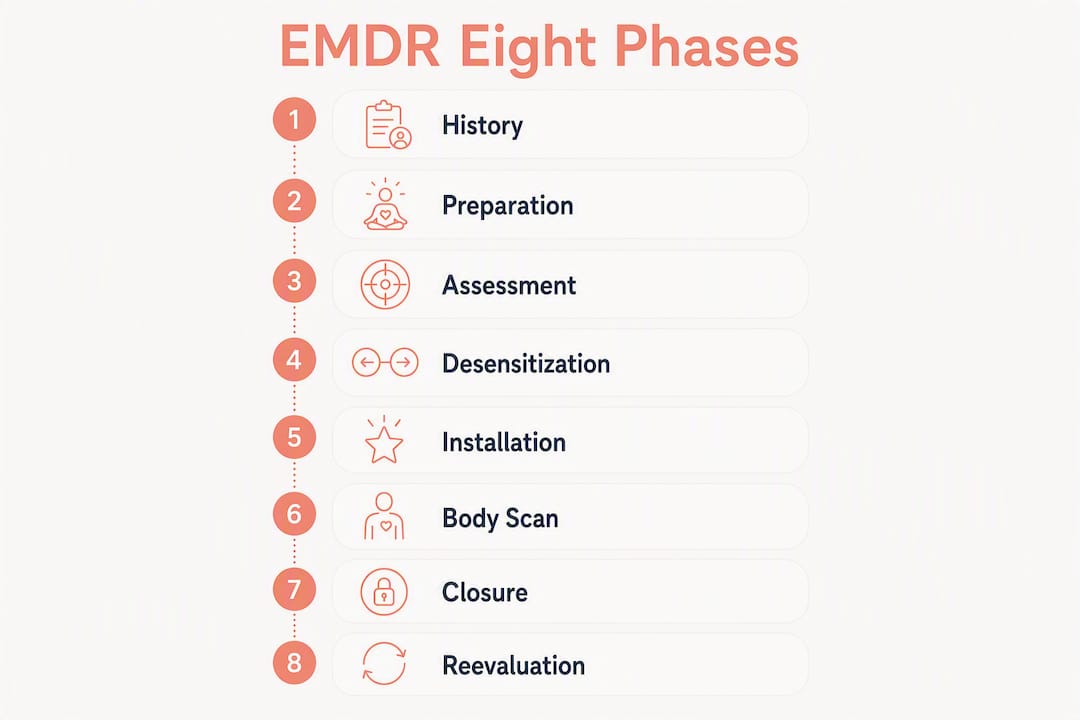
EMDR follows a standardized eight-phase protocol that moves from assessment and stabilization through active reprocessing and then confirmation that the work held. Each phase has a clear purpose, and a good clinician will not rush through the early phases to get to the processing.

| Phase | Name | What happens |
|---|---|---|
| 1 | History and treatment planning | Therapist gathers your history, identifies trauma targets, and assesses readiness for processing. |
| 2 | Preparation | You learn stabilization techniques (calm place, container exercise) and the therapist explains the process. |
| 3 | Assessment | You identify the target memory: the image, the negative belief, the emotion, and where you feel it in your body. |
| 4 | Desensitization | Bilateral stimulation begins while you hold the memory. Sets continue until distress drops to near zero. |
| 5 | Installation | A positive belief (“I am capable”) is strengthened and linked to the memory using additional bilateral stimulation. |
| 6 | Body scan | You scan your body for any remaining tension or discomfort linked to the memory. |
| 7 | Closure | The session ends with stabilization. If processing is incomplete, you use containment techniques to leave safely. |
| 8 | Re-evaluation | At the next session, the therapist checks whether the previous target held and whether new material emerged. |
A brief example of how this looks in practice: a person processing a car accident might identify the image of headlights coming toward them, the belief “I should have reacted faster,” and a tightness in the chest. During desensitization, they hold that image while tracking the therapist’s fingers. Between sets, they might notice the image shifting, the feeling of relief that they survived, or an unrelated memory surfacing. By the end of a successful session, the distress rating on that specific memory drops significantly, and a belief like “I did the best I could” feels genuinely true rather than forced.
Some targets take multiple sessions to fully process, particularly when a memory is connected to a broader network of related experiences. Clinicians monitor distress levels throughout and use closure techniques at the end of every session, whether or not processing is complete, so clients leave in a stable state.
What to expect in a session and across a full treatment course
A standard EMDR session runs 60–90 minutes, according to Harvard Health. The first portion involves a brief check-in: how has the week been, any new material from the last session, any changes in symptoms. Then the therapist and client move into active processing, running sets of bilateral stimulation with brief pauses to report what came up. The session closes with stabilization, regardless of where the processing landed.
For single-event trauma, many people complete a course in 6–12 sessions. Complex trauma, childhood abuse, or multiple targets typically require more. Factors that extend treatment include the number of distinct trauma targets, the presence of dissociation, and the need for more stabilization work before active processing begins.
What to expect between sessions:
-
Continued processing: The brain often keeps working after a session. Dreams, new memories, or shifts in mood are common and usually temporary.
-
Journaling: Many therapists ask clients to log any material that comes up between sessions, without trying to analyze it.
-
Stabilization practice: Techniques learned in Phase 2 (calm place, breathing exercises) are used as needed between sessions.
-
No homework processing: Clinicians generally advise against trying to process trauma material on your own between sessions.
Telehealth EMDR is widely available and clinically effective. The main adjustment is the bilateral stimulation method: therapists use audio tones delivered through the client’s headphones, or they guide clients to use self-tapping (alternating knee taps or butterfly hug) instead of tracking a moving hand. Privacy matters here too: a private room with a closed door and headphones makes a significant difference in session quality.
Pro Tip: For telehealth EMDR, a stable internet connection and a device with a camera positioned at eye level make the session smoother. If your therapist uses audio tones, test your headphone volume before the session starts — the alternating sound needs to be clear but not jarring.
Who EMDR is used to treat and who tends to benefit most
PTSD is the condition with the strongest and most consistent evidence base for EMDR. That includes PTSD from combat, sexual assault, accidents, natural disasters, and childhood trauma. The VA’s National Center for PTSD lists EMDR as one of the trauma-focused therapies with the strongest support for veterans and active-duty service members.
Beyond PTSD, EMDR is used for a range of conditions with varying levels of evidence:
-
Anxiety disorders: Including panic disorder and specific phobias, where a traumatic or conditioning event underlies the fear.
-
Depression: Particularly when depressive episodes are linked to adverse life experiences.
-
OCD: Emerging research, not yet a primary recommendation.
-
Chronic pain: Some evidence that trauma-linked pain responds to EMDR, though research is still developing.
-
Addiction and substance use: Used adjunctively to address underlying trauma that drives use.
A good candidate for EMDR is someone who is emotionally stable enough to tolerate brief, controlled exposure to distressing material. That does not mean being symptom-free. It means having enough grounding and safety in daily life that the reprocessing work will not destabilize functioning. Clinicians typically spend Phase 2 building that capacity before any processing begins.
“EMDR can be adapted for different populations, including children, adolescents, and older adults, and clinician training in these adaptations matters as much as the core protocol.”
— EMDRIA
Cultural context and individual history shape how trauma is held and expressed, and a skilled EMDR clinician accounts for that. The protocol is flexible enough to accommodate different cultural frameworks around memory, emotion, and healing, but only when the therapist has training and awareness to apply it thoughtfully.
How strong is the evidence for EMDR’s effectiveness?
The evidence base for EMDR in PTSD is among the strongest of any trauma-focused psychotherapy. The APA gives EMDR a conditional recommendation as a treatment option for PTSD, placing it alongside other trauma-focused therapies rather than above or below them. The World Health Organization and the VA both include EMDR in their PTSD treatment guidelines.
Key findings from the research:
-
Multiple randomized controlled trials show EMDR produces significant reductions in PTSD symptom severity compared to waitlist controls and some active comparators.
-
A 2001 meta-analysis published in PubMed contributed early systematic evidence for EMDR’s effectiveness, and the literature has grown substantially since.
-
Harvard Health references a 2021 review of 90 studies examining EMDR for conditions beyond PTSD, reflecting the expanding research base.
-
Head-to-head comparisons with trauma-focused cognitive behavioral therapy (TF-CBT) generally show similar outcomes, with neither consistently outperforming the other.
Limitations worth knowing:
-
Many EMDR trials have small sample sizes and methodological variation.
-
The mechanism question (whether eye movements add to outcomes beyond structured exposure) remains open.
-
Evidence for non-PTSD conditions is promising but less definitive than for PTSD.
The conditional recommendation from the APA is sometimes misread as weak. It is not. It means EMDR is recommended as one of several effective options, not that it is experimental or unproven. For PTSD specifically, the evidence is solid enough that major health systems around the world have incorporated it into standard care.
Risks, side effects, and when EMDR is not the right fit
EMDR is generally safe when delivered by a trained clinician following the standard protocol. That said, it is not without short-term effects, and there are situations where it needs to be approached carefully or deferred.
Common short-term reactions (usually transient):
-
Increased emotional distress during or immediately after sessions.
-
Vivid dreams or sleep disruption in the days following processing.
-
Surfacing of new memories or emotions that were not the original target.
-
Temporary fatigue or a sense of emotional rawness.
These reactions are a normal part of the reprocessing process. They typically settle within a day or two, and clinicians prepare clients for them in Phase 2.
Situations requiring caution or deferral:
-
Active substance intoxication or unstable substance use.
-
Unmanaged suicidal ideation without a safety plan in place.
-
Severe dissociation that has not been assessed and stabilized.
-
Acute crisis situations where basic safety and stabilization are the immediate priority.
-
Certain medical conditions affecting eye movement (for eye-movement-based protocols specifically).
“Stabilization comes before processing. A clinician who moves into active EMDR reprocessing before a client has adequate coping resources and a stable enough foundation is skipping the step that makes the rest of the work safe.”
— Grounded in EMDRIA protocol guidance
The controversy about whether eye movements are necessary is worth addressing plainly. Some researchers argue that the structured exposure component of EMDR does most of the therapeutic work, and that bilateral stimulation adds little beyond a focusing mechanism. Clinicians and researchers continue to debate this. What the debate does not challenge is whether the full EMDR protocol works. It does, and that is what matters for someone deciding whether to pursue it.
Pro Tip: Before your first processing session, ask your therapist directly: “What stabilization techniques will we use if I feel overwhelmed during a session?” A well-trained EMDR clinician will have a clear answer and will have already taught you those techniques in Phase 2.
How to find a qualified EMDR therapist in the US
Finding a credentialed EMDR clinician takes a few specific steps. The general therapist directory is not enough here, because EMDR requires specialized post-graduate training that not every licensed therapist has completed.
Where to look:
-
EMDRIA’s therapist directory at emdria.org lists clinicians who have completed EMDRIA-approved training and, for those with the EMDRIA Certified Therapist designation, have met additional supervised practice requirements.
-
The EMDR Institute at emdr.com maintains a list of therapists trained through its programs.
-
State licensing boards can verify that a therapist holds an active license (LCSW, MFT, psychologist, LPC) in your state.
-
Kin-wellness offers both in-person and telehealth EMDR therapy services for adults in California, with licensed therapists and insurance billing support.
Questions to ask a prospective EMDR therapist:
-
Where did you complete your EMDR training, and are you EMDRIA-certified?
-
How many EMDR cases have you treated, and what populations do you have the most experience with?
-
How do you handle sessions where processing feels incomplete or overwhelming?
-
Do you offer telehealth, and what bilateral stimulation methods do you use for remote sessions?
-
Do you accept my insurance, and what is your out-of-network billing process?
On cost and insurance: EMDR sessions are typically billed at the same rate as standard psychotherapy sessions, which means they are often covered by PPO plans and some HMO plans, subject to deductibles and copays. Out-of-network benefits vary significantly by plan. Before booking, call your insurance company and ask specifically whether outpatient psychotherapy with a licensed therapist is covered, what your out-of-pocket responsibility is, and whether prior authorization is required.
Pro Tip: When calling your insurance plan, ask for the “mental health or behavioral health” department specifically, not general customer service. They can tell you exactly what your plan covers for outpatient therapy and whether telehealth sessions are reimbursed at the same rate as in-person.
Key Takeaways
EMDR is a structured, evidence-based psychotherapy with strong guideline support for PTSD and a growing body of research for other trauma-related conditions, delivered across eight defined phases by a specially trained clinician.
| Point | Details |
|---|---|
| What EMDR is | An eight-phase psychotherapy using bilateral stimulation to help the brain reprocess stuck traumatic memories. |
| Evidence strength | Endorsed by the APA, EMDRIA, VA, and WHO for PTSD; evidence for other conditions is promising but still developing. |
| Session and course expectations | Sessions typically run 60–90 minutes; single-event trauma often resolves in 6–12 sessions. |
| Short-term reactions | Temporary distress, vivid dreams, and surfacing memories are normal and usually settle within a day or two. |
| Finding care | Kin-wellness offers licensed EMDR therapy in California via telehealth and in-person, with insurance billing support. |
A clinician’s perspective on EMDR in practice
The part of EMDR that surprises most new clients is what it does not require. You do not have to narrate the trauma in detail. You do not have to explain every feeling or construct a coherent story about what happened. The protocol works by activating the memory elements — the image, the body sensation, the belief — and then letting the brain do the processing while bilateral stimulation runs. That distinction matters clinically, because it lowers the barrier for people who have spent years avoiding their trauma precisely because talking about it felt unbearable.
What I find most important in practice is the pacing. The eight-phase structure exists for a reason: Phases 1 and 2 are not administrative formalities. They are where a clinician assesses whether a client has the internal resources to tolerate reprocessing without being destabilized. Rushing that assessment to get to the “real work” is the most common clinical error I see discussed in EMDR supervision and training contexts. The preparation phase is the real work.
EMDRIA’s guidance and the APA’s position both reflect something that gets lost in popular coverage of EMDR: the therapy is most effective when it is integrated into a broader treatment relationship, not delivered as a standalone technique. For clients with complex trauma histories, medication management, group support, and aftercare planning often run alongside EMDR. That is the model Kin-wellness builds its care around, and it is the model the evidence supports.
Kin-wellness offers EMDR therapy for adults in California
If you have read this far and are thinking seriously about starting EMDR, the next step is finding a clinician you can actually work with, not just one who appears in a directory. Kin-wellness provides licensed EMDR therapy for adults in California, available both in-person and via telehealth, delivered by credentialed therapists who follow the full eight-phase protocol.

What sets Kin-wellness apart from a general therapy search is the integrated care model. EMDR does not happen in isolation here. It sits alongside individual therapy, group therapy, family therapy, medication management, and aftercare planning, so the reprocessing work is supported before, during, and after each session. Insurance billing support is built in, and the team works with PPO and HMO plans to reduce the friction of figuring out coverage on your own.
To get started, visit the Kin-wellness services page to review care options and check whether your insurance is accepted. Have your insurance card ready when you reach out. The intake process is designed to match you with a therapist whose training and experience fit your specific needs. Your privacy is protected under Kin-wellness’s published privacy policy, which covers confidentiality and client data practices in full.
Useful sources for further reading
These are the primary sources used throughout this article. Each one is worth bookmarking if you want to read the original guidance or verify specific claims.
-
EMDR International Association (EMDRIA) — About EMDR Therapy: The governing body for EMDR credentialing in the US; covers the therapy’s goals, protocol, and training standards.
-
EMDRIA — Thinking About EMDR Therapy: Plain-language overview of the eight-phase protocol for prospective clients.
-
American Psychological Association — EMDR Therapy and PTSD: APA’s position and conditional recommendation for EMDR as a PTSD treatment.
-
EMDR Institute — What Is EMDR?: The original training organization founded by Francine Shapiro; covers protocol, modalities, and the AIP model.
-
VA National Center for PTSD — EMDR for PTSD: Federal health system guidance on EMDR for veterans and the general public.
-
Harvard Health — What Is EMDR Therapy, and Who Can It Help?: Accessible clinical summary covering session structure, course length, and emerging evidence for non-PTSD conditions.
-
PubMed — Early Meta-Analytic Evidence for EMDR: Peer-reviewed systematic evidence contributing to the research base for EMDR effectiveness.
-
Kin-wellness — Services: Full list of outpatient and intensive mental health programs, including EMDR therapy, available to adults in California.
This article is general information, not a substitute for professional mental health advice. Consult a licensed clinician or your primary care provider to determine whether EMDR is appropriate for your specific situation.