

Most intensive outpatient programs commonly run for several weeks to a few months, though many treatment teams use a roughly three-month episode as the benchmark for durable results. There's no fixed calendar date stamped on an IOP stay. Length gets set by weekly hours of care and, more importantly, by how a person is actually doing in treatment.
A few things to know before you go further:
- Programs typically require a minimum of 9 hours of structured treatment per week for adults, per ASAM-based guidance.
- Clinicians reassess progress on a rolling basis and adjust length up or down instead of discharging on a preset day.
- Federal data on completed IOP episodes point to a median stay near 81 days, a figure worth knowing but not one to plan your life around just yet.
Key Takeaways
IOP length of stay is a clinical decision driven by weekly treatment hours and measured progress, not a fixed calendar term, and most episodes run 6 to 12 weeks with many extending toward a 90-day benchmark.
| Point | Details |
|---|---|
| Typical range | Most IOP episodes run 8 to 12 weeks, with clinical guidance often citing 90 days as a benchmark for durable outcomes. |
| Median stay data | SAMHSA's Treatment Episode Data Set puts median adult IOP length near 81 days, a population figure rather than an individual target. |
| Intensity vs. duration | ASAM sets adult IOP at 9 or more hours weekly across 3 to 5 days; duration adjusts separately based on progress. |
| Logistics drive dropout | Work conflicts, childcare, and insurance authorization gaps cause more early discharges than clinical disagreement. |
| Kin-wellness approach | Kin-wellness structures virtual and in-person IOP for California adults with flexible, evening, and hybrid scheduling plus insurance billing support. |
This article is general information, not a substitute for advice from a qualified doctor. Consult a qualified healthcare professional about your own circumstances before acting on anything here.
Table of Contents
- IOP Length Of Stay: Common Duration Ranges And Why They Vary
- How Many Hours A Week Does IOP Actually Require?
- What A Typical Week In IOP Looks Like
- How Clinicians Decide To Extend, Step Down, Or End Treatment
- What Does The Research Actually Say About Duration And Outcomes?
- Fitting IOP Into A Work And Family Schedule
- Life After IOP: Step-Down And Relapse Prevention
- Is There A Maximum Length For IOP, And When Do Extensions Make Sense?
- Why Do People Leave IOP Early, And What Does That Mean For Planning?
- How Insurance Coverage Shapes How Long Treatment Actually Lasts
- How Kin-wellness Builds IOP Schedules Around Real Lives
- Start Intensive Outpatient Care That Works Around Your Schedule, Not Against It
- Sources
IOP Length Of Stay: Common Duration Ranges And Why They Vary
Ask five treatment providers how long IOP takes and you'll get five slightly different answers, all defensible. The most common range cited across clinical guides and provider literature is 8 to 12 weeks, though some programs run shorter stabilization tracks and others extend care past 16 weeks for people with more complex needs. The NCBI clinical review on intensive outpatient treatment notes that many panels land on roughly 90 days as a reasonable minimum for a full treatment episode, not because that number is magic, but because it tends to give someone enough time to build new coping patterns before life tests them.
The federal Treatment Episode Data Set puts the median length of stay for adult IOP discharges at approximately 81 days, which lines up closely with that 90-day clinical benchmark.
A median is a population statistic, not a prediction about you. Half the people in that dataset stayed longer than 81 days, and half stayed shorter. What actually drives the variation:
- Co-occurring conditions. Someone managing depression alongside a substance use disorder usually needs more weeks than someone addressing a single, well-defined issue.
- Housing and stability. Unstable living situations or unpredictable work schedules can stretch a treatment timeline because consistency takes longer to establish.
- Relapse history. A first treatment episode often resolves faster than a third or fourth attempt, where deeper patterns need more repetition to shift.
- Rapid stabilization. Some people respond quickly and step down to standard outpatient care in six weeks or less, freeing up intensity for someone who needs it more.
None of this means longer is automatically better or shorter is a failure. It means length is a variable clinicians adjust, not a countdown clock everyone shares.
How Many Hours A Week Does IOP Actually Require?
The distinction that trips people up is treatment intensity versus treatment duration. Intensity is measured in hours per week; duration is how many weeks that intensity continues. ASAM criteria, the reference standard most programs build their schedules around, set the adult IOP minimum at 9 hours per week, and many programs run higher, up to 19 hours in some structures according to treatment provider summaries.
In practice, that usually breaks down into 3 to 5 days per week, with individual sessions running 2 to 4 hours, a pattern Medical News Today's overview of intensive outpatient therapy confirms is standard across most programs, including evening and hybrid formats built for people who work.
Here's how IOP sits relative to the rest of the treatment continuum:
| Level of care | Typical weekly hours | Living situation |
|---|---|---|
| Inpatient/residential | around-the-clock structured care | Lives at the facility |
| Partial hospitalization (PHP) | 20 to 30 hours | Lives at home, attends daily |
| Intensive outpatient (IOP) | 9 to 19 hours | Lives at home, attends 3 to 5 days/week |
| Standard outpatient | Under 9 hours | Lives at home, attends weekly or biweekly |
A few takeaways from that comparison:
- IOP is the step between "I need daily structured support" and "I need periodic check-ins."
- Most people move down the continuum as they stabilize, not up; for additional insights on practical scheduling and community therapy, see the DEWY COUNSELLING blog.
- Hours per week and total duration are separate dials. A program can run high-intensity hours for a short window or moderate hours for a longer stretch.
What A Typical Week In IOP Looks Like
Weekly hours don't just mean sitting in a room. They're divided across distinct components, each doing different work. Group therapy usually eats the largest share of scheduled time, since it's efficient for teaching skills and building peer accountability at once. Individual counseling sessions run weekly or biweekly and focus on personal history, goal tracking, and issues that don't surface well in a group setting.
Medication management, when relevant, is typically a shorter, separate appointment with a prescriber rather than part of the group block. Psychoeducation sessions cover topics like relapse triggers, sleep hygiene, and nervous system regulation. Family sessions, where included, tend to be scheduled less frequently but carry outsized weight in whether treatment sticks after discharge.
Common modalities woven through these hours include:
- Cognitive behavioral therapy (CBT) for identifying and restructuring unhelpful thought patterns
- Dialectical behavior therapy (DBT) skills groups for emotional regulation
- Relapse prevention planning, often built around specific personal triggers
- Motivational interviewing, especially early in treatment when ambivalence is highest
Telehealth and hybrid formats have changed the calculus for a lot of working adults. Weekly hour requirements don't shrink, but attendance barriers do, since a video session eliminates a commute that might otherwise make a 6 p.m. group impossible after a full workday.
Pro Tip: Ask upfront how a program splits hours across group versus individual work. A schedule heavy on groups with minimal individual time might not fit someone who needs more one-on-one processing to make progress.
How Clinicians Decide To Extend, Step Down, Or End Treatment
Treatment teams don't discharge people because a calendar page turned. They discharge based on measurable, observed progress against goals set early in treatment. The NCBI review on intensive outpatient care frames this as an ongoing reassessment process rather than a fixed protocol, and that framing matters because it means your actual timeline is negotiable in a way a rigid 8-week package would never be.
Reassessment typically happens on a recurring cycle, often every few weeks, and looks at:
- Attendance and engagement — consistent participation signals readiness to reduce intensity; frequent missed sessions might signal the opposite.
- Functional gains — sleep, work performance, relationship stability, and daily routines improving outside the treatment room.
- Symptom measures — standardized scales for depression, anxiety, or substance use tracked over time rather than a single snapshot.
- Toxicology results, where relevant to substance use treatment, used alongside self-report rather than as a sole determinant.
- Clinical judgment on risk — whether stepping down now creates realistic risk of relapse or regression.
A person who hits every functional marker at week 6 but still reports strong cravings under stress is a reasonable candidate for extension, not because they "failed" but because the data says the work isn't done yet.
Extensions get triggered by things like a major life stressor emerging mid-treatment, a co-occurring diagnosis surfacing that wasn't part of the original plan, or slower-than-expected symptom improvement. Step-down gets triggered by sustained stability across multiple reassessment cycles, not just one good week. The practical move: ask your treatment team directly what their reassessment schedule looks like and what specific, written goals will determine your length of stay. A program that can't answer that clearly is worth questioning.
What Does The Research Actually Say About Duration And Outcomes?
Longer engagement in IOP does correlate with better outcomes, but the relationship isn't a straight line where more weeks always means more benefit. Research on engagement factors in intensive outpatient treatment found that increased days of care reduce hospitalization risk, up to a point. Past that point, additional days deliver diminishing returns, a pattern sometimes called the plateau effect.
That plateau is why the 90-day benchmark shows up so often in clinical literature. It's roughly where researchers see enough "dose" of treatment to produce durable change in social functioning and reduced substance use, without stretching treatment so long that engagement fatigue sets in.
A few caveats worth holding onto:
- The 81 day median from SAMHSA's Treatment Episode Data Set reflects population averages across many program types and diagnoses, not a target for any individual.
- Program models differ enough that comparing raw duration across two different IOPs can be misleading without knowing their weekly hour intensity.
- Populations vary too. Someone with a first-time, single-diagnosis presentation typically needs less time than someone managing multiple co-occurring conditions.
None of this cancels out the basic finding: retention in treatment matters. It just means retention should be measured against your own progress markers, not against someone else's median.
Fitting IOP Into A Work And Family Schedule
The biggest reason people drop treatment isn't clinical disagreement. It's logistics. Here's how to build a plan that actually survives contact with a real week:
- Pick a schedule format that matches your actual life, not your ideal one. Evening tracks work well for people who can't leave work mid-day; hybrid formats mixing telehealth with in-person sessions cut commute time on high-demand days. Kin-wellness's guidance on structuring an IOP schedule covers how to weigh these trade-offs against childcare and commute realities.
- Talk to your employer early, not after you've missed three sessions. In the United States, the Family and Medical Leave Act can protect job security for intermittent treatment absences at qualifying employers, so ask HR about intermittent leave before treatment starts, not mid-crisis.
- Verify insurance coverage before your first session, not during it. Confirm your plan's IOP benefit, session caps, and whether your provider is in network. If you're working with an out-of-network provider, understand the reimbursement process in advance, a process Kin-wellness's out-of-network reimbursement guide walks through step by step.
- Line up childcare or transportation backup before week one, not after the first schedule conflict forces a missed session.
Pro Tip: Write down your actual weekly commitments (work hours, school pickup, commute time) and hand that schedule to your intake coordinator before you agree to a program's default time slot. Programs built for working adults will adjust around it.
Life After IOP: Step-Down And Relapse Prevention
Discharge from IOP rarely means treatment stops cold. Most transitions follow a gradual reduction in frequency rather than an abrupt end.
A typical step-down pattern moves from IOP's 3 to 5 days a week down to weekly standard outpatient sessions, then to biweekly or monthly check-ins over the following months. Continuing care usually includes some combination of:
- Ongoing individual counseling at reduced frequency
- Medication management appointments, where applicable
- Peer support or alumni groups
- Periodic symptom check-ins scheduled in advance, not left to chance
Before discharge, ask your team specifically what triggers a return to more intensive care, who to contact if symptoms resurface, and what the first 30 days of reduced support will look like. Programs that plan this transition deliberately, rather than treating discharge as an endpoint, tend to see fewer readmissions.
Is There A Maximum Length For IOP, And When Do Extensions Make Sense?
There's no universal hard ceiling written into clinical standards the way there's a minimum hours-per-week requirement. In practice, most insurance plans and clinical programs treat somewhere in the range of 12 to 16 weeks as the upper end of a typical single episode, with extensions beyond that requiring documented clinical justification rather than routine approval.
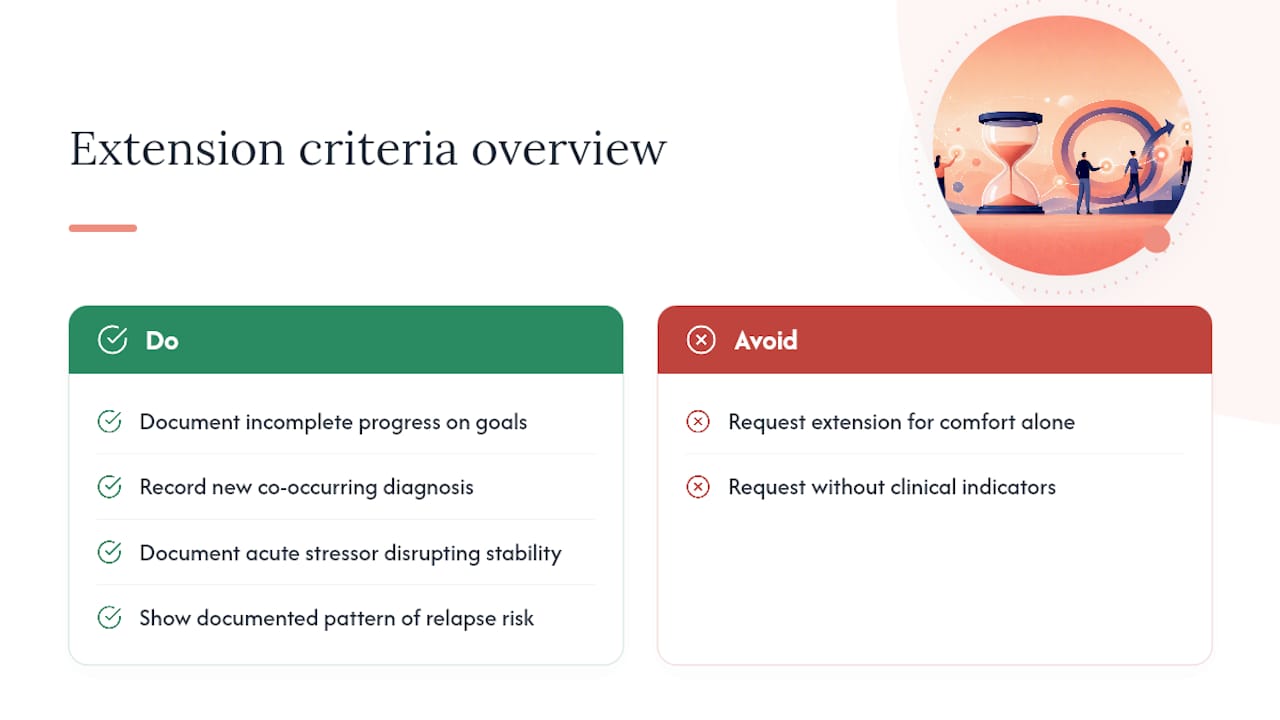
Extension criteria generally center on measurable, ongoing need rather than personal preference to keep going. Reasonable grounds include incomplete progress on documented treatment goals, a new co-occurring diagnosis identified mid-treatment, an acute stressor (job loss, bereavement, a housing crisis) that disrupts stability, or a documented pattern of relapse risk that hasn't resolved. What doesn't typically justify extension on its own: comfort with the structure or anxiety about stepping down, absent other clinical indicators.
Insurance plays a real role here too. Many payers require periodic utilization review, essentially a checkpoint where a clinician documents continued medical necessity, before authorizing additional weeks. That's not a bureaucratic formality to resent. It's a built-in prompt for the kind of reassessment that should be happening anyway. If your treatment team is requesting an extension, ask them to walk you through the specific data supporting it, not just their general clinical impression.
Why Do People Leave IOP Early, And What Does That Mean For Planning?
Premature discharge, treatment ending before clinical goals are met, happens for reasons that are more logistical than clinical more often than people expect. Scheduling conflicts with work top the list, followed by transportation barriers, childcare gaps, and financial strain when insurance coverage runs shorter than the recommended episode.

Clinical factors matter too. Some people leave early because symptoms improve faster than expected and they feel done, even when their treatment team recommends continuing. Others disengage when the program format doesn't match their needs, too much group time and not enough individual attention, for example, or a schedule that consistently conflicts with shift work.
The implication for length of stay is straightforward: a program that's clinically appropriate on paper is worthless if it's not actually attendable. That's why matching schedule format to real life, discussed above, isn't a side consideration. It's directly tied to whether someone completes the recommended duration at all. Programs that build in flexibility, evening groups, hybrid telehealth options, individualized check-ins about barriers as they emerge, see better completion rates than rigid, one-size schedules. If you're evaluating a program, ask directly what their completion rate looks like and what they do when a patient starts missing sessions, before that becomes your situation.
How Insurance Coverage Shapes How Long Treatment Actually Lasts
Clinical need sets the ideal length of an IOP episode. Insurance authorization often sets the practical one, and the gap between those two numbers is where a lot of premature discharges originate.
Most private insurance plans, including PPO and HMO products, cover IOP but require periodic authorization renewals, sometimes every 2 to 4 weeks, tied to documented progress notes. If a utilization review denies continued coverage, patients face a choice between paying out of pocket, stepping down to a lower level of care before they're clinically ready, or pausing treatment entirely. None of those are good options, which is why understanding your specific plan's authorization pattern before you start matters as much as understanding the clinical timeline itself.
Out-of-network benefits complicate this further. Reimbursement timing and percentage vary substantially by plan, and patients using out-of-network providers need to track claims actively rather than assume automatic reimbursement. Getting a clear answer from your insurer, in writing where possible, about session limits, authorization renewal cadence, and out-of-network reimbursement rates before your first appointment prevents a mid-treatment financial surprise from becoming a reason to leave early.
How Kin-wellness Builds IOP Schedules Around Real Lives
We've built our intensive outpatient structure around a simple observation: the best treatment plan is the one someone can actually attend for the full recommended duration. That means offering evening groups, hybrid telehealth options, and licensed clinicians who reassess progress regularly instead of defaulting to a fixed calendar. Our schedule resources and out-of-network reimbursement guidance exist because working professionals and parents asked for them directly.
— Dakota
Start Intensive Outpatient Care That Works Around Your Schedule, Not Against It
Kin-wellness runs virtual and in-person IOP for California adults built specifically around the scheduling conflicts that derail treatment elsewhere, evening groups, hybrid telehealth, and licensed clinicians who adjust your plan based on actual progress instead of a fixed number of weeks.

Getting started means an intake call to review your history and goals, insurance verification (we support PPO, HMO, and out-of-network billing), and a schedule built around your work hours and family obligations before your first session, not after. Our team includes therapists and prescribers who treat working professionals, parents, executives, and healthcare workers as the norm, not the exception, so questions about evening availability or hybrid formats aren't an inconvenience. Review our full range of outpatient and IOP services and request an intake consult to get a treatment timeline built around your actual life.
Sources
- Chapter 3. Intensive Outpatient Treatment and the Continuum of Care - NCBI Bookshelf
- CLINICAL ISSUES IN INTENSIVE OUTPATIENT TREATMENT FOR SUBSTANCE USE DISORDERS - Advisory 47 (SAMHSA)
- Intensive outpatient therapy (Medical News Today)
- Intensive Outpatient Program (IOP): How It Works - Drug Rehab Headquarters