
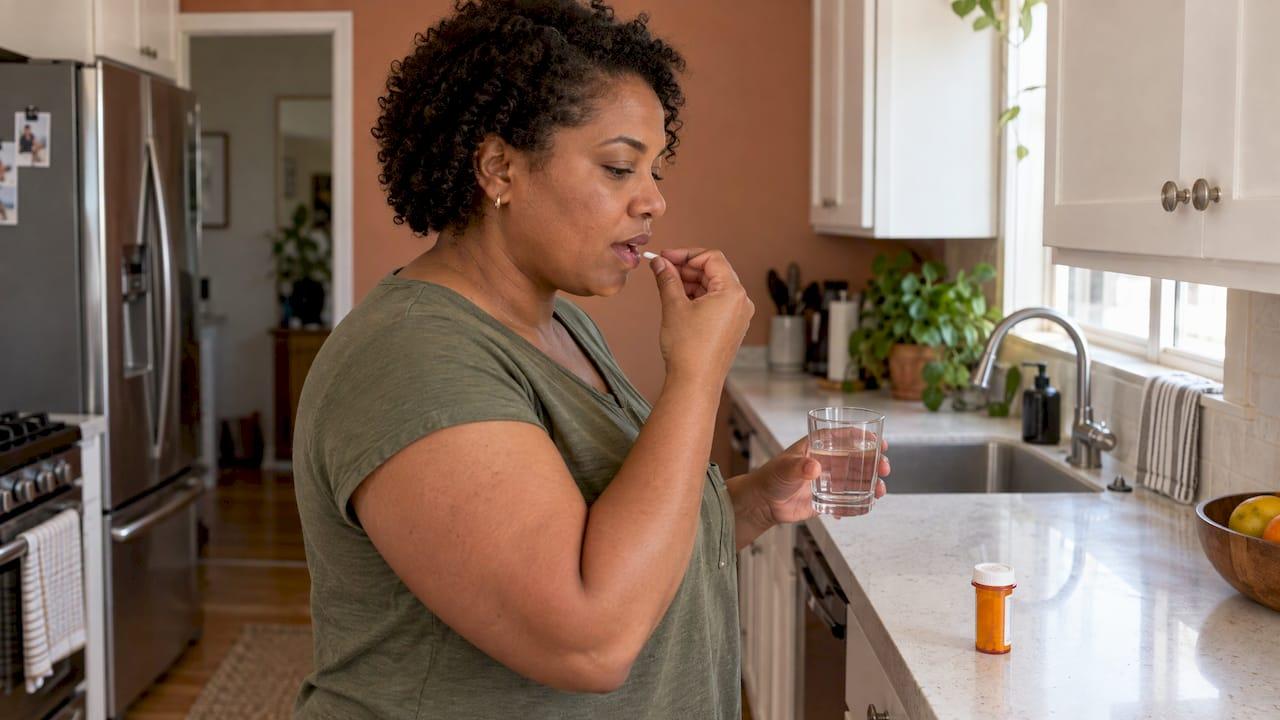
Most antidepressants take about 4 to 8 weeks to work fully, according to the National Institute of Mental Health. Some changes show up earlier. Sleep, appetite and energy often improve before mood does. If you started a medication last week and feel nothing yet, that is common. It does not mean the medication has failed.
This guide walks through what people often notice and when. It also covers why the wait happens, what to do if you feel no change, and how long people usually stay on treatment. It is general education, not a plan for your own care. Your prescriber knows your history and should guide every decision about your medication.
TL;DR
- Antidepressants usually take 4 to 8 weeks to work fully. Early signs can appear in the first 1 to 2 weeks.
- Sleep, appetite and energy often improve before mood lifts.
- Side effects tend to show up first and often ease within 1 to 2 weeks.
- If you notice no change after 2 to 4 weeks, contact your prescriber. Do not stop or change anything on your own.
- The typical length of treatment is 6 to 12 months, and some people stay on longer.
Table of Contents
- The short answer: 4 to 8 weeks, with early signs sooner
- A week by week timeline
- What newer research says about the first two weeks
- Why antidepressants are not instant
- Side effects and the early weeks
- What to do if you feel no change
- How to track your progress
- Why therapy and medication work well together
- How long people stay on antidepressants
- Our perspective
- Support while you wait for your medication to work
- FAQ
- Sources
The short answer: 4 to 8 weeks, with early signs sooner
The most common figure you will see is 4 to 8 weeks. MedlinePlus says antidepressants usually take that long to work, and notes that problems like sleeping and eating may get better before your mood does.
Other professional sources give slightly different windows, which can be confusing:
| Source | What it says about timing |
|---|---|
| UpToDate patient education | Most start to work within 2 weeks, full effect usually takes at least 4 to 6 weeks, and sometimes up to 12 weeks |
| American Psychiatric Association | Most people do not see major benefits for three to six weeks, and full impact may take eight weeks or longer because doses are often raised slowly |
| NAMI | It may take 6 to 8 weeks for the medication to fully work |
| Oregon Health Authority | Some clinical improvement in the first 1 to 2 weeks, with maximum effect not typically reached until 4 to 6 weeks |
These ranges overlap more than they conflict. A fair way to read them: some benefit may start early, the middle of the range is when many people feel a real difference, and the full effect can take two months or a bit more.
A week by week timeline
Every person responds differently, and each medication behaves differently. Treat this as a rough map, not a schedule you are failing if you miss.
Days 1 to 7: side effects first, small shifts possible
The first week is often when side effects appear, not benefits. NAMI says common side effects are most noticeable at the beginning and usually get better within 1 to 2 weeks. They include headache, upset stomach, diarrhea, and either sleepiness or feeling more awake.
Some people notice small gains early. NAMI notes that better sleeping and eating habits can appear in the first few days. The American Association of Psychiatric Pharmacists lists better energy, appetite and sleep within one week as something you can expect to see sooner.
Weeks 1 to 3: body and energy before mood
NAMI describes the first 1 to 3 weeks as the time when some people notice better memory, sex drive and self care habits, more energy and less anxiety. Many people describe this stage as being able to do things again before they feel better about them. You might get out of bed more easily or finish a task you were avoiding, even while your mood still feels flat.
Sleep is a good place to help the process along. Steady sleep hygiene habits, such as a regular wake time and a calm wind down, can make it easier to notice whether your rest is actually improving.
Weeks 2 to 4: mood, hope and interest
NAMI says that after 2 to 4 weeks, mood, hopelessness, suicidal thoughts and interest in hobbies may improve. The AAPP similarly points to better mood and motivation within 2 to 4 weeks. This is also the point where many prescribers check in. If you feel no better by now, that is a reason to call, not a reason to wait quietly.
Weeks 4 to 8: the full effect
For many people, weeks 4 to 8 are when the medication is doing most of what it is going to do at your current dose. The AAPP says it may take up to 6 to 8 weeks before you see the drug fully work. If your prescriber raises your dose along the way, the clock for that dose can shift, which is part of why the American Psychiatric Association says full impact can take eight weeks or longer.
What newer research says about the first two weeks
The classic advice is "it takes 4 to 6 weeks." A 2026 paper by Mihilli and colleagues argues that this message does not match the trial data well. According to their review, the first 2 weeks of active treatment are when the greatest rate of change on depression rating scales happens, and improvement levels off around the 6 to 8 week mark. They also report a meta-analysis finding that one third of the total improvement seen with SSRIs over 6 weeks occurred within the first week.
What does that mean for you? Early, small changes can be real signals, and the "nothing happens for a month" idea is not quite right. But it does not mean you should expect to feel well in two weeks. Early change on a rating scale is often modest. Many people do not feel it yet. Both things can be true: the process starts early, and the full benefit builds over weeks.

Why antidepressants are not instant
The delay is not about the drug taking time to get into your body. SSRIs block the reuptake of serotonin quickly. Research by Celada and colleagues explains that the therapeutic action still takes weeks, because the brain goes through adaptive changes in the cells that send and receive signals after reuptake is blocked. Those changes may involve shifts in gene expression that reshape the circuits affected in major depression.
Another explanation comes from a 2018 model in The British Journal of Psychiatry. Harmer, Goodwin and Cowen propose that the lag sits between the drug's early effect on how you process emotional information and the later effect on mood. In plain terms, the medication may first change how you read faces, events and situations, and mood follows as your mind and daily experience catch up.

Side effects and the early weeks
Side effects often arrive before relief, which is one of the hardest parts of starting. Knowing this ahead of time helps you stay with a plan you made with your prescriber.
- Common early effects such as headache, upset stomach and sleep changes usually improve within 1 to 2 weeks, according to NAMI.
- Sexual side effects can occur with some antidepressants, including lower sex drive or problems with ejaculation, per NAMI.
- Emotional blunting and sexual dysfunction can be more persistent with some medications like SSRIs, according to the Oregon Health Authority.
Tell your prescriber about any side effect that bothers you, however small it seems. There are often ways to address it. Our guide to managing SSRI side effects covers practical questions to bring to that conversation.
Watch your mood closely in the first months. The Oregon Health Authority guidance notes that antidepressants can increase the risk of suicidality during the first few months of treatment. This is why follow up matters, especially for younger adults. If you have thoughts of harming yourself, call or text 988, the Suicide and Crisis Lifeline, or call 911 right away. Kin Wellness does not provide crisis services, so do not wait for an appointment.
What to do if you feel no change
The steps depend on how long you have been on the medication.
- Before 2 weeks: Keep taking it as prescribed. Note side effects and any small shifts in sleep, appetite or energy.
- At 2 to 4 weeks with no change: Contact your prescriber. UpToDate says to ask your doctor or nurse what you can do. They might suggest waiting, a dose change, a different medicine, adding counseling or cognitive behavioral therapy, or adding exercise, yoga, bright light therapy or a support group.
- At 6 to 8 weeks with only partial improvement: Oregon's clinical guidance says that if there is only a partial response at a maximum dose in that window, further improvement with the same medication is unlikely. That is a point to talk about options, not a point to stop alone.
- After more than one medication: The NIMH describes treatment resistant depression as symptoms that do not improve after at least two antidepressants. Other options exist, including esketamine, which the NIMH says is FDA approved for this situation and often acts within a couple of hours, with people usually continuing an oral antidepressant to maintain the gain.
Mental Health America puts the mindset well: do not give up. It may take time for a medicine to start working, or you may need a different amount, a different medicine, more than one medicine, or added treatment such as psychotherapy.
If a switch is on the table, our article on switching antidepressants explains how it works and what to ask. Please do not stop, skip or change a dose on your own. Always talk with your prescriber before starting, stopping or changing any medication.
How to track your progress
It is hard to judge your own mood from day to day. A few habits make the picture clearer.
- Write down your baseline. The AAPP suggests noting how you felt before starting and which symptoms get better or worse.
- Ask someone close to you. The AAPP also suggests asking supportive family or friends to notice signs of improvement or side effects of concern.
- Be honest at appointments. The AAPP recommends being open about how you feel the medication is working.
- Use a short symptom scale. Many prescribers use the PHQ-9 at follow ups. Our guide to antidepressant follow up and PHQ-9 timelines explains how those scores are used.
- Keep follow ups on the calendar. The Oregon guidance suggests a first follow up in 4 to 6 weeks for mild to moderate symptoms. For moderate to severe symptoms, young adults, or serious co-occurring conditions, it suggests a first follow up at 2 weeks, then every 2 to 4 weeks during the first 3 months.
A simple log with three lines a day is enough: sleep, energy, mood on a scale of 1 to 10. Over several weeks, the trend is easier to see than any single day.
Why therapy and medication work well together
Medication is one part of depression care. UpToDate and Mental Health America both list counseling or psychotherapy among the options that may be added when medication alone has not been enough. For working adults, a practical advantage is that therapy gives you something to do during the weeks when medication has not yet kicked in. Skills such as scheduling activity, challenging harsh thoughts and building routines do not depend on how the medication is behaving.
If you want a wider view of what exists, read our overview of depression treatment options for adults. If poor sleep is part of your picture, CBT for insomnia is worth knowing about. And if you are comparing common medications, see Lexapro vs Zoloft or SSRI vs SNRI.
How long people stay on antidepressants
Once a medication helps, the next question is how long to continue. MedlinePlus says the typical length of treatment is 6 to 12 months, and some people stay on antidepressants much longer. The right length depends on your history, how many episodes you have had and how you feel. That decision belongs with your prescriber. Stopping suddenly can cause problems, so any end to treatment should be planned together.
Our perspective
At Kin Wellness, we see the same pattern again and again with adults who start an antidepressant. The first weeks are the hardest to sit through. Side effects can show up before relief, and the people around you may expect you to look better sooner than you feel.
We think the best use of that waiting period is support, not willpower. Our medication management is run by prescribers who check in on how you are doing, so questions about side effects or timing do not sit unanswered for weeks. Pairing that with therapy gives you tools to use while the medication builds its effect.
For adults who need more than weekly sessions, our virtual intensive outpatient program meets in groups of about three hours, three to five days a week, in the morning or evening, by video. Our groups use DBT, CBT and ACT skills. Medication management is part of the program, so your prescriber and your therapists work with the same picture of how you are doing.
Our team includes a clinical director (LCSW), a medical director (MD) and a registered associate therapist working under clinical supervision. We serve adults in California only.
Kin Wellness Clinical Team
Support while you wait for your medication to work
If you are in California and want help during the early weeks of a new medication, we can support you. Our medication management is for adults who want a prescriber who follows their progress. Our virtual intensive outpatient program adds structured group care by video, with morning and evening options that can fit around work and family. You can also learn more about our depression treatment approach.

We do not treat eating disorders, a primary substance use disorder or detox. If one of those is your main concern, a specialized program is the better fit. We do treat dual diagnosis when mental health is the main focus. We do not accept Medi-Cal or Medicare.
FAQ
How quickly does an antidepressant work?
Some people notice small changes in sleep, appetite or energy within the first one to two weeks. Mood usually improves later, often between weeks 2 and 4 for early gains, and the full effect usually takes 4 to 8 weeks. Your timeline may be shorter or longer, and your prescriber can tell you what to expect for your specific medication.
How long should you stay on antidepressants?
MedlinePlus says the typical length of treatment is 6 to 12 months, and some people stay on much longer. The right length depends on your own history and how you respond. Talk with your prescriber before stopping, and do not stop on your own.
Is it normal to feel worse before I feel better?
Side effects often come first. NAMI says common ones such as headache, upset stomach and sleep changes usually improve within 1 to 2 weeks. If you feel your mood is getting worse, or you have thoughts of self harm, contact your prescriber right away, and call or text 988 or call 911 in an emergency.
What if I feel nothing after a month?
Call your prescriber. UpToDate says that if you do not feel better after 2 to 4 weeks, you should ask what you can do. Options may include waiting, changing the dose, trying another medicine or adding therapy. Do not change your dose or stop the medication without that conversation.
Can therapy help while the medication takes effect?
Yes, counseling or cognitive behavioral therapy is one of the options UpToDate lists for people who are not yet feeling better. Therapy gives you skills to use right away, while the medication builds its effect over weeks.
Sources
- Mental Health Medications, National Institute of Mental Health
- Antidepressants, MedlinePlus
- Commonly used medicines for depression, UpToDate patient education
- Psychiatric Medications: An Overview, American Psychiatric Association
- What to Expect From Your Medications, NAMI
- Patient education presentation, American Association of Psychiatric Pharmacists
- Factors to Consider When Starting an Antidepressant, Oregon Health Authority
- When Do Antidepressants Kick In, Mihilli et al., PMC
- The therapeutic role of 5-HT1A and 5-HT2A receptors, Celada et al., PMC
- Why do antidepressants take so long to work, The British Journal of Psychiatry
- Dealing with treatment resistant depression, Mental Health America
If you live in California and want to know whether your plan covers medication management or intensive outpatient care, you can check your insurance coverage with us.
Recommended
- Switching Antidepressants: How It Works and What to Ask
- SSRI Side Effects Management: A Practical Guide for Adults
- Antidepressant Follow-Up for Adults: PHQ-9 Timelines and When to Act
- SSRI vs SNRI: Which Antidepressant Is Right for Adults?
Clinically reviewed by Angelina DeSanto, LCSW, Clinical Director at Kin Wellness. This article is for general information only and is not medical or mental health advice. Kin Wellness serves adults in California. If you are in crisis, call or text 988, or call 911 in an emergency.