

Yes, persistent exhaustion, foggy decision-making, and a creeping sense of detachment from work you used to care about are consistent with executive burnout, not just a rough quarter. Roughly 7 in 10 CEOs report emotional exhaustion at least occasionally, and among IT leaders specifically, 15% say they're currently burned out with another 33% reporting some history of it. If you're noticing declining decision confidence alongside physical symptoms like headaches or disrupted sleep, treat that combination as a signal, not a coincidence.
- If two or more of these signs have lasted more than two weeks, plan a clinical check-in this month.
- If you're having thoughts of self-harm or can't function safely, seek urgent care today.
Pro Tip: Block 20 minutes in the next 24 hours to write down every decision you've delayed this week. If the list surprises you, that's your first data point.
Key Takeaways
Executive burnout impairs judgment before it impairs mood, which is why decision confidence is the earliest reliable warning sign to track.
| Point | Details |
|---|---|
| Judgment erodes first | Watch for slower decisions and more requests for reassurance before mood symptoms even appear. |
| Prevalence is high | About 7 in 10 CEOs report occasional emotional exhaustion, and 15% of IT leaders call themselves currently burned out. |
| Stage determines urgency | Early signs need behavior changes; late-stage signs with physical symptoms need clinical evaluation. |
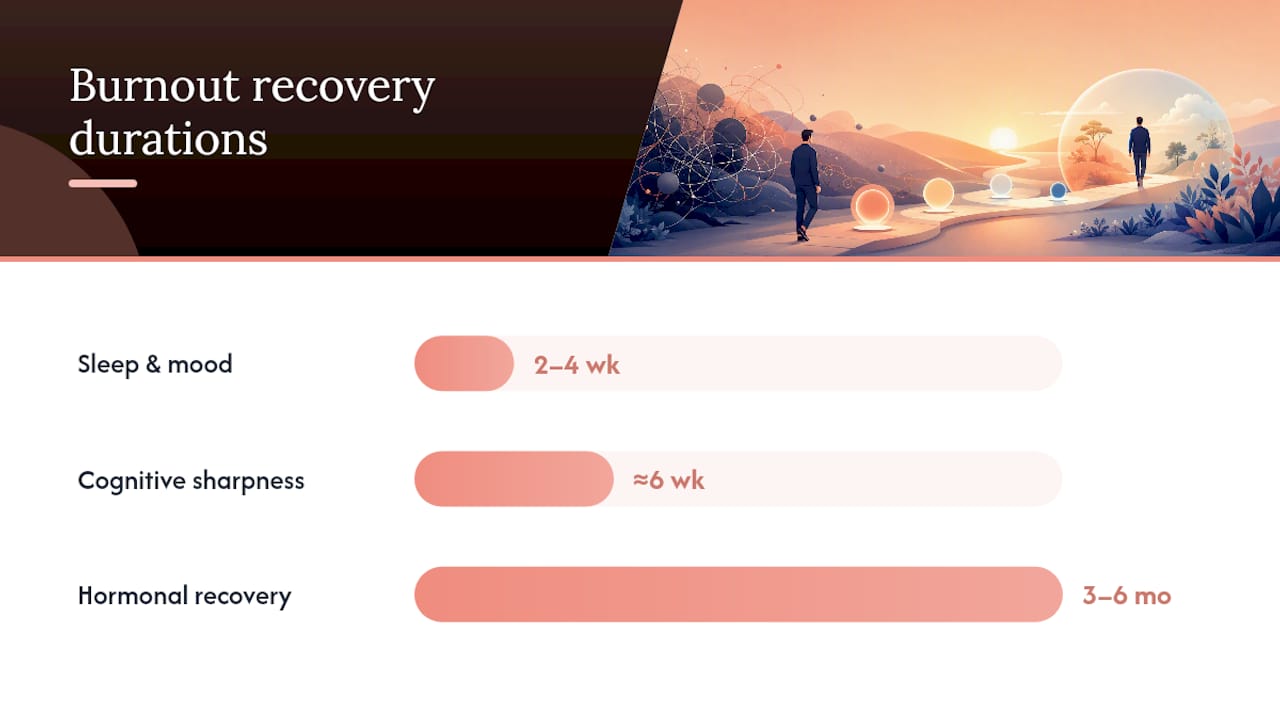
| Recovery has a timeline | Sleep and mood often improve in 2 to 4 weeks; full biological recovery can take 3 to 6 months. |
| Clinical support is available | Kin-wellness offers virtual outpatient therapy, medication management, and IOP care for California executives with insurance billing support. |
Table of Contents
- Executive Burnout Signs by Stage: Early, Mid, and Late
- Why Executive Burnout Hits Judgment Harder Than Job Satisfaction
- A Quick Self-Check: How Severe Is This?
- Immediate Steps to Reduce Harm in the Next 7 Days
- Treatment and Recovery Options for Executives
- Talking to Your Board, HR, or Team About Burnout
- A Clinician's Note on Executive Burnout
- How Kin Wellness Supports Executive Burnout Recovery
- Sources
Executive Burnout Signs by Stage: Early, Mid, and Late
Burnout rarely arrives all at once. It builds in stages, and executives tend to misread the early ones as dedication rather than depletion.
Early stage looks like subtle erosion: a shorter fuse in meetings, sleep that feels "productive" because you're up answering emails at 11 p.m., and a quiet loss of curiosity about problems that used to excite you. You're still performing, but the fuel gauge is dropping faster than you'll admit.
Mid stage brings chronic decision fatigue. You start avoiding the strategic, ambiguous work (the kind that actually requires your judgment) in favor of tactical busywork that feels safer. Quality slips. Tolerance for uncertainty shrinks. A SHRM guide on executive burnout notes this stage is where team morale starts absorbing the cost, even if no one names it yet.
Late stage is emotional shutdown paired with physical breakdown: persistent headaches, digestive problems, insomnia that no longer resolves with a good weekend, and a genuine desire to quit rather than lead. Vistage's research describes CEOs at this point showing decreased collaboration and outright health crises, not just bad moods.
Common threads across all three stages, per Inc.:
- Fatigue that rest doesn't fix
- Declining confidence in your own calls
- Irritability that surprises people who know you
- Detachment from the mission you used to champion
Pro Tip: The most underrated early flag isn't exhaustion. It's a quiet loss of confidence in your own decisions. If you're seeking more reassurance from your team before calls you'd normally make alone, your judgment is already compensating for something.
Why Executive Burnout Hits Judgment Harder Than Job Satisfaction
Burnout in a frontline employee usually shows up as disengagement. In an executive, it shows up as impaired judgment, and that difference matters because your decisions carry organizational weight that a single contributor's don't.
Reduced professional efficacy in leaders often looks like slower decision cycles, more requests for reassurance before committing to a call, and a loss of the strategic clarity that used to feel automatic. That's not a personality shift. It's a cognitive one.
The organizational cascade is real: when a leader's bandwidth narrows, meetings expand to fill the gap, decisions slow down, and friction increases across the team. One analysis of executive judgment found this pattern shows up as meeting inflation and duplicated work, the organizational equivalent of a limp.
In technical and IT-heavy cultures, long hours are often normalized as the price of leadership, which makes burnout harder to name. Combine that with rising AI-driven expectations and recent layoff pressure, and it's no surprise a significant portion of IT leaders report current burnout.
A Quick Self-Check: How Severe Is This?
Answer yes or no to these. Give yourself a minute, not a philosophy session.
Emotional: Do you feel detached from work you used to care about? Are you more irritable than people who know you would expect?
Cognitive: Has your confidence in your own decisions dropped? Are you avoiding ambiguous, strategic problems in favor of busywork?
Behavioral: Are you withdrawing from your team or delegating less than you should?
Physical: Are you dealing with headaches, digestive issues, or sleep that doesn't restore you?
- Zero to one "yes": Likely stress, not burnout. Monitor it.
- Two to four "yes": You're teetering. Act this week using the steps below.
- Five or more, especially cognitive and physical together: This looks like clear executive burnout. Schedule a clinical consult.
If you're experiencing panic attacks, suicidal thoughts, or insomnia severe enough to affect your safety, that's an urgent situation. Contact a crisis line or emergency care immediately, not next week.
Immediate Steps to Reduce Harm in the Next 7 Days
Recovery doesn't start with a sabbatical. It starts with a handful of specific moves that protect your judgment while you figure out the bigger picture.
- Protect your morning decision window. Move your hardest calls before noon, when cognitive resources are freshest, and push administrative tasks to the afternoon.
- Run a delegation audit. List every recurring task on your plate and mark three you can hand off this week, even imperfectly.
- Triage your meetings. Cancel or shorten anything that doesn't require your specific judgment.
- Fix your sleep window first. Consistent sleep and morning light exposure do more for cognitive recovery in week one than almost anything else.
- Set one calendar boundary. Block a recovery window (even 90 minutes) and treat it as non-negotiable, the same way you'd treat a board call.
Pro Tip: Think of the delegation audit like an elimination diet. You're not permanently removing tasks, you're temporarily removing cognitive load to see what symptoms clear once the load drops.
- Skip anything that requires a major public announcement this week.
- Don't make irreversible personnel or strategic decisions while you're triaging.
- Don't make irreversible personnel or strategic decisions while you're triaging.
- Tell one trusted person (a peer, coach, or clinician) what's happening. Isolation compounds this.
Treatment and Recovery Options for Executives
Executives often delay care because they equate visible struggle with losing their leadership identity, according to a clinical guide for high performers. That fear is understandable, and it's also the thing keeping recovery out of reach.

Outpatient therapy works well for early to mid-stage burnout, especially when it addresses the identity and control issues underneath the exhaustion. Therapy for professionals built around executive schedules and concerns tends to see better follow-through than generic weekly sessions.
Medication management can help when sleep, anxiety, or mood symptoms are severe enough to block other recovery work, and it's typically paired with therapy rather than used alone.
Intensive outpatient programs (IOP) offer more structured, frequent support for late-stage burnout or when symptoms overlap with depression or anxiety disorders, without requiring a full leave of absence.
Recovery has a real timeline: sleep and mood often improve within two to four weeks, cognitive sharpness returns by around week six, and full hormonal or metabolic recovery can take three to six months. Peer groups and executive coaching paired with clinical care extend those gains further.
Kin-wellness offers virtual outpatient therapy, medication management, and IOP levels of care for California adults, including working professionals and executives, with support for insurance billing. If you're unsure which level fits, a consult call is the fastest way to find out. For a deeper look at treatment pathways, see work burnout treatment strategies.
Pro Tip: Ask any provider you're considering how they sequence care for executives specifically. Generic burnout advice ("just rest more") ignores the reality that you still have a business to run while recovering.
Talking to Your Board, HR, or Team About Burnout
You don't need to disclose a diagnosis to ask for support. A short, factual script protects your privacy while still getting you what you need.
To your board or CEO: "I'm adjusting my schedule for the next few weeks to protect my decision-making capacity. I'll keep you updated on anything that affects deliverables."
To HR: "I'd like to understand my options for a temporary schedule adjustment or leave, and what documentation you'd need from a provider." California has specific protections here worth knowing before that conversation; see mental health leave rights in California for what's typically required.
To your team: "I'm reducing my meeting load for a bit so I can focus on the decisions that matter most. Here's who to loop in on X and Y in the meantime."
Reasonable accommodations to request:
- A cap on daily meetings
- Protected blocks for strategic decision-making
- Temporary delegation of specific projects
- Reduced travel for a defined period
Keep a simple record of dates, symptoms, and any clinical recommendations. It makes both the leave conversation and your own recovery tracking easier later.
A Clinician's Note on Executive Burnout
Working with executives, I've noticed a pattern: the people most equipped to run a company under pressure are often the last to admit they're drowning in it...
If any of this guide sounds familiar, that recognition is worth acting on. A short consult call costs you little and tells you a lot.
How Kin Wellness Supports Executive Burnout Recovery
There's no shortage of advice telling executives to "just take a vacation." Kin-wellness takes a different approach: structured, clinical care that fits around a working leader's actual schedule instead of asking you to disappear from your role entirely.

Kin-wellness provides virtual outpatient therapy, medication management, and intensive outpatient programs for adults across California, with insurance billing support built into the process. When you reach out, ask about telehealth availability in your area, which insurance plans they accept, and how quickly you can be matched with a provider who works with executives specifically..
If two or more signs from the checklist above sound like your last month, the next reasonable step is a consult, not another week of pushing through. Visit Kin Wellness's services page to see current care options, or start at Kin-wellness to book an initial conversation.
Sources
For deeper reading on the research behind this guide, see the Foundry State of the CIO burnout data, the Vistage CEO Confidence Index, and Executive Health's recovery timeline research. Kin-wellness also publishes guidance on work burnout treatment and mental health leave in California.
FAQ
Is executive burnout the same as depression? No. Burnout is tied to chronic workplace stress and often improves with changes to workload and recovery habits. Depression can occur alongside it but usually needs its own treatment, so a clinical evaluation helps tell the two apart.
How long does executive burnout recovery take? Sleep and mood often improve within two to four weeks, cognitive sharpness returns by around six weeks, and full hormonal recovery can take three to six months, according to Executive Health's research.
Can I recover from burnout without stepping away from my role? Often, yes, especially in early or mid stages, using delegation, boundaries, and outpatient therapy. Late-stage burnout with severe physical symptoms may require more structured care like an IOP.
What's the first sign I should not ignore? A drop in confidence about your own decisions, especially if you're seeking more reassurance from others before calls you'd normally make alone.
This article is general information, not a substitute for advice from a qualified doctor. Consult a qualified healthcare professional about your own circumstances before acting on anything here.
- IT leadership burnout: The hidden cost of executive stress | CIO
- CEO Burnout Recovery: How Leaders Rebuild | Vistage
- 7 ways to overcome executive burnout and sustain success | Inc.
- How High-Performing Executives Recover From Burnout — Executive Health