
EMDR is an evidence-based, first-line therapy for PTSD that follows a standardized eight-phase protocol and often reduces symptoms within weeks rather than months. It's a strong option for many adults with trauma-related symptoms, not a fringe treatment. Sessions typically run 50 to 90 minutes, once a week, for approximately three months, though your timeline will depend on your history and how you respond. Expect some short-term discomfort as memories get processed, alongside meaningful relief for most people who stick with it.
TL;DR:
- EMDR typically reduces PTSD symptoms within about three months of weekly sessions, each lasting 50 to 90 minutes.
- The protocol involves eight specific phases, including history-taking, assessment, desensitization, installation, and reevaluation, whether in person or via telehealth.
- While the mechanism of bilateral stimulation remains debated, extensive research supports EMDR's effectiveness and durable long-term outcomes.
- Clients with complex trauma or childhood abuse may require longer preparation and stabilization phases before full processing starts.
- Transient side effects, such as emotional distress or vivid dreams, are common and manageable through stabilization techniques, but severe or persistent distress warrants immediate clinician contact.
Table of Contents
- What Is EMDR for PTSD, and How Does the 8-Phase Protocol Work?
- How Does EMDR Work? The Science Behind Memory Reprocessing
- Does EMDR Really Work for PTSD? What the Research Shows
- What Happens in an EMDR Session, and How Long Does Treatment Take?
- What Are the Risks and Side Effects of EMDR Therapy?
- Who Is a Good Candidate for EMDR, and How Does It Compare to Other Trauma Therapies?
- How to Find a Qualified EMDR Therapist for PTSD Treatment
- Kin Wellness's Approach to EMDR and Trauma-Focused Care
- The Eight Phases of EMDR, Explained in Practical Detail
- Long-Term Outcomes and Relapse Prevention After EMDR
- Adapting EMDR for Complex PTSD and Childhood Trauma
- Managing Distress Between EMDR Sessions
- What This Means for Anyone Considering EMDR
- Start EMDR Therapy for PTSD With Kin Wellness
- Sources
- FAQ
What Is EMDR for PTSD, and How Does the 8-Phase Protocol Work?
EMDR stands for Eye Movement Desensitization and Reprocessing. It's a structured, trauma-focused psychotherapy built around helping the brain finish processing memories that got "stuck" during a traumatic event. Instead of talking through the trauma in exhaustive detail the way some talk therapies do, EMDR pairs brief recall of the memory with bilateral stimulation, usually side-to-side eye movements, though tapping or alternating audio tones work too.
The VA's National Center for PTSD describes EMDR as a standardized eight-phase protocol, and that structure is what separates it from looser trauma-processing approaches. Here's the sequence a trained clinician follows:
- History and treatment planning: Your therapist gathers background on your trauma history and identifies target memories.
- Preparation: You learn about the process and build coping skills for managing distress between sessions.
- Assessment: You and your therapist pinpoint the specific image, belief, and body sensation tied to a target memory.
- Desensitization: You focus on the memory while doing sets of bilateral stimulation until distress decreases.
- Installation: You strengthen a positive belief to replace the negative one tied to the memory.
- Body scan: You check for lingering physical tension connected to the memory.
- Closure: Your therapist helps you return to a calm state before ending the session.
- Reevaluation: The next session opens by checking how the processed memory feels now and whether new targets need attention.
Telehealth EMDR uses the same eight phases. Bilateral stimulation adapts through therapist-guided eye movements on screen, tapping instructions you follow yourself, or audio tones through headphones. The mechanics change slightly; the protocol doesn't.
How Does EMDR Work? The Science Behind Memory Reprocessing
EMDR's theoretical foundation is the adaptive information processing model. The idea is that traumatic memories sometimes get stored in a raw, fragmented way, disconnected from the rest of your memory network, which is why a trigger years later can feel like the event is happening again. Reprocessing, in this model, means helping the brain link that memory into a broader, less charged context so it stops firing off the same alarm response.

Bilateral stimulation is the part people find hardest to believe works, and researchers haven't fully settled on why it helps. The VA points to a proposed mechanism: bilateral stimulation may lower physiological arousal and reduce the vividness of the memory, which then makes room for the mind to do associative work it couldn't do while flooded with distress. Some researchers compare it to what happens during REM sleep, when the brain naturally processes emotional experiences. Others argue the eye movements simply occupy working memory, making the recalled trauma feel less vivid and less overwhelming in the moment.
Here's the honest part: the mechanism is still debated. What isn't debated nearly as much is the outcome. Clinicians and researchers have somewhat different opinions on why EMDR works, but the that it works question has a much stronger consensus behind it. That's worth remembering if you get hung up on the eye-movement piece sounding unusual. The protocol's structure and the client outcomes are what clinical guidelines are actually built around, not a settled theory of bilateral stimulation.
Does EMDR Really Work for PTSD? What the Research Shows
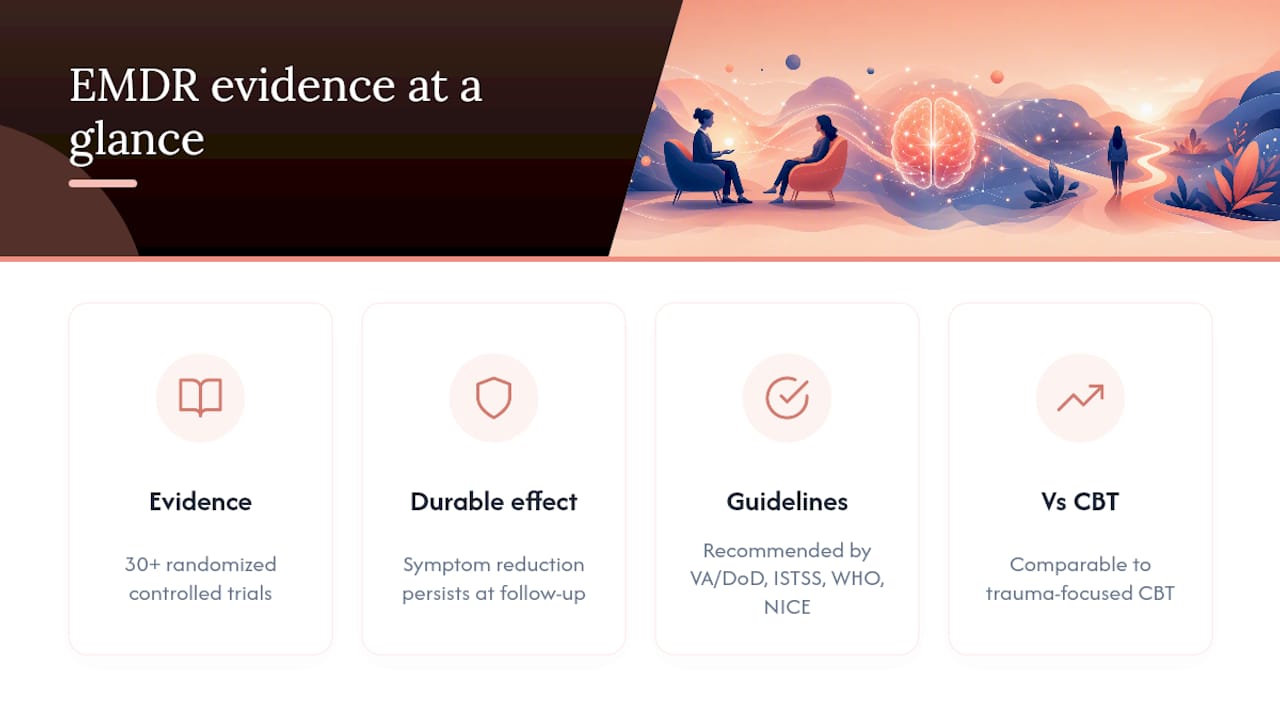
Yes, and the evidence base is deeper than most people expect. A state-of-the-science review identified more than 30 randomized controlled trials backing EMDR's efficacy, with effect sizes holding up across a range of trauma types, from single-incident accidents to combat exposure, according to a review published in the Journal of Traumatic Stress.
A meta-analysis of randomized controlled trials found that EMDR produces both immediate symptom reduction and effects that hold up at follow-up, according to research published in BMC Psychology. That same analysis found added benefits for anxiety and depression symptoms that often ride alongside PTSD, which matters because trauma rarely shows up as a single, isolated diagnosis.
The sustained-effect finding matters more than it sounds. A lot of therapies show good results while you're in the room with a clinician and then fade once treatment ends. EMDR's follow-up data showing durable improvement is one reason it has earned first-line status rather than "promising but unproven."
Guideline bodies have converged on EMDR as a recommended PTSD treatment. The VA and Department of Defense, the International Society for Traumatic Stress Studies, the World Health Organization, and the UK's National Institute for Health and Care Excellence all list EMDR among their recommended trauma treatments. The American Psychological Association's position is a bit more measured: its 2017 guideline gave EMDR a conditional recommendation, reflecting somewhat lower confidence in the certainty of evidence compared to trauma-focused cognitive behavioral therapy, though a systematic review revisiting those recommendations argues the evidence base has only strengthened since then.
How does EMDR stack up against trauma-focused CBT directly? A systematic review and meta-analysis comparing the two found broadly comparable results for core PTSD symptom reduction, with some samples showing EMDR producing faster improvement in co-occurring anxiety and depression. Neither therapy clearly beats the other across every outcome. The honest takeaway is that both are legitimate, guideline-backed options, and the right choice often comes down to your specific symptom picture and what feels workable for you.
What Happens in an EMDR Session, and How Long Does Treatment Take?
A typical EMDR course runs weekly, with sessions lasting 50 to 90 minutes, and most people complete treatment in about three months, according to the National Center for PTSD. That's a rough average, not a promise. Someone with a single traumatic incident and strong coping resources might finish faster; someone with a long trauma history often needs longer.
Here's roughly how a course of treatment unfolds:
- Early sessions focus on history-taking and stabilization. Your therapist maps out your trauma history and teaches grounding skills you'll use if a session gets intense.
- Assessment sessions identify specific targets. You'll pinpoint the exact memories, images, and beliefs that need processing, rather than working from vague generalities.
- Processing sessions do the core work. Your therapist guides sets of bilateral stimulation, usually 20 to 40 passes at a time, while you hold the memory in mind, pausing to check how the distress level shifts.
- Later sessions install and reinforce positive beliefs, then scan for lingering physical tension the trauma left behind.
- Final sessions reevaluate progress and check whether new targets have surfaced.
Homework is lighter than in some other trauma therapies. You might track mood or triggers between sessions, but EMDR doesn't typically require the extensive exposure exercises associated with some cognitive behavioral approaches. Telehealth EMDR follows the same arc, with bilateral stimulation delivered through on-screen visual cues, tapping instructions, or audio tones, and safety planning discussed upfront in case a remote session brings up strong emotion when a therapist isn't physically present.
Pro Tip: Ask your therapist how they pace desensitization sets before your first processing session. Pacing is individualized. Some clinicians move through targets quickly if you're tolerating it well; others slow down and add more stabilization if a memory turns out to be more loaded than expected.
What Are the Risks and Side Effects of EMDR Therapy?
EMDR is generally well tolerated, but it isn't free of short-term discomfort. Heightened emotional distress during and immediately after a processing session is common. So are vivid or intrusive imagery, fatigue, and disrupted sleep in the day or two following a session. These reactions are typically transient and often signal that reprocessing is actively happening, not that something has gone wrong.
Trained clinicians build monitoring into every session. The VA notes that stabilization skills, grounding techniques, and careful pacing are core parts of managing these reactions, and a competent therapist will check in on your distress level throughout desensitization rather than pushing through regardless of how you're doing.
Certain situations call for extra caution, and some people explore medical cannabis for PTSD symptom management as part of an adjunctive approach. Active suicidality, unmanaged substance use, and severe dissociation are signals that stabilization needs to come first, sometimes for weeks, before trauma processing begins. This isn't a reason to avoid EMDR altogether; it's a reason a good clinician sequences your care carefully rather than diving straight into memory work. If you have a complex clinical picture, a phased approach, stabilization first, then processing, tends to produce safer, more durable outcomes than rushing.
Who Is a Good Candidate for EMDR, and How Does It Compare to Other Trauma Therapies?
EMDR fits a wide range of adults with PTSD, including those with complex trauma histories and co-occurring anxiety or depression, though the evidence base is strongest for single-incident and combat-related trauma. If your trauma history is more layered, treatment often takes longer and may lean more heavily on the early stabilization phases.
Compared with trauma-focused cognitive behavioral therapy, the practical differences show up more in process than outcome. Trauma-focused CBT typically involves more between-session homework and direct written or verbal exposure to trauma narratives. EMDR relies less on homework and does not require you to narrate the trauma in exhaustive detail, which some people find more tolerable. Clinicians often lean toward EMDR when a client is hesitant to talk extensively about the trauma, or toward trauma-focused CBT when a client responds well to structured, skills-based homework.
Neither is universally superior. The broader research on trauma therapy options supports treating this as a genuine choice, not a hierarchy, and shared decision-making between you and your clinician matters more than picking the "correct" therapy from a chart. Some treatment plans combine approaches, using EMDR for specific memory targets alongside broader anxiety or depression-focused interventions when comorbid symptoms need direct attention.
How to Find a Qualified EMDR Therapist for PTSD Treatment
Not every therapist who mentions EMDR on their website has equivalent training. Formal EMDR training runs through recognized programs, and many practitioners pursue certification through the EMDR International Association (EMDRIA), which maintains directories of trained clinicians. Start there, or ask any licensed therapist directly about their EMDR training background before booking.
Look for these credentials and experience markers:
- A current license in good standing (psychologist, licensed clinical social worker, licensed professional counselor, or similar).
- Completed EMDR training through an accredited program, ideally with ongoing supervision or consultation.
- Direct experience treating your type of trauma, since combat trauma, childhood abuse, and single-incident trauma sometimes call for different pacing.
At a first consult, ask specific questions: How many EMDR cases have you handled similar to mine? How do you decide session pacing? What's your plan if I become highly distressed during processing? Do you offer telehealth EMDR, and how does bilateral stimulation work remotely? What are your fees, and do you handle insurance billing directly? A checklist for preparing for your first therapy session can help you walk in with the right questions ready.
Red flags worth taking seriously: a therapist who can't clearly explain the eight-phase structure, who dismisses your questions about pacing, or who seems unfamiliar with handling dissociation or crisis situations during processing.
Kin Wellness's Approach to EMDR and Trauma-Focused Care
Outpatient and intensive outpatient mental health services for adults typically include EMDR therapy delivered in-person or via telehealth by licensed clinicians. That range matters for trauma treatment specifically, since some clients need standard weekly outpatient care while others benefit from a more structured intensive outpatient level of support during active symptom flare-ups.
Insurance billing support for EMDR and related services can help remove one of the more common barriers people face when trying to start trauma-focused care.
The Eight Phases of EMDR, Explained in Practical Detail
Phase one, history and treatment planning, is where your therapist learns your trauma history, current symptoms, and coping resources, then maps out which memories need processing first. Phase two, preparation, builds the coping and grounding skills you'll rely on, and it's also where your therapist explains what bilateral stimulation will feel like so nothing catches you off guard.
Phase three, assessment, gets specific: you identify the image that represents the worst part of the memory, the negative belief attached to it ("I'm powerless," for example), and the physical sensation tied to it. Phase four, desensitization, is the active reprocessing phase, sets of bilateral stimulation while holding the memory in mind, repeated until distress drops meaningfully.
Phase five, installation, replaces that negative belief with a more accurate, positive one and strengthens it through additional stimulation sets. Phase six, body scan, checks for residual physical tension connected to the memory, since trauma often lodges in the body even after the emotional charge fades. Phase seven, closure, brings you back to a stable state before you leave the session, using grounding techniques if the memory isn't fully resolved yet. Phase eight, reevaluation, opens the next session by checking how the previously processed memory feels now and whether it's time to move to a new target.
Long-Term Outcomes and Relapse Prevention After EMDR
The meta-analytic evidence on EMDR isn't just about symptom relief during treatment. Follow-up data shows the improvements tend to hold, according to the BMC Psychology meta-analysis, which is a meaningfully different claim than "it works while you're in therapy." Durability is what separates a genuinely effective trauma treatment from one that just manages symptoms temporarily.
That said, "durable" doesn't mean "permanent and maintenance-free." New stressors, anniversaries of the trauma, or major life transitions can reactivate symptoms even after successful EMDR treatment. The relapse prevention piece typically involves identifying your personal triggers before treatment ends, keeping the grounding and stabilization skills you learned during preparation phases active in daily life, and knowing when to schedule a booster session rather than waiting for symptoms to snowball.
Many clinicians build a brief check-in plan into the final sessions, spacing out follow-up appointments rather than ending treatment abruptly. If new traumatic memories surface later, or if an old target that seemed resolved starts feeling charged again, that's not a sign EMDR failed. It's a normal part of how memory networks continue to reorganize after intensive reprocessing work, and it's usually addressed with a short return to targeted processing rather than restarting the entire protocol.
Adapting EMDR for Complex PTSD and Childhood Trauma
Standard EMDR was developed with single-incident trauma in mind, and it still works well there. Complex PTSD, typically the result of prolonged or repeated trauma such as childhood abuse or long-term domestic violence, usually requires a modified approach that leans more heavily on the early phases of the protocol.
Clinicians treating complex trauma often extend the preparation phase considerably, sometimes over multiple sessions, to build a stronger foundation of emotional regulation skills before touching any specific memory. Rather than targeting one incident, therapists frequently work with clusters of related memories or identify a representative "template" memory that captures a recurring pattern of harm. Practitioner guidance emphasizes individualized pacing and prioritizing stabilization when dissociation or significant dysregulation is present, which shows up more frequently in complex trauma cases than in single-incident PTSD.
Childhood trauma adds another layer, since memories formed early in life are sometimes stored differently, less as coherent narratives, more as fragmented sensations or beliefs about the self. Therapists working with childhood trauma often spend more time on the assessment phase, helping clients articulate a negative belief that may have been operating below conscious awareness for decades. Treatment courses for complex or childhood trauma routinely run longer than the roughly three-month average timeline cited for more straightforward PTSD cases, and that extended timeline reflects appropriate caution, not a stalled treatment.
Managing Distress Between EMDR Sessions
Feeling raw after a processing session is common, and it doesn't mean the therapy is failing. Fatigue, vivid dreams, unexpected memories surfacing, or a temporary uptick in irritability in the day or two following a session are all recognized short-term reactions as your brain continues working through what got activated in the room.
The grounding skills taught during the preparation phase exist precisely for this window. Simple techniques, container visualization to mentally set aside distressing material until your next session, deep breathing, or a brief physical activity like a walk, are commonly taught precisely for managing the gap between sessions. Keeping a brief log of what comes up between appointments also gives your therapist useful material for the next reevaluation phase, rather than something you have to carry alone.
If distress escalates well beyond what feels manageable, contact your therapist before your next scheduled session rather than waiting it out. A quick check-in call or brief additional session focused purely on stabilization is a normal part of care, not an exception to it. Persistent, severe distress that doesn't ease within a few days, or any thoughts of self-harm, warrants immediate contact with your provider or a crisis line rather than waiting for your next appointment. Consistent sleep, limiting alcohol use, and staying connected to supportive people during an active course of EMDR all measurably ease this in-between period, and most clinicians will ask about all three during preparation.
What This Means for Anyone Considering EMDR
The gap between how EMDR gets discussed online and what the actual evidence supports is smaller than skeptics assume and smaller than enthusiasts sometimes present too. This isn't an unproven fad wrapped in the appeal of finger-waving. It's a manualized therapy with more than 30 RCTs behind it, endorsement from major guideline bodies, and meta-analytic support for effects that hold up at follow-up. That's a real track record.
Where conventional discussion falls short is in treating EMDR versus trauma-focused CBT as a competition with a clear winner. The comparative research doesn't support that framing. Both are legitimate, and the right pick depends on your specific trauma pattern, comorbid symptoms, and honestly, what you can tolerate sitting through. A client who can't stomach writing detailed trauma narratives shouldn't be talked into CBT because it's "more studied." A client who needs structured homework to feel progress shouldn't be pushed toward EMDR because it sounds faster.
What matters most: find a clinician who explains their reasoning, not one who sells you a single method as the only answer. Ask about their pacing philosophy before you commit to anything.
— Dakota
Start EMDR Therapy for PTSD With Kin Wellness
If the eight-phase structure and the evidence behind EMDR make sense for your situation, the next question is simply where to start. EMDR therapy is available through licensed clinicians, in person or via telehealth, alongside outpatient and intensive outpatient programs and insurance billing support for adults in certain regions.

Booking an intake is the fastest way to find out whether EMDR fits your specific history, and it's the point where a clinician can actually assess your trauma pattern instead of you guessing from an article. When you schedule, ask specifically for a clinician trained in EMDR, and mention if telehealth works better for your schedule than in-person sessions. If you're not sure whether your plan covers therapy, Kin Wellness's team can help verify insurance benefits before your first appointment so cost isn't a surprise later. You can review the full range of services, including EMDR, individual and family therapy, and medication management, on the Kin Wellness services page, and take the next concrete step toward booking an intake.
Sources
- Eye Movement Desensitization and Reprocessing (EMDR) for PTSD - PTSD: National Center for PTSD
- Revisiting Eye Movement Desensitization and Reprocessing Therapy for Post-traumatic Stress Disorder: A Systematic Review and Discussion of the American Psychological Association’s 2017 Recommendations
This article is general information, not a substitute for advice from a qualified doctor. Consult a qualified healthcare professional about your own circumstances before acting on anything here.
FAQ
Does EMDR Really Work for PTSD?
Yes. More than 30 randomized controlled trials support its efficacy, and meta-analyses show both immediate symptom reduction and effects that hold up at follow-up assessments.
What Are the Signs of a PTSD Flare-Up?
Common signs include sudden intrusive memories or flashbacks, heightened startle response, avoidance of reminders, irritability, and disrupted sleep, often triggered by anniversaries, stress, or reminders of the original trauma.
What Are the Signs That EMDR Isn't Working?
If distress stays consistently high across several sessions with no reduction during desensitization, or if you feel worse overall between sessions without any signs of processing, it's worth discussing pacing and stabilization needs with your therapist rather than assuming the therapy has failed outright.
What Are the Common Side Effects of EMDR Therapy Sessions?
Temporary increases in emotional distress, vivid or intrusive imagery, fatigue, and disrupted sleep are common in the day or two after a session, and these typically ease as processing continues.
How Long Does a Course of EMDR Treatment Usually Take?
Most people complete EMDR in weekly 50 to 90 minute sessions over about three months, though complex trauma histories often require a longer course.