

The best-supported trauma therapies are Prolonged Exposure (PE), Cognitive Processing Therapy (CPT), and EMDR. The 2023 VA/DoD Clinical Practice Guideline names all three as the trauma-focused psychotherapies with the strongest evidence for PTSD, and none reliably beats the others across every patient. Other supported options exist, including Written Exposure Therapy and trauma-focused CBT variants, and non-trauma-focused approaches can help when trauma-focused work isn't yet possible. What matters most:
- Pick a therapy through shared decision-making with a trained clinician, not a self-diagnosis from a blog post.
- Ask about therapist training and protocol fidelity before starting.
- Check whether stabilization work should come first if you're highly reactive or newly in crisis.
Key Takeaways
PE, CPT, and EMDR carry the strongest evidence for treating PTSD, but the right choice depends on individual goals, readiness, and clinician training, not a universal ranking.
| Point | Details |
|---|---|
| Top evidence-based therapies | PE, CPT, and EMDR are the trauma-focused therapies with the strongest guideline support for PTSD. |
| No universal best option | Head-to-head trials show comparable outcomes among PE, CPT, and EMDR, so fit matters more than ranking. |
| Shorter option available | Written Exposure Therapy offers a supported 5 to 6 session alternative for those wanting a shorter course. |
| Stabilize before processing | Grounding and regulation skills often need to come first for patients with high reactivity or complex trauma. |
| Kin Wellness offers a direct path | Kin Wellness provides EMDR, outpatient therapy, IOP, and medication management with insurance billing support in California and Arizona. |
Table of Contents
- What Are the Main Types of Trauma Therapy?
- How Do You Choose the Right Trauma Therapy for You?
- What Does a Course of Trauma Therapy Actually Look Like?
- What If Trauma-Focused Therapy Isn't the Right Fit Right Now?
- How Do You Prepare for Trauma Processing?
- Frequently Asked Questions
- Sources
What Are the Main Types of Trauma Therapy?
Three trauma-focused therapies carry the strongest research backing, and understanding how each one actually works helps you ask better questions at intake.
Prolonged Exposure (PE) asks you to revisit the traumatic memory directly, both in session (imaginal exposure, narrating the event aloud repeatedly) and in daily life (in vivo exposure, gradually facing avoided situations). A typical course runs multiple sessions over several weeks. The logic is straightforward: avoidance keeps fear alive, and controlled, repeated exposure teaches your nervous system that the memory itself is not currently dangerous. PE has one of the largest evidence bases of any PTSD treatment, backed by decades of randomized trials.
Cognitive Processing Therapy (CPT) takes a different route to a similar destination. Instead of revisiting the trauma narrative repeatedly, CPT targets the stuck beliefs trauma leaves behind: "It was my fault," "I can never trust anyone again," "The world is only dangerous." Sessions run over a similar multi-week timeframe to PE, built around written accounts and structured worksheets that challenge those beliefs. People who find repeated exposure to the memory itself unbearable often respond well to CPT's more cognitive framing.
EMDR (Eye Movement Desensitization and Reprocessing) uses a structured eight-phase protocol where you focus on a specific traumatic memory while performing bilateral stimulation, typically guided eye movements, though tapping or auditory tones work in some protocols. Trials comparing EMDR against PE and CPT tend to find comparable outcomes, and the National Center for PTSD lists it alongside PE and CPT as top-tier evidence. Some patients prefer it precisely because it does not require detailed verbal narration of the trauma, which matters for people who struggle to talk about what happened in a linear way.
Written Exposure Therapy (WET) is the newest name on this list, and it's worth knowing about specifically because it's shorter. WET runs just 5 to 6 sessions, built around timed written narratives of the traumatic event. Research on WET and other massed formats shows it can be non-inferior to CPT or PE in some trials, meaning similar symptom reduction with a fraction of the time commitment. It's a strong option for people who want meaningful trauma-focused treatment but can't or won't commit to three months of weekly sessions, including many working professionals juggling demanding schedules.
Beyond these four, several trauma-focused CBT variants exist for specific populations, and phase-based models (stabilization, then processing, then integration) are common for complex trauma involving repeated or early-life abuse rather than a single incident.
- Trauma-Focused CBT (TF-CBT) is the standard for children and adolescents, built around similar cognitive and exposure principles adapted for developmental stage.
- Phase-oriented treatment sequences stabilization skills before any exposure work, which matters most for dissociation, self-harm history, or ongoing instability.
- Somatic and body-based approaches, along with mindfulness-based practices, function mostly as adjuncts. They're rarely first-line trauma-focused treatments on their own, but they show up constantly as stabilization tools and complements to the therapies above.
Some readers researching options also come across native healing traditions and other culturally rooted practices for trauma recovery. These approaches, often community-based and ceremonial, are increasingly recognized as meaningful complements to clinical trauma therapy for people whose recovery is tied to cultural or community identity, and clinicians are increasingly trained to integrate them respectfully rather than treat them as separate from "real" treatment.
How Do You Choose the Right Trauma Therapy for You?
There's no single right answer here, and that's not a cop-out. The National Center for PTSD is explicit that no one therapy fits every patient, which is why shared decision-making, a structured conversation between you and your clinician about goals, preferences, and constraints, is the recommended starting point. A tool like the PTSD Treatment Decision Aid can help you walk into that conversation with real questions instead of guesswork.
Work through these in order:
- Define your treatment goal. Do you want to process the specific memory directly, or are you more focused on managing day-to-day symptoms like hypervigilance and sleep disruption? This alone narrows the field.
- Ask about clinician training. PE and CPT are manualized protocols, and outcomes correlate with how closely a therapist follows the model and how much supervised training they've had. A vague "I do trauma work" answer isn't enough.
- Assess your current stability. Active suicidal ideation, ongoing substance use, or severe dissociation often means stabilization comes before trauma processing, not instead of it.
- Check logistics and insurance. Weekly availability for three months, telehealth versus in-person requirements, and whether your plan covers EMDR or intensive outpatient formats all shape what's realistic.
- Know your tolerance for exposure intensity. If narrating the trauma repeatedly sounds unbearable right now, that's useful information, not a failure, and it should steer you toward CPT, EMDR, or WET over classic PE.
At intake, ask directly: "What's your training in this specific protocol?" "How many sessions do you typically recommend, and what happens between sessions?" "What does a normal session look like week to week?" Vague answers to those three questions are a signal to keep looking.
Pro Tip: If a clinician can't name the specific protocol they're using (PE, CPT, EMDR, WET) and instead describes "trauma-informed talk therapy" without more detail, ask what evidence supports that approach specifically. Trauma-informed is a stance every good therapist should have; it isn't the same as a trauma-focused treatment protocol.
Red flags that suggest stabilization first: recent psychiatric hospitalization, unmanaged substance dependence, or a pattern of walking out of previous trauma-focused attempts within the first few sessions.
What Does a Course of Trauma Therapy Actually Look Like?
Session counts vary by protocol, but the ranges are consistent across the research: PE typically runs 8 to 15 sessions, CPT around 12, EMDR often falls in a similar range depending on memory complexity, and WET's massed format compresses the work into just 5 to 6 sessions. None of these guarantee a specific outcome for a specific person. Comparative trials consistently show PE, CPT, and EMDR landing in similar territory on average, which is exactly why fit and engagement matter more than chasing the "best" one on paper.
Expect some short-term discomfort. Revisiting traumatic material, even in a controlled format, often stirs up distress before it eases. Good clinicians manage this with pacing (adjusting how fast you move through exposure), safety planning for between-session spikes in distress, and regular check-ins on whether the current pace is sustainable. This is normal, not a sign the therapy is failing.
- PE and CPT: weekly sessions over roughly 2 to 4 months, sometimes compressed into massed formats.
- EMDR: comparable timeline, structured around processing specific target memories.
- WET: 5 to 6 sessions total, often weekly or twice weekly.
- Aftercare: relapse-prevention planning and check-ins matter as much as the acute course itself.
What If Trauma-Focused Therapy Isn't the Right Fit Right Now?
Sometimes trauma-focused therapy isn't available, or a person isn't ready for it. Present-Centered Therapy (PCT) focuses on current-day problems and coping rather than the traumatic memory itself. The National Center for PTSD notes that PCT and similar non-trauma-focused options can reduce symptoms, generally with smaller effect sizes than PE, CPT, or EMDR, which makes it a reasonable bridge rather than a permanent substitute for many patients.
Common adjuncts include:
- STAIR (skills training in affective and interpersonal regulation) for emotional regulation deficits.
- DBT-derived skills for distress tolerance.
- Mindfulness-based practices and somatic therapy for nervous-system regulation.
Medications, particularly certain antidepressants, are sometimes used for PTSD symptoms, but comparative research generally favors psychotherapy over medication alone for most adults. Group therapy can work well for shared-experience populations, like combat veterans or survivors of similar trauma types, though it's not automatically right for everyone, especially early after a traumatic event.
How Do You Prepare for Trauma Processing?
Stabilization means building enough nervous-system regulation to tolerate revisiting difficult material without becoming overwhelmed or dissociating. Clinical guidance consistently recommends bottom-up regulation strategies, grounding, paced breathing, somatic awareness, before intensive trauma-focused work for many patients, particularly those with complex trauma histories.

Pro Tip: Before your first trauma-focused session, practice one grounding technique (like naming five things you can see, hear, and touch) until it feels automatic. You'll want it available on a hard day, not something you're learning for the first time mid-session.
Clinicians typically recommend delaying trauma-focused work when you're in active crisis, newly sober, or managing severe dissociation. Preparatory care can include intensive outpatient programs (IOP), skills groups, and medication stabilization before trauma processing begins.
Kin Wellness structures exactly this kind of preparatory and processing care through outpatient and IOP programs, including EMDR delivered in-person or via telehealth, with insurance billing support for adults across California balancing treatment with work and family demands.
The Therapy That Works Is the One You'll Stay In
Modality matters, but therapeutic alliance often predicts outcomes just as strongly. If a treatment isn't clicking after a fair trial, say so. Switching protocols, or switching therapists, isn't giving up. It's how good care for busy professionals actually gets built.
Getting Started With Trauma Care at Kin Wellness
Kin Wellness is built for adults who need real trauma treatment without putting the rest of their life on hold. Working professionals, parents, healthcare workers, and executives get EMDR, individual therapy, group therapy, and medication management, delivered through outpatient or intensive outpatient formats that fit around a job and a family, not the other way around.

If a clinician recommends stabilization before trauma-focused work, Kin Wellness's IOP scheduling options and skills groups are built for that exact phase, with aftercare planning built in so treatment doesn't stop the moment symptoms ease. Insurance billing support covers PPO, HMO, and out-of-network benefits, and private-pay options are available for adults across California and Arizona. Explore Kin Wellness's services to see which format fits your goals, or visit Kin Wellness to schedule an intake and start the conversation with a licensed clinician this week.
Frequently Asked Questions
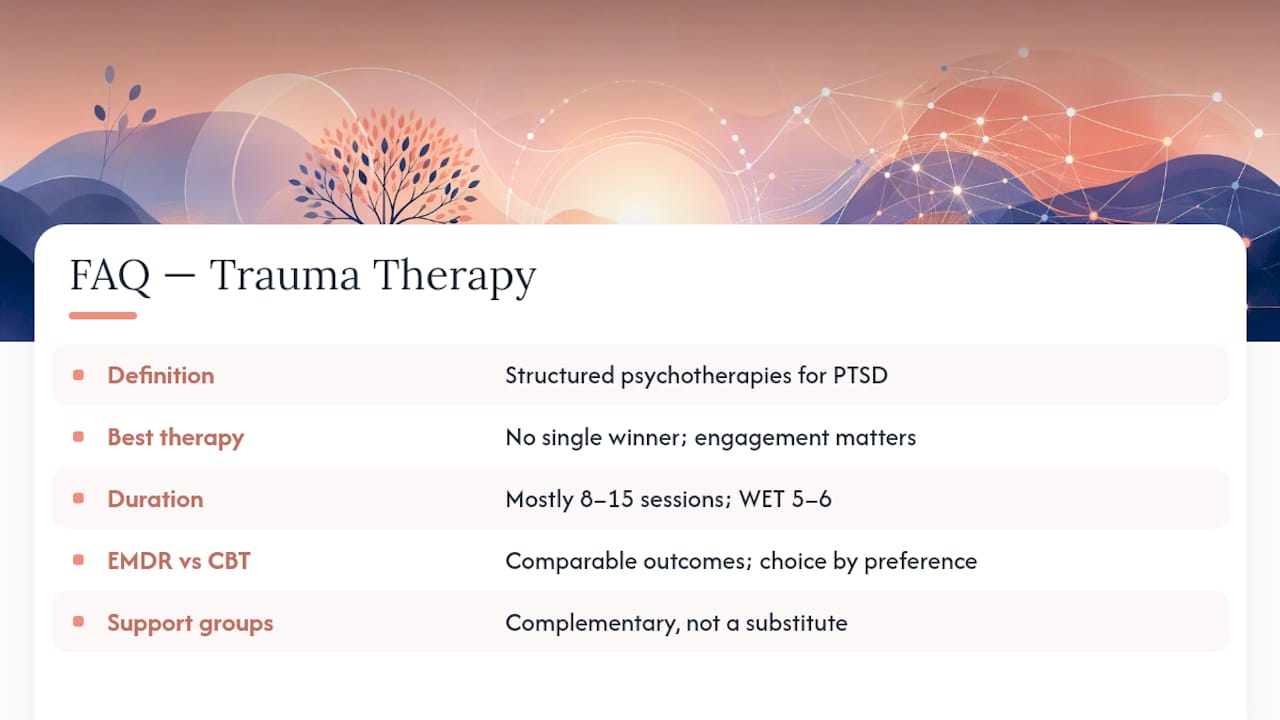
What is trauma therapy? Trauma therapy refers to structured, evidence-based psychotherapies designed to reduce PTSD symptoms by processing traumatic memories or addressing the beliefs and avoidance patterns trauma creates. It includes protocols like PE, CPT, and EMDR alongside supportive, non-trauma-focused options.
What is the most effective trauma therapy? No single therapy outperforms the others for every patient. PE, CPT, and EMDR show comparable outcomes in most head-to-head trials, so the "most effective" option is the one a person will actually engage with consistently under a well-trained clinician.
How long does trauma therapy usually take? Most trauma-focused protocols run 8 to 15 weekly sessions, though Written Exposure Therapy compresses meaningful results into just 5 to 6 sessions for many patients.
Is EMDR better than cognitive behavioral therapy for trauma? Neither consistently outperforms the other. EMDR and CPT (a form of trauma-focused CBT) tend to produce similar symptom reduction, so the choice often comes down to whether a person prefers verbal narrative work or the bilateral stimulation protocol.
Do trauma support groups replace individual therapy? Trauma support groups can complement individual treatment, especially for shared-experience populations like veterans, but they generally aren't a substitute for trauma-focused individual psychotherapy when PTSD symptoms are significant.
This article is general information, not a substitute for advice from a qualified doctor. Consult a qualified healthcare professional about your own circumstances before acting on anything here.
Sources
- Overview of Psychotherapy for PTSD - PTSD: National Center for PTSD
- Posttraumatic stress disorder in adults: Psychotherapy and psychosocial interventions - UpToDate
- PMC review on trauma/stabilization approaches