
The most effective anxiety group therapy topics are CBT-based skills like thought records, graded exposure ladders, mindfulness and relaxation training, and structured social-skill role-plays. Most evidence-based programs run 8 to 12 sessions using a transdiagnostic model, meaning members with generalized anxiety, panic, and social anxiety work through the same curriculum side by side rather than being split into separate diagnostic tracks.
A pragmatic randomized trial found that adding 12 weekly sessions of group transdiagnostic CBT to usual care reduced anxiety symptom severity compared with treatment as usual. That single finding is why so many outpatient programs default to the 8 to 12 session window instead of open-ended support groups.
Here's what actually belongs on the agenda:
- CBT skills: thought records and behavioral experiments
- Graded exposure ladders and values-based exposure
- Mindfulness, diaphragmatic breathing, and progressive muscle relaxation
- Role-play for social exposures and assertiveness
- Worry-sorting (solvable vs. unsolvable)
- Relapse prevention and maintenance planning
The rest of this guide breaks each topic into a facilitator-ready activity, then maps them into a full session-by-session curriculum you can adapt this week.
Key Takeaways
Anxiety group therapy works best when CBT skills, graded exposure, and relaxation training are sequenced across 8 to 12 sessions rather than delivered as isolated, unstructured discussions.
| Point | Details |
|---|---|
| Lead with psychoeducation | Spend a full session on the fight-or-flight response before introducing any exposure work. |
| Sequence exposure mid-program | Build ladders around session 6, after trust and relaxation skills are established. |
| Expect an early anxiety spike | Symptoms often rise in sessions 1 to 2 before improving by sessions 3 to 4. |
| Track with validated tools | Use the GAD-7 or Beck Anxiety Inventory every two to three sessions, not just at intake. |
| Choose a clinician-led model | Kin-wellness runs licensed, transdiagnostic anxiety groups with insurance billing support for California and Arizona adults. |
This article is general information, not a substitute for advice from a qualified doctor. Consult a qualified healthcare professional about your own circumstances before acting on anything here.
Table of Contents
- Anxiety Group Therapy Topics and Activities That Actually Work in Session
- How to Build an 8 to 12 Session Curriculum
- Screening, Group Agreements, and Safety Protocols
- Tracking Progress: What Change Actually Looks Like Week to Week
- Where This Curriculum Comes From
- What the Curriculum Gets Right, and Where Facilitators Overcorrect
- Ready to Run a Group That Actually Works
- Sources
Anxiety Group Therapy Topics and Activities That Actually Work in Session
Below are the activities that show up, in some form, across most well-run adult anxiety groups. Each one includes a goal, rough timing, and a modification note, because a technique that works for panic disorder can flop for social anxiety if you run it the same way.
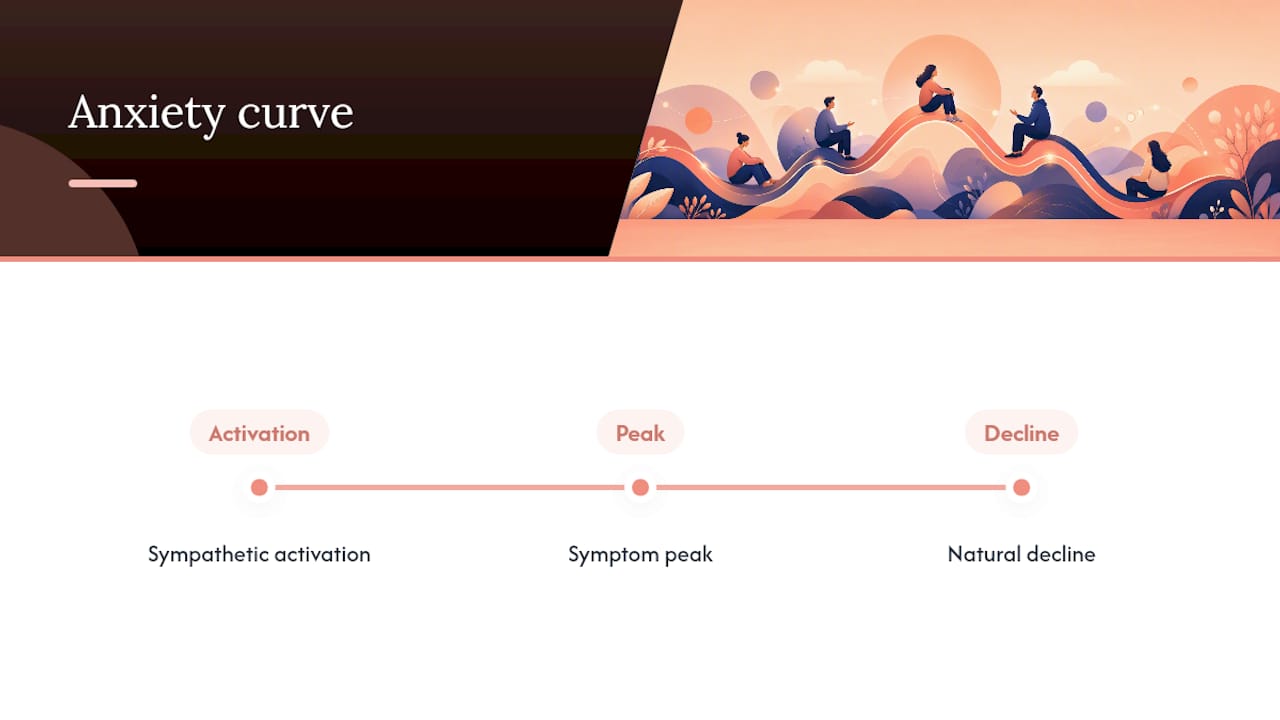
1. Psychoeducation on the fight-or-flight response. Goal: normalize symptoms before anyone is asked to do anything uncomfortable. Spend 15 to 20 minutes in session one drawing the anxiety curve on a whiteboard: sympathetic activation, symptom peak, natural decline. Facilitator prompt: "Your body isn't broken. It's running an old alarm system at the wrong volume." Clinicians frequently open group work this way specifically to prepare members for exposure exercises later in the program.
2. Thought records. Goal: separate automatic thoughts from facts. Hand out a five-column log (situation, automatic thought, emotion and intensity, evidence for/against, balanced thought). Give members 10 minutes to complete one entry from the past week, then invite two or three to share. Modification: for panic-disorder members, focus the "evidence" column on body sensations they've catastrophically misread.
3. Behavioral experiments. Goal: test a feared prediction against reality instead of just talking about it. Example: a member believes "if I speak up in the group, everyone will judge me." The experiment is to speak up once this session and rate the actual reaction versus the predicted one. Homework: repeat one small experiment outside group and log the outcome.
4. Exposure ladder construction. Goal: build a personalized hierarchy from least to most feared. Materials: index cards or a shared worksheet. Each member ranks 8 to 10 feared situations from 0 to 100 SUDS (subjective units of distress). Facilitator script: "We're not aiming for zero fear. We're aiming for tolerable, decreasing fear." Variation: for GAD, ladders often center on tolerating uncertainty; for social anxiety, they center on scrutiny and evaluation.

5. Safety-behavior audit. Goal: identify the small avoidance habits that quietly maintain anxiety, such as over-preparing, excessive checking, or avoiding eye contact. Structured safety-behavior audits are a recurring feature of well-designed anxiety curricula because members rarely notice these habits until someone names them out loud.
6. Worry-sorting: solvable vs. unsolvable. Goal: reduce time spent ruminating on things outside anyone's control. Members write down current worries, then sort each into "something I can act on today" or "something I can't control right now." Homework: a 15-minute daily "worry window" instead of all-day rumination.
7. Diaphragmatic breathing and progressive muscle relaxation (PMR). Goal: give the body a physiological off-ramp. Run a 5-minute guided breathing exercise, then a 10-minute PMR script moving from feet to face. Telehealth note: this works fine on video, but ask members to mute themselves during the exhale-count portion to avoid distracting group echo.

8. Guided imagery. Goal: rehearse calm before facing a feared situation. A guided imagery script that walks members through a safe, sensory-rich scene works well as a bridge between relaxation training and exposure work, particularly for members who find breathing exercises too clinical.
9. Role-play for social exposures. Goal: rehearse a feared interaction in a low-stakes setting. Pair members up to practice a scripted scenario, like asking a boss for time off, then swap roles so each person plays both parts. Trauma-informed note: never assign a role-play without asking first. Some members with trauma histories need advance notice, not a surprise cold-call.
10. Two-chair emotion work. Goal: externalize an internal conflict, often between an anxious voice and a wiser one. One chair speaks the anxious script out loud; the member physically switches chairs to respond as their more grounded self. This runs longer, closer to 20 minutes, and works best once trust is established, usually session 4 or later.
11. Collaborative problem-solving. Goal: use group intelligence instead of facilitator-only advice. One member presents a real, current dilemma; the group generates options in round-robin format before the facilitator weighs in. This also happens to be where group therapy earns its reputation: members get live peer feedback and a real social environment to practice interpersonal skills, which individual therapy simply cannot replicate.
12. Journaling shares. Goal: build consistency between sessions. A short prompt (three sentences on "a moment this week I noticed my anxiety and what I did about it") read aloud, optionally, at the start of each session.
13. Values-based exposure. Goal: connect exposure work to something members actually care about, not just symptom reduction. Ask: "What would you do this week if anxiety weren't driving the decision?" Then build the exposure task around that answer.
14. Relapse prevention planning. Goal: prepare for setbacks before they happen. In the final two sessions, each member writes a one-page plan: early warning signs, three go-to coping tools, and who to call if things slide.
Pro Tip: Keep an exposure task inside session whenever possible, even a small one like sharing an unfinished thought record out loud. In-group exposure builds tolerance faster than homework alone, because the group itself is the feared audience.
How to Build an 8 to 12 Session Curriculum
Sequencing matters more than any single activity. Psychoeducation has to come before exposure, and exposure has to come before consolidation, or members either flee the group or plateau. The pacing below reflects the 12-weekly-session structure used in the pragmatic trial that outperformed treatment-as-usual, trimmed to 8 sessions for shorter formats or extended to 16 for programs that want more repetition on exposure.
| Session | Core topic | In-session activity | Between-session assignment |
|---|---|---|---|
| 1 | Psychoeducation and group agreements | Anxiety-curve teaching, introductions | Symptom log for the week |
| 2 | Cognitive model of anxiety | Thought records | Complete one thought record daily |
| 3 | Worry-sorting | Solvable vs. unsolvable sort | Daily 15-minute worry window |
| 4 | Safety behaviors | Safety-behavior audit | Drop one safety behavior once |
| 5 | Relaxation skills | Diaphragmatic breathing, PMR | Practice breathing twice daily |
| 6 | Exposure ladder building | Construct personal hierarchy | Attempt lowest-rung item |
| 7 | Graded exposure | In-group role-play exposure | Mid-ladder exposure task |
| 8 | Behavioral experiments | Test a feared prediction | Repeat experiment independently |
| 9 | Social skills practice | Role-play scripts | Real-world social exposure |
| 10 | Values-based exposure | Two-chair emotion work | Values-linked exposure task |
| 11 | Consolidation | Group problem-solving | Review progress on ladder |
| 12 | Relapse prevention | Write personal maintenance plan | Schedule a 30-day check-in |
For a 10-week version, merge sessions 8 and 9. For a 16-week extension, add extra graded-exposure sessions between weeks 7 and 10, since that's where most members need repeated practice rather than new content. Telehealth groups work fine through session 9, but panic-related exposure work (session 7 onward) sometimes benefits from at least one in-person session if members are practicing situations like driving or crowded spaces.
Screening, Group Agreements, and Safety Protocols
A well-run curriculum falls apart fast without the right intake screen. Before placing someone in a transdiagnostic anxiety group, rule out active suicidal crisis, uncontrolled substance use, or self-harm within the past 30 days. Those cases need individual stabilization first, not group exposure work. The Anxiety and Depression Association of America draws a clear line between peer-led support groups and clinician-led therapy groups, and that distinction should shape both your screening criteria and what you tell prospective members to expect.
Group agreements worth stating explicitly on day one:
- Attendance: miss no more than two sessions without notifying the facilitator
- Confidentiality: what's shared in group stays in group, full stop
- Airtime: no one dominates; the facilitator will redirect if needed
- No-fix stance: members offer reflections, not unsolicited advice
For in-session panic or dissociation, pause the activity, use a grounding script ("name five things you can see right now"), and check in privately afterward. Telehealth groups need a backup plan too, a known contact number if a member disconnects mid-panic-attack. Co-facilitation works best when one clinician runs content and the other tracks the room, watching for withdrawal, distress spikes, or side conversations that need addressing.
Pro Tip: Screen for trauma history before assigning role-play. A surprise cold-call into a scripted scenario can retraumatize someone with a history of public humiliation or abuse, so always offer an opt-out.
Tracking Progress: What Change Actually Looks Like Week to Week
Use the GAD-7 or Beck Anxiety Inventory every two to three sessions, not just at intake and discharge, so you can catch a stalled member before session 10. Pair that with a simple homework-completion tracker; adherence usually predicts outcome better than any single in-session behavior.
Expect anxiety to spike, not drop, during sessions 1 and 2. The group itself functions as exposure, and many members report measurable relief by sessions 3 to 4 once trust builds and reality-testing kicks in. Meaningful, clinically significant change tends to show up by the end of the 8 to 12 week arc, not before it.
Signs of real progress:
- Members volunteer for exposure tasks without being asked twice
- Homework completion rises past the midpoint
- Cross-talk and unprompted peer support increase, which matters most for members with social anxiety specifically
Where This Curriculum Comes From
This structure reflects Kin Wellness's virtual outpatient group therapy programs for adults, which run alongside intensive outpatient options and individual therapy for working professionals, parents, and healthcare workers. Groups are led by licensed clinicians, not peer facilitators, with insurance billing support built into intake. For related reading, see our posts on mindfulness exercises for anxiety and preparing for a first therapy session.
What the Curriculum Gets Right, and Where Facilitators Overcorrect
Most anxiety groups fail for one of two reasons: too much talking, not enough doing, or exposure introduced so early that half the group quits by session 3. The transdiagnostic model gets criticized for being "generic," but that criticism misses the actual mechanism. Mixing a panic-disorder member with a socially anxious one isn't a compromise, it's the point. Watching someone else's exposure task land successfully does more for a skeptical member than any amount of facilitator reassurance.
Where I'd push back on convention: too many programs treat psychoeducation as a single throwaway session instead of the load-bearing wall it actually is. Skip it, or rush it, and you'll spend session 6 re-explaining the fight-or-flight response to someone who's still convinced their heart racing during exposure means something is medically wrong. Give it the full 20 minutes it needs in week one.
The other overcorrection: facilitators who treat relapse prevention as an afterthought tacked onto the last five minutes of session 12. It deserves its own full session. A written plan a member can pull out at 2 a.m. during a bad week is worth more than another round of in-session processing.
— Dakota
Ready to Run a Group That Actually Works
Building this curriculum from scratch, screening members correctly, and staffing a clinician who can hold both content and safety in the same session takes real infrastructure. Kin-wellness runs virtual outpatient group therapy for adults built around exactly this transdiagnostic model, with licensed clinicians facilitating rather than peer volunteers, and insurance billing handled for you instead of left as a separate hassle.
If you're a clinician looking to refer a client into a structured 8 to 12 session anxiety group, or an adult trying to find one for yourself, Kin-wellness's group therapy and outpatient services are built for working professionals, parents, executives, and healthcare workers across California and Arizona who need a program with real structure, not an open-ended support circle. Sessions are virtual, so scheduling around a full-time job doesn't mean choosing between showing up and staying employed. Check current availability and insurance coverage options to see how quickly you can get into the next group cohort.
Sources
- Group transdiagnostic cognitive-behavior therapy for anxiety disorders: a pragmatic randomized clinical trial
- Effectiveness of transdiagnostic group cognitive-behavioural therapy
- Understanding group therapy and support groups — ADAA