

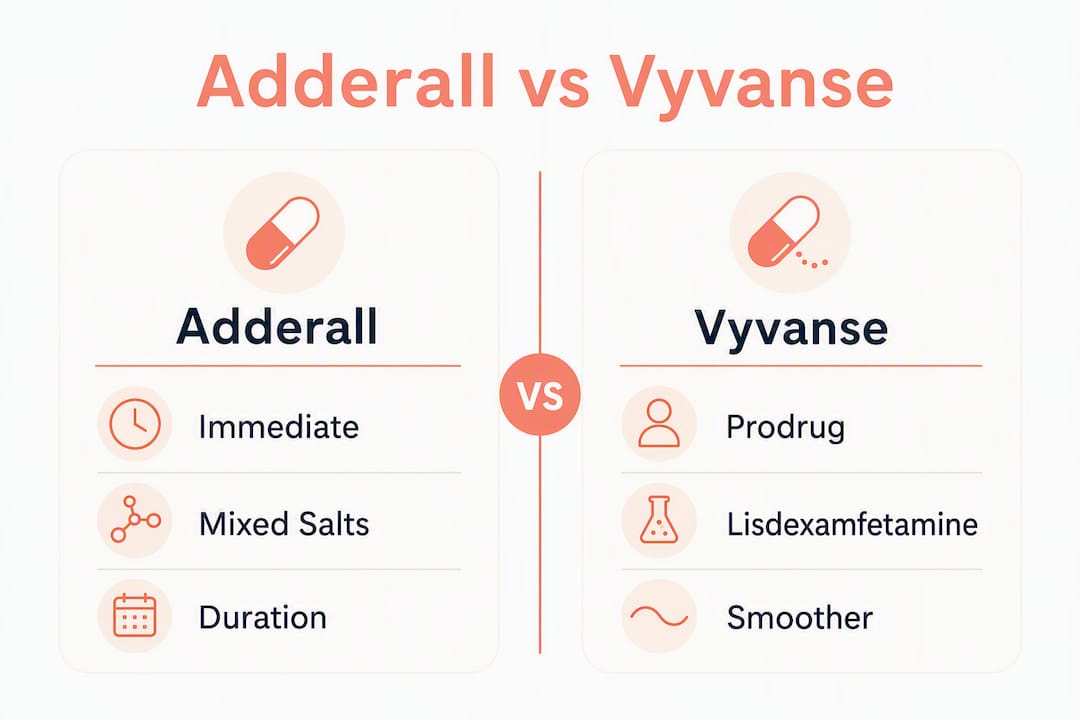
Vyvanse (lisdexamfetamine) is a prodrug that converts to active dextroamphetamine in your bloodstream, producing slower onset and steadier, longer coverage across the day. Adderall delivers mixed amphetamine salts that are active the moment they're absorbed, giving faster onset and the flexibility of both immediate-release (IR) and extended-release (XR) formulations. For most adults who need all-day symptom control with lower misuse risk, clinicians tend to reach for Vyvanse first. When targeted, time-limited coverage or incremental dose titration is the priority, Adderall IR or XR is often the better fit.
- Choose Vyvanse when: you need once-daily, predictable coverage, have a history that raises diversion concerns, or find that stimulant peaks and crashes are disruptive.
- Choose Adderall when: you need faster symptom relief, want the option to dose in the afternoon without a full 12-hour commitment, or are in early titration and need fine-grained dose adjustments.
Pro Tip: Before starting either medication, tell your prescriber your complete cardiac history, including any family history of sudden cardiac death or arrhythmia, and be honest about any substance-use history. Both drugs carry FDA boxed warnings for misuse and dependence, and both require a baseline cardiovascular screen.
Table of Contents
- How Adderall and Vyvanse compare at a glance
- How each drug works in your body
- What to expect after you take each medication
- Formulations, dosing ranges, and why the milligrams don't translate
- What the FDA has approved each drug to treat
- Side effects and serious risks you need to know about
- Abuse potential, DEA scheduling, and what the prodrug design actually changes
- Drug interactions and contraindications to discuss with your prescriber
- Can you take Vyvanse and Adderall together, and how do you switch safely?
- Cost, generics, and insurance realities in the U.S.
- How clinicians decide, and what to ask at your appointment
- How this article was reviewed
- Key Takeaways
- What the prescribing conversation actually looks like
- Kin-wellness medication management for ADHD
- Useful sources and further reading
How Adderall and Vyvanse compare at a glance
The table below captures the dimensions prescribers weigh most when choosing between these two stimulants.
| Dimension | Adderall IR | Adderall XR | Vyvanse |
|---|---|---|---|
| Active ingredient | Mixed amphetamine salts (dextro + levo) | Mixed amphetamine salts (dextro + levo) | Lisdexamfetamine (prodrug → dextroamphetamine) |
| Mechanism | Active on absorption | Active on absorption | Requires enzymatic conversion in blood |
| Onset | 30–60 min | 30–60 min | 1–2 hours |
| Peak | ~1–3 hours | ~7 hours (biphasic) | ~3–4 hours |
| Duration | 4–6 hours | 8–12 hours | 10–14 hours |
| Formulations | Tablets (IR) | Capsules (XR) | Capsules |
| Typical adult starting dose | 5 mg once or twice daily | 5–10 mg once daily | 30 mg once daily |
| FDA-approved uses | ADHD, narcolepsy | ADHD | ADHD (6+), binge eating disorder (adults) |
| DEA schedule | Schedule II | Schedule II | Schedule II |
| Generic available? | Yes | Yes | Limited |
| Relative cost | Lower (generic) | Lower (generic) | Higher (brand) |
| Monitoring needs | Cardiac, psychiatric, BP/HR | Cardiac, psychiatric, BP/HR | Cardiac, psychiatric, BP/HR |
The single biggest differentiators come down to two things. First, Vyvanse's prodrug design produces a smoother pharmacokinetic curve with less pronounced peaks and crashes. Second, Adderall's IR form gives prescribers a tool for precise, short-window dosing that Vyvanse simply cannot replicate.
On milligram equivalency: the numbers on the bottle are not interchangeable. A commonly referenced clinical starting point is approximately 20 mg Adderall IR ≈ 50 mg Vyvanse, but this is a rough conversion estimate, not a prescription. Individual response, metabolism, and tolerance all shift where a patient actually lands.
How each drug works in your body
Adderall is a combination of dextroamphetamine and levoamphetamine salts. Both components are pharmacologically active the moment they reach systemic circulation, which is why onset is fast. The dextro isomer drives most of the CNS stimulant effect; the levo component contributes a somewhat different receptor profile and is thought to extend the overall duration slightly compared to pure dextroamphetamine alone.

Vyvanse works differently at a fundamental level. Lisdexamfetamine is a prodrug that has no pharmacological activity until red blood cell enzymes cleave the lysine molecule from the compound, releasing active dextroamphetamine. This enzymatic step is rate-limited, meaning the body can only convert so much at a time regardless of how much is ingested. The result is a slower, more gradual rise in active drug concentration.
Why does that matter clinically?
- Onset shape: Adderall's faster absorption produces a sharper early peak; Vyvanse's conversion step smooths the curve.
- Peak intensity: The rate-limited conversion in Vyvanse prevents the rapid concentration spikes associated with crushing or snorting, which directly reduces certain misuse routes.
- Side-effect timing: Patients sensitive to stimulant peaks, such as those who experience anxiety or irritability at peak concentration, often tolerate Vyvanse's profile better.
- Individual variability: Metabolic differences, including red blood cell enzyme activity and renal function, affect how quickly lisdexamfetamine converts, which is one reason two people on the same Vyvanse dose can have noticeably different experiences.
What to expect after you take each medication
Timing matters more than most patients expect. Getting the dose window wrong by even an hour or two can mean either missing your most demanding work hours or lying awake at midnight.
Adderall IR typically begins working within 30–60 minutes of ingestion. Effects peak around 1–3 hours and wear off within 4–6 hours. That short window is a feature, not a flaw, for patients who only need coverage for a specific block of the day. A second afternoon dose is common, though it requires careful timing to avoid sleep disruption.

Adderall XR uses a biphasic bead system that releases roughly half the dose immediately and the other half about four hours later. Onset is similar to IR (30–60 minutes), but the extended release stretches coverage to approximately 8–12 hours, making it a practical single-morning-dose option for most school and workdays.
Vyvanse has the slowest onset of the three, typically 1–2 hours, because of the enzymatic conversion step. Effects peak around 3–4 hours post-dose and last approximately 10–14 hours. For most adults, a single morning dose covers the full workday and into the evening.
Practical timing note: Vyvanse's long tail is an advantage for all-day coverage but a liability if taken too late in the morning. Most prescribers recommend taking it before 9 AM to avoid sleep interference.
- Sleep risk: All three formulations can delay sleep onset. Adderall IR taken after 2 PM and Vyvanse taken after 9 AM are common culprits.
- Rebound effect: Adderall IR's shorter duration can produce a "rebound" as it wears off, with irritability or fatigue. Vyvanse's gradual taper tends to reduce this.
- Food: Taking stimulants with a high-fat meal can delay Vyvanse's onset; Adderall IR is less affected.
Formulations, dosing ranges, and why the milligrams don't translate
Available formulations and typical adult dosing ranges differ enough that switching without clinical guidance is genuinely risky.
- Adderall IR: Tablets in 5, 7.5, 10, 12.5, 15, 20, and 30 mg. Adults typically start at 5 mg once or twice daily, with doses titrated upward based on response. The maximum labeled adult dose is 40 mg/day, though clinical practice varies.
- Adderall XR: Capsules in 5, 10, 15, 20, 25, and 30 mg. Adults often start at 5–10 mg once daily in the morning. Maximum labeled adult dose is 30–40 mg/day.
- Vyvanse: Capsules (and chewable tablets) in 10, 20, 30, 40, 50, 60, and 70 mg. The typical adult starting dose is 30 mg once daily, with titration in 10–20 mg increments. Maximum labeled dose is 70 mg/day.
The milligram non-equivalency is one of the most misunderstood aspects of switching between these medications. A patient stable on 20 mg Adderall IR does not simply move to 20 mg Vyvanse. The clinical conversion estimate of 20 mg Adderall IR ≈ 50 mg Vyvanse is a starting approximation, and most prescribers begin conservatively below that estimate, then titrate up.
| Adderall IR dose | Approximate Vyvanse starting estimate | Clinical note |
|---|---|---|
| 10 mg | ~30 mg | Start low; titrate by response |
| 20 mg | ~50 mg | Most-cited conversion reference |
| 30 mg | ~60–70 mg | Near maximum Vyvanse dose; monitor closely |
These numbers are reference points, not prescriptions. Clinician-led titration over several weeks is standard practice because individual pharmacokinetics vary considerably.
What the FDA has approved each drug to treat
Adderall and Vyvanse share the ADHD indication but diverge on everything else.
Adderall (IR and XR):
- ADHD in adults and children: Adderall IR is approved for ages 3 and older; Adderall XR for ages 6 and older.
- Narcolepsy: Adderall IR is also FDA-approved for narcolepsy treatment. Adderall XR is not labeled for narcolepsy.
- Generic mixed amphetamine salts are widely available for both IR and XR forms.
Vyvanse:
- ADHD in patients ages 6 and older.
- Moderate-to-severe binge eating disorder (BED) in adults. This is the only stimulant with an FDA approval specifically for BED, which can be a meaningful clinical differentiator for patients managing both conditions.
Off-label prescribing happens with both medications, particularly for adult ADHD presentations that fall outside the labeled age ranges or for comorbid conditions. That said, off-label use should always follow prescriber guidance and documented clinical rationale. The NIMH's ADHD overview is a useful starting point for understanding the broader treatment landscape.
Side effects and serious risks you need to know about
Both drugs share a common stimulant side-effect profile because both ultimately deliver dextroamphetamine to the CNS. The differences are mostly in timing and intensity, not in kind.
Common side effects (both medications):
- Decreased appetite and weight loss
- Insomnia or difficulty falling asleep
- Dry mouth
- Headache
- Nervousness or anxiety
- Elevated heart rate and blood pressure
- Dizziness
Drugs.com user reviews rate Adderall XR at 8.0/10 (74% positive) and Vyvanse at 7.4/10 (65% positive), suggesting slightly higher overall satisfaction with Adderall XR among self-reporting patients, though this reflects subjective experience rather than clinical outcomes.
Serious risks requiring monitoring:
- Cardiovascular events: Both drugs raise heart rate and blood pressure. Patients with pre-existing hypertension, structural cardiac abnormalities, or a history of cardiac events face elevated risk. Sudden death has been reported in patients with structural heart disease taking stimulants at recommended doses.
- Psychiatric symptoms: New or worsening psychosis, mania, aggression, or hallucinations can emerge, particularly in patients with a personal or family history of bipolar disorder or psychosis. These symptoms warrant immediate discontinuation and prescriber contact.
- Peripheral vascular effects: Raynaud's phenomenon (fingers or toes turning white or blue in cold) has been reported with stimulant use. It is typically reversible on dose reduction or discontinuation.
- Growth suppression in children: Long-term stimulant use in pediatric patients is associated with modest reductions in growth velocity; height and weight monitoring is standard.
Pro Tip: Track any mood or behavior changes in a simple daily log during the first 4–6 weeks on either medication. Bring that log to your follow-up appointment. Prescribers can adjust doses or switch formulations far more effectively when they have a concrete timeline of when symptoms changed.
Both medications carry FDA boxed warnings for misuse and dependence potential, which is the highest-level safety warning the agency issues.
Abuse potential, DEA scheduling, and what the prodrug design actually changes
Both Adderall and Vyvanse are DEA Schedule II controlled substances, the same category as opioids like oxycodone. Schedule II means high potential for abuse that may lead to severe psychological or physical dependence. This classification applies to both drugs equally under federal law.
Where they differ is in the mechanism of misuse risk. Adderall's active salts are immediately bioavailable, meaning that crushing and snorting or otherwise altering the delivery method can accelerate drug absorption and produce a faster, more intense effect. That acceleration is a key driver of stimulant misuse.
Vyvanse's prodrug design directly addresses this route. Because lisdexamfetamine requires enzymatic conversion in the bloodstream to become active dextroamphetamine, crushing or snorting it does not meaningfully increase the rate of drug delivery. The conversion step is the rate-limiter, not the delivery method. This does not make Vyvanse abuse-proof, but it does reduce the attractiveness of certain misuse routes.
Practical safety guidance for patients:
- Store both medications in a locked location, away from household members who do not have a prescription.
- Never share a prescription stimulant. Sharing is a federal crime and a clinical risk for the recipient.
- Prescribers may use urine drug screens, prescription drug monitoring programs (PDMPs), and pill counts to monitor for diversion.
- Patients with a personal or family history of substance use disorder should discuss this openly before starting either medication. It affects prescribing decisions, not just monitoring.
Drug interactions and contraindications to discuss with your prescriber
Stimulants interact with a meaningful number of medications and medical conditions. Some combinations are absolute contraindications; others require closer monitoring or dose adjustments.
Hard contraindications and serious cautions:
- MAOIs (monoamine oxidase inhibitors): Combining either stimulant with an MAOI, or starting a stimulant within 14 days of stopping one, can cause hypertensive crisis. This is an absolute contraindication.
- Uncontrolled hypertension: Both drugs raise blood pressure. Starting a stimulant in a patient with poorly controlled hypertension requires careful risk-benefit analysis and usually blood pressure stabilization first.
- Structural cardiac disease or recent cardiac events: Patients with cardiomyopathy, serious arrhythmias, or a recent heart attack or stroke are generally not candidates for stimulant therapy without specialist clearance.
- Serious psychiatric history: A history of psychosis, bipolar disorder, or severe anxiety may be a relative contraindication or require concurrent mood stabilization before stimulant initiation.
Important drug interactions:
- Antidepressants (SSRIs, SNRIs, TCAs): Can increase serotonergic activity and, with tricyclics, may potentiate cardiovascular effects. Patients on SSRIs or SNRIs should flag this to their prescriber before starting a stimulant.
- Antihypertensives: Stimulants can blunt the effect of blood pressure medications, requiring dose adjustments.
- Acidifying agents (vitamin C, fruit juices high in ascorbic acid): Can reduce amphetamine absorption and urinary reabsorption, lowering drug levels.
- Alkalinizing agents (sodium bicarbonate): Can increase amphetamine blood levels by slowing urinary excretion.
When stimulants are contraindicated or poorly tolerated, prescribers may consider nonstimulant alternatives such as atomoxetine (Strattera), viloxazine (Qelbree), or guanfacine (Intuniv), each with different mechanisms and monitoring requirements.
Can you take Vyvanse and Adderall together, and how do you switch safely?
Taking Vyvanse and Adderall simultaneously is not a standard clinical practice and is rarely appropriate. Both deliver dextroamphetamine as the active compound. Combining them stacks the total amphetamine load, raising cardiovascular and psychiatric risk without a proportional therapeutic benefit. The scenario where a prescriber might briefly overlap them during a cross-titration is tightly controlled and closely monitored.
Switching from Adderall to Vyvanse (or vice versa):
Most clinicians do a direct switch rather than a gradual overlap, using the 20 mg Adderall ≈ 50 mg Vyvanse conversion estimate as a starting point and beginning at or below the estimated equivalent dose. The rationale for starting conservatively: individual pharmacokinetics vary, and it is easier to titrate up from a lower dose than to manage side effects from an overshoot.
| Switching direction | Typical approach | Key monitoring point |
|---|---|---|
| Adderall IR → Vyvanse | Stop IR; start Vyvanse at ~50 mg (if on 20 mg IR) | Sleep, appetite, BP/HR at 1–2 weeks |
| Adderall XR → Vyvanse | Stop XR; start Vyvanse at conservative estimate | Duration overlap; watch for insomnia |
| Vyvanse → Adderall XR | Stop Vyvanse; start XR at lower equivalent | Rebound symptoms in first 1–2 days |
Important cautions during any switch:
- Blood pressure and heart rate should be checked within the first 1–2 weeks after a switch.
- Patients with a seizure history face elevated risk during stimulant transitions; prescribers should be aware of this before initiating any cross-titration.
- Never self-switch. Adjusting stimulant doses without prescriber oversight is both medically risky and legally problematic given Schedule II restrictions.
Cost, generics, and insurance realities in the U.S.
Cost is one of the most practical factors in the Adderall vs Vyvanse decision, and the gap is substantial.
Generic availability:
- Adderall IR and Adderall XR both have widely available generic versions (mixed amphetamine salts IR and XR). Generic pricing makes these significantly more affordable for patients paying out of pocket or with high-deductible insurance.
- Vyvanse has limited generic availability in the U.S. as of 2026. Brand-name Vyvanse carries a substantially higher list price than generic Adderall formulations.
Out-of-pocket cost differences:
- Generic Adderall formulations are typically available at major pharmacy chains for a fraction of brand-name stimulant prices, and GoodRx or similar discount programs can reduce costs further.
- Brand Vyvanse without insurance or prior authorization can run considerably higher per month. Takeda (Vyvanse's manufacturer) has offered savings programs for eligible commercially insured patients, but these do not apply to Medicare or Medicaid beneficiaries.
Insurance and prior authorization:
- Many insurance plans require step therapy for Vyvanse, meaning they want documentation that a patient has tried and not tolerated or responded adequately to a generic amphetamine formulation first.
- Prior authorization requests for Vyvanse typically require the prescriber to document the clinical rationale, including why a generic alternative is not appropriate.
- Patients switching from Adderall to Vyvanse should ask their prescriber to submit prior authorization paperwork proactively rather than waiting for a pharmacy rejection.
Patient-facing cost comparisons consistently identify cost as a deciding factor when clinical profiles are otherwise similar, and it is a legitimate conversation to have openly with your prescriber.
How clinicians decide, and what to ask at your appointment
Prescribers do not flip a coin. The choice between Adderall and Vyvanse follows a clinical logic that you can understand and participate in.
Factors prescribers weigh:
- Symptom timing needs: Does the patient need all-day coverage, or targeted coverage for specific hours?
- Comorbid anxiety: Patients with significant anxiety sometimes tolerate Vyvanse's smoother profile better than Adderall IR's sharper peaks.
- Substance use history: A history of stimulant misuse or SUD shifts the risk-benefit calculation toward Vyvanse's prodrug design.
- Cardiac history: Baseline blood pressure, heart rate, and any structural cardiac concerns must be evaluated before starting either drug.
- Sleep patterns: A patient who already struggles with insomnia may do better with Adderall IR's shorter duration than Vyvanse's 10–14 hour tail.
- Prior medication response: What has worked or failed before is often the most predictive variable.
- Cost and insurance: Clinically equivalent options should factor in what the patient can realistically afford and access.
Questions to ask your prescriber:
- Which formulation fits my daily schedule, and when exactly should I take it?
- What side effects should prompt me to call you before my next appointment?
- How will we know if the dose needs adjusting, and what's the timeline?
- What's the plan if this medication doesn't work or causes problems?
- Do I need any cardiac testing before starting?
- How does this interact with my current medications?
- What does the prior authorization process look like for my insurance?
Pro Tip: Bring three things to a medication management visit: a written symptom log covering the past 2–4 weeks, a complete list of current medications and supplements, and any family history of cardiac disease or psychiatric illness. Prescribers can make faster, safer decisions with that information in hand.
For a broader look at adult ADHD treatment options beyond stimulants, ADHD medication for adults covers the full range of pharmacological approaches and what to expect from the monitoring process.
How this article was reviewed
This article was written by Dakota, a senior editorial writer at Kin-wellness with a focus on medication comparisons and mental health pharmacology. The clinical content was reviewed against FDA prescribing information, peer-reviewed pharmacology literature, and patient-facing clinical resources before publication.
Sources prioritized in this review:
- FDA prescribing labels (DailyMed and FDA Access Data) for Adderall and Vyvanse
- Peer-reviewed pharmacology literature on lisdexamfetamine's mechanism and misuse implications (PMC)
- Clinical conversion guides for stimulant cross-titration (SingleCare, Neurolaunch)
- Patient-facing drug comparison resources (Drugs.com, Healthline)
- DEA scheduling reference for controlled substance classification
If you are considering a stimulant comparison for a non-amphetamine option, Concerta vs Vyvanse covers methylphenidate-class alternatives and how prescribers weigh them against lisdexamfetamine.
This article is general health information, not medical advice. Confirm current prescribing guidelines and your individual suitability with a licensed prescriber.
Key Takeaways
Vyvanse's prodrug mechanism and Adderall's active mixed salts produce meaningfully different onset, duration, and misuse-risk profiles that should drive the prescribing conversation, not patient preference alone.
| Point | Details |
|---|---|
| Mechanism drives the difference | Vyvanse converts to active drug in blood; Adderall is active on absorption, producing faster onset. |
| Duration shapes daily fit | Adderall IR lasts 4–6 hours; Adderall XR 8–12 hours; Vyvanse 10–14 hours for all-day coverage. |
| Milligrams don't translate directly | 20 mg Adderall IR ≈ 50 mg Vyvanse is a clinical estimate only; always titrate under prescriber guidance. |
| Cost favors Adderall generics | Generic mixed amphetamine salts are widely available; Vyvanse has limited generic options and higher brand cost. |
| Kin-wellness offers medication management | Adults in California can access stimulant evaluation, cardiac review, and ongoing monitoring through Kin-wellness's outpatient services. |
What the prescribing conversation actually looks like
At Kin-wellness, stimulant selection is never a one-size-fits-all decision. The clinical team reviews cardiac history, psychiatric background, substance-use history, and daily schedule demands before recommending Adderall or Vyvanse. Medication management is integrated with therapy and aftercare planning so that monitoring does not stop at the prescription. For adults in California managing ADHD alongside work, parenting, or high-demand careers, that integrated approach tends to produce better outcomes than medication alone.
Kin-wellness medication management for ADHD
If you have read this far, you are doing the right kind of preparation. The next step is a clinical conversation, not more research.

Kin-wellness provides outpatient medication management for adults in California, including a thorough initial assessment covering cardiac history, psychiatric history, and current medications before any stimulant is considered. You get a licensed prescriber, a clear monitoring plan, and therapy integration if needed. No guesswork about whether Adderall or Vyvanse is right for you. A clinician who knows your full picture makes that call with you. Book an appointment or explore services at Kin-wellness to get started.
Useful sources and further reading
- Adderall prescribing information (DailyMed): Full FDA prescribing label for Adderall, including approved indications, contraindications, and dosing guidance.
- Dextroamphetamine and amphetamine (MedlinePlus): Patient-facing drug information from the National Library of Medicine covering Adderall IR, XR, and Mydayis.
- Pharmacology of lisdexamfetamine (PMC): Peer-reviewed article on Vyvanse's prodrug mechanism and clinical implications for misuse potential.
- Stimulant conversion guide (Neurolaunch): Clinical conversion tables for switching between stimulant formulations, including the Adderall-to-Vyvanse approximation.
- Vyvanse vs. Adderall dosage and equivalency (SingleCare): Practical dosing ranges, starting doses, and conversion guidance for clinicians and patients.
- Adderall XR vs Vyvanse comparison (Drugs.com): Side-by-side drug comparison including side effects, interactions, and user ratings.
- Vyvanse vs. Adderall: effects, side effects, and costs (Super.com): Patient-facing guide covering onset, duration, and cost differences.
- ADHD overview (NIMH): National Institute of Mental Health's overview of ADHD diagnosis and treatment options.
- DEA controlled substance schedules: Official DEA reference for Schedule II classification of stimulant medications.
Always review the current FDA prescribing information for the specific formulation you are prescribed, and consult a licensed prescriber for recommendations tailored to your individual health history.