
Vyvanse (lisdexamfetamine) and Concerta (methylphenidate extended-release) are both Schedule II stimulants approved for ADHD, but they work through fundamentally different mechanisms. Vyvanse is a prodrug that stays inactive until your body converts it to dextroamphetamine, producing a gradual onset. Concerta delivers methylphenidate through an osmotic pump system (OROS) that releases the drug in a controlled wave across the day. That single difference in delivery drives most of the practical distinctions between them: how quickly they kick in, how smoothly they wear off, and which misuse routes are available.
Neither drug is universally better. Individual response is unpredictable, and selecting between them is a clinical process, not a formula.
Before your next prescriber visit, bring answers to four questions: When do your symptoms peak? Have you tried a stimulant before, and how did it go? Do you have any heart conditions or elevated blood pressure? Is there any personal or family history of substance misuse?
- Both are FDA-approved for ADHD; Vyvanse is also approved for moderate to severe binge eating disorder in adults.
- Both carry boxed warnings about misuse, abuse, and dependence as DEA Schedule II substances.
- Concerta is approved for ages 6–65; Vyvanse is approved for ADHD in ages 6 and older.
This article is general health information, not medical advice. Confirm any medication decision with your prescriber or pharmacist.
Table of Contents
- How do Concerta and Vyvanse compare at a glance?
- How do Concerta and Vyvanse actually work in your body?
- What are Concerta and Vyvanse each approved to treat?
- What side effects and risks should you know about?
- How do dosing and switching work between these two medications?
- How do you choose between Vyvanse and Concerta?
- How Kin-wellness approaches stimulant selection and monitoring
- Key Takeaways
- The part most comparison articles skip
- Kin-wellness medication management for adults in California
- Useful sources and further reading
How do Concerta and Vyvanse compare at a glance?
| Feature | Concerta | Vyvanse |
|---|---|---|
| Active ingredient | Methylphenidate ER | Lisdexamfetamine (prodrug → dextroamphetamine) |
| Drug class | CNS stimulant (methylphenidate) | CNS stimulant (amphetamine prodrug) |
| Mechanism | OROS osmotic pump; biphasic release | Enzymatic conversion after ingestion |
| Onset | ~30–60 minutes | ~1–2 hours (gradual) |
| Duration | ~10–12 hours | Up to ~14 hours |
| Formulations | Tablets (18, 36, 54 mg); do not crush | Capsules and chewable tablets (10–70 mg) |
| FDA-approved uses | ADHD (ages 6–65) | ADHD (ages 6+); BED in adults |
| Common side effects | Appetite loss, insomnia, headache, GI upset, increased BP/HR | Same, plus fatigue and GI complaints in BED patients |
| Serious risks | Cardiac events, psychiatric symptoms, tics contraindication | Cardiac events, psychiatric symptoms, priapism (rare) |
| DEA scheduling | Schedule II | Schedule II |
| Typical dose range | 18–54 mg/day | 30–70 mg/day |
| Cost/coverage | Generic available; lower out-of-pocket | Brand-name only; higher cost without coverage |
Key decision points from the table:
- Vyvanse's longer duration (up to ~14 hours) suits people who need coverage into the evening.
- Concerta's generic availability makes it significantly cheaper without insurance.
- Vyvanse's prodrug design limits some misuse routes, though it does not eliminate abuse risk.
- No direct mg-to-mg conversion exists between the two. Switching requires clinician-guided titration, not a simple dose swap.
How do Concerta and Vyvanse actually work in your body?

Concerta's OROS delivery system
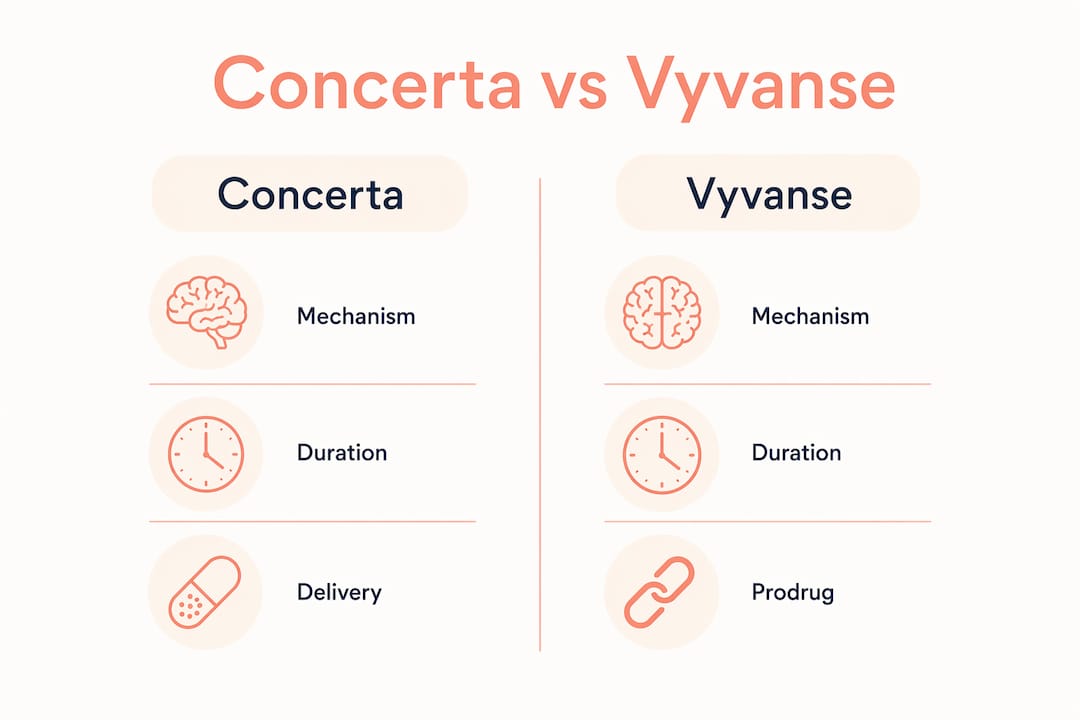
Concerta uses an osmotic-controlled release system that functions like a tiny pump. About 22% of the methylphenidate dose releases immediately after you swallow the tablet. The remaining 78% is pushed out gradually over the next several hours by osmotic pressure. The result is a biphasic curve: a modest early peak, then a sustained therapeutic level through the afternoon. Because the OROS mechanism depends on the tablet's physical structure, crushing or chewing Concerta destroys that profile entirely and dumps the full dose at once. That is a safety issue, not just a preference.
Vyvanse's prodrug conversion
Lisdexamfetamine is pharmacologically inert until red blood cell enzymes cleave the lysine molecule from it, releasing dextroamphetamine. This conversion happens after oral ingestion and cannot be bypassed by snorting or injecting the drug, which removes two common misuse routes. The enzymatic step also slows the rise in plasma amphetamine, producing a more gradual onset than immediate-release amphetamines and, for many patients, a smoother wearing-off period at the end of the day.
What this means in real life
- Morning start: Concerta typically reaches therapeutic effect in 30–60 minutes; Vyvanse takes closer to 1–2 hours.
- Afternoon coverage: Vyvanse's longer tail (up to ~14 hours) tends to outlast Concerta's (~10–12 hours), which matters for people with late-afternoon work or parenting demands.
- Wearing off: Some patients report a noticeably smoother Vyvanse wear-off compared to the more abrupt methylphenidate drop.
- Swallowing difficulties: Vyvanse capsules can be opened and the powder dissolved in water; chewable Vyvanse tablets are also available. Concerta tablets cannot be altered.
Pro Tip: If you need medication working before a 7 AM meeting, Vyvanse's slower onset may be a disadvantage. Concerta's faster kick-in can be a practical edge for early-morning demands.

What are Concerta and Vyvanse each approved to treat?
Both medications are FDA-approved for ADHD, but their approvals diverge in one clinically meaningful way. Vyvanse is also approved for moderate to severe binge eating disorder in adults, making it the only Schedule II stimulant with that indication. Concerta's approval covers ADHD in patients ages 6–65 only.
FDA-approved indications:
- Concerta: ADHD (ages 6–65)
- Vyvanse: ADHD (ages 6 and older); moderate to severe BED (adults only)
For ADHD specifically, head-to-head trial data is limited. In at least one adolescent trial, Vyvanse produced modestly larger mean reductions on the ADHD Rating Scale (ADHD-RS-IV) compared to Concerta, though the differences were small and not uniformly replicated across studies. Systematic reviews consistently find both medications effective for ADHD symptom reduction, with no strong evidence that one is categorically superior for the general population.
What the evidence actually tells you: Both drugs work. The question is which one works better for you, and that answer comes from a monitored trial, not a chart.
Off-label use of both medications occurs in adults outside the approved age ceiling and in conditions like treatment-resistant depression, though neither is approved for those purposes. Any off-label use requires explicit prescriber judgment and monitoring.
What side effects and risks should you know about?
Common adverse effects
Both medications share a core set of stimulant side effects: decreased appetite, insomnia, dry mouth, headache, nausea, and increased heart rate and blood pressure. These are dose-dependent and often improve after the first few weeks. Vyvanse patients being treated for BED report fatigue, GI complaints, and constipation at higher rates than ADHD patients on the same drug.
Serious warnings
Seek immediate medical attention if you experience: chest pain, shortness of breath, fainting, new or worsening psychiatric symptoms (hallucinations, paranoia, aggression), or a painful erection lasting more than four hours (priapism, rare but reported with Vyvanse).
Stimulants raise heart rate and blood pressure in most patients. Anyone with a pre-existing cardiac condition, structural heart abnormality, or serious arrhythmia needs a cardiology clearance before starting either drug. Psychiatric effects, including new-onset psychosis or mania, can occur even in patients with no prior psychiatric history.
Abuse potential and Schedule II status
Both Concerta and Vyvanse carry DEA Schedule II classification and boxed warnings about misuse, abuse, and dependence. Vyvanse's prodrug design blocks snorting and injection as misuse routes, but the drug still raises dopamine after oral ingestion and carries real abuse potential. It is not a "safe" stimulant; it is a differently structured one.
Pediatric and tic considerations
Growth monitoring is recommended for children on either stimulant, as appetite suppression can affect weight gain over time. Concerta carries stronger contraindication language for motor tics and Tourette syndrome; Vyvanse can cause tics in a minority of patients but is not absolutely contraindicated for all tic disorders. For patients with ADHD and comorbid tics, Vyvanse is often the more cautiously preferred option, though the prescriber's judgment governs.
How do dosing and switching work between these two medications?
Typical dose ranges
- Concerta: 18 mg/day starting dose; usual range 18–54 mg/day for adults and adolescents; maximum 54 mg/day
- Vyvanse: 30 mg/day starting dose; titrated in 10–20 mg increments; maximum 70 mg/day for ADHD
Why mg-to-mg conversion is unreliable
Methylphenidate and lisdexamfetamine have different potency, receptor profiles, and pharmacokinetics. A patient stable on Concerta 36 mg cannot simply switch to Vyvanse 36 mg and expect equivalent coverage. Clinical conversion practices use rough equivalence ratios as a starting point, but these are estimates. The actual effective dose must be found through titration.
Practical switching steps
- Short washout or same-day switch: Most clinicians either stop Concerta the day before starting Vyvanse or switch on the same morning, since methylphenidate clears quickly. A formal washout period is rarely required but may be used when side effects need to resolve first.
- Conservative starting dose: Begin Vyvanse at the lowest available dose regardless of the prior Concerta dose, then titrate up over 2–4 weeks.
- Monitoring after the switch: Track sleep quality, appetite, mood stability, and resting heart rate and blood pressure at each follow-up.
Pro Tip: Keep a simple daily log for the first four weeks after switching: note the time you took the medication, when it felt active, when it wore off, what you ate, and how you slept. That data makes your next prescriber visit far more productive than a general "it seems okay."
How do you choose between Vyvanse and Concerta?
No single factor decides this. Prescribers weigh several variables together:
Favor Vyvanse when:
- The patient also has moderate to severe binge eating disorder (only FDA-approved option for both).
- A longer duration of effect is needed (evening coverage, late work hours).
- There is a history of substance misuse and the prodrug's reduced misuse routes are clinically meaningful.
- Swallowing whole tablets is difficult (chewable Vyvanse is available).
- A smoother wearing-off period is a priority based on prior stimulant experience.
Favor Concerta when:
- Cost is a significant barrier and generic methylphenidate ER is accessible.
- A faster morning onset is needed.
- The patient has a history of good response to methylphenidate.
- Insurance covers methylphenidate generics but not brand-name Vyvanse.
Comorbidities that shift the decision:
- Tics or Tourette syndrome: Concerta is more strongly contraindicated; Vyvanse used with caution.
- Glaucoma: Concerta is contraindicated; discuss Vyvanse with an ophthalmologist.
- Anxiety or psychosis risk: Both stimulants can worsen anxiety; neither is preferred, and the risk-benefit ratio needs explicit discussion.
- Heart conditions: Both require cardiac clearance; neither is preferred over the other on cardiac grounds alone.
Insurance and out-of-pocket cost can be the deciding factor for many patients. Generic Concerta (methylphenidate ER) is widely available and substantially cheaper than brand-name Vyvanse, which has no generic equivalent. Prescription discount programs can reduce Vyvanse's cost, but coverage varies by plan and pharmacy.
Patients managing ADHD alongside other strategies, including audiobooks and listening-based tools, often find that medication choice interacts with how well those supports work during peak and off-peak medication hours.
How Kin-wellness approaches stimulant selection and monitoring
Kin-wellness uses a structured, measurement-based process for medication management that treats stimulant selection as a clinical partnership, not a one-time decision.
- Intake assessment: A licensed prescriber reviews symptom history, prior medication trials, cardiovascular history, substance use history, and current comorbidities before any prescription is written.
- Baseline vitals: Blood pressure, heart rate, height, and weight are recorded before starting a stimulant and at every follow-up.
- Starting dose: Prescribers begin at the lowest effective dose for the chosen medication and titrate based on symptom response and tolerability, not a fixed schedule.
- Scheduled follow-ups: Check-ins at 2 weeks, 4 weeks, and then monthly during the titration phase allow for dose adjustments and early identification of side effects.
- Symptom rating scales: Standardized tools (such as the Adult ADHD Self-Report Scale) track objective symptom change across visits, so titration decisions are grounded in data, not impression.
- Coordination with therapy: When a patient is also receiving individual or group therapy through Kin-wellness, the prescriber and therapist communicate to align behavioral strategies with medication timing.
- Adjustment or switch: If a medication is not producing adequate response after a full titration trial, the team discusses switching, augmenting, or reconsidering the diagnosis before changing course.
Pro Tip: Kin-wellness uses e-prescribing for all controlled substances, which reduces diversion risk and keeps the prescribing record current. Patients are also asked to complete a brief symptom check-in between visits through the patient portal, so the prescriber has real-time data rather than a 30-day memory gap.
Key Takeaways
Both Concerta and Vyvanse are effective, Schedule II ADHD medications with meaningfully different mechanisms, durations, and practical profiles, and the right choice depends on individual clinical factors that only a prescriber can weigh.
| Point | Details |
|---|---|
| Mechanism drives the difference | Vyvanse is a prodrug converting to dextroamphetamine; Concerta uses OROS to deliver methylphenidate in a biphasic wave. |
| Duration and onset vary | Vyvanse lasts up to ~14 hours with a slower onset; Concerta covers ~10–12 hours and kicks in faster. |
| No reliable mg-to-mg conversion | Switching between the two requires clinician-guided titration starting at the lowest dose, not a direct swap. |
| Vyvanse has an extra FDA indication | It is the only stimulant approved for both ADHD and moderate to severe binge eating disorder in adults. |
| Kin-wellness offers structured support | Kin-wellness provides virtual medication management with baseline vitals, titration follow-ups, and coordinated therapy for adults in California. |
The part most comparison articles skip
The framing of "which is better" misses what actually matters in clinical practice. Prescribers who have worked with both medications will tell you that the patient sitting in front of them rarely fits the clean decision tree. Someone with a history of stimulant misuse might still do better on Concerta if Vyvanse's cost puts them at risk of stopping medication entirely. A patient with no misuse history might prefer Concerta's faster onset because their job starts at 6 AM. The pharmacology is real, but it operates inside a life.
What the research does not capture well is the wearing-off experience. The smoother Vyvanse tail that some patients describe is not just a comfort preference. For a parent who needs to be present and regulated at 5 PM, or an executive in a late-afternoon board meeting, a rough methylphenidate drop-off is a functional problem. That is worth naming explicitly with your prescriber, not just noting that "it wears off."
The other thing worth saying plainly: trial-and-error is not a failure of medicine. It is the method. No biomarker currently predicts stimulant response reliably. The process of starting low, measuring outcomes, and adjusting is not a workaround. It is the standard of care, and a prescriber who does it carefully is doing it right.
Kin-wellness medication management for adults in California
If you are weighing Concerta versus Vyvanse and want a prescriber who will actually walk through the decision with you, rather than hand you a prescription and schedule a follow-up in three months, Kin-wellness offers virtual outpatient medication management for adults across California.

The intake process starts with a comprehensive assessment covering your symptom history, prior medication trials, and any comorbidities. Kin-wellness accepts PPO insurance and works with out-of-network benefits, and the care team can help you understand your coverage before your first appointment. Prescribers coordinate directly with therapists when you are receiving both services, so your medication timing and your behavioral strategies are aligned rather than running in parallel.
To get started or learn more about what Kin-wellness offers, visit kin-wellness.com.
Useful sources and further reading
- Vyvanse prescribing information (DailyMed): Full FDA label including indications, dosing, contraindications, and boxed warnings. The primary source for any Vyvanse prescribing question.
- Concerta prescribing information (DailyMed): Official label covering OROS delivery, Schedule II status, and contraindications for methylphenidate ER.
- Cleveland Clinic: Concerta vs. Vyvanse: Clinician-reviewed comparison covering common side effects, individual response variability, and shared decision-making.
- Verywell Health: Concerta vs. Vyvanse for ADHD: Covers FDA approvals, smoother wear-off reports, and practical patient considerations.
- Child Mind Institute: How Vyvanse Is Different: Clear explanation of the prodrug mechanism and why it affects misuse potential and onset.
- Medical News Today: Concerta vs. Vyvanse: Covers OROS delivery, crushing warnings, and contraindication differences for tics and glaucoma.
- SingleCare: Concerta vs. Vyvanse: Includes head-to-head trial summaries, cost comparisons, and switching considerations.
- MedlinePlus: Methylphenidate: Government drug information page covering the full methylphenidate family, including Concerta.
- DEA Drug Scheduling: Official DEA resource confirming Schedule II classification for both medications.