
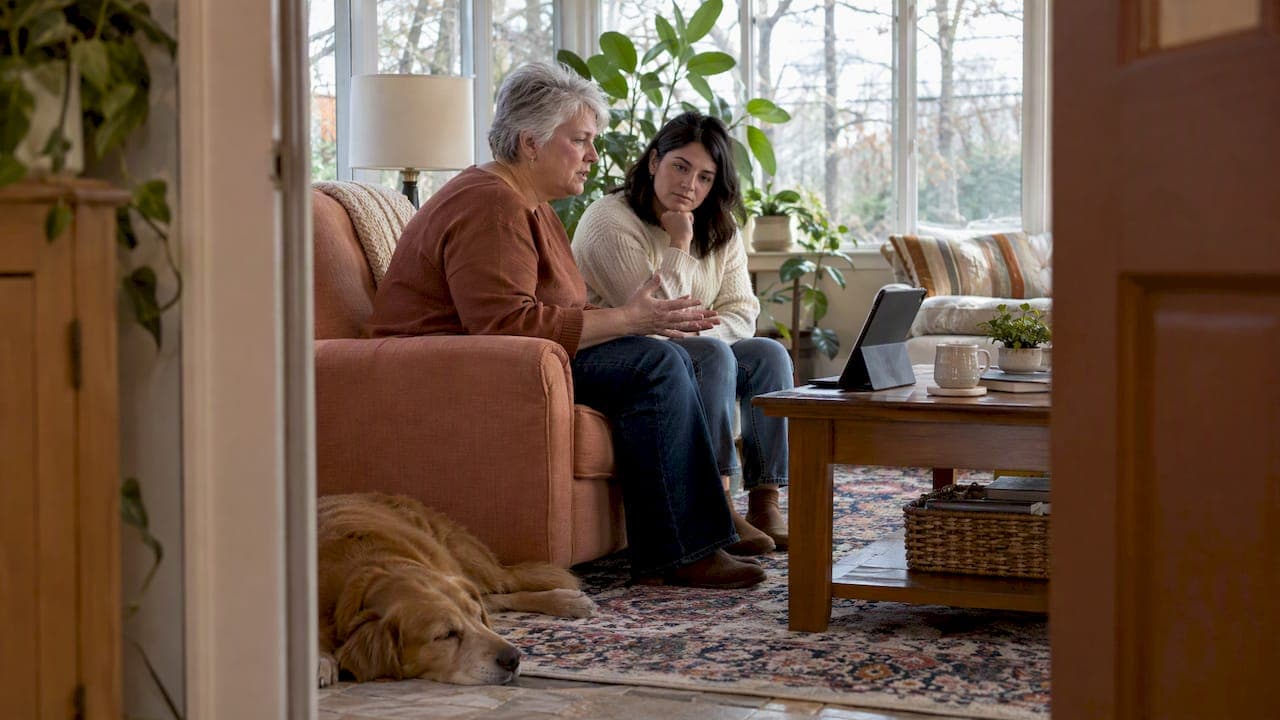
Virtual family therapy is family counseling delivered by live video, with a licensed or supervised clinician guiding conversations among relatives who may be in the same room or in different homes. Research so far suggests it can work about as well as meeting in an office for many outcomes, though the evidence is still early. This guide covers what the studies show, how a session runs, how to set one up well, and what California law says about telehealth.
TL;DR
- A systematic review of telehealth family therapy found outcomes equivalent to face to face care for many measures, and no included study where video did worse. The authors call the evidence preliminary.
- Video does not run itself. Good online family sessions depend on agreed rules for who speaks, who attends, and what happens if a conflict escalates or someone drops off.
- In California, telehealth is a delivery method, not a lower standard of care. Documented consent is required before it begins.
- Not every session needs every relative. Your therapist may alternate between the whole family, a pair, or individual check ins.
- Kin Wellness serves adults in California only, and we do not treat substance use disorders, dual diagnosis or eating disorders.
Table of Contents
- What virtual family therapy is
- Does online family therapy work?
- How a virtual family session actually runs
- How to prepare your household
- Virtual or in person: how to choose
- What California law means for you
- Our perspective at Kin Wellness
- Family therapy at Kin Wellness
- When family therapy is a good next step
- Questions to ask a provider before you book
- FAQ
- Sources
What virtual family therapy is
Family therapy treats the relationships between people as the thing to work on, not only each person's own symptoms. A therapist helps relatives talk about conflict, grief, a major change, a mental health diagnosis in the home, or a pattern that keeps repeating. The virtual version does the same work over a secure video platform.
The "family" is whoever matters to the problem and is willing to take part. That can be spouses, adult siblings, an adult child and a parent, in laws, or a blended household. Because everyone joins from their own device, relatives who live in different cities, or who work shifts, can sit in the same session. That is often the main reason families choose video.
It differs from a family chat on a phone in one way that matters: a clinician structures the conversation. The therapist sets ground rules, slows down heated moments, and makes sure quieter people get a turn.
Does online family therapy work?
This is the question most readers ask first, and the honest answer has two parts: the early evidence is encouraging, and it is not yet large.
What the research shows
A systematic review of 20 studies examined telehealth family therapy. It found outcomes equivalent to face to face therapy for many measures, including child behavior problems and parental depression. The authors reported no included study in which telehealth results were worse than in person results. They also described the evidence as preliminary, because only 20 studies qualified.
Two 2024 analyses looked at online parenting programs, which overlap with family work:
- A meta analysis of seven randomized trials with 957 participants found online parenting support was as effective as in person support, with a trend toward higher parent satisfaction online. The authors noted that format and professional guidance matter, and that adding online elements to in person care did not clearly add benefit beyond in person care alone.
- A network meta analysis of 27 randomized trials with 5,312 participants found moderate average effects on child behavior and emotional problems, parenting practices, and parent mental health. It also reported high variation between studies.
That last point deserves attention. Averages hide a lot. Results differ by program design and by family circumstances, so these studies describe groups, not guarantees. No therapist, in person or online, can promise how your family will respond.
What the research does not say
Most of these studies focus on parents and children, often in structured programs. They do not prove that video suits every family or every problem. If a household has active safety concerns, such as violence or a person in crisis, an online format may not be appropriate, and a clinician should assess that before starting. If anyone is in immediate danger, call 911. In the United States you can also call or text 988 for the Suicide and Crisis Lifeline.
How a virtual family session actually runs
The reviewers of the telehealth literature made a point we agree with: technical guidelines often cover operations, such as platforms and logins, while saying less about the therapeutic process. A good online session takes deliberate work on rapport, participation, engagement and safety. Video is not just an office on a screen.
A typical first session covers these things:
- Consent and logistics. The clinician explains telehealth, its risks and limits, and records your consent.
- Identity and location. Each session, a California therapist verifies your name and current location and keeps a local emergency plan on file.
- Ground rules. Who speaks when, how to signal that you want a turn, and what happens if voices rise or someone disconnects.
- Goals. Each person says what they want to change. These do not need to match.
- A plan for who attends. Some sessions may include everyone. Others may include only parents, two people, or one person.
You do not need everyone every week
A clinically sound plan can rotate. One week may be the whole family, the next two spouses, then an individual check in. The review's guidance points out that this flexibility can lower scheduling barriers and make sensitive topics easier to raise. Your therapist should still explain consent, confidentiality, and who may attend before treatment begins. Ask directly: if one relative shares something in a one on one check in, what stays private and what comes back to the group?
How to prepare your household
Preparation does more for a video session than any piece of equipment. Our own reading on involving family in therapy covers this in depth, and the short version follows.
Set up the space
- Pick a private room. Close the door. Use headphones if walls are thin. People hold back when they fear being overheard.
- Use separate devices when relatives are in the same home. One shared laptop pushes people into a cramped frame and hides faces. Separate devices in separate rooms can reduce echo, but ask your therapist which setup they prefer for your situation.
- Test your connection early. A dropped call mid conflict is hard to recover from.
- Stay put. Join from a stable location, not a moving car. Tell your therapist if you are traveling or cannot speak safely, since they need to know where you are.
Agree on the ground rules
Sit down for ten minutes before the first session. Decide who will join, what each person hopes for, and what you will do if someone needs a break. Also decide what is off the table. Some topics are better introduced by the therapist than sprung on a relative on camera.
Our short guide to telehealth etiquette in therapy lists habits that make sessions smoother, including how to handle interruptions and distractions.
Plan for the hard moments
Talk with your therapist about a plan for escalation. What happens if someone logs off angry? Who calls whom afterward? What should a person do if they feel unsafe at home during a session? These questions feel awkward to ask, but asking them at the start is far easier than improvising later.
Virtual or in person: how to choose
Neither format is better for everyone. Use the criteria below as a starting point and talk it through with a clinician.
| Question | Virtual fits well when | In person may fit better when |
|---|---|---|
| Where does everyone live? | Relatives are in different cities or counties | Everyone lives near the office and wants to meet there |
| Schedule | Work shifts or commutes make weekly travel hard | Your calendar is flexible |
| Privacy at home | You have a quiet room and a door that closes | Space is shared and no private room exists |
| Comfort with video | Most participants are at ease on camera | A key person finds screens stressful |
| Safety | No active safety concerns | There are safety concerns that need closer clinical assessment |
| Attention and age | Everyone can stay engaged on a call | Someone struggles to focus on a screen |
Because California treats telehealth as a delivery method, you can also receive in person care during the same course of treatment. Starting online does not lock you in.
What California law means for you
If you live in California, a few rules shape what you should expect.

Consent comes first. Before telehealth begins, the provider must explain what it is and obtain documented verbal or written consent, including relevant risks and limits. Under California Business and Professions Code section 2290.5, confidentiality, professional responsibility and scope of practice rules continue to apply to telehealth.
Your therapist needs to be authorized in California. The state Board of Behavioral Sciences states that you must have a current and active California license or registration to provide marriage and family therapy, clinical social work and professional clinical counseling to clients located in California. That is a fair question to ask any provider: what is your license or registration, and under whom are you supervised, if applicable?
Location matters. Because the clinician must know where you are, you may be asked to confirm your address at the start of each session. If you travel out of state, tell your therapist before the session, since the rules for where care can be delivered depend on the client's location.
Privacy is shared work. The therapist uses a secure platform, but you control your end. For a closer look at how researchers view this, read our summary of what studies say about teletherapy privacy.
Our perspective at Kin Wellness
We serve adults in California, and we see family issues show up in nearly every kind of work we do: a healthcare worker whose shifts strain a marriage, a parent worn down by burnout, an executive whose relatives no longer know how to talk to each other. Family stress rarely stays in one lane.
Here is how we think about virtual family work:
- Treat the video room as a clinical space. Rules, turn taking and a plan for escalation are part of the treatment, not a technical footnote.
- Match the format to the person. Some people need a weekly conversation with relatives. Others first need individual support so they can walk into a family session steady.
- Be honest about limits. Family therapy is one tool. When symptoms are heavy enough that weekly sessions do not carry enough support, a step up to intensive outpatient care may be the better first move, and relatives can be part of that plan.
- Keep the family conversation voluntary. Nobody should be pushed onto a call. A relative who declines can still be helped through individual work.
- Refer out when we are not the right fit. We do not treat substance use disorders, dual diagnosis or eating disorders. If those are central in your family, a specialized program is the right place to start.
Our overview of family therapy research goes into what the evidence does and does not support.
— Kin Wellness Clinical Team
Family therapy at Kin Wellness
Kin Wellness offers individual, group and family therapy for adults in California, along with a virtual intensive outpatient program, medication management and aftercare planning. Groups meet by video. Individual sessions can be by video or in person in Fountain Valley. Our team includes a clinical director (LCSW), a medical director (MD) and a registered associate therapist working under clinical supervision.
If you are weighing your options, start with our therapy page for weekly individual work, or see individual, group and family therapy for how these services fit together. If weekly sessions feel like too little, read about our virtual IOP, which offers three hour groups, three to five days a week, morning or evening. We do not accept Medi-Cal or Medicare.
When family therapy is a good next step
You do not need a crisis to benefit from talking with a professional. Families often reach out when:
- Arguments repeat and nothing changes.
- A relative's mental health condition affects everyone at home.
- A big transition, such as a move, a job loss, a new baby or a death, has shifted roles.
- Burnout in one adult is spilling into the household. Our guide to parenting stress and when to get help may help you sort what is ordinary strain from what needs support.
- Communication has shrunk to logistics.
If you take psychiatric medication, talk with your prescriber before starting, stopping or changing it. Family therapy does not replace that conversation.
Questions to ask a provider before you book
- What is your license or registration, and who supervises your work?
- How do you get consent for telehealth, and how is it documented?
- Which relatives can attend, and how do you handle confidentiality when one person speaks alone?
- What is your plan if someone leaves the call mid session or a conflict escalates?
- What is the emergency plan for my location?
- Can we move to in person sessions if video is not working?
- Do you bill my insurance, and what out of network benefits might apply?
A clear, unhurried answer to each of these is a good sign.
FAQ
Is online family therapy as effective as in person?
For many outcomes, the early research says yes. A systematic review found equivalent outcomes on many measures and no study where video did worse, though the authors call the evidence preliminary. Results vary between families, and no provider can promise an outcome.
Does everyone in the family have to join every session?
No. A plan can rotate between the whole family, parents only, a pair, or individual check ins. Your therapist should explain consent, confidentiality and who may attend before treatment begins.
Do I need special equipment?
You need a device with a camera and microphone, a stable internet connection, and a private space. Headphones help. Your clinician will send instructions for the platform before your first session.
Can I do virtual family therapy if I travel?
Tell your therapist first. California clinicians must know your location at the start of each session, and the rules for where care can be delivered depend on where you are. Your therapist can tell you whether a session is appropriate.
Can Kin Wellness help with substance use or an eating disorder in the family?
No. Kin Wellness does not treat substance use disorders, dual diagnosis or eating disorders. A specialized program is the right place to start for those concerns.
Sources
- Exploring the efficacy of telehealth for family therapy (systematic review)
- Online parenting support: meta analyses of non inferiority (2024)
- Online parenting programs for children's behavioral and emotional problems: network meta analysis (2024)
- California Business and Professions Code section 2290.5
- California Board of Behavioral Sciences: providing telehealth services in California
Before you book, check your insurance coverage with Kin Wellness to see how your plan may apply.
Recommended
- Parents: 8 Practical Steps to Prepare for Family Involvement in Therapy
- Family Therapy Benefits: What the Research Actually Shows
Clinically reviewed by Angelina DeSanto, LCSW, Clinical Director at Kin Wellness. This article is for general information only and is not medical or mental health advice. Kin Wellness serves adults in California. If you are in crisis, call or text 988, or call 911 in an emergency.