

Process group therapy is a clinician-led format where a small, consistent group of people, usually several, meet weekly to work through what happens between them in real time rather than following a lesson plan. The "process" in the name means the group focuses on live interpersonal dynamics as they surface in the room. It works well for people struggling with relationships, anxiety, depression, or trauma who want direct feedback from others, and it's generally not appropriate for anyone in acute crisis, active psychosis, or severe intoxication.
TL;DR:
- Cohesion is the primary driver of effectiveness, with trust and safety enabling interpersonal risks that foster meaningful change.
- Participants usually start seeing benefits after two to three months, with early sessions characterized by anxiety, resistance, and transference reactions.
- Suitable for those dealing with relationship patterns, anxiety, and trauma, but not recommended during active psychosis, severe intoxication, or acute crises.
- Proper screening, clear confidentiality agreements, and facilitator credentials are crucial to ensure a responsible and beneficial group experience.
Table of Contents
- What Sets Process Group Therapy Apart From Other Group Formats
- How Process Groups Work: Size, Length, and Logistics
- Who Benefits Most, and Who Should Wait
- Why Process Groups Work: The Evidence Behind the Method
- What Members Actually Experience Over Time
- Finding and Preparing for a Process Group
- How Kin-wellness Structures Process Groups for Working Adults
- What Nobody Tells You About Your First Group Session
- Getting Started With Group Therapy Through Kin-wellness
- Sources
What Sets Process Group Therapy Apart From Other Group Formats
Most group therapy isn't process therapy. Psychoeducational groups teach coping skills through a curriculum. Support groups let members share experiences with minimal clinical direction. Process groups do neither. The therapist sets a container, then members largely decide what gets discussed, and the material that matters most is often what's happening between people in the room right now, not a topic on a whiteboard.
This is the "here-and-now" approach: instead of only talking about a conflict from last week, a skilled facilitator might stop the conversation to ask what's happening between two members at that exact moment. The group becomes a kind of social microcosm, a small stage where the relational patterns people bring from their outside lives show up live, which gives everyone a chance to notice and shift those patterns with immediate feedback instead of secondhand advice.
The therapeutic factors driving that shift include:
- Interpersonal learning through direct, real-time feedback
- Group cohesion, which research consistently flags as the strongest predictor of improvement
- Corrective emotional experiences, where old relational fears don't play out the way they always have
- Universality, the relief of realizing your struggle isn't uniquely shameful
How Process Groups Work: Size, Length, and Logistics
Group psychotherapy resources describe the typical setup pretty consistently: a small number of members with one or two trained therapists, meeting for about an hour to an hour and a half once a week. Some clinics run sessions closer to 60 minutes, and others extend to two hours, but that weekly, hour-plus rhythm is the standard therapist-led format across most outpatient settings.
A typical session tends to move through three phases:
- Check-in round. Each member briefly shares what's on their mind or names something from the past week worth bringing into the room.
- Live interaction. The bulk of the session, where the facilitator lets conversation unfold and steps in with here-and-now questions when tension, avoidance, or a strong reaction surfaces between members.
- Closing round. A shorter wrap-up where members reflect on what came up and how they're leaving the session.
Process groups run in private practices, community mental health clinics, intensive outpatient programs, and increasingly through telehealth. Many groups use a co-therapist model, two clinicians sharing facilitation, which helps one track group dynamics while the other supports an individual member in a difficult moment. Groups are also usually closed, meaning membership is fixed for a set cycle rather than open to new people dropping in each week, since consistency is what builds the trust the whole model depends on.
Who Benefits Most, and Who Should Wait
Process groups tend to help people working through relationship patterns, chronic anxiety, depression, grief, or the after effects of trauma, particularly when they're already getting some individual support elsewhere. The interpersonal focus is what makes it distinct from a support group; you're not just there to be heard, you're there to see how you relate to others and try something different.
That said, a few situations call for caution:
- Active psychosis or severe untreated mania, where reality testing is impaired
- Current substance intoxication during sessions
- Acute suicidality or a recent crisis without a stabilization plan in place
- Severe emotional dysregulation that would repeatedly derail the group for everyone else
Clinicians usually address fit through a screening interview before the first session, asking about current symptoms, past group experience, relationship goals, and whether concurrent individual therapy makes sense alongside the group work. Many people do both at once, especially in the early months.
Pro Tip: If a facilitator skips the screening interview entirely and just adds you to the next session, that's worth questioning. A real screening call is one of the clearest signs a group is being run responsibly.
Why Process Groups Work: The Evidence Behind the Method
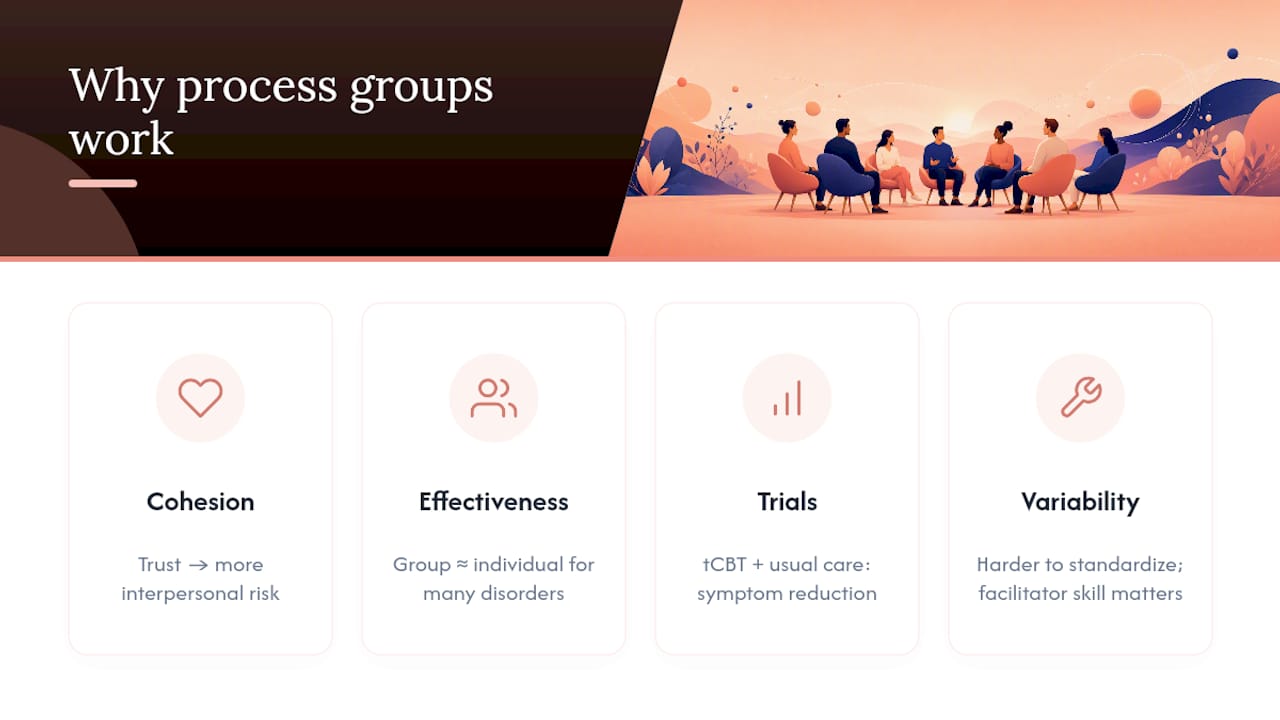
Cohesion is the engine. When a group develops a real sense of trust and safety, members take more interpersonal risks, and those risks are where change happens. That's not a soft claim, it's the mechanism clinicians point to most often when explaining why the format works at all.
The evidence backs it up at a meaningful scale. Meta-analytic and clinical trial summaries reviewed by the American Psychological Association found group therapy can be just as effective as individual therapy for many conditions, not a lesser substitute when someone can't access one-on-one care. Pragmatic trials of group-based transdiagnostic CBT, added to usual care in real clinical settings, have shown clinically meaningful symptom reduction compared to usual care alone, and group CBT programs for generalized anxiety disorder have produced moderate to large effect sizes in outpatient hospital settings.
The caveat worth holding onto: process groups are harder to standardize than a structured CBT protocol. Two process groups run by different facilitators can look genuinely different in tone and pace, which is part of why outcome research on the purely interpersonal, unstructured model is less uniform than the tCBT literature. That doesn't undercut the approach, it just means facilitator skill matters more here than in a manualized program.
What Members Actually Experience Over Time
The benefits people report tend to fall into a few consistent categories: honest feedback they can't get from friends or family, relief at realizing their struggles aren't unique, a low stakes place to practice a new way of responding to conflict, and space to process feelings that don't have anywhere else to go.
Change in a process group is rarely fast. The first several sessions are often about building enough trust for people to speak honestly, and deeper interpersonal work usually doesn't start until the group has found its footing, often somewhere around the two to three month mark for a weekly closed group.
Early sessions also come with predictable friction:
- Anxiety about being seen or judged, especially in the first few weeks
- Resistance to giving or receiving direct feedback
- Moments of transference, where a member reacts to the therapist or another participant as though they were someone from their past
- Occasional conflict between members, which a skilled facilitator treats as material, not a problem to shut down
A good therapist contains these reactions rather than smoothing them over, naming what's happening in the room so the group can learn from it instead of avoiding it.
Finding and Preparing for a Process Group
Starting the search doesn't have to be complicated, but a few steps make the difference between landing in a well-run group and a poorly matched one.
- Ask your individual therapist for a referral, or search outpatient clinics and telehealth programs licensed in your state; many intensive outpatient programs integrate process groups directly into a broader treatment schedule.
- Ask the facilitator direct questions before joining: their credentials, whether the group is closed or open, how confidentiality limits are handled, and what happens if a member misses several sessions.
- Prepare for session one by thinking through what you'd like feedback on and reviewing how to walk into a first therapy session without over-planning what you'll say.
- Watch for red flags: no screening call, no stated confidentiality agreement, or a facilitator who can't clearly explain their approach to managing conflict.
Confidentiality deserves its own moment here. A therapist cannot legally guarantee that other members will keep group discussions private, since that's not something a clinician controls. That's why reputable groups use explicit signed agreements at the outset, spelling out expectations and what happens if they're broken, rather than relying on an unspoken assumption of privacy.
How Kin-wellness Structures Process Groups for Working Adults
Group therapy can be a core part of outpatient and intensive outpatient programs offered for working professionals, parents, healthcare workers, and executives. Groups are typically facilitated by licensed therapists, with screening built into intake to match participants to appropriate levels of care, sometimes group therapy alone, sometimes combined with individual therapy or medication management. Sessions may run over telehealth, with administrative support to help navigate scheduling and insurance billing.
What Nobody Tells You About Your First Group Session
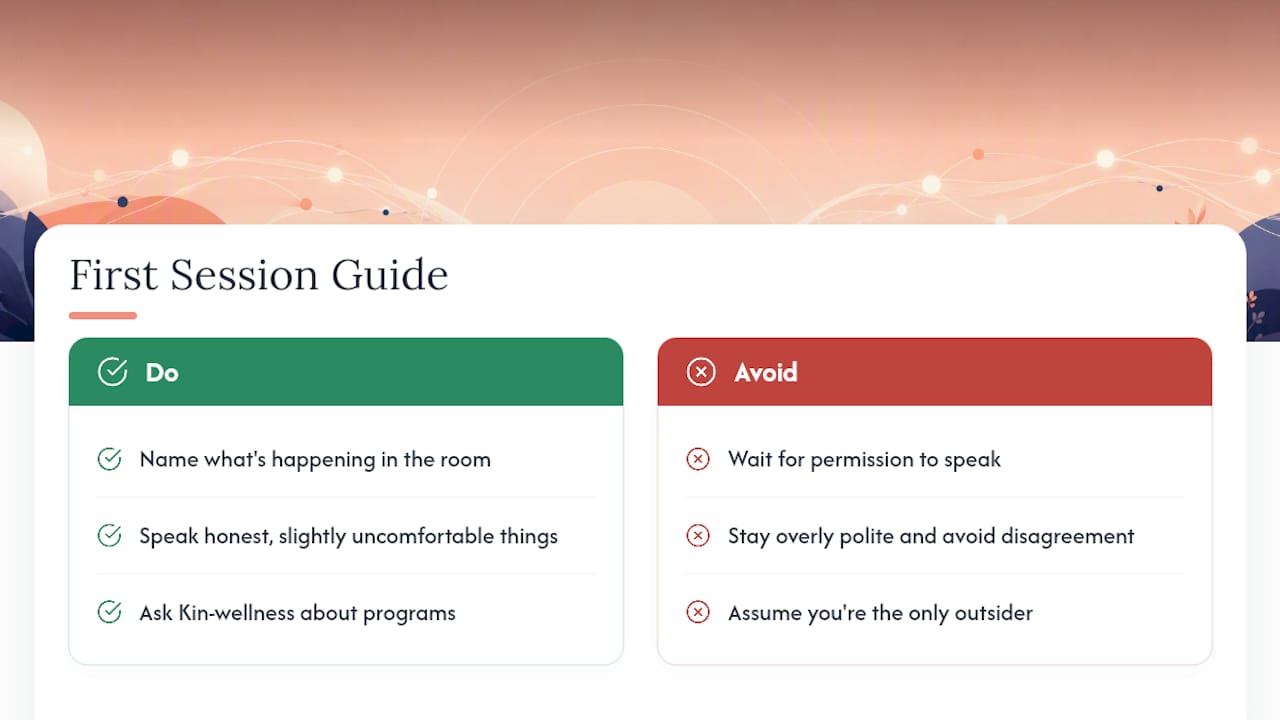
Nearly everyone walks into their first process group convinced they're the only one who feels like an outsider. They're not. That nervous energy in the first few minutes, the overly polite check-ins, the reluctance to disagree with anyone, that's not a sign the group is failing. It's the standard opening act.
The one thing I'd tell a new member: don't wait for permission to say the honest, slightly uncomfortable thing. The moment someone names what's actually happening in the room, the group usually shifts from polite to real within a session or two. If you're weighing whether this format fits you, Kin-wellness's outpatient programs are a reasonable place to ask questions before committing.
— Dakota
Getting Started With Group Therapy Through Kin-wellness
If you've read this far, you already know process groups take real commitment, matching with the right facilitator, working around a schedule, figuring out insurance. Some services aim to reduce barriers for working professionals, parents, healthcare workers, and executives requiring care that fits around demanding jobs.
Groups are usually led by licensed therapists, with intake processes that include screening to match participants to group therapy, individual sessions, or both, depending on individual needs. Sessions often run over telehealth with support available to assist with insurance billing and paperwork. This setup can be particularly helpful for people managing work hours or caregiving responsibilities, offering flexibility without commuting or rigid scheduling. To see current group offerings and start the intake conversation, visit Kin-wellness's services page and request an appointment.
Sources
- Group psychotherapy (NCBI Bookshelf)
- Group therapy evidence overview (APA Monitor, 2023)
- Group transdiagnostic cognitive–behavior therapy for anxiety disorders (Psychological Medicine, 2020)
- Group therapy: definition, benefits, what to expect (Cleveland Clinic)
- Legal and ethical aspects of group psychotherapy (PubMed indexed resource)
This article is general information, not a substitute for advice from a qualified doctor. Consult a qualified healthcare professional about your own circumstances before acting on anything here.