

Night and rotating shifts throw your circadian clock out of sync with the sun, and for a meaningful share of workers, that mismatch turns into shift work sleep disorder (SWSD). The fix starts with a few concrete moves: anchor your sleep timing as much as your schedule allows, use naps strategically, control light exposure around your shift, and treat your bedroom like a cave during the day. If you're falling asleep at the wheel or can't function despite trying all of this for months, see a clinician. Drowsy driving after a night shift kills people every year, so treat that risk as non-negotiable by following Essential Safety Fixes for Elderly Parents that also emphasize nighttime safety precautions.
TL;DR:
- Up to 40% of shift workers, especially older adults and those with rotating schedules, develop shift work sleep disorder characterized by insomnia and sleepiness.
- Light therapy during the first half of a shift and darkening the environment for sleep are essential for partial circadian adaptation and better rest.
- Implementing a consistent sleep schedule with an anchor window and strategic naps can significantly improve sleep quality and alertness.
- Use melatonin and cognitive behavioral therapy for insomnia only under clinician guidance, as evidence supports their conditional use.
- Employers should consider fixed schedules, longer recovery times, and scheduled naps to reduce risks and improve health outcomes for shift workers.
Table of Contents
- What Is Shift Work Sleep Disorder and How Is It Diagnosed?
- How Common Is Shift Work Sleep Disorder, and Why Does It Matter for Your Health?
- Practical Sleep Strategies for Night and Rotating Shift Workers
- Managing Light Exposure Around Your Shift
- Medical and Behavioral Treatments: What Actually Has Evidence Behind It
- Talking to Your Employer About Schedule and Shift Design
- When to See a Clinician or Sleep Specialist
- About the Author and Where to Get Clinical Support
- Managing Sleep Inertia After a Sudden Shift Change
- Balancing the Real Trade-offs of Night Work
- Sources
What Is Shift Work Sleep Disorder and How Is It Diagnosed?
Shift work sleep disorder is a circadian rhythm disorder. Your internal clock, tuned by millions of years of evolution to expect darkness at night and light in the day, keeps pushing you toward wakefulness when you need to sleep and drowsiness when you need to be sharp. The result is a combination of insomnia and excessive sleepiness tied directly to your work schedule, and it's a recognized clinical diagnosis, not just "being tired."
Clinicians typically look for a specific pattern before confirming SWSD. Symptoms need to persist for at least three months, track closely with your shift schedule (better on days off, worse during work stretches), and show up in objective data like sleep logs or actigraphy, a wrist-worn device that tracks movement and rest cycles over one to two weeks. Doctors also want to rule out conditions that mimic or compound the problem before landing on SWSD as the diagnosis, since treating the wrong disorder wastes time you don't have.
Several conditions commonly overlap with or get mistaken for SWSD:
- Obstructive sleep apnea, especially if there's snoring, gasping, or witnessed pauses in breathing during sleep.
- Depression or anxiety, which share symptoms like fatigue, poor concentration, and disrupted sleep.
- Restless legs syndrome or periodic limb movement disorder, which fragment sleep independent of shift timing.
- Delayed sleep phase disorder, a separate circadian issue more common in younger adults that can look similar but has a different underlying mechanism.
Cleveland Clinic notes that shift work sleep disorder is treatable with lifestyle changes, light therapy, and sometimes medication under clinician guidance, which is worth remembering if you've assumed this is just the permanent cost of working nights.
How Common Is Shift Work Sleep Disorder, and Why Does It Matter for Your Health?
Estimates suggest anywhere from 10% to 40% of people working permanent night or rotating shifts meet criteria for SWSD, with higher rates among older workers, those on rapidly rotating schedules, and people who also handle caregiving or second jobs during the day. That's a wide range, and it reflects how much individual tolerance for circadian disruption varies. Some people adapt reasonably well; others struggle from the first month.
By the numbers: Shift workers typically lose 1 to 4 hours of sleep compared with day workers, and that daytime sleep tends to be more fragmented, with more awakenings and less time in deep, restorative stages.
That deficit compounds. Research links chronic shift work to higher cardiometabolic risk, including elevated rates of hypertension, obesity, and type 2 diabetes, along with an increased likelihood of mood disorders like depression and anxiety. Some studies have also flagged a possible association with certain cancers, though that link remains less consistent across research and shouldn't be treated as settled science.
The more immediate risk is what happens on the drive home or on the floor during a 3 a.m. shift. Cognitive impairment from sleep deprivation shows up fast: slower reaction time, poorer judgment, and higher error rates. Hospitals, factories, and transportation companies all report elevated incident rates tied to fatigue during overnight hours. If you've ever caught yourself microsleeping at a red light after a night shift, you've experienced this firsthand, and it's exactly the scenario that makes drowsy driving a leading safety concern for this population.
Practical Sleep Strategies for Night and Rotating Shift Workers
There's no single formula that works for every schedule, but there is a clear hierarchy of tactics worth trying in order. Standard sleep hygiene advice, the kind built for a 9 to 5 world, often fails shift workers outright. A Delphi consensus of sleep experts built 18 tailored guidelines specifically because they agreed many standard rules, like "never nap" or "keep a rigid sleep window," simply don't apply once you're working nights.
-
Pick a schedule strategy and stick with it. If your shifts are permanent nights, full adaptation (sleeping days, staying up nights, even on off days) works best for some people, but it's socially brutal. The more realistic option for most: keep an anchor sleep window, a chunk of consistent sleep time that overlaps across both workdays and days off. NIOSH recommends something like sleeping 8 a.m. to noon every day, work or not, then filling in extra sleep around that anchor as needed. This compromise reduces the repeated jet-lag effect of swinging wildly between day and night sleep.
-
Time your naps deliberately. Before a night shift, a 90-minute nap in the late afternoon can bank a full sleep cycle and blunt the sleepiness that hits around 3 or 4 a.m. During a shift, if breaks allow it, a 20 to 30 minute nap boosts alertness without dropping you into deep sleep, which is what causes that groggy, disoriented sleep inertia when you wake up too abruptly. If you need a nap and a jolt, try a caffeine nap: drink coffee (roughly 100 mg of caffeine) right before a 15 to 20 minute nap. Caffeine takes about that long to kick in, so you wake up as it's hitting your system instead of fighting through morning fog for an hour.
-
Build a daytime sleep environment that actually blocks the world out. Blackout curtains, a room temperature under 68°F (20°C), and white noise or earplugs to mask daytime household and street noise all matter more than people expect. If you live with family, a "sleeping now" sign on the door and a household conversation about noise during your sleep window prevents a lot of resentment and a lot of interrupted sleep.
-
Watch your substance timing. Cut caffeine at least 6 hours before your intended sleep time. Avoid alcohol near bedtime; it may make you drowsy initially but fragments sleep later in the cycle. Nicotine is a stimulant, so skip it in the hours before you plan to sleep.
-
Create a wind-down routine, even a short one. Ten to fifteen minutes of the same low-stimulation activity, dimming lights, a shower, quiet music, before bed every time signals your brain that sleep is coming, regardless of what time the clock says.
Pro Tip: Eat your main meal before your shift starts, not in the middle of the night. A heavy meal at 2 a.m. disrupts digestion and can make the post-shift crash worse; a lighter snack partway through keeps blood sugar steady without derailing your eventual sleep.
Managing Light Exposure Around Your Shift
Light is the single strongest signal your circadian clock responds to, which makes it one of your most powerful tools for adjusting to night work. Bright light early in your shift, roughly the first half, tells your brain to stay alert and nudges your internal clock toward partial adaptation to a nighttime schedule. Bright light early in a night shift combined with dimmer light afterward supports that partial shift, though full adaptation is unrealistic for most people on rotating schedules, since your days off usually pull you back toward a normal daytime rhythm.
Here's how to put that into practice:
- Get bright light exposure in the first half of your shift. Practical guidance suggests 2,500 to 10,000 lux during that window, which is far brighter than typical office lighting. A dedicated light box, similar to those used for seasonal depression, can help if your workplace lighting is dim.
- Wear sunglasses or amber-tinted glasses on your commute home. Morning sunlight is one of the most powerful cues telling your brain it's daytime, exactly the wrong message when you're trying to fall asleep. Cutting that light exposure on the drive or walk home helps your body wind down instead of waking up further.
- Never compromise driving safety for light control. Sunglasses that are too dark for the actual light conditions are a real hazard; use amber or moderately tinted lenses, not blackout-dark ones, if you're driving.
- Dim your screens in the second half of your shift. Phones, tablets, and computer monitors emit blue light that mimics daylight. Most devices have a night mode or blue-light filter; turn it on a few hours before you're due to sleep.
Medical and Behavioral Treatments: What Actually Has Evidence Behind It
The American Academy of Sleep Medicine has issued conditional recommendations for several interventions in adults with shift work disorder. "Conditional" is a specific term in clinical guidelines: it means the evidence supports the treatment for most people, but individual circumstances (other health conditions, side effect tolerance, personal preference) should factor into the decision more than with a strong recommendation.
- Melatonin for daytime sleep: the AASM suggests using melatonin over no melatonin for shift workers transitioning to daytime sleep, though the recommendation is conditional and the certainty of evidence is low. Take it timed to your intended sleep window, not randomly, and be aware it can cause lingering grogginess. Plan your commute accordingly; don't drive if you feel drowsy after dosing.
- Bright light therapy during the shift, as covered above, has similar conditional support.
- Caffeine and wake-promoting agents like modafinil or armodafinil can reduce excessive sleepiness, but these come with side-effect and safety considerations that make them a conversation for a prescriber, not a self-directed fix.
- Strategic naps, covered in the practical strategies section, also carry conditional support in the same guideline set.
- Cognitive behavioral therapy for insomnia (CBT-I) addresses the insomnia side of SWSD specifically, retraining sleep-related thoughts and habits rather than relying on medication. It's typically delivered over several sessions with a trained therapist and adapted for shift-specific schedules. For a deeper look at how CBT-I works and what to expect, insomnia therapy options walks through the process.
Roughly 10% to 40% of shift workers may meet criteria for SWSD at some point, which is exactly why these interventions exist as guideline-backed options instead of fringe advice.
Talking to Your Employer About Schedule and Shift Design
Not every fix lives inside your bedroom. Schedule design itself changes how much your body has to fight. If you rotate shifts, forward rotation (day to evening to night) is generally tolerated better than backward rotation (night to evening to day), because it aligns more naturally with how your circadian clock wants to drift. There's no strong evidence that 8-hour shifts beat 12-hour shifts for SWSD specifically; length matters less than recovery time and consistency.
- Ask about recovery time between shifts. Guidance generally supports at least 11 hours between shifts and 48 or more hours off after a run of night shifts, enough time to catch up on sleep debt without immediately swinging back into a disrupted pattern.
- Request predictable, posted schedules as far in advance as possible. Unpredictability is often worse for sleep than the night work itself, since you can't plan naps, meals, or family time around a schedule you don't know yet.
- Ask about scheduled nap breaks, especially on 12-hour shifts, where a 20 to 30 minute break midway through has measurable safety benefits.
- Bring data, not just complaints. A sleep log showing the pattern of your symptoms tied to specific shift rotations gives HR or a supervisor something concrete to act on. Chronic scheduling stress also tends to bleed into broader burnout, and work burnout treatment covers how that overlap shows up and what to do about it.
When to See a Clinician or Sleep Specialist
Some symptoms shouldn't wait three months of self-experimentation. Get evaluated sooner if you notice any of the following:
- You've fallen asleep at work, especially during safety-sensitive tasks, or nodded off while driving.
- You've tried consistent scheduling, naps, and light management for three months with no meaningful improvement.
- You or a partner notice loud snoring, gasping, or breathing pauses during sleep, which points toward sleep apnea rather than SWSD alone.
- Mood or cognitive changes are severe: persistent low mood, memory problems, or difficulty functioning outside of sleepiness alone.
Before an appointment, track two to four weeks of sleep and wake times, shift schedule, and how you felt each day; a simple notebook or phone app works, and some clinicians will supplement that with actigraphy for objective data. In the short term, if you're too drowsy to drive safely after a shift, take a 20-minute nap in your car before leaving, call a rideshare, or ask a coworker for a ride. That's not overcaution; it's the same logic as not driving after a few drinks.
About the Author and Where to Get Clinical Support
This article was written by Dakota, a contributor covering sleep, mental health, and workplace wellness. You can find more of Dakota's work on the Kin-wellness blog.
Virtual outpatient mental health services for adults, including individual therapy, medication management, and CBT-I referrals, are relevant for shift workers whose sleep problems have started affecting mood, relationships, or daily functioning. This article draws on guidance from the American Academy of Sleep Medicine, CDC/NIOSH occupational health resources, and peer-reviewed clinical reviews. None of it replaces an individual evaluation. If your sleep problems persist despite the changes described here, that's a signal to talk with a clinician, not a personal failure.
Managing Sleep Inertia After a Sudden Shift Change
Sleep inertia, that thick, disoriented grogginess right after waking, gets worse the more abruptly your schedule shifts. Going from a regular day schedule straight into a run of nights, or bouncing between rotations with no transition, hits your brain harder than a gradual change would.
A few techniques blunt the impact. First, if you know a schedule change is coming, shift your sleep time by an hour or two per day in the days beforehand rather than flipping all at once; this eases your circadian clock into the new pattern instead of shocking it. Second, avoid waking from deep sleep when possible. Naps under 30 minutes tend to keep you in lighter sleep stages, which means less inertia on waking; naps that stretch past 30 minutes risk waking you mid deep-sleep cycle, when grogginess is worst.
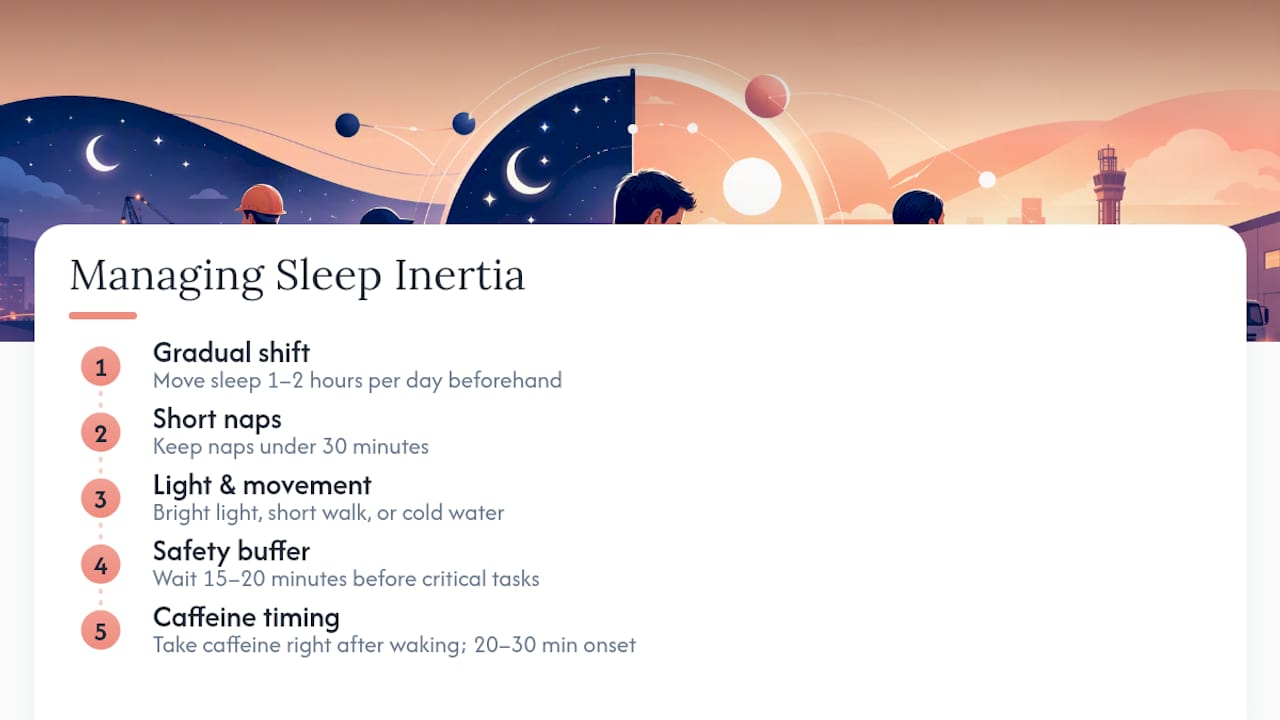
Third, use light and movement immediately after waking, even if it's the middle of the night for the outside world. A few minutes of bright light, a short walk, or splashing cold water on your face all speed up the transition out of that foggy state. Fourth, build in a buffer between waking and any task requiring sharp judgment or safety awareness, ideally 15 to 20 minutes. Driving, operating machinery, or making critical decisions in that inertia window is when errors spike.
Finally, caffeine timed right after waking, not before, can shorten the inertia period, since it takes roughly 20 to 30 minutes to take effect, lining up with the tail end of that grogginess rather than trying to preempt it.
Balancing the Real Trade-offs of Night Work
Nobody chooses night shifts because the lifestyle sounds appealing. People choose them for the pay differential, the schedule flexibility around kids or school, or because the job simply requires it. That trade-off is real, and no amount of blackout curtains or timed melatonin erases the cost of missing dinners, school events, or a partner's normal waking hours.
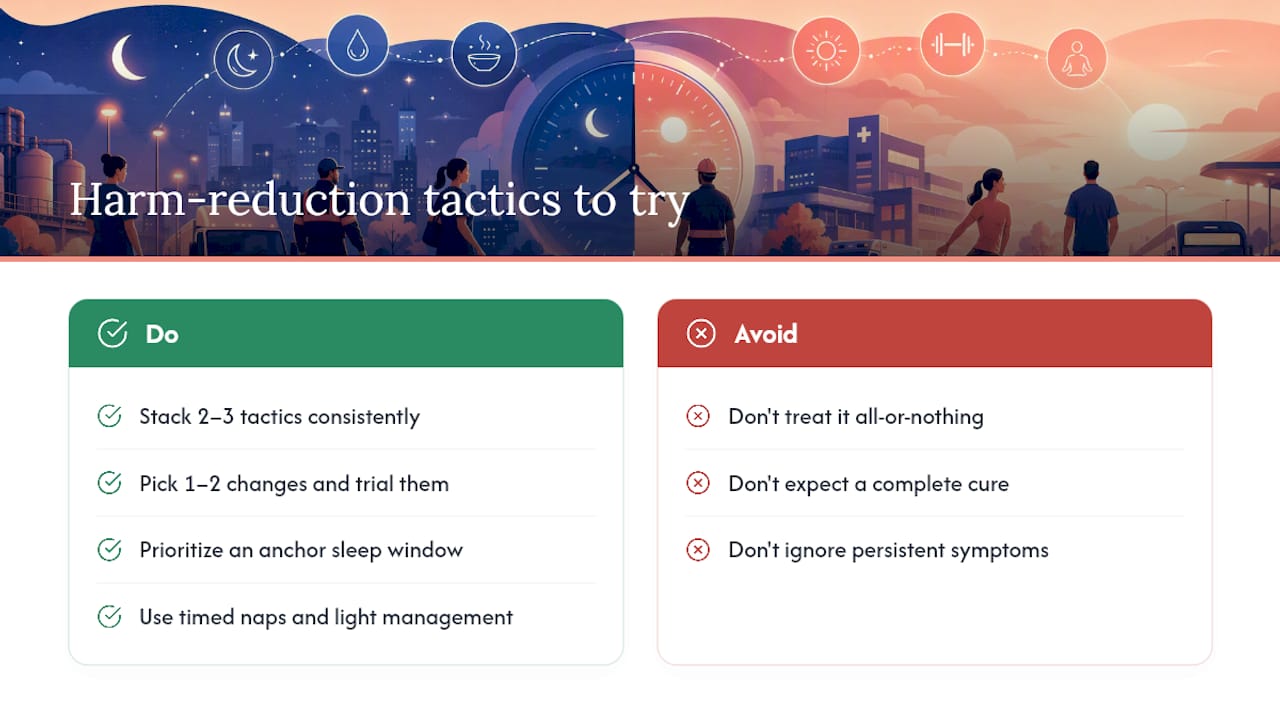
What I'd push back on is the idea that you have to choose between "tough it out" and "quit the job." The tactics in this piece, anchor sleep windows, timed naps, light management, aren't a cure, but they're a genuine harm-reduction strategy, and stacking two or three of them consistently tends to move the needle more than people expect. The mistake I see most often is treating this as an all-or-nothing project instead of picking one or two changes and giving them a real trial.
If you've made honest changes and you're still exhausted, still irritable, still struggling to function, that's not a sign you're doing it wrong. It's a sign your situation needs more than self-help. Structured clinical support is worth considering when the self-directed approach has hit its ceiling for chronic, schedule-driven strain.
— Dakota
This article is general information, not a substitute for advice from a qualified doctor. Consult a qualified healthcare professional about your own circumstances before acting on anything here.
Sources
- Shift Work Sleep Disorder (SWSD): Symptoms & Treatment — Cleveland Clinic
- AASM guideline statements summary — pharmacologic and nonpharmacologic interventions