
Family therapy helps families build boundaries that are clear but not rigid, so people keep their roles straight, stop getting pulled into other people's conflicts, and can actually talk without a fight breaking out. Most families notice the shift within a handful of sessions: less triangulation, more direct conversations, fewer blowups over the same recycled arguments. The rest of this guide walks through the concepts, the clinical techniques behind that shift, and the exact scripts you can bring into a session or use at home.
TL;DR:
- Most families notice boundary improvements within a few sessions, but ingrained patterns may require 8 to 20 or more follow-up visits.
- Clear boundaries involve specific rules about participation and influence, while rigid and diffuse boundaries can cause withdrawal or enmeshment.
- Using rehearsed, concise scripts with defined consequences enhances boundary enforcement and builds family stability over time.
- Family therapy techniques like enactments and genograms help identify and adjust boundary issues rooted in subsystems and coalitions.
- Technology and blended family dynamics introduce new boundary challenges, requiring explicit rules about digital use, custody, and extended family involvement.
Table of Contents
- What Family Therapy Boundaries Actually Mean
- How Family Therapy Helps: Models and In-Session Techniques
- Scripts and Steps to Set Family Boundaries That Actually Hold
- Handling Pushback Without Blowing Up the Relationship
- When to Seek Family Therapy and What Treatment Looks Like
- What to Look for in a Family Therapist
- Boundaries in Blended Families and Complex Households
- How Phones and Social Media Are Reshaping Family Boundaries
- Keeping Boundaries in Place After Therapy Ends
- Culture Shapes What Counts as a Healthy Boundary
- Signs of Unhealthy Boundaries and Common Violations
- What Most Families Get Wrong About Boundaries
- Get Professional Support for Family Boundary Work
- Sources
- FAQ
What Family Therapy Boundaries Actually Mean
A boundary, in family systems terms, is really a rule about who gets to participate in what, and how much influence they have over it. It answers questions like: does mom get a say in her adult son's marriage? Does the oldest sibling get to parent the younger ones? Family therapists usually sort boundaries into three types, and most families are a blend depending on the relationship in question.
- Rigid boundaries cut off closeness almost entirely. A father who never discusses his job loss with his kids, or an estranged sibling who won't return calls, is operating with a rigid boundary. Information and emotion don't cross the line.
- Diffuse (enmeshed) boundaries let too much cross. A mother who reads her 16-year-old's texts and treats every disagreement as a personal crisis is diffuse. Roles blur, privacy disappears, and everyone's mood depends on everyone else's.
- Clear boundaries allow connection without losing individual identity. Family members share feelings and support each other but still make their own decisions.
Boundary problems tend to show up as triangulation, where a third person gets pulled into a conflict that belongs to two others. A child asked to relay messages between divorced parents is a textbook example. They also show up in subsystems. Parent-child and sibling subsystems each need their own boundary, and when a parent treats a child as a peer confidant, or siblings form a coalition against one parent, the whole structure starts to wobble.
How Family Therapy Helps: Models and In-Session Techniques
Most family therapy techniques fall under a handful of established models, and each one attacks the boundary problem from a different angle, according to a breakdown of family therapy approaches. Structural family therapy focuses squarely on hierarchy and subsystems, mapping who is close to whom and adjusting the boundaries between them. Systemic approaches look at the family as an interconnected unit and pay close attention to context and circular patterns rather than individual blame. Strategic therapy zeroes in on the specific sequence of behavior that keeps a problem alive and interrupts it directly.
In session, therapists lean on a specific toolkit:
- Genograms and structural maps chart who is enmeshed, who is cut off, and where coalitions have formed, according to research on structural family therapy.
- Enactment asks family members to act out a real conflict in the room instead of describing it, so the therapist can see the boundary problem happen live and redirect it.
- Circular questioning asks each person about someone else's behavior rather than their own, which shifts the conversation away from blame and toward the actual pattern repeating itself.
- Reframing relabels a behavior so the family sees it differently. A teenager's silence becomes "protecting the family from more conflict" instead of "disrespect."
- Unbalancing temporarily sides with one family member to shift a rigid hierarchy, a deliberate, short-term move meant to loosen a stuck pattern.
Therapist neutrality matters here more than people expect. A therapist who stays neutral and "joins" the family without picking sides earns enough trust to run enactments and unbalancing moves without the family shutting down. Family therapy treats relational patterns, not individual pathology, and a typical course for a complex boundary issue runs 8 to 20 sessions, depending on how entrenched the pattern is.
Scripts and Steps to Set Family Boundaries That Actually Hold
Clinicians generally recommend a four-step method, and it works whether you're rehearsing it in session or trying it cold at Sunday dinner.
- Clarify the need. Get specific about what's actually bothering you. Not "my mother is too much" but "my mother calls three times a day and gets hurt if I don't answer."
- State the boundary. Keep it short and free of justification. "I can talk on the phone once a day, in the evening."
- Name the consequence. Attach a concrete, enforceable action. "If you call more than once, I'll let it go to voicemail and call you back the next day."
- Follow through. The boundary only means something the first time you actually do what you said.
Clinicians point to short, specific statements paired with a named follow-through as the version that actually sticks, because both sides know exactly what to expect.
Here's how that sounds across common friction points:
- Time: "I love seeing you, but I need Sunday afternoons for myself. Let's plan for Saturdays instead," as recommended in how to set healthy boundaries with aging parents.
- Privacy: "I won't be sharing details about my relationship. I'll let you know if I need advice."
- Unsolicited advice: "I hear you, and I'm not looking for feedback on this one."
- Money: "I can't lend money right now. I can help you look at other options."
- Unannounced visits: "I need a heads-up before you stop by. If it's not planned, I won't be able to answer the door."
Pro Tip: Write your boundary script on a note in your phone before the conversation. Under stress, people default to over-explaining, and a boundary loses its weight the moment it turns into a debate.
Therapists often build these scripts into an enactment right in session, rehearsing the exact words with each family member in short turns rather than letting the conversation sprawl. That's deliberate. A tight, rehearsed exchange feels manageable; an open-ended confrontation usually doesn't.
Handling Pushback Without Blowing Up the Relationship
Expect resistance. It's not a sign you're doing it wrong.
- Guilt ("You're abandoning this family") gets met with a calm repeat: "I know this is hard to hear. The boundary still stands."
- Anger often needs space, not a counter-argument: "I'm not going to argue about this tonight. We can talk when things are calmer."
- Bargaining ("What if I only call twice a day?") gets a firm restate: "Once a day works for me."
- Withdrawal sometimes needs a bridge: "I still want us to talk. I just need this one thing to change first."
Therapists use values conversations to connect the boundary to something the whole family already cares about, which lowers defensiveness more than a rule stated in isolation. They also help families build contingency plans and coach the actual follow-through in real time, since knowing what you should say and managing to say it under pressure are two different skills.
If pushback escalates into threats, intimidation, or any safety concern, that changes the priority entirely. Safety planning comes first, and the boundary conversation waits until a licensed clinician can help structure it safely.
When to Seek Family Therapy and What Treatment Looks Like
Some signs point clearly toward professional support rather than another round of DIY conversations:
- The same argument has repeated for years with no shift in the pattern.
- Attempts to set a boundary have failed more than once, or made things worse.
- There's a safety concern: threats, coercion, or emotional abuse.
- A major transition (divorce, blended family, illness, a child leaving home) has scrambled everyone's role.
A first session usually maps the terrain: what the family wants to change, a genogram of who's connected to whom, and a decision about which combination of individual and full-family sessions makes sense. Frequency and format vary by goal and complexity. Short-term work often runs around 12 sessions, while more entrenched, multigenerational patterns can take considerably longer. Teletherapy has made attendance far easier for families spread across households or time zones, and most of the structural techniques above translate to video sessions without much loss.
What to Look for in a Family Therapist
Virtual outpatient family therapy for adults across California is often delivered by licensed clinicians with insurance billing support built into the process. That kind of setup matters for boundary work specifically, because structural and systemic techniques take practice across multiple sessions, not a single conversation.
When you contact a therapist, a few questions cut through the marketing language fast:
- Do you have direct experience with structural or systemic family therapy techniques?
- Are you comfortable running enactments and role-play in session, not just talking through problems?
- What insurance do you accept, and what does teletherapy scheduling look like for a full family?
- Can multiple family members join separate or joint sessions depending on the issue?
Bring the scripts from this guide to your first session. A good therapist will help you sharpen them, test them through enactment, and adjust the wording until it actually fits how your family talks. For more on what that first conversation should cover, see how to prepare for your first therapy session.
Boundaries in Blended Families and Complex Households
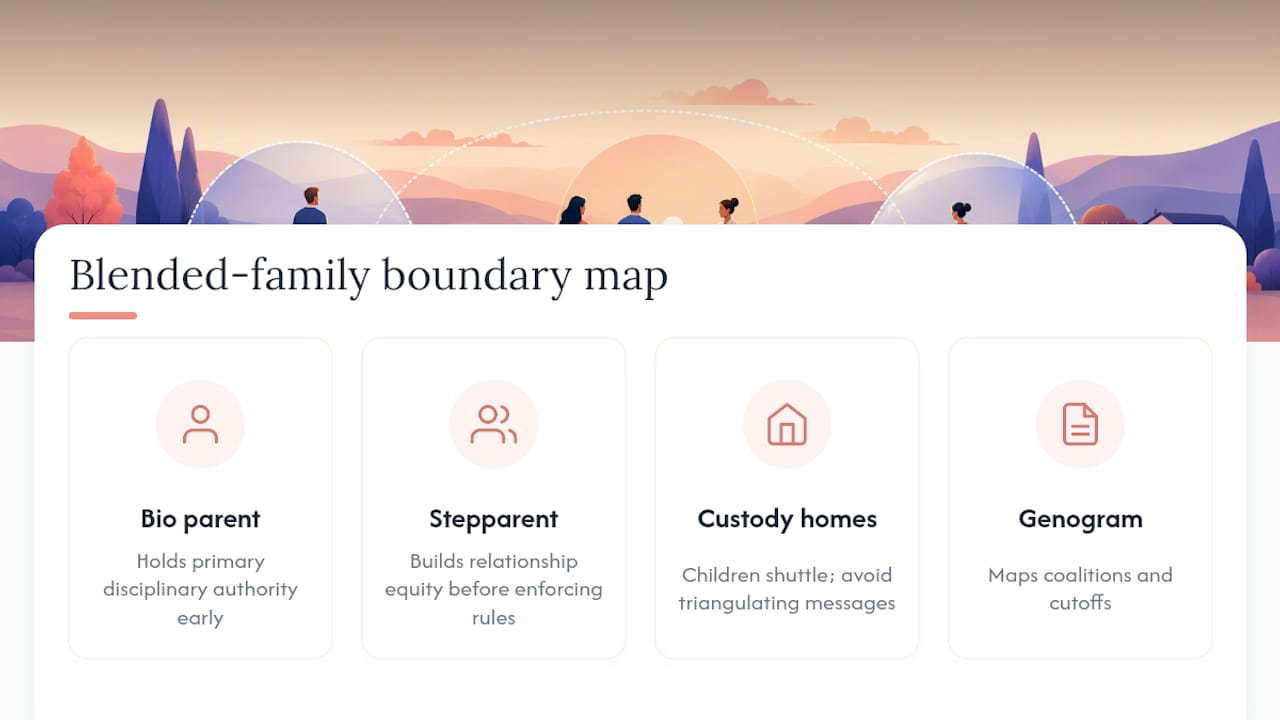
Blended families carry a specific boundary challenge: two sets of established rules colliding at once. A stepparent walking into disciplinary authority too fast, before trust exists, almost always backfires, even when the intention is good. Structural family therapy treats this as a hierarchy problem first. The biological parent typically needs to hold primary disciplinary authority early on, while the stepparent builds relationship equity before taking on rule-enforcement roles.
Custody arrangements add another layer. Kids moving between households often get triangulated into carrying messages, comparing rules out loud, or reporting on one parent to the other. A clear boundary here sounds like: "You don't need to tell me what happens at your dad's house unless you want to." That single sentence removes a child from a job they never agreed to take.
Extended family complicates things further. Grandparents used to weighing in on parenting decisions, or an ex-spouse's new partner navigating a stepparent role, both need explicit boundary conversations rather than assumed ones. Family therapists often use genograms specifically in blended-family cases, because the map alone reveals coalitions and cutoffs that nobody had named out loud. Naming them tends to defuse a surprising amount of tension before any script gets used at all.
How Phones and Social Media Are Reshaping Family Boundaries
Technology has collapsed a boundary that used to exist by default: physical distance. A parent can now text an adult child at any hour, track their location, or comment on a photo within seconds of it posting, and none of that required a conversation about whether it's welcome.
Social media adds a public layer to what used to be private family business. A parent posting about a teenager's struggles, or a sibling airing a family conflict online, turns a boundary violation into one with an audience. Family therapists increasingly treat digital boundaries as their own category: rules about tagging, posting, texting frequency, and location sharing that families need to negotiate explicitly rather than assume.
The fix isn't unplugging. It's the same four-step method applied to a newer problem: "I'm not comfortable with family photos of my kids posted without asking me first. If it happens again, I'll ask you to take it down and we'll talk about why." Clear, specific, and enforceable, same as any other boundary on this list.
Keeping Boundaries in Place After Therapy Ends
Boundaries set inside a structured, therapist-supported room tend to erode once that structure disappears. That's not failure. It's a predictable pattern, and a few habits keep the gains from fading.
Revisit the boundary out loud periodically, even when nothing has gone wrong. A quick check-in ("Is the Sunday call schedule still working for you?") keeps a boundary a living agreement instead of a rule that quietly stops applying. Expect at least one test of the boundary after treatment ends. Family members often push once to see if it still holds, and following through on that one test does more to cement the boundary than the original conversation did.
Some families schedule a booster session three or six months out, specifically to troubleshoot whatever's slipped. It's far easier to course-correct one habit than to rebuild a whole boundary structure from scratch a year later. Individual therapy also helps here. Managing your own stress and emotional regulation makes it considerably easier to hold a boundary under pressure, which is part of why stress management therapy often runs alongside family work rather than replacing it.
Culture Shapes What Counts as a Healthy Boundary
Boundary norms aren't universal, and a good therapist adjusts for that instead of applying one template to every family. In cultures that emphasize collective decision-making and multigenerational households, a level of involvement that looks enmeshed by one standard might be completely functional and expected within that family's own context.
The clinical distinction that matters more than "close" versus "distant" is whether the closeness is chosen or coerced, and whether individual members still have room to disagree without punishment. A large extended family that consults each other on major decisions isn't automatically diffuse. A family where one person's opinion overrides everyone else's regardless of the topic has a boundary problem, whatever the cultural backdrop.
Therapists trained in structural and systemic models are supposed to ask before assuming, mapping the family's actual values through the genogram and intake conversation rather than importing an outside standard for what boundaries "should" look like. That's part of why therapist neutrality matters so much in these cases specifically. A clinician who treats every close-knit family as enmeshed by default will misdiagnose the real problem and likely alienate the family in the process.
Signs of Unhealthy Boundaries and Common Violations
Some patterns show up across nearly every family that ends up in therapy for boundary issues:
- One person reads another's texts, mail, or messages without permission.
- A parent shares an adult child's private struggles with relatives without asking.
- A family member is expected to drop personal plans whenever another member has a crisis.
- Disagreement gets treated as betrayal rather than a normal part of being close.
- One person consistently makes decisions for another adult in the family, from finances to relationships.
- A child is used to relay messages, resolve conflicts, or manage a parent's emotions.
Any of these on their own might be a one-time lapse. A pattern of them, repeated across months or years, is the entrenched dynamic that family therapy is built to interrupt.
What Most Families Get Wrong About Boundaries
The most common mistake isn't setting boundaries badly. It's treating a boundary as a one-time announcement instead of a skill that gets rehearsed, tested, and adjusted over time. Families walk out of a single hard conversation expecting permanent change, and when the old pattern resurfaces three weeks later, they conclude the boundary "didn't work."
That's backwards. Structural family therapy exists precisely because boundary shifts need practice under supervision, not a single brave sentence delivered once. The research on structural techniques backs this up: enactment and unbalancing work because they're repeated, adjusted, and rehearsed across multiple sessions, not deployed once and left alone.
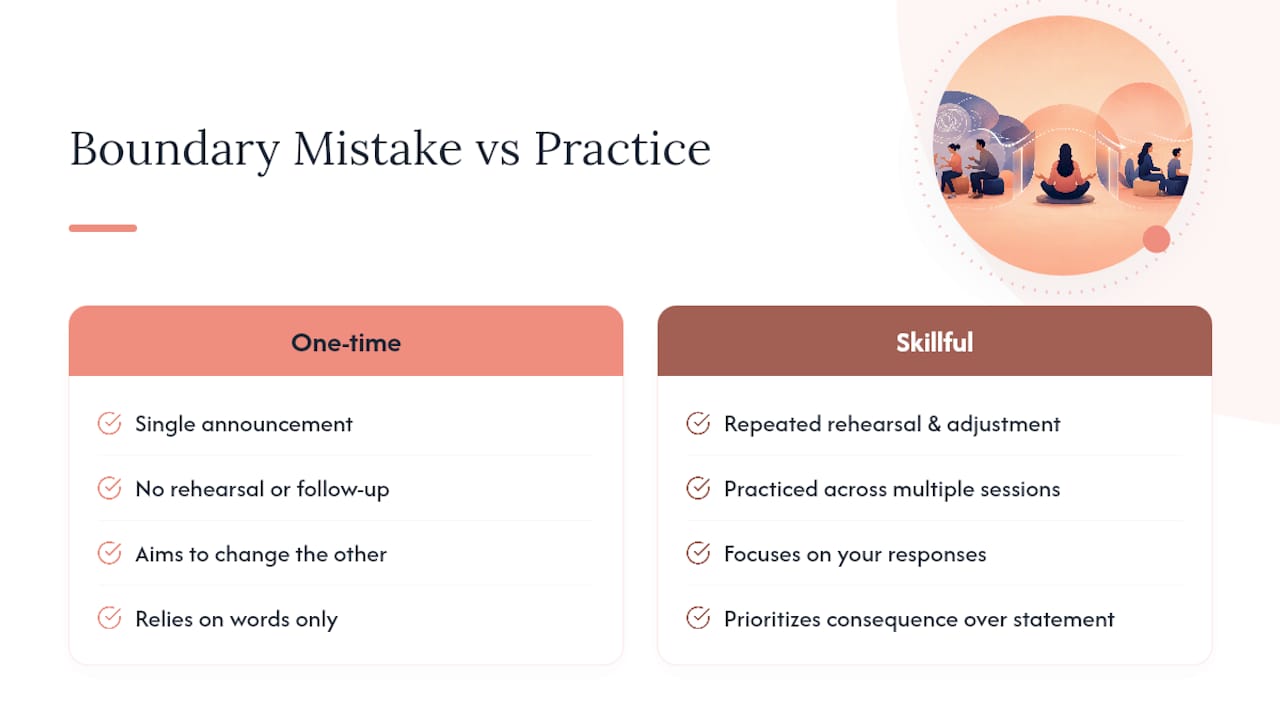
The other overlooked piece: boundaries aren't really about the other person's behavior. They're about what you'll do in response to it. A boundary that depends on someone else changing is a request, not a boundary. The families who make real progress are the ones who stop trying to control a relative's reaction and start controlling their own follow-through, even when that follow-through is uncomfortable the first several times.
Prioritize the consequence step over the statement step. Anyone can say the words. Fewer people actually do the thing they said they'd do, and that's where the real change happens.
— Dakota
Get Professional Support for Family Boundary Work
If the patterns in your family have outlasted every conversation you've tried on your own, working with a licensed clinician changes the equation. Virtual outpatient family therapy for adults across California can include sessions led by licensed therapists trained in structural and systemic techniques, sometimes with insurance billing support to facilitate scheduling.

When you reach out, ask directly about family-session availability, whether the clinician runs enactments and role-play rather than just talking through issues, and how their teletherapy scheduling works for multiple household members. Bring the scripts from this guide with you. A therapist who knows structural family therapy will help you sharpen them into something your specific family can actually hold onto. Explore Kin-wellness's services to see current availability and get matched with a clinician who fits your family's situation.
Sources
- Family therapy overview (NCBI Bookshelf)
- Boundary making and structural family therapy (PMC article)
- Family therapy: what it is, techniques & types (Cleveland Clinic)
- How to set boundaries with your family (Time)
- Positivepsychology
FAQ
What are examples of unhealthy boundaries in family relationships?
Reading someone's private messages without permission, sharing another adult's personal struggles without consent, and expecting a family member to cancel plans for every crisis all count as unhealthy boundaries.
What are the main types of boundaries in family therapy?
Family therapists typically describe three core types: rigid (too little contact or sharing), diffuse or enmeshed (too much, with no privacy or individual identity), and clear (connected but still independent).
What are signs I lack healthy boundaries?
Common signs include feeling guilty for saying no, agreeing to things you don't want to do, feeling responsible for other people's emotions, and struggling to identify what you actually need in a relationship.
Can you give examples of personal boundaries to bring into a family conversation?
Yes: limiting how often you take calls, declining to share relationship or financial details, saying no to unannounced visits, and refusing to relay messages between other family members are all common personal boundaries.
How long does family therapy usually take to see results?
Short-term family therapy often runs around 12 sessions, while more complex, entrenched patterns can take 8 to 20 sessions or longer, depending on the family's goals and history.