
An aftercare plan is a written, personalized roadmap for the weeks after you leave structured treatment. The three moves that matter most right away: get a first follow-up appointment on the calendar before you walk out the door, leave with a written safety plan in your own words, and confirm exactly how your medications get refilled. Doing all three in the first 72 hours cuts your risk during the most dangerous window of recovery.
TL;DR:
- An effective aftercare plan must include specific appointment details, medication management, support contacts, practical supports, and wellness routines, all documented in a single, portable document.
- Discharge within 24 hours, with follow-up contact within 72 hours and the first outpatient appointment scheduled within that window, significantly reduces the risk of relapse or readmission.
- Coordinating a warm handoff where the treatment team directly schedules the first outpatient visit enhances appointment attendance and continuity of care.
- A personalized safety plan with clear warning signs, coping strategies, and emergency contacts in the patient's own words helps prevent crises and improves responsiveness.
- Barriers like insurance delays, scheduling conflicts, and transportation can undermine aftercare, so early planning and involving natural supports are essential for staying engaged.
Table of Contents
- What Is a Mental Health Aftercare Plan?
- Why Aftercare Matters: The Danger Zone After Discharge
- Key Components of an Effective Aftercare Plan
- When Should Follow-Up Happen After Discharge?
- What Goes Into a Suicide-Prevention Safety Plan?
- How Do You Create a Personalized Aftercare Plan?
- What Barriers Get in the Way of Sticking With Aftercare?
- How Do IOP and PHP Fit Into an Aftercare Plan?
- What Recovery Actually Looks Like After You Leave
- Get Help Building an Aftercare Plan That Actually Fits Your Life
- Primary Sources Behind This Guide
- Sources
- FAQ
What Is a Mental Health Aftercare Plan?
A mental health aftercare plan is a written document that spells out who you'll see, when, and what to do if things get hard again. It's not a pamphlet of hotline numbers handed to you at checkout. Clinicians who take this seriously build it with you, in specific language, before your last day of treatment.
Anyone leaving a structured level of care needs one. That includes people discharged from inpatient psychiatric units, crisis stabilization units, Intensive Outpatient Programs (IOP), and Partial Hospitalization Programs (PHP). The stakes are highest right after a suicidal crisis, but the same logic applies to anyone stepping down from a higher level of care.
In practice, an aftercare plan usually takes one of a few shapes:
- A single-page relapse prevention plan covering warning signs, coping tools, and contacts
- An appointment calendar naming providers, dates, and times, not just "follow up with outpatient"
- A contact list with crisis lines, a peer supporter, and a family member who knows the plan exists
- A medication schedule tied to a specific pharmacy and refill date
The best plans combine all four into one document you can actually carry with you or photograph on your phone.
Why Aftercare Matters: The Danger Zone After Discharge
The period right after discharge is statistically the riskiest stretch of the entire treatment process, not the treatment itself. Research on outpatient follow-up found that a large majority of people who have attempted suicide never make it to their first scheduled outpatient appointment or drop off treatment shortly after leaving a higher level of care.
Why the gap happens: Discharge paperwork often hands someone a phone number to call, not an appointment that's already on the books. That single difference, a scheduled visit versus a suggested one, appears to be one of the biggest levers in whether someone shows up.
That's why SAMHSA's best-practice guidance on care transitions recommends a "warm handoff," where the inpatient or IOP team books the first outpatient visit directly, rather than leaving the patient to make the call alone. Federal quality programs have taken notice, too: follow-up within 7 and 30 days of hospitalization for mental illness is now a tracked national quality measure, which tells you how seriously the field treats this window.
Without an aftercare plan, the pattern is predictable:
- Missed first appointments, which often cascade into missed second and third appointments
- Medication gaps when refills lapse and no one catches it
- A return to crisis services or readmission, sometimes within weeks
- Loss of momentum built during treatment, which is harder to rebuild than to maintain
The 2025 National Guidelines for Crisis Care go a step further, calling for dedicated follow-up teams and formal follow-up policies rather than treating post-discharge contact as an afterthought.
Key Components of an Effective Aftercare Plan
A plan that actually holds up under stress needs six working parts, not just a list of good intentions.
- Follow-up appointments with specifics. Not "see a therapist soon." A name, a date, a time, a location or telehealth link.
- Medication management. Who prescribes it, which pharmacy fills it, and what the refill date is before you run out.
- A collaborative safety or relapse-prevention plan. Written in your own words, not clinical jargon, so it means something to you at 2 a.m.
- Support network and crisis contacts. This includes 988, a peer supporter if one is available, and at least one person who has actually read the plan.
- Practical supports. Transportation to appointments, housing stability, childcare coverage, and whether work obligations conflict with your schedule.
- Lifestyle and wellness routines. Sleep, movement, and structure that reinforce what treatment started, not a separate wish list.
SAMHSA's own crisis care guidelines note that social drivers like housing, transportation, and language access belong inside the plan itself, not treated as separate logistics problems someone else will solve later. If your plan doesn't mention how you're getting to your next appointment, that's a gap worth flagging before discharge, not after you miss the first one.
Pro Tip: Ask for a copy of your aftercare plan in writing before you leave, even if the facility says they'll "send it later." Plans that exist only in a case manager's notes have a way of never making it to you.
Kin-wellness structures its plans around a single-page relapse prevention plan with six clinician-reviewed fields, which condenses the safety and support components above into something you can actually read in under a minute during a hard moment.
When Should Follow-Up Happen After Discharge?
Discharge planning should start within 24 hours of admission, not the morning you're leaving. Waiting until the last day almost guarantees a scramble, and scrambled plans are the ones that fall apart.
From there, the timing targets are specific:
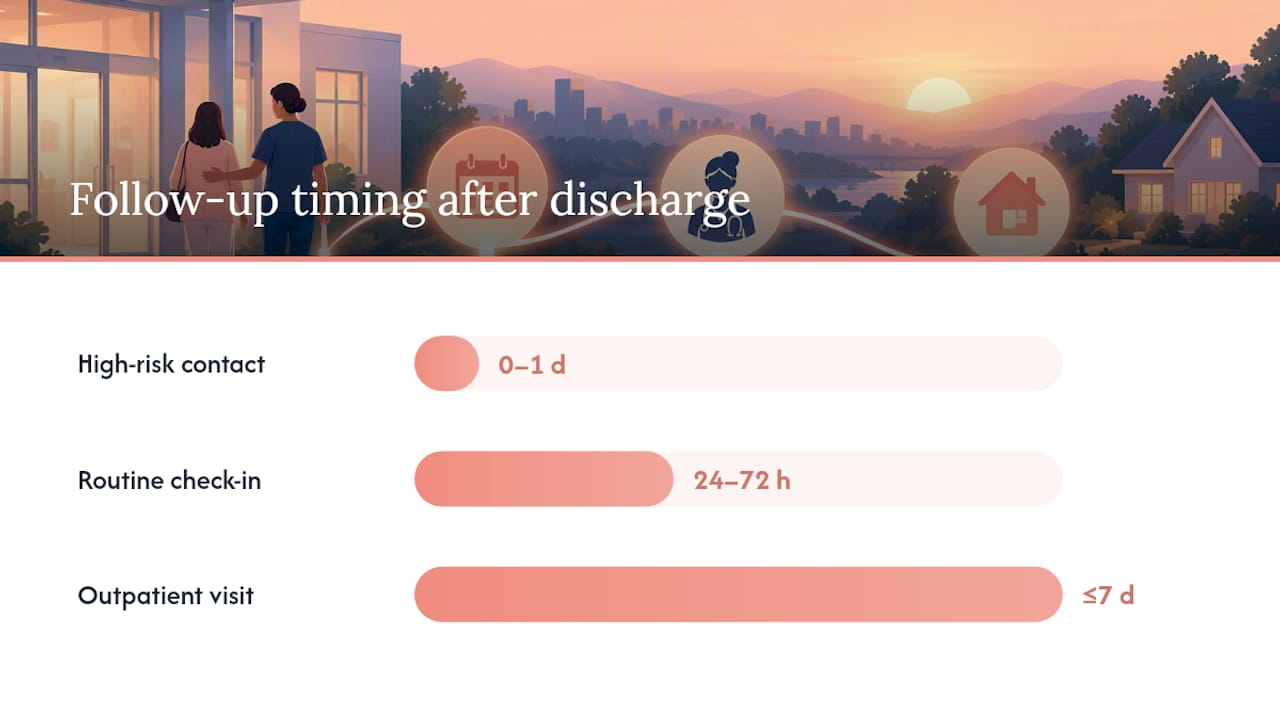
- Check in with the patient within 24 to 72 hours of discharge, by phone, text, or in person
- Schedule the first outpatient visit for within 72 hours when possible, and no later than 7 days
- Escalate to same day or next day contact for anyone flagged as high risk
SAMHSA's care transitions guidance frames the warm handoff as the mechanism that makes those targets realistic: the discharging team books the appointment directly, confirms it with the receiving provider, and shares relevant records before the patient ever has to make a phone call.
Before you leave a facility, ask the discharge planner three direct questions: Is my first appointment already scheduled, or do I need to call someone? Has my information been sent to the outpatient provider, or will I need to repeat my history? Who is checking in with me in the next three days, and how?
Pro Tip: If the answer to any of those three questions is vague, push for specifics before you sign discharge paperwork. A warm handoff only works if someone on the clinical side actually executes it.
Involving family or other natural supports early, even before discharge, tends to smooth this transition considerably, according to SAMHSA's own transition-of-care recommendations.
What Goes Into a Suicide-Prevention Safety Plan?
A safety plan is a distinct document from the general aftercare plan, though the two work together. The VA's safety planning framework treats a written safety plan as the standard of care following any suicidal crisis, and it names five specific elements that need to be on the page:
- Personal warning signs that a crisis may be building
- Internal coping strategies you can try on your own first
- People and social settings that provide distraction or support
- Professional and crisis contacts, including 988
- A plan for lethal means safety, meaning restricting access to whatever method poses the greatest risk
The plan works best when it's written in the person's own words, not clinical language. "I start avoiding texts from my sister" means more to the person living it than "social withdrawal is noted as a warning sign."
That specificity matters because a safety plan you didn't write yourself is easy to ignore in the moment. It should also be shared, not private. A partner, parent, or roommate who knows the plan exists can act on it faster than a clinician three days out.
For anyone identified as higher risk, follow-up cadence intensifies: phone check-ins on a set schedule, a documented mobile crisis contact if things escalate, and a clear line to 988 that's been rehearsed, not just written down. The outpatient team receiving the handoff should get a copy of the safety plan as part of the transfer, so nobody starts from zero.
How Do You Create a Personalized Aftercare Plan?
Building a workable plan is a sequence, not a single conversation. Here's the order that tends to hold up:
- Inventory your needs before discharge. List every appointment, medication, and practical barrier (transportation, work schedule, childcare) while you still have staff support to help sort it out.
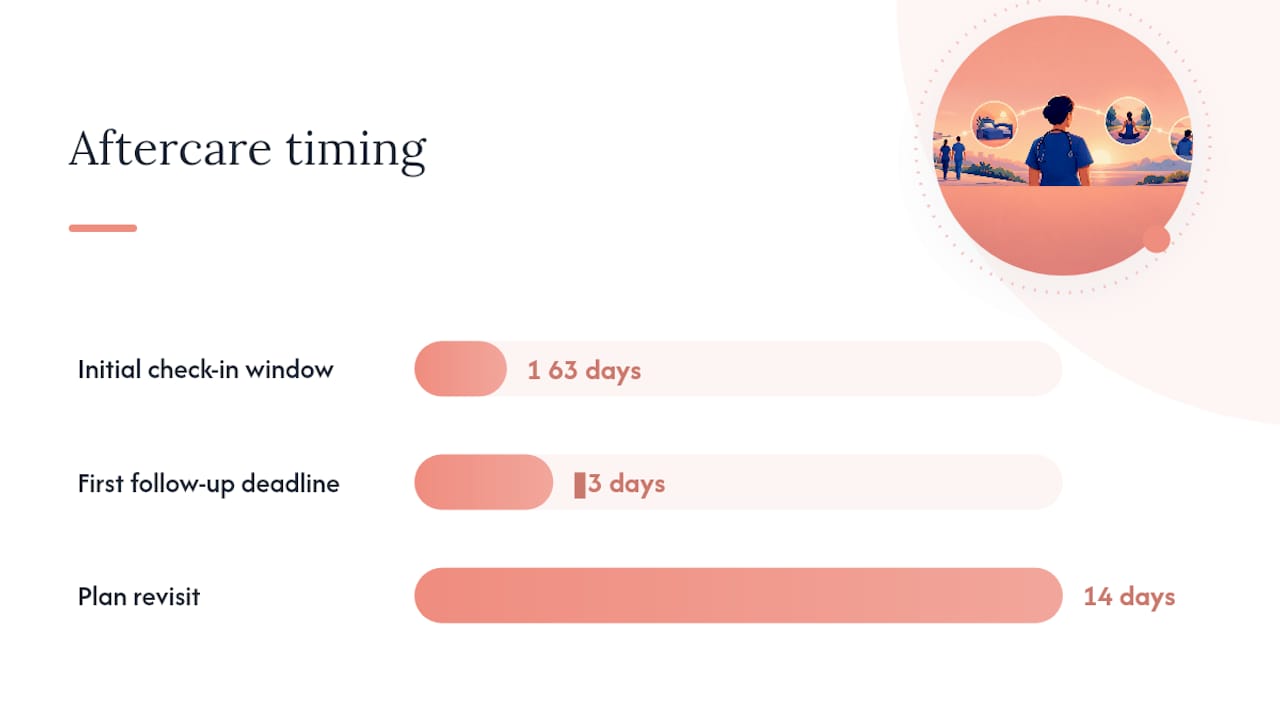
- Schedule the first follow-up before you leave, ideally within 72 hours, using a warm handoff rather than a callback list.
- Fill out a single-page relapse prevention plan covering six fields: warning signs, internal coping strategies, people and settings that help, professional contacts, lethal means safety, and your medication plan.
- Set reminders for appointments and refills, using your phone calendar or a simple paper system if that's what actually works for you.
- Build a backup for missed sessions. If a ride falls through or work runs long, know in advance whether telehealth is an option instead of just skipping the appointment.
- Revisit the plan within the first two weeks and again at any major life change, because a plan built for week one of recovery rarely fits week eight.
For the single-page relapse plan, concrete phrasing beats vague categories every time. Under warning signs, write "not answering calls from my mom" rather than "isolation." Under coping strategies, write "walk the dog for 20 minutes" rather than "self-care." Kin-wellness builds this exact document with patients directly, and its 7-step aftercare planning framework is designed around that 24 to 72 hour check-in window specifically because that's when plans either take hold or quietly fall apart.
Pro Tip: Keep a photo of your safety plan and appointment list on your phone's lock screen or notes app. Paper gets left in a bag; your phone is usually within reach.
What Barriers Get in the Way of Sticking With Aftercare?
Insurance friction, scheduling conflicts, and transportation gaps derail more aftercare plans than lack of motivation ever does. Prior authorization delays can push a first appointment back by weeks if nobody starts the paperwork early. Ask your discharge team to initiate authorization requests before you leave, and if a claim gets denied, request the specific denial reason in writing so an appeal has something concrete to address.
Work and family schedules are the next biggest obstacle, particularly for adults managing a job or kids alongside recovery. A few things help:
- Ask specifically about evening or weekend group options if daytime slots conflict with work
- Request telehealth for weeks when travel isn't realistic
- Line up a backup ride or rideshare budget before the day you need it, not after you miss an appointment
- Loop in one family member early so childcare isn't a last-minute scramble every week
Peer support and family education also do quiet, underrated work here. A peer supporter reaching out directly tends to improve follow-through in a way that a generic clinic reminder call rarely matches, partly because it removes some of the stigma that keeps people from picking up the phone in the first place.
How Do IOP and PHP Fit Into an Aftercare Plan?
Outpatient therapy, IOP, and PHP represent different intensities of the same step-down process. PHP is the most intensive, often running most of the day; IOP is a mid-level commitment, typically several sessions a week; standard outpatient is the lightest touch, usually weekly or biweekly. Most people move down through these levels rather than jumping straight from inpatient to occasional therapy.
- Sync your IOP or PHP schedule with a calendar app the same week you start, not after the first missed session
- Treat telehealth sessions like in-person ones: camera on, quiet room, no multitasking
- Use the 24 to 72 hour check-in as a real checkpoint, not a formality, and flag anything that feels off early
- Ask your outpatient team how relapse-prevention tools get reviewed as you step down a level
Kin-wellness's guide on fitting an IOP schedule into a working life covers this transition in more detail for adults juggling a job alongside treatment.
What Recovery Actually Looks Like After You Leave
The conventional wisdom treats aftercare like a checklist you complete once and file away. That's backwards, and it sets people up to feel like they've failed when a plan needs revision three weeks in. A plan that never changes wasn't built for a real life. It was built for a clean discharge summary.
What actually predicts whether someone stays engaged isn't willpower, it's whether the plan accounted for their actual week, their actual commute, their actual family obligations. An approach that relies on a 24 to 72 hour check-in and a concise relapse plan can be effective for maintaining engagement despite complex schedules. Recovery isn't a straight line, and a good aftercare plan expects that instead of pretending otherwise. If your current plan feels too rigid to adjust, that's worth raising with a clinician directly rather than quietly abandoning it.
— Dakota
Get Help Building an Aftercare Plan That Actually Fits Your Life
Most aftercare planning falls apart because it's handed to you as a checklist instead of built with you as a working document. Some providers structure aftercare planning around clinician-reviewed relapse prevention tools and 24 to 72 hour check-ins, delivered virtually to increase appointment attendance.

If you're finishing an inpatient stay, a PHP, or another IOP and need your next step scheduled before the gap widens, Kin-wellness's virtual intensive outpatient and aftercare planning services are built specifically for working professionals, parents, executives, and healthcare workers who need real appointments, not a callback list. Medication management runs alongside therapy so refill gaps don't become their own crisis, and most major insurance plans are accepted. Reach out through the services page to confirm coverage and get a first check-in on the calendar within that critical 72 hour window.
Primary Sources Behind This Guide
This article draws on SAMHSA's care transition guidance and the 2025 National Guidelines for Crisis Care.
This article is general information, not a substitute for advice from a qualified doctor. Consult a qualified healthcare professional about your own circumstances before acting on anything here.
Sources
- PubMed: Study on outpatient follow-up after discharge
- SAMHSA: Best practices in care transitions for individuals with suicide risk
- SAMHSA: 2025 National Guidelines for Crisis Care
- VA: Safety planning resources
FAQ
What Are the 5 Stages of Recovery in Mental Health?
Recovery is generally described across dimensions like health, home, purpose, and community rather than a fixed five-step sequence, and definitions vary by framework. An aftercare plan should touch on all of those areas, not just symptom management, since housing instability or lack of purpose can undo clinical progress just as fast as a missed medication.
What Is a Recovery Plan in Mental Health?
A recovery plan is a broader roadmap covering your goals across health, relationships, work, and community, while an aftercare plan is the more immediate, practical document covering appointments, medications, and safety steps right after discharge. The two overlap, and a strong aftercare plan usually feeds into the longer-term recovery plan.
How Long Does Aftercare Usually Last?
There's no fixed endpoint, since aftercare should be reviewed and adjusted as circumstances change, but the highest-risk window is generally the first 72 hours to 7 days after discharge, with continued check-ins recommended through at least the first 30 days. Many people keep some form of aftercare structure, like a relapse prevention plan, active well beyond that.
Does Kin-wellness Offer Aftercare Planning Directly?
Yes. Kin-wellness provides aftercare planning as part of its virtual outpatient services, built around a single-page relapse prevention plan and a 24 to 72 hour check-in workflow, delivered by licensed clinicians. Pricing details and insurance information are available directly on the services page.
What Happens if I Skip Aftercare After Treatment?
Skipping aftercare raises the odds of missed medication refills, a return to crisis services, and in some cases readmission, since a significant portion of people who've attempted suicide don't make it to their first scheduled outpatient visit without structured follow-up. A written plan with a scheduled first appointment measurably closes that gap.